Skip to content

customer-experience

12 posts with the tag “customer-experience”

Checklist for AI Branding in POD

AI is transforming the Print-on-Demand (POD) industry, making branding faster, smarter, and more efficient. Here’s how you can use AI to optimize your POD business:

  • Design Smarter: AI tools like Canva, Adobe Sensei, and Midjourney can create unique designs, suggest color palettes, and improve design quality - even if you’re not a designer.
  • Personalize Customer Experience: AI analyzes customer preferences to offer real-time product customization, boosting satisfaction and sales.
  • Automate Social Media: Tools like Print2Social generate promotional content, schedule posts, and connect with POD providers for seamless branding.
  • Streamline Operations: AI predicts inventory needs, reduces waste, and automates repetitive tasks, saving time and cutting costs.
  • Enhance Customer Support: AI chatbots handle up to 95% of customer interactions, ensuring 24/7 assistance without expanding your team.

Quick Comparison of AI Tools for POD Branding

Section titled “Quick Comparison of AI Tools for POD Branding”

Tool

Purpose

Starting Price

Canva

AI design suggestions

$149.90/year

Adobe Creative Cloud

Advanced generative design

$59.99/month

Midjourney

Artistic design creation

$10/month

Print2Social

Social media automation

Competitive pricing

Chatfuel

Customer support automation

$23.99/month

AI is reshaping how POD businesses operate. Start small, choose the right tools, and focus on areas like design, marketing, and customer support to stay ahead in this rapidly growing market.

10 Genius Ways to Use AI to Supercharge Your POD Business

Section titled “10 Genius Ways to Use AI to Supercharge Your POD Business”

Getting your AI tools set up correctly is crucial for effective POD branding. When done right, it can save time, reduce costs, and create a consistent brand experience. For example, businesses have reported a 30% reduction in operational costs and a 40% boost in customer satisfaction through proper AI implementation. With 62% of print industry businesses already using or planning to adopt AI-powered solutions within the next year, setting up these tools properly can give you a clear advantage.

The key is to select tools that fit seamlessly into your existing workflow. This starts with picking design tools that integrate smoothly into your processes.

AI design tools are changing the game for POD businesses, making it easier to create and refine product designs. These tools can generate original designs, suggest color palettes, and produce professional mockups - even if you don’t have advanced design expertise.

Some popular options include:

  • Canva: Offers AI-driven design suggestions and templates. Professional plans start at $149.90 per year.
  • Adobe Creative Cloud with Adobe Sensei: Provides advanced generative AI features and copyright-safe content. Pricing starts at $59.99 per month.
  • Midjourney: Specializes in creating unique artistic designs, with plans starting at $10 per month.
  • GIMP: A free, open-source tool with robust editing features for those on a budget.

When choosing a design tool, focus on factors like how well it integrates with your e-commerce platform, cost, scalability, ease of use, and availability of support and training. With the global AI art market projected to grow from $3.2 billion in 2023 to $40 billion by 2030, it’s smart to start with reliable platforms. You can also combine AI-generated art with custom edits to add a personal touch to your designs.

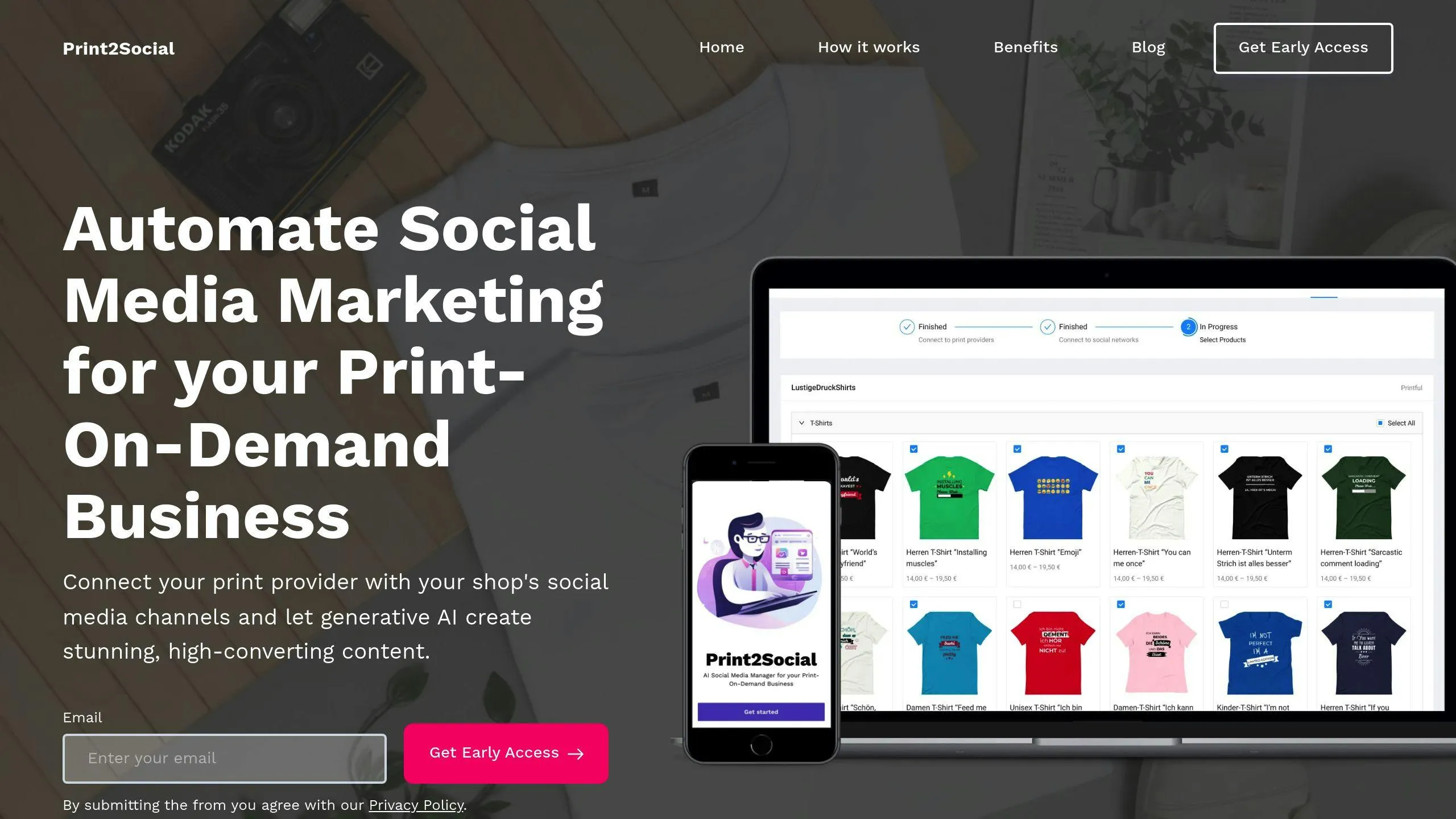
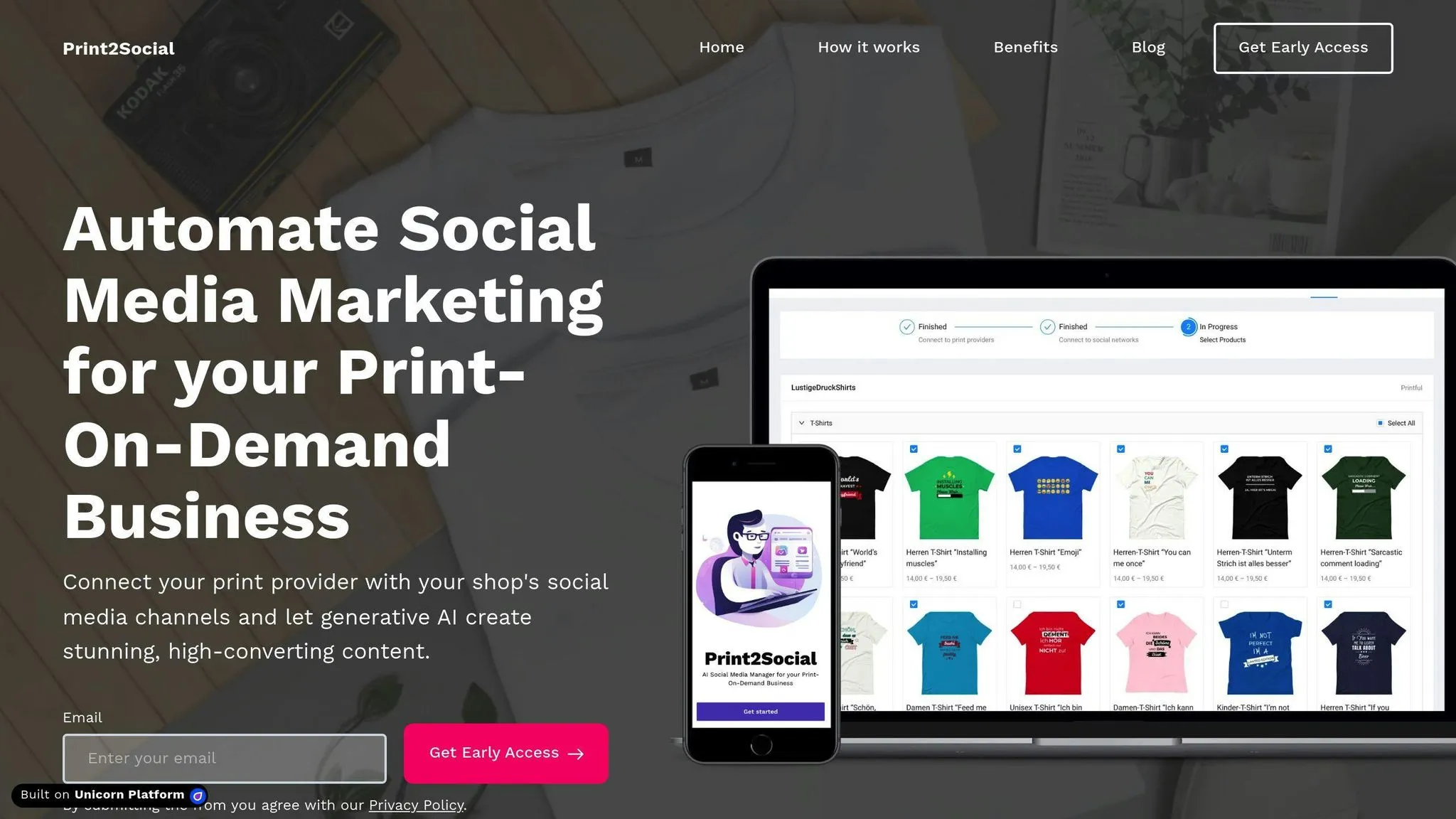
AI-powered tools can make social media management much more efficient by automating tasks like content creation, scheduling, and audience engagement. For example, Print2Social connects directly with POD fulfillment providers and your social media accounts. It uses generative AI to create promotional images and videos featuring your products, while automation tools handle scheduling to keep your brand active online.

To get the most out of these tools, use AI to draft content and then refine it to ensure it aligns with your brand’s tone and identity. Always review AI-generated content for accuracy and relevance. This approach helps maintain a human touch while keeping your messaging consistent. Additionally, integrating these tools with your POD providers ensures smooth data synchronization for promotional efforts.

Integrating AI tools with your POD fulfillment providers is essential for creating a seamless branding experience across all customer interactions. This setup allows for real-time product updates, inventory synchronization, and consistent branding across platforms.

Make sure your AI tools can directly communicate with your POD systems. This connectivity ensures automatic updates for product details, inventory levels, and branding elements. For instance, Print2Social synchronizes product data to generate consistent promotional content.

AI also helps maintain brand consistency by analyzing your brand’s core attributes and applying them across platforms. This is especially useful when managing multiple POD providers or selling on various channels. As Mark de Grasse puts it:

AI branding is a version of branding that is enforceable, consistent, and easy. By centralizing decision making and guiding it through clear brand parameters, you can create almost anything and make it brand consistent.

Automation is another major advantage of AI. It’s perfect for handling repetitive tasks like product updates, applying brand guidelines, and syncing data across platforms. You can even use AI to streamline tasks in everyday apps like Slack, Google Sheets, and HubSpot, creating an interconnected system where your POD operations, marketing, and customer service all work together.

The end result? A scalable branding system that delivers the consistency and quality necessary to build trust and recognition in the competitive POD market.

Once your AI tools are up and running, the next step is making them work for you with strategies that deliver measurable results. These approaches focus on three key areas where AI can significantly boost your print-on-demand (POD) branding efforts.

AI takes design creation to the next level by analyzing customer data and current trends. It can suggest tailored design elements like colors, fonts, and layouts that align with your audience’s preferences.

It also works behind the scenes to optimize user-uploaded images for print. From automatically adjusting image quality to cropping and removing backgrounds, AI ensures designs are ready for production. It can even upscale images to meet print quality standards. Additionally, AI simplifies repetitive tasks like layout adjustments and color matching, while quickly generating multiple design variations.

AI doesn’t just make designs better - it also reduces errors. By identifying and correcting mistakes during the design process, AI minimizes waste and improves efficiency.

Once your designs are polished, the next step is to extend your reach through automated social media strategies.

AI can also streamline your social media marketing efforts, making it easier to connect with your audience. By integrating with POD fulfillment providers, AI tools can automatically generate promotional content, saving you hours of manual work.

These tools create a variety of content options, from promotional posts to educational and engagement-focused material. For instance, Print2Social generates 12 images and 8 short videos per product. AI tools also schedule posts at optimal times for maximum engagement.

The results speak for themselves. In a two-week experiment using Print2Social, a pets niche store saw a 207% increase in views, a 200% jump in reach, and an 80% boost in site visits. Meanwhile, a humor niche store experienced a 97% drop in reach after pausing Meta ads, yet its Reels still managed over 100 views. A travel niche store saw modest engagement, with some Reels also surpassing 100 views.

Print2Social’s pricing is competitive compared to traditional social media management services, and it integrates seamlessly with major POD platforms and social networks. To maximize results, focus on Reels and short-form video content. Experiment with different ad creatives - headlines, images, and copy - to identify what drives the most clicks and conversions.

AI doesn’t just streamline design and content creation - it also provides valuable market insights to refine your branding strategy. By analyzing vast amounts of data, AI tools can uncover trends and customer preferences in record time. For example, they can process social media comments, reviews, and customer interactions to measure sentiment about your products and services.

Competitive intelligence tools like Crayon compare your performance against competitors by analyzing their websites, social media activity, and even job postings, revealing untapped opportunities. Similarly, platforms like Insight7 analyze videos, calls, and interviews to identify customer sentiment and buying motivations. Considering that 65% of shoppers say personalized experiences influence their purchases and 79% of ecommerce businesses report higher conversion rates with AI tools, these insights are invaluable for POD success.

To implement this effectively, start by organizing your internal data, such as employee surveys, and combine it with external data like SEO keywords. AI tools like ChatGPT can help you create detailed buyer personas to better understand your target audience. Unlike traditional market research, which can be time-consuming, AI aggregates and analyzes data almost instantly. Tools like Quantilope even automate A/B testing through surveys, helping you make informed decisions about your POD offerings.

Looking to bring AI into your print-on-demand business? Here’s a step-by-step checklist to guide you from selecting the right tools to tracking performance, ensuring your AI branding efforts deliver measurable results.

Start by identifying AI tools that match your branding and marketing goals. These tools can help with everything from design and mockup generation to social media management, customer support, and advertising.

For design, consider platforms like Kittl, which offers plans starting at $15/month (or $10/month with annual billing), and Imagine Art, whose Basic plan is also $15/month. If you’re new to mockups, Dynamic Mockups provides a Forever Free Plan, along with a Pro Plan at $10/month. For automating social media, Print2Social can simplify your workflow.

Customer support automation is another area to explore. Tools like Chatfuel offer a Business plan at $23.99/month for 1,000 conversations. For advertising, Adzooma provides a Free Plan and paid options starting at $69/month.

Strike a balance between free and premium tools. Free options cover basic needs, but paid tools offer advanced features like SEO optimization, multilingual support, and deeper customization.

Once you’ve chosen your tools, refine your workflows to make the most of AI’s capabilities.

AI can revolutionize your design process by analyzing customer data and trends to suggest elements like colors, fonts, and layouts tailored to your audience. Test AI-generated designs to ensure they meet your quality standards.

Use AI tools to enhance your workflow. These tools can upscale images for print quality, automatically adjust settings, and even remove backgrounds from user-uploaded content. Plus, AI can quickly generate multiple design variations, saving you time.

To maintain brand consistency, pair AI insights with your creative vision. While AI is great for technical optimization, your input ensures designs reflect your brand’s personality and resonate with your target audience. Introduce quality control checkpoints to ensure AI-driven designs meet both branding and market expectations.

Social media automation is a major advantage AI offers to print-on-demand businesses. AI can help generate content ideas, create visuals, write captions, and analyze audience engagement to refine your strategy.

Schedule posts at the best times across platforms. For instance, posts with images get 98% more comments on LinkedIn, and tweets with visuals are three times more likely to engage users. Use these insights to focus on visual content in your campaigns.

AI can also help create high-engagement visuals and captions. For example, memes often generate 60% more organic engagement than standard posts. Additionally, AI tools can perform sentiment analysis, giving you a better understanding of customer preferences.

Set up systems to monitor trending topics so your content stays timely and relevant. Once your content is automated, define clear metrics to measure its success.

To measure the success of your AI branding efforts, set up robust tracking systems. Businesses using AI in marketing often see 20–30% higher ROI compared to traditional methods.

Track both technical and business metrics. For technical performance, monitor measures like accuracy, precision, recall, F1 score, AUC-ROC, and MAE to ensure your AI systems are reliable and unbiased.

On the business side, focus on metrics like customer lifetime value, repeat purchase rates, and average order values. Over 55% of retailers report AI-driven ROI exceeding 10%, and even a 5% increase in customer retention can boost profits by 25% to 95%.

Combine data-driven metrics with real user feedback for a well-rounded view of your performance. Collect feedback on AI-generated designs, social media posts, and overall customer experience.

Start with core performance indicators - such as engagement rates, conversion rates, and revenue per customer - and expand to more detailed measurements as your AI strategy evolves. Stay ahead by participating in online communities and experimenting with the latest AI tools.

AI is making waves in print-on-demand (POD) operations by enhancing efficiency, cutting costs, and driving smarter decisions. For example, AI simplifies order processing, reduces errors, and fine-tunes production with accurate material forecasting, helping businesses save money. Companies like Amarra have already seen impressive results - using ChatGPT for product descriptions slashed their content creation time by 60%, while their AI-driven inventory system reduced overstocking by 40%.

Customer service is another area where AI shines. AI-powered chatbots now handle 70% of customer inquiries, offering round-the-clock support. On top of that, advanced data analysis helps businesses deliver personalized product recommendations and create marketing materials tailored to their audience - all without the need for large inventories.

AI design tools are also a game-changer. They create original designs, refine color schemes, and optimize fonts, all while minimizing waste through on-demand production. The result? A more streamlined and cost-effective approach to branding.

To make the most of these benefits, start with clear goals and manageable AI projects that can grow over time.

Starting small is key. Businesses with well-defined AI goals and measurable KPIs are 1.5 times more likely to succeed. Begin by identifying areas where AI can provide the most support, such as marketing, inventory management, or customer service.

One practical starting point is using tools like Print2Social, which automates social media content creation and scheduling. This tool integrates directly with POD fulfillment providers, making it easier to manage promotions effectively.

“AI tools for print-on-demand can help sellers create designs, streamline operations, and market their products effectively…the best AI tools can help you save time, reduce costs, and scale efficiently.”

When choosing AI tools, focus on those that work seamlessly with platforms like Shopify or Etsy. Opt for beginner-friendly options that offer free trials or basic plans, so you can test their value before committing to premium versions. Look for tools with strong customer support and learning resources, especially if you’re new to AI.

Start with small, manageable projects and expand gradually. Keep a close eye on performance, and don’t hesitate to tweak your tools and strategies as you learn what works best for your business. Regularly evaluate your AI investments to ensure you’re getting the most out of them.

The POD industry is evolving rapidly, and AI is at the forefront of this transformation. Businesses that embrace these technologies early will be better equipped to stay competitive. With the AI e-commerce market expected to grow from $5.83 billion to $64.03 billion by 2034, now is the perfect time to position your business for long-term success.

How can AI tools help POD businesses create professional designs without advanced design skills?

Section titled “How can AI tools help POD businesses create professional designs without advanced design skills?”

AI tools are making life easier for print-on-demand (POD) businesses by simplifying the design process. With intuitive features that don’t demand advanced design skills, platforms like Canva and Adobe Sensei use AI to handle tasks such as removing backgrounds, optimizing layouts, and generating realistic product mockups.

These tools allow business owners to create polished visuals quickly and efficiently, cutting down on the time and effort that would otherwise go into design. By taking the hassle out of the creative process, AI tools free up more time to focus on building your brand and engaging with your customers.

How can I integrate AI tools seamlessly with my print-on-demand fulfillment systems?

Section titled “How can I integrate AI tools seamlessly with my print-on-demand fulfillment systems?”

To make AI tools work effectively with your print-on-demand (POD) fulfillment systems, start by focusing on API compatibility and establishing clear data exchange protocols. These measures ensure smooth communication between AI tools and your fulfillment platforms, cutting down on errors and boosting overall efficiency.

It’s also important to invest in thorough training for your team so they can adapt to AI-driven workflows. Introducing these tools gradually - by rolling them out in phases - can help reduce disruptions and give you time to resolve any technical hiccups. This step-by-step approach helps ease the transition and allows your POD business to fully leverage the advantages of AI solutions.

How can AI-powered tools like Print2Social improve social media marketing for print-on-demand businesses?

Section titled “How can AI-powered tools like Print2Social improve social media marketing for print-on-demand businesses?”

AI-powered tools like Print2Social are changing the game for social media marketing in the print-on-demand (POD) world. These tools take the hassle out of managing social media by automating tasks like creating and scheduling posts. Using generative AI, they craft eye-catching images and videos that showcase your products, helping your brand grab attention on social platforms.

What makes Print2Social even more efficient is its ability to connect directly to your POD providers and online store. It pulls product details automatically and handles everything from content creation to publishing. This not only saves you time but also ensures your online presence stays polished and consistent, giving you more freedom to focus on growing your business.
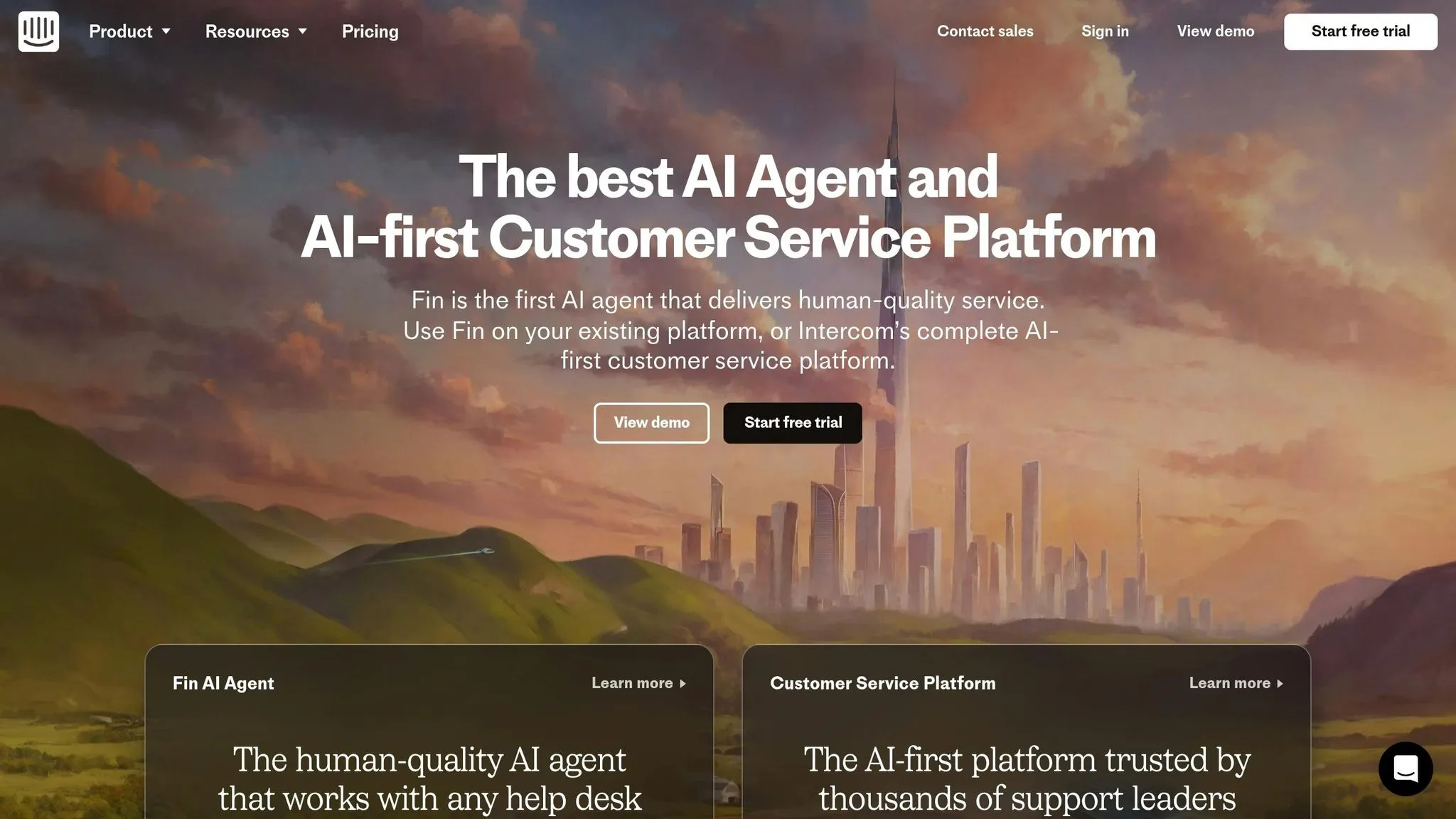
Top 5 AI Tools for Automated Customer Responses

Managing customer inquiries can be time-consuming, especially for print-on-demand businesses. AI tools can automate repetitive tasks, speed up response times, and let teams focus on more complex issues. Here’s a quick look at five AI tools that can help:

  • Zendesk AI: Handles inquiries across channels, prioritizes urgent requests, and reduces response times.
  • Freshdesk AI: Automates routine tasks, improving efficiency and allowing focus on complex issues.
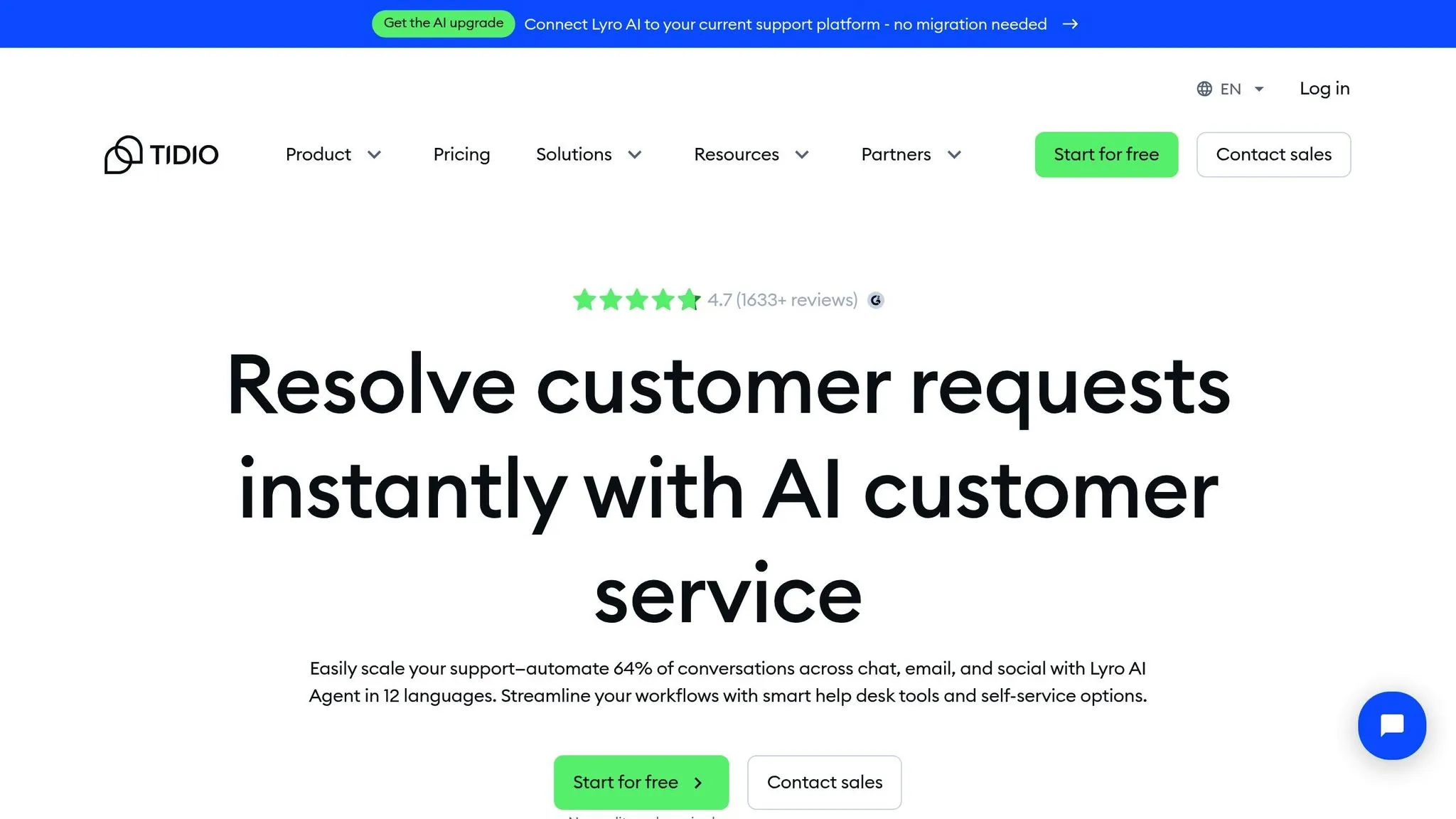
  • Tidio: Offers 24/7 multilingual chat support, smart order tracking, and analytics for improving customer interactions.
  • Intercom: Provides real-time updates, personalized replies, and integrates with e-commerce platforms.
  • Print2Social: Focused on print-on-demand, it automates social media posts with AI-generated visuals and schedules campaigns.

Feature

Zendesk AI

Freshdesk AI

Tidio

Intercom

Print2Social

Core Functionality

Customer service

Multi-channel support

Chat automation

Messaging platform

Social media for POD

Visual Content

Basic

Basic

Limited

Standard

Lifestyle images/videos

Automation Level

Medium

Medium

High

High

Full catalog automation

Platform Integration

Email, chat

Email, chat, social

Website chat

Multiple channels

POD + social media

Performance Analytics

Advanced

Advanced

Basic

Advanced

Social media metrics

These tools vary in focus, from general customer service to print-on-demand-specific solutions. Choose based on your business needs, integration options, and desired automation level.

Use These 2 AI Tools to Automate 80% of Your Customer …

Section titled “Use These 2 AI Tools to Automate 80% of Your Customer …”

Zendesk AI streamlines customer support by instantly handling inquiries across various communication channels. It efficiently manages common questions about order status, shipping details, and product information. With its smart routing system, urgent print-on-demand requests are prioritized, while routine queries are resolved automatically. This allows support teams to dedicate their time to more complex tasks, like custom design consultations. The result? Faster response times - cutting them down from hours to just seconds - and happier customers.

Now, let’s take a look at another AI tool transforming customer service automation.

Freshdesk AI is designed to simplify customer support for print-on-demand businesses by automating routine tasks. This tool helps businesses efficiently manage a high volume of customer inquiries.

By handling common questions automatically, Freshdesk AI allows support teams to focus on more complicated issues. It also shortens response times and improves overall service efficiency. With its smart automation features, businesses can offer reliable customer service while growing their operations.

Next, we’ll take a look at the following tool in our lineup.

Tidio

Tidio is an AI-powered support tool designed for print-on-demand businesses, offering real-time communication to handle customer inquiries efficiently and improve overall satisfaction.

The AI chatbot manages common questions like order status, shipping details, and customization options, providing 24/7 support without requiring constant manual input. It also features smart order tracking, which automatically retrieves and shares order updates when customers ask, cutting down on manual tasks.

The chatbot can handle multiple conversations at once, ensuring quick responses even during busy periods. You can customize messages for situations like order confirmations, shipping delays, or specific product details, and the AI improves its accuracy over time.

For businesses with a global reach, Tidio’s multilingual support is a game-changer. The AI can detect and respond in different languages, making it easier to connect with customers worldwide - perfect for companies selling custom products internationally.

Tidio also offers an analytics dashboard that helps you understand customer interactions. You can monitor common questions, response times, and satisfaction levels, giving you the data needed to improve your support strategies.

Additionally, Tidio includes proactive engagement tools to assist hesitant shoppers, helping turn potential customers into buyers.

Intercom

Intercom’s AI platform simplifies customer service for print-on-demand businesses by automating common tasks. Its Resolution Bot efficiently handles questions about order status, customization, and shipping, making it easier to manage workflows from the start.

The bot retrieves order details and provides real-time updates, helping reduce response times - especially during busy seasons. It also delivers personalized replies by tracking the context of previous conversations, ensuring customers feel heard and understood.

Intercom connects seamlessly with major e-commerce platforms, pulling in order details, tracking numbers, and product specifications. It automatically syncs this data with your catalog, so customers always get up-to-date information.

The platform also offers advanced analytics, helping you monitor key metrics like first response time, resolution rates, and customer satisfaction. These insights can guide improvements in your support process.

Even with high volumes of inquiries, Intercom’s scalable system maintains a personal touch, making it a great tool for businesses that prioritize efficient, customer-focused service.

Print2Social

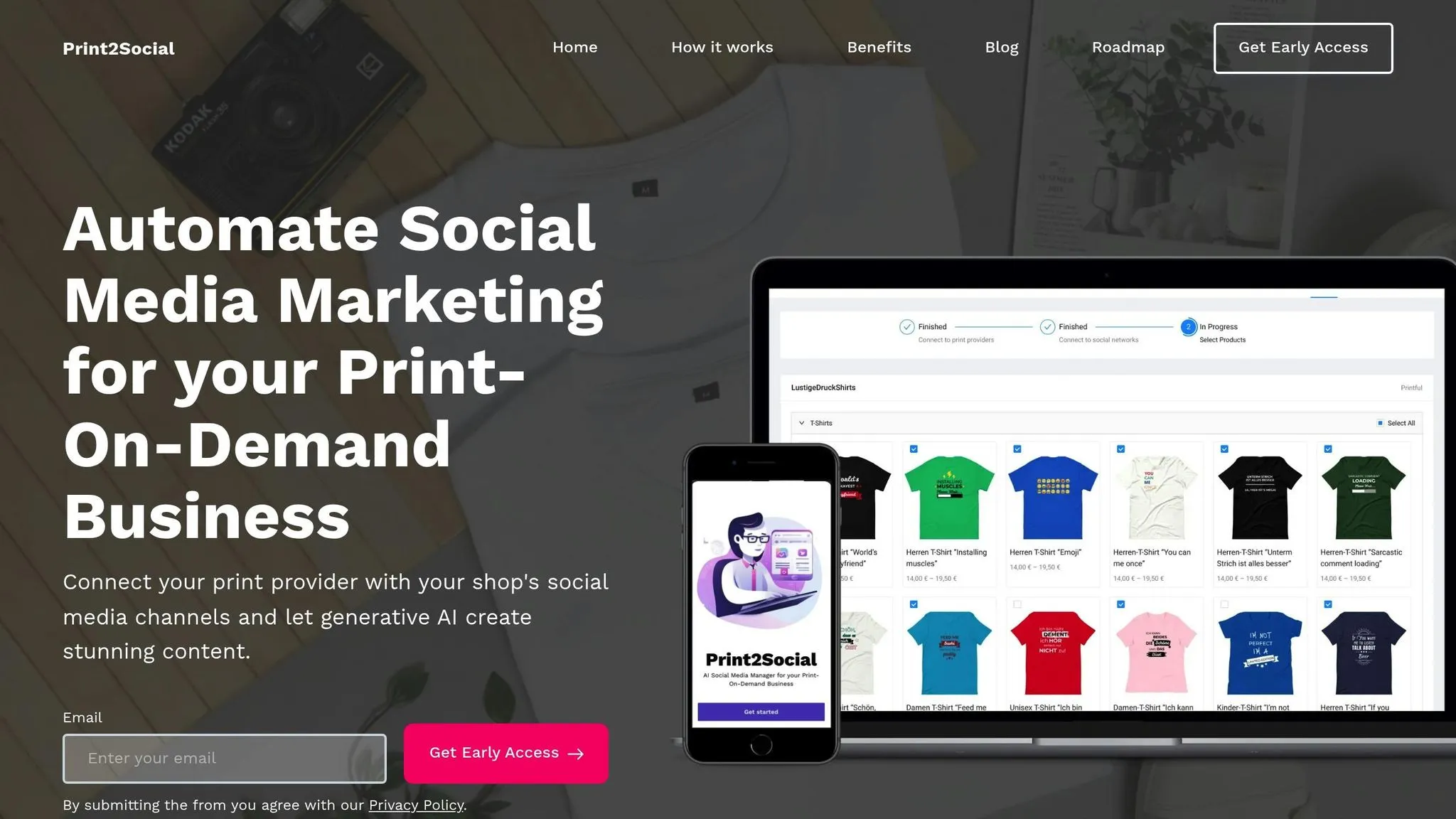
Print2Social is an AI-driven tool designed specifically for print-on-demand businesses to simplify social media management and customer response. It connects directly with popular print-on-demand providers, automatically pulling store and product data. This integration allows it to create social posts tailored to your products, showcasing your designs with minimal effort.

The platform uses AI to analyze your product catalog and generate posts featuring images and videos. It even auto-schedules these posts into a social media calendar, ensuring your promotions stay consistent and on track.

Through its centralized dashboard, Print2Social offers a clear overview of your connected print-on-demand stores and scheduled content. Key features include:

  • Performance Tracking: View engagement metrics and measure the success of your campaigns.
  • Content Customization: Adjust AI-generated posts to match your brand’s style and tone.
  • Content Scheduling: Organize and plan your social media posts for optimal timing and impact.

This tool helps streamline social media efforts, making it easier for businesses to maintain a strong online presence.

Here’s a breakdown of the key features and capabilities of these AI-powered customer response tools to help you decide which one suits your needs:

Feature

Zendesk AI

Freshdesk AI

Tidio

Intercom

Print2Social

Core Functionality

General customer service automation

Multi-channel support automation

Website chat automation

Customer messaging platform

Social automation for print-on-demand (POD) businesses

Content Generation

Text responses

Text responses

Text responses

Text and basic images

12 images + 8 videos per product

Post Generation

N/A

N/A

N/A

Basic posts

20 unique posts per product

Visual Content

Basic

Basic

Limited

Standard

Lifestyle shots and product videos

Automation Level

Medium

Medium

High

High

Full catalog automation

Industry Focus

General

General

General

General

Print-on-demand specific

Platform Integration

Email, chat

Email, chat, social

Website chat

Multiple channels

POD providers + social media

Scheduling Features

Basic

Standard

Limited

Advanced

Automated calendar

Content Customization

Manual

Manual

Template-based

Template-based

AI-powered with manual override

Performance Analytics

Advanced

Advanced

Basic

Advanced

Social media metrics

The table highlights why Print2Social is tailored for print-on-demand businesses. It stands out by automatically generating high-quality images and videos, including lifestyle shots and product demos, which enhance social media engagement. Additionally, it offers full catalog automation, streamlining content creation and scheduling for any number of products. Its seamless integration with POD providers ensures accurate and efficient social media promotion, making it a powerful tool for businesses in this niche.

When selecting AI tools, look for those that connect effortlessly with your existing systems, create both text and visual content, and grow alongside your business needs. Our research shows that while general customer service AI tools handle basic text replies, specialized options like Print2Social go further by combining automated responses with visual content creation.

Focus on these three factors: integration, content creation, and scalability. To put these priorities into action, follow these steps:

  • Platform Integration: Link your print-on-demand stores and social media accounts to maintain consistent communication.
  • Content Automation: Use AI to generate templates and visuals that align with your brand identity.
  • Performance Analytics: Track metrics like response time, customer satisfaction, and social media engagement to continuously improve your approach.

How can I choose the right AI tool to automate customer responses for my print-on-demand business?

Section titled “How can I choose the right AI tool to automate customer responses for my print-on-demand business?”

To choose the best AI tool for your print-on-demand business, start by identifying your specific needs. Look for tools that offer features like automated content creation, product mockups, and social media scheduling. Consider whether the tool integrates seamlessly with your store and fulfillment providers, as well as its ability to generate engaging content such as promotional posts, lifestyle images, and short videos.

Evaluate how well the tool aligns with your marketing goals, such as streamlining social media management or enhancing customer engagement. Prioritize options that save you time while maintaining a professional and consistent brand presence.

What are the key benefits of using AI tools to automate customer service tasks?

Section titled “What are the key benefits of using AI tools to automate customer service tasks?”

AI tools designed for automating customer service tasks offer several key advantages that can significantly improve efficiency and customer satisfaction:

  • Faster Response Times: AI-powered systems can handle customer inquiries instantly, reducing wait times and ensuring customers receive prompt assistance.
  • 24/7 Availability: These tools work around the clock, providing support even outside of regular business hours.
  • Scalability: AI tools can manage multiple customer interactions simultaneously, making them ideal for businesses experiencing high volumes of inquiries.

By leveraging AI, businesses can streamline their operations while maintaining high-quality service, freeing up human agents to focus on more complex or personalized customer needs.

How does Tidio’s multilingual support improve customer interactions for global businesses?

Section titled “How does Tidio’s multilingual support improve customer interactions for global businesses?”

Tidio’s multilingual support allows businesses to communicate with customers in their preferred language, breaking down language barriers and enhancing the overall customer experience. This feature is especially valuable for print-on-demand businesses with an international customer base, as it ensures clear and effective communication across different regions.

By offering real-time translations and support for multiple languages, Tidio helps businesses build trust and foster stronger relationships with their global audience, ultimately leading to increased customer satisfaction and loyalty.

Top Engagement Metrics for POD Stores

Want to grow your POD store? Start by tracking the right engagement metrics. These metrics reveal what your customers like, how they interact with your content, and what drives sales. Here’s a quick overview:

  • Social Media Likes: Identify popular designs and improve your content strategy.
  • Customer Comments: Understand feedback, address concerns, and boost engagement.
  • Content Sharing: Expand your reach when customers share your posts.
  • Click Rates (CTR): Measure how well your content drives traffic to your store.
  • Sales Conversion: Track how many visitors turn into buyers.
  • Total Engagement Score (TES): Combine all metrics for an overall performance view.

Tools like Print2Social automate content creation, scheduling, and tracking, saving you time while improving results. Focus on these metrics to refine your strategy and grow your store effectively.

Etsy Stats Explained & How to Get More Sales Using Data

Section titled “Etsy Stats Explained & How to Get More Sales Using Data”

Social media likes offer quick insights into customer interest in your POD store. They show which designs and products resonate with your audience.

Tracking likes can help you pinpoint:

  • Which product categories catch attention
  • Design styles that spark engagement
  • Presentation approaches that get the best response

This information can guide your approach to boost interaction with your audience.

Based on these insights, aim to diversify your content. Combine promotional posts with engaging visuals, such as:

  • Lifestyle Photos: Show your products in everyday settings.
  • Design Spotlights: Highlight your artwork with clear, detailed images.
  • Short Videos: Include clips of product demos or design creation.

AI tools can make your content strategy more effective. By creating multiple versions of product presentations, you can test what works best. Tools like Print2Social simplify this process by automating content variations and tracking likes.

Automated tools can monitor likes across your posts, helping you spot trends and adjust your strategy. Focus on engagement rates rather than raw numbers - a post with 100 likes from 1,000 followers is performing better than one with 200 likes from 10,000 followers. This data-driven approach ensures you’re prioritizing content that truly connects.

Customer comments provide more than just surface-level feedback - they offer detailed insights into customer opinions, concerns, and suggestions. These insights can guide your strategy and help improve your approach.

Pay attention to both the number and quality of comments. Look for:

  • Specific Product Feedback: Comments that mention particular design details or features.
  • Customer Service Issues: Questions or complaints about shipping, sizing, or material quality.
  • Suggestions for Improvement: Ideas for new products or variations.
  • Customer Conversations: Discussions between customers about your products.

Effective comment management is crucial. Follow these best practices:

  1. Reply within 2–4 hours during business hours.
  2. Personalize your responses by using the customer’s name and addressing specific points they’ve raised.
  3. Offer clear, actionable solutions to address their concerns.
  4. Follow up to ensure the issue has been resolved.

Print2Social’s analytics can help you track trends in customer sentiment and feedback. Use this data to make informed decisions about:

  • Improving products based on recurring feedback.
  • Exploring new design ideas that resonate with customers.
  • Adjusting your content strategy to increase engagement.
  • Enhancing customer service based on common issues.

Set up alerts for keywords that highlight service issues, praise, product inquiries, or design suggestions. Focus on:

  • Keywords signaling problems with service or delivery.
  • Positive feedback that can be reshared to boost brand credibility.
  • Questions about products or shipping.
  • Suggestions for new designs or improvements.

Customer comments can also reveal purchase intent and highlight barriers to buying. Pay attention to:

  • Products that generate questions before purchase.
  • Common concerns that may deter customers.
  • Features that spark interest or excitement.
  • Design elements that encourage conversation.

These insights go beyond traditional engagement metrics, giving you a direct view into what customers want and how to adjust your strategy to meet their needs.

Content sharing takes your POD store’s visibility to the next level by leveraging your customers’ networks. When followers share your posts, they essentially become advocates for your brand, helping you reach a broader audience.

Print2Social uses AI to produce a steady stream of visually appealing posts designed to be shared. This approach ensures your content stays fresh and engaging across all platforms.

To encourage sharing, vary the types of posts you create. Include a mix of:

  • Product highlights and special offers
  • Helpful tips on design and product care
  • Interactive content that invites engagement

This combination keeps your audience interested and more likely to share your posts.

Pay attention to what works. Tracking which posts get shared the most helps you fine-tune your strategy and grow your reach organically.

Print2Social simplifies the process by customizing posts for each platform and monitoring their performance. Focus on creating visually striking content that encourages sharing, such as:

  • Lifestyle photos showcasing products in real-life settings
  • Short videos that highlight product features
  • Formats designed specifically for each platform to maximize shares

Click-through rate (CTR) tells you how effective your content is at turning views into clicks.

For instance, if 1,000 people see your content and 50 of them click, your CTR is 5%. This metric helps you understand how well your content connects with your audience and where you can make improvements.

To increase clicks, focus on using eye-catching lifestyle images, short and engaging videos, and visuals designed for specific platforms. Tools like Print2Social’s AI can create different product presentation styles to see what works best.

Tracking tools can also pinpoint the times when your audience is most active. Use this data to schedule posts when engagement is highest and adjust your content based on click trends.

Finally, strong calls-to-action (CTAs) are key. Phrases like “Shop Now” or “Get Yours Today” encourage immediate action. Make sure your content matches the style and tone of each platform to keep CTRs high. Print2Social can help tailor your visuals and messages for maximum impact.

Sales conversion tells you what percentage of your visitors end up making a purchase. It’s a key indicator of how well your store is performing.

Here’s how to calculate it:
Conversion Rate = (Number of Sales ÷ Total Store Visitors) × 100

If you want to improve your store’s conversion rates, focus on these areas:

  • Use clear, high-quality images to showcase your products.
  • Add detailed size charts and specifications to reduce uncertainty.
  • Write short, precise descriptions that highlight key features.
  • Include reviews from real customers to build trust.

Your website’s functionality plays a big role in conversions. Make sure your site:

  • Loads quickly
  • Is easy to navigate
  • Offers a smooth and simple checkout process

Using tools like Print2Social can take this further. Their AI-powered content creation generates platform-specific product visuals and presentations. These are designed to connect with your audience and turn social media traffic into sales.

Don’t just stop at your overall conversion rate. Keep an eye on related metrics like:

  • Add-to-cart rate: How many visitors add items to their cart.
  • Cart abandonment rate: How often people leave before completing a purchase.
  • Checkout completion rate: The percentage of users who finish the checkout process.
  • Average order value: How much customers typically spend per order.

Finally, track conversion rates by traffic source. This helps you identify which channels bring the most value and where to focus your efforts.

The Total Engagement Score (TES) brings together multiple metrics to give you a clear picture of how your store is performing across different platforms.

TES combines key factors such as direct sales, social interactions, click-through rates, and time spent on your site. Each of these is weighted to create a single, comprehensive score. This approach makes it easier to track and compare your performance over time.

Tools like Print2Social can simplify tracking your engagement. You can create customized promotional content, schedule posts for the best times, and monitor how your efforts perform across various platforms - all in one place.

Use these strategies to improve your score:

  • Diversify Your Content: Include a mix of promotional, educational, and interactive posts.
  • Focus on Quality Visuals: Share sharp, appealing images and lifestyle shots that resonate with your audience.
  • Stay Consistent: Post regularly to keep your audience engaged.
  • Respond Quickly: Engage with comments and messages promptly to show your audience you’re active and attentive.

Use a real-time dashboard to dig deeper into your TES. Identify which content performs best, when your audience is most active, and which promotional tactics are driving results. This data can help you fine-tune your strategy for better outcomes.

Print2Social

Track engagement more effectively using Print2Social’s tools, which combine automation, scheduling, and performance analysis to simplify social media management for POD stores.

Print2Social offers an all-in-one solution for managing engagement and content creation. Its analytics suite monitors key metrics while automating the creation of social media posts.

Print2Social’s AI engine creates multiple content options for each product, including:

  • 12 product images featuring lifestyle shots
  • 8 short videos showcasing your designs
  • A mix of promotional and informational posts

This automation not only saves time but also ensures consistent engagement. Once the content is ready, the next step is scheduling it for maximum impact.

The platform uses an algorithm to identify the best times to post and automatically shares your content across your social media channels.

Keep track of your engagement metrics with a centralized dashboard that provides insights like:

Metric Type

Measures

Value

Visual Content

Image and video performance

Identifies which product visuals generate the most engagement

Post Balance

Content type distribution

Ensures a balanced mix of promotional and informational posts

Scheduling

Timing effectiveness

Highlights the best posting times for higher engagement

Campaign Results

Overall engagement rates

Offers a clear view of your campaign’s success

These insights allow you to fine-tune your marketing strategy for better results.

Print2Social integrates with major POD platforms and social media networks. It can import product catalogs, generate content, schedule posts, and track engagement seamlessly.

While the system handles much of the content creation, you retain full control over your marketing efforts. Before publishing, you can:

  • Edit generated posts
  • Adjust posting schedules
  • Choose specific products or categories to promote
  • Refine the balance of content types

This flexibility ensures your brand’s voice and style remain consistent while benefiting from automation. By making data-driven adjustments, you can align your strategy with your engagement objectives.

Engagement metrics provide valuable insights that can directly influence the success of your POD store. The data highlights how meaningful social media interactions can boost sales conversions and fuel brand growth.

Here’s a quick breakdown of key metrics and their business impact:

Metric Category

Business Impact

Optimization Strategy

Social Engagement

Increases brand visibility and builds community

Use a mix of lifestyle images and product showcases

Customer Interaction

Offers insights through feedback

Respond quickly to comments to keep the conversation going

Content Performance

Highlights effective product presentations

Experiment with both static images and video formats

Sales Metrics

Directly linked to revenue

Track how social posts lead to completed purchases

Print2Social simplifies metric tracking and content creation by:

  • Producing 12 images and 8 videos per product for testing different content styles
  • Generating 20 unique social posts that balance promotions and educational value
  • Automating post schedules based on engagement trends

Every metric, from social engagement to sales conversions, plays a crucial role in refining your strategy.

For the best outcomes, POD store owners should focus on:

  • Tracking a Range of Metrics: Measure both short-term engagement (likes, shares) and long-term results (sales).
  • Using Automation Tools: Rely on Print2Social’s AI to ensure a steady flow of content.
  • Regularly Reviewing Data: Use engagement insights to fine-tune your marketing approach.
  • Balancing Your Content: Mix promotional posts with educational and community-focused content.

Top 5 AI Tools for Customer Journey Mapping

AI tools can simplify and enhance customer journey mapping for businesses, especially in print-on-demand. These tools help analyze data, predict customer behavior, and personalize experiences at scale. Here’s a quick overview of the top 5 AI tools for customer journey mapping:

  • Print2Social: Automates social media content creation with AI-generated images and videos tailored to different customer journey stages.
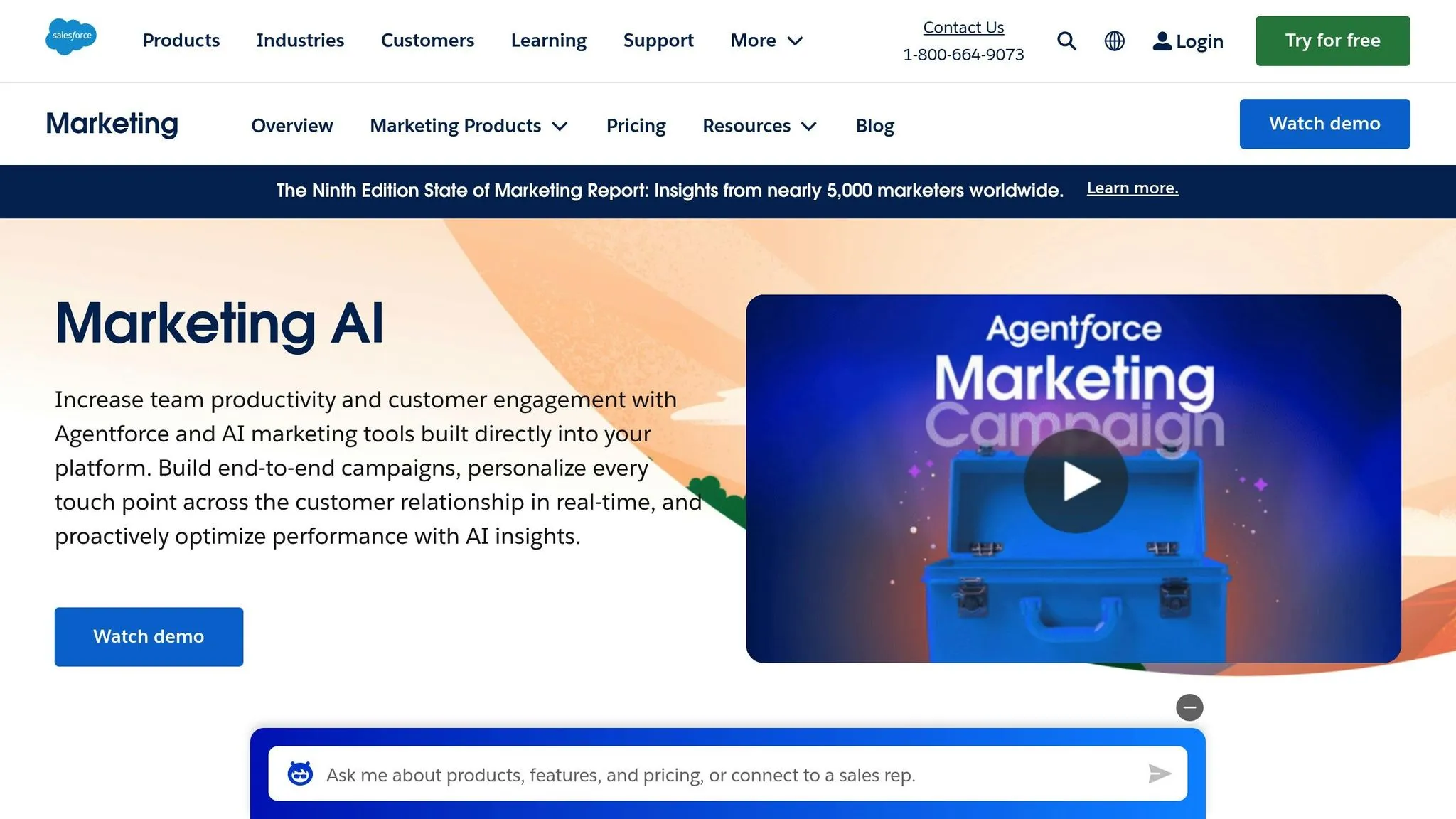
  • Salesforce Marketing Cloud: Uses AI for predictive analytics, real-time journey optimization, and cross-channel orchestration.
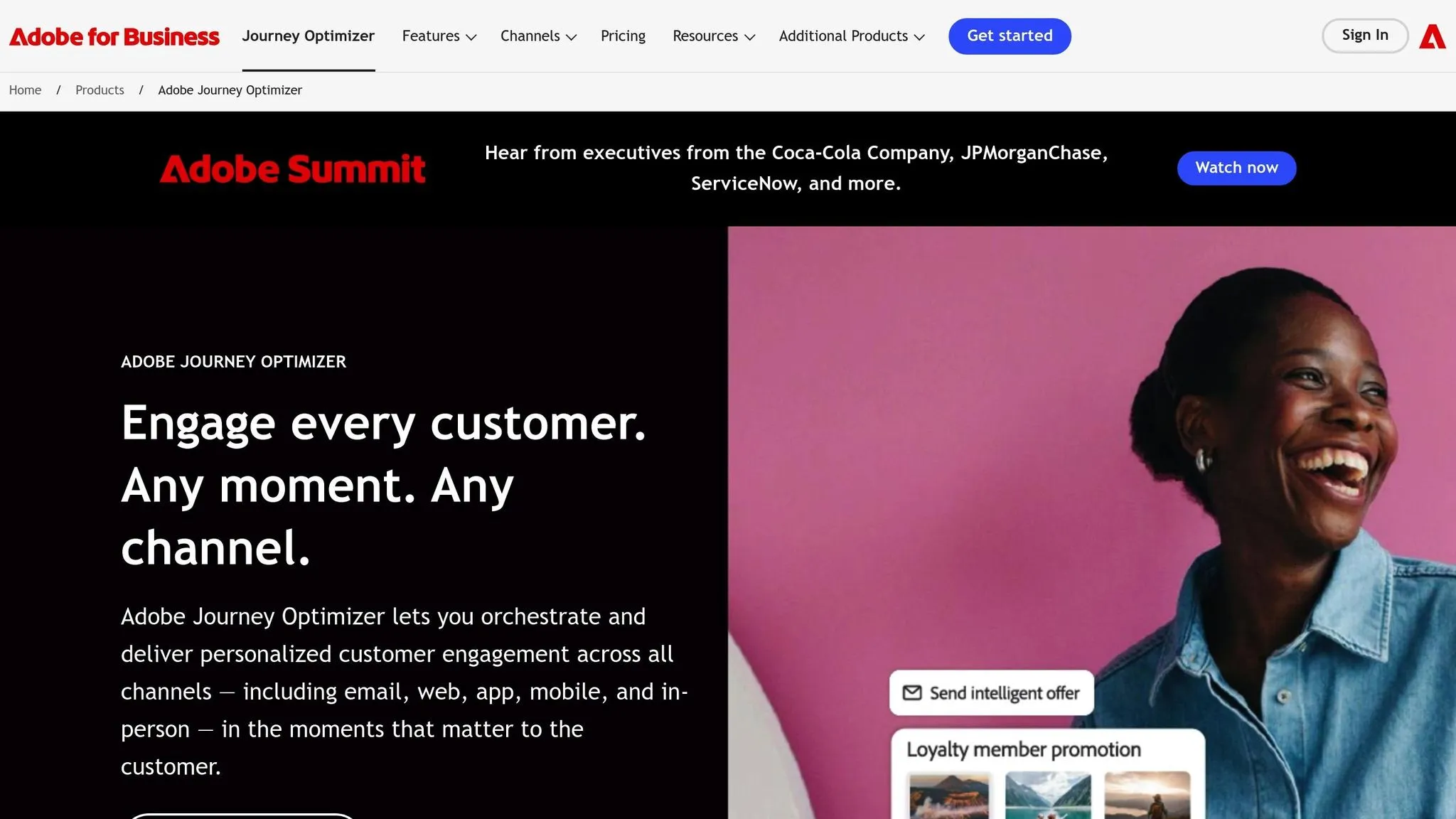
  • Adobe Journey Optimizer: Offers smart segmentation, real-time decision-making, and detailed journey analytics.
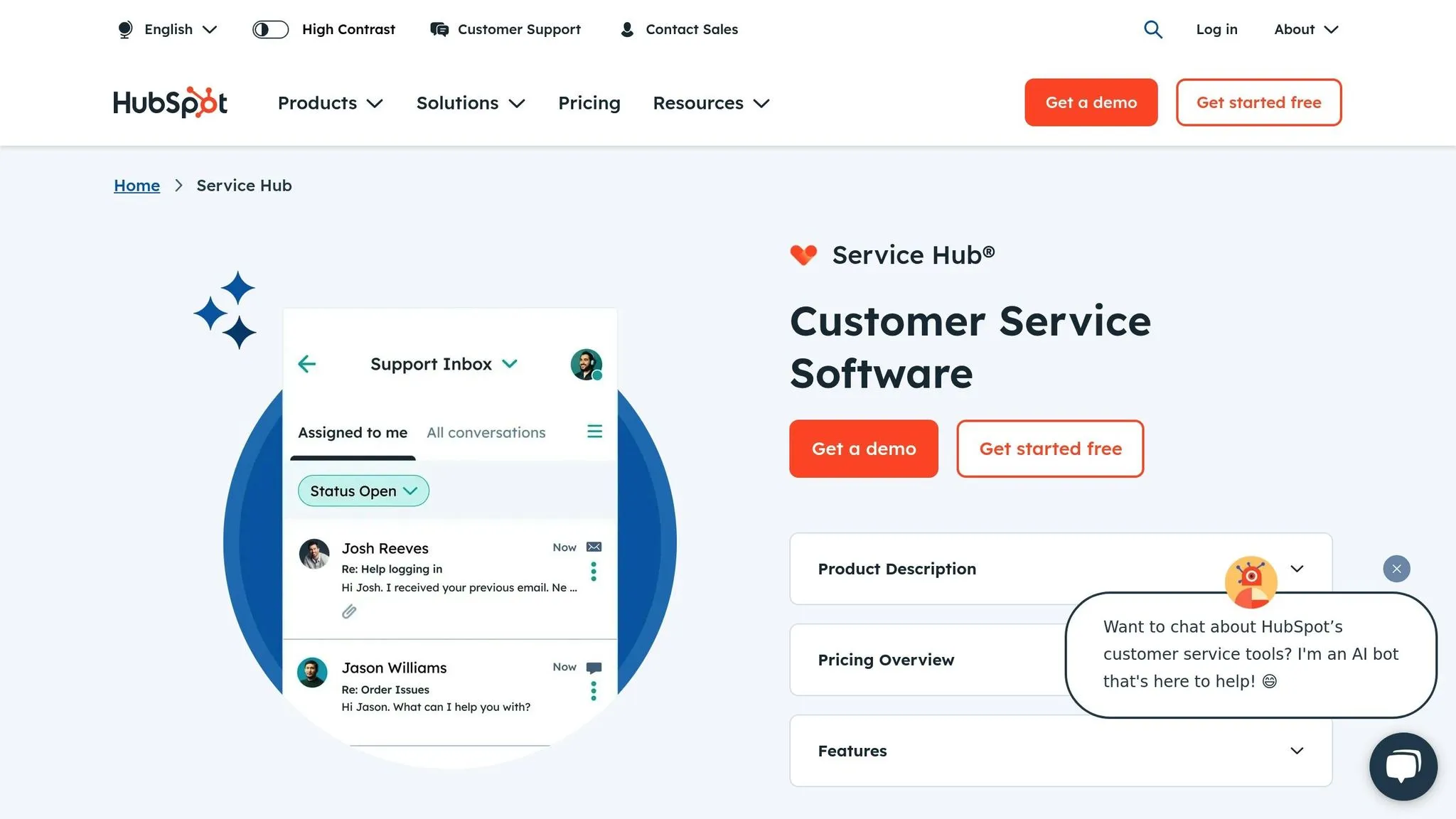
  • HubSpot Service Hub: Focuses on customer support with automated ticket routing, smart response suggestions, and unified analytics.
  • Clarabridge Engage: Leverages natural language processing (NLP) for sentiment analysis, omnichannel tracking, and journey visualization.

These tools help businesses save time, improve customer engagement, and optimize operations. Below, we dive into the features, benefits, and use cases for each tool.

How to Build a Customer Journey With Data and AI

Section titled “How to Build a Customer Journey With Data and AI”

Print2Social

Print2Social transforms how print-on-demand businesses manage their customer journey by automating social media content creation. At the heart of this platform is an AI-powered system that generates a collection of visuals for each product - 12 lifestyle images and 8 video clips that highlight practical, everyday use. This extensive content library forms the backbone of an effective social media strategy.

The platform’s content strategy focuses on a well-rounded approach that includes:

  • Promotional posts: Highlighting products and special deals
  • Engagement posts: Encouraging interaction and building community
  • Informative posts: Sharing useful insights to build credibility
  1. Connect your print-on-demand stores and social media accounts.
  2. Choose the products you want to promote using the user-friendly interface.
  3. Review and tweak the AI-generated content before it goes live.

With these steps, Print2Social simplifies the entire process, making it easy to maintain a personalized customer experience.

The platform produces 20 social media posts for each product, ensuring consistent brand messaging while tailoring content for different stages of the customer journey. This approach helps deliver engaging, relevant content no matter where customers are in their buying process.

For businesses juggling complex customer interactions, Print2Social’s AI takes over repetitive tasks, allowing teams to focus on strategy rather than execution. By syncing product catalogs with social accounts, it ensures your content stays accurate and up-to-date across every platform.

Salesforce Marketing Cloud

Salesforce Marketing Cloud leverages Einstein AI to streamline customer journey mapping, making it easier for businesses to handle complex interactions. It tracks customer activity across multiple channels, delivering insights backed by data.

The platform’s AI concentrates on three main areas:

  • Predictive Analytics: Analyzes past data to predict customer behavior and schedule interactions at the right time.
  • Journey Builder: Offers a drag-and-drop tool to design tailored customer journeys based on AI-generated insights.
  • Cross-Channel Orchestration: Ensures smooth coordination of customer interactions across email, mobile, social media, and websites.

These tools work together to fine-tune customer journeys in real time.

The system adapts customer journeys dynamically by analyzing:

  • Engagement Scores: Tracks how customers interact with various touchpoints.
  • Channel Preferences: Identifies the most effective communication methods for each customer.
  • Purchase History: Examines past buying patterns to forecast future actions.
  • Time-Based Triggers: Sends personalized messages at the most impactful moments.

All this data feeds into a dashboard that provides a clear view of journey performance with:

  • Journey Maps: Visual tools showing customer paths.
  • Conversion Metrics: Tracks success rates at different points in the journey.
  • Engagement Reports: Monitors interaction levels across all channels.
  • ROI Analysis: Measures the return on investment for each journey.

Salesforce Marketing Cloud excels at turning large volumes of customer data into practical insights, helping businesses optimize their customer interactions effectively.

Adobe Journey Optimizer

Adobe Journey Optimizer combines AI-driven analytics with real-time decision-making to create personalized customer experiences. Its AI engine analyzes data to fine-tune customer journeys across multiple channels.

Using AI, the platform identifies customer behavior patterns to suggest effective journey paths through features like:

  • Smart Segmentation: Groups customers automatically based on preferences and behaviors.
  • Predictive Engagement Scoring: Estimates how likely customers are to take specific actions.
  • Channel Optimization: Identifies the best communication channels for each customer group.

With real-time capabilities, the platform adapts journeys dynamically by:

  • Contextual Analysis: Combines current behavior with historical data to evaluate customer needs.
  • Automated Response Triggers: Activates personalized actions based on customer signals.
  • Cross-Channel Coordination: Ensures consistent messaging across web, mobile, and email.

This real-time approach is paired with detailed analytics to track the effectiveness of customer journeys.

The platform’s analytics dashboard offers detailed insights into customer journeys, including:

  • Journey Performance Metrics: Tracks where customers drop off and how many complete their journeys.
  • Interaction Analysis: Monitors engagement across various touchpoints.
  • Revenue Impact: Assesses the financial outcomes of journey adjustments.

Adobe Journey Optimizer includes tools for refining customer journeys through advanced testing:

1. Multivariate Testing

Automatically tests different journey variations to find the most effective options. It evaluates factors like:

  • Timing of messages
  • Personalization of content
  • Choice of communication channels
  • Combinations of offers

2. Predictive Analytics

Uses AI to anticipate journey outcomes by analyzing:

  • Past engagement trends
  • Seasonal patterns
  • Customer lifecycle stages
  • Buying behaviors

3. Optimization Recommendations

The system provides actionable suggestions based on ongoing analysis, such as:

  • Improving journey flows
  • Adjusting content
  • Fine-tuning timing
  • Selecting the right channels

Built-in compliance features ensure customer journeys meet privacy laws and align with brand standards across all channels. This helps businesses maintain trust and consistency in their messaging.

HubSpot Service Hub

HubSpot Service Hub is designed to improve customer support by leveraging AI tools and automation. It simplifies support processes and keeps a close eye on customer satisfaction to ensure a smoother experience.

Here are some standout features:

  • Automated ticket routing: Matches incoming requests with the right team members based on the complexity of the issue and the agent’s expertise.
  • Smart response suggestions: Helps maintain quick, consistent, and on-brand communication with customers.
  • Unified analytics dashboard: Provides a clear view of service metrics and identifies areas causing friction.

This system makes managing customer support more efficient and helps create a better overall experience.

Clarabridge Engage

Clarabridge Engage uses advanced natural language processing (NLP) to analyze customer interactions, uncover sentiment, and map out customer experiences in detail.

The platform stands out for its ability to process feedback from multiple sources, offering tools like:

  • Omnichannel Analysis: Tracks interactions across social media, email, chat, phone calls, and surveys, giving businesses a complete view of the customer journey.
  • Sentiment Analysis: Leverages AI to pick up on emotional tones in customer communications, helping pinpoint pain points and positive moments.
  • Journey Visualization: Builds visual maps of customer journeys, showing common paths, obstacles, and points where customers drop off.

These features help businesses take a more unified and proactive approach to understanding customer experiences.

With real-time analysis, businesses can:

  • Monitor satisfaction trends
  • Spot issues early, before they escalate
  • Evaluate the success of customer service efforts
  • Anticipate potential customer actions

The platform’s Smart Alerts flag unusual patterns, allowing teams to address problems quickly and effectively.

The Journey Analytics Dashboard provides insights into:

  • Interaction patterns across channels
  • Sentiment shifts over time
  • Performance metrics for different channels
  • Customer effort scores

With these tools, Clarabridge Engage helps businesses refine customer touchpoints and improve overall satisfaction.

AI-powered journey mapping plays a key role in helping print-on-demand businesses improve customer engagement and streamline operations.

When choosing an AI tool, focus on these critical factors:

Smooth Integration

  • Ensure the tool works effortlessly with your current print-on-demand platforms.
  • Confirm it supports your go-to social media channels.
  • Look for automation features that fit neatly into your workflow.

These elements help ensure the tool enhances your customer journey, as discussed earlier.

Content Creation Capabilities
For instance, tools like Print2Social can automate the creation of images, videos, and social media posts.

Flexibility and Control
Opt for tools that let you adjust content, manage scheduling, and stay true to your brand’s voice.

Ability to Scale
Make sure the tool can grow alongside your business. Check if it can handle:

  • Expanding product catalogs.
  • Multiple social media platforms.
  • Higher content production needs.

The future of journey mapping in print-on-demand lies in crafting tailored, efficient, and engaging customer experiences. By using these tools wisely, businesses can automate repetitive tasks while balancing technology with human creativity to maintain authenticity and quality.

10 Ways to Use Reviews for Social Media Growth

Customer reviews are a powerful tool for boosting your social media presence. They provide social proof, user-generated content, and valuable feedback to improve your products and engage your audience. Here’s how you can use them effectively:

  • Turn Reviews into Posts: Share customer quotes with product images or videos.
  • Create Review Videos: Use tools to make dynamic videos from testimonials.
  • Engage with Reviews: Reply to both positive and negative feedback to build trust.
  • Improve Products: Use feedback to refine your offerings and share updates.
  • Run Contests: Encourage customers to share reviews through contests.
  • Collaborate with Influencers: Blend reviews into influencer content.
  • Highlight Patterns in Stories: Share recurring themes from reviews.
  • Weekly Features: Post a standout review every week.
  • Add Reviews to Ads: Use testimonials in social media ads for credibility.
  • Leverage AI Tools: Automate the process with tools like Print2Social.

How To Market Your Business On Social Media

Section titled “How To Market Your Business On Social Media”

Turn positive customer reviews into engaging social media content that builds trust and encourages interaction. By transforming reviews into visually appealing posts, you can highlight customer experiences and connect with new audiences.

How to Make Reviews Stand Out

Tools like Print2Social make it simple to convert reviews into eye-catching visuals. These AI-driven platforms can automatically create professional posts by combining customer testimonials with product images or video clips.

Tips for Crafting Review-Based Posts

To create effective posts from customer reviews, consider these tips:

  • Use quotes that emphasize key product benefits.
  • Pair reviews with images showing the product in action.
  • Tag customers (with their consent) to encourage engagement.
  • Add product links so viewers can shop easily.

These approaches help you create content that resonates with your audience and keeps them engaged.

Mixing It Up

Keep your content fresh by alternating between different types of review-based posts. For example, combine customer quotes, product photos, and video testimonials to tell a well-rounded story about your brand.

Why Automation Helps

Using automation tools ensures a steady stream of content while maintaining a good balance between promotional, engaging, and informative posts. This keeps your social media strategy consistent and effective.

Turn customer reviews into engaging video content to boost your social media presence. Videos consistently perform better than static posts, making them a must-have for growing your audience.

Platforms like Print2Social use AI to transform written reviews into dynamic videos, saving time while keeping the quality consistent. For each product, the tool generates eight variations, allowing you to test and improve quickly.

Here are some effective formats for showcasing reviews:

  • Product-focused videos: Combine testimonials with product visuals.
  • Lifestyle clips: Add review text to real-life usage scenarios.
  • Animated designs: Use quotes creatively with mockups or animations.

To make your review-based videos stand out, pay attention to these details:

  • Keep them short and attention-grabbing.
  • Use clear, easy-to-read text overlays.
  • Highlight the product visually throughout the video.
  • Add music that complements the tone.
  • End with a strong call-to-action.

AI tools like Print2Social simplify the process by blending visuals and reviews into professional-quality videos. This automation helps maintain a consistent look and feel across all your content.

Try different approaches - product showcases, lifestyle clips, or animations - to see what resonates with your audience. Regularly tweak your formats to keep your videos fresh and engaging.

Engaging with reviews on social media isn’t just about visibility - it’s about building stronger connections with your customers.

Responding to reviews quickly shows customers you value their time and feedback. A prompt reply can leave a lasting impression.

Craft thoughtful replies that make customers feel appreciated. Here’s how:

  • Address them by name and mention specific details from their review.
  • Highlight their positive experience to reinforce it.
  • Encourage future interactions, like returning or sharing more feedback.

For example:

“Thanks for your feedback, Sarah! We’re thrilled you loved our custom hoodies. Can’t wait to serve you again!”

Turning Negative Reviews Into Opportunities

Section titled “Turning Negative Reviews Into Opportunities”

Negative reviews can be tricky, but they’re also a chance to show your commitment to improvement. Here’s a simple approach:

  • Acknowledge the issue without being defensive.
  • Offer to resolve it privately after a brief, empathetic public reply.
  • Once resolved, update the thread to let others see how you handled it.

This approach not only addresses the issue but also shows transparency and care.

AI tools, like Print2Social, can help make responding to reviews more efficient. They can:

  • Analyze sentiment to prioritize reviews.
  • Suggest tailored response templates.
  • Monitor your response times and engagement levels.
  • Schedule follow-ups to keep the conversation going.

Use customer feedback to refine your products while also boosting your presence on social media. Build a system that turns this feedback into actionable improvements.

Sort customer reviews into categories like:

  • Print quality
  • Material durability
  • Size accuracy
  • Design clarity
  • Shipping experience

Tracking these categories regularly helps you spot recurring issues and measure progress over time.

Address common concerns directly. For example, if customers mention sizing problems, update your size charts, add detailed fitting guides, or include comparison photos to make it easier for customers to choose the right size.

Use social media to highlight product updates with before-and-after visuals. Include customer testimonials and reviews that prompted these changes to show you’re listening and taking action.

Monitor how your updates perform by tracking metrics like likes, shares, comments, and customer sentiment. Pay attention to new reviews that reflect customer responses to your improvements.

Save time by using tools like Print2Social to automate social media updates. This allows you to focus on analyzing feedback and implementing changes more efficiently. Automating these processes ensures you stay responsive without sacrificing time.

Turn customer reviews into contests to boost engagement and build social proof for your print-on-demand business. These contests not only increase visibility but also encourage customers to share their experiences in creative ways.

Create contests with clear rules and appealing rewards. Keep participation straightforward to ensure you receive quality entries. Here are some ideas:

  • Photo Review Challenge: Invite customers to share photos of themselves using your products along with their honest reviews.
  • Video Testimonial Contest: Ask for short video reviews showcasing your product’s features.
  • Creative Review Stories: Encourage customers to share unique or unexpected ways they use your products.

Motivate participation with tiered prizes that encourage effort and creativity. Here’s an example prize structure:

Prize Tier

Reward Type

Requirements

Grand Prize

$250 store credit

Best photo or video review

Runner-up

$100 store credit

Top 3 detailed written reviews

Participation

15% discount code

All valid review submissions

Use multiple channels to spread the word and maximize participation:

  • Pin announcements to your social media profiles.
  • Create branded hashtags to track entries easily.
  • Showcase winning entries to inspire others.
  • Use Instagram Stories highlights to feature ongoing contests.

These strategies will help your contest gain traction and encourage more entries.

Set clear guidelines to maintain the integrity of your contests:

  • Require proof of purchase for eligibility.
  • Specify minimum review length requirements.
  • Ask customers to include details about the product.
  • Request original photos or videos that show the product in use.

These steps ensure the reviews are genuine and useful, both for your business and future customers.

Track important metrics to evaluate the contest’s impact:

  • Total review submissions
  • Social media engagement levels
  • Hashtag usage
  • Customer participation trends
  • Conversion rates from contest-related traffic

Analyzing these metrics will help you refine future contests for even better results.

Simplify the process with tools like Print2Social. These can help you schedule, manage, and track your contests, so you can focus on reviewing entries and picking winners.

Combine influencer marketing with customer reviews to strengthen your print-on-demand brand. Here’s how to seamlessly integrate reviews into influencer content.

Choose Reviews That Match the Influencer’s Style

Section titled “Choose Reviews That Match the Influencer’s Style”

Pick reviews that align with the influencer’s tone and audience. Focus on real testimonials that showcase specific product features or benefits the influencer can naturally highlight in their content.

Incorporate customer feedback into various content formats:

Content Type

How to Add Reviews

Purpose

Instagram Stories

Overlay verified customer quotes on images

Build trust and show transparency

YouTube Reviews

Include testimonials in b-roll footage

Add social proof

TikTok Videos

Use review screenshots during transitions

Make content feel relatable and engaging

Transform plain text reviews into shareable visuals. Tools like Print2Social can help by:

  • Turning customer feedback into eye-catching graphics.
  • Creating short videos featuring product reviews.
  • Designing custom visuals that combine influencer content with testimonials.

Authenticity matters. Make sure influencers:

  • Use verified customer reviews.
  • Have creative freedom in how they present the reviews.
  • Share their own experiences alongside the testimonials.
  • Clearly label sponsored content to maintain transparency.

Track how well these posts perform by analyzing:

  • Engagement rates on posts featuring reviews.
  • Click-through rates to product pages.
  • Conversion rates from influencer-shared content.
  • Audience reactions and feedback.

These metrics can help you fine-tune your strategy for better results.

Once you’ve found what works, expand your efforts by:

  • Repurposing successful posts for other platforms.
  • Adapting review content for specific social channels.
  • Encouraging influencers to share reviews in multiple formats.
  • Building a consistent message across all touchpoints.

Print2Social can simplify the process, helping you maintain consistent branding while scaling your influencer campaigns effectively.

7. Share Review Patterns in Social Stories

Section titled “7. Share Review Patterns in Social Stories”

Turn recurring themes from customer reviews into engaging Stories content that resonates with your audience.

Break down customer feedback into key themes to guide your content:

Theme Type

What to Look For

Story Content Ideas

Product Quality

Mentions of durability, materials

Before/after wear tests

Customer Service

Response time, issue resolution

Behind-the-scenes support clips

Design Features

Popular style elements, print quality

Close-up product showcases

Shipping Experience

Delivery speed, packaging quality

Unboxing highlights

This structure helps you craft Stories that reflect both the strengths and challenges highlighted in reviews.

Turn these themes into a series of Stories that feel connected and purposeful. Use tools to ensure visuals are consistent and polished.

Go beyond celebrating positive feedback by tackling areas for improvement:

  • Highlight reviews, share quick tutorials, and showcase success stories to underline key benefits.
  • Be transparent about concerns raised in reviews.
  • Explain the steps you’ve taken to address these concerns.
  • Offer behind-the-scenes glimpses of ongoing improvements.

Design your Stories with these tips to make them visually appealing and interactive:

  • Use brand colors to differentiate feedback categories.
  • Create custom Story highlights for each major theme.
  • Add interactive polls to engage with recurring feedback.
  • Include product tags for easy navigation to items.

Measure the impact of your review-based Stories by monitoring these metrics:

Metric

What It Tracks

Why It Matters

Story Completion Rate

Percentage watching full story

Indicates content relevance

Tap Forward Rate

Number of quick forwards

Highlights less engaging segments

Reply Rate

Direct responses to stories

Shows audience connection

Link Clicks

Visits to product pages

Reflects purchase interest

Use this data to refine your approach, focusing on the themes that resonate most with your audience.

Use customer reviews to create a weekly feature that builds trust and keeps your audience engaged. Highlight real experiences to showcase your products in a relatable way.

Develop a template that aligns with your brand and makes reviews stand out. Include:

  • A consistent look (colors, fonts, and layout)
  • A featured review alongside a product image
  • Key product details
  • Customer tags (make sure you have their permission)
  • A clear call-to-action to drive engagement

Schedule your review posts ahead of time. Rotate through different product categories each week to keep things fresh and appeal to a wider audience. Automating this process can help you stay on track without extra hassle.

Use tools like Print2Social to simplify your workflow. These tools can help you create and schedule visuals for each review, turning them into attention-grabbing images or videos while keeping your social media calendar organized.

Take your review posts to the next level by:

  • Pairing customer photos with professional product images
  • Highlighting standout product features
  • Adding helpful details like sizing or care instructions
  • Tying posts to seasonal trends or popular themes

Pay attention to metrics like engagement, click-through rates, and comments. Use this data to tweak your posting schedule and refine your content for better results.

Get more customers to share their experiences by:

  • Offering incentives like discounts or entry into contests
  • Promoting a branded hashtag for reviews
  • Showing how customer feedback influences your products and services

Adding reviews to your social media ads can boost customer trust and improve visibility. Reviews act as social proof, helping potential buyers feel more confident about your product and encouraging them to take action.

Choose reviews that highlight your product’s strengths or address common customer concerns. These should clearly showcase how your product solves problems or stands out from competitors. Pair these reviews with eye-catching product images to create ads that grab attention and drive clicks.

To streamline the process, you can use tools like Print2Social to create multiple ad variations. This allows you to test different formats and messages to see what works best for your audience.

Keep an eye on key metrics like click-through rates and conversions. Testing and refining your ads will help you get the best possible results.

Print2Social

Print2Social helps you turn customer reviews into eye-catching social media posts, perfect for print-on-demand businesses. Using AI, it creates visual content like product images and video clips, paired with testimonials to boost social proof.

Here’s how to make the most of Print2Social:

  • Connect Your Accounts: Link your print-on-demand shops and social media profiles to streamline your product catalog and reviews in one place.
  • Generate Visual Content: Use AI to produce lifestyle images and promotional videos that highlight customer testimonials. Each product gets 12 images and 8 video clips, giving you 20 unique posts.
  • Schedule Posts: Plan the timing of your posts to maximize visibility and engagement across different platforms.

These features make it easy to incorporate customer feedback into your social media strategy.

Use customer reviews and AI tools to boost your social media presence. This approach transforms everyday feedback into a powerful way to connect with your audience.

By consistently sharing real customer experiences and automating content creation with AI, you can strengthen your online presence. Tools like Print2Social simplify this process for print-on-demand businesses, helping them create up to 20 unique posts per product (12 images and 8 videos). This ensures a constant flow of engaging content.

Here’s how to get started:

  • Review Your Feedback: Gather and organize customer reviews from all platforms.
  • Pick Your Platforms: Focus on social media channels where your audience spends the most time.
  • Automate the Process: Link your print-on-demand store with your social accounts to streamline content creation.

Start today by turning customer feedback into actionable content. Build stronger connections with your audience, monitor engagement, and refine your strategy as needed.

Combining customer feedback with AI-driven tools is the next step in social media marketing. Print-on-demand businesses can use these strategies to create a reliable, time-efficient social media presence.

How AI Improves Feedback Collection for POD Stores

AI tools are transforming how print-on-demand (POD) stores collect and analyze customer feedback. Instead of relying on slow, manual methods, AI systems provide fast, automated solutions that help businesses make data-driven decisions. Here’s a quick overview:

  • Why Feedback Matters: AI processes customer reviews to reveal insights on product quality, design trends, and satisfaction, enabling stores to adapt quickly.
  • Challenges Solved by AI:
    • Handles large feedback volumes
    • Provides real-time analysis
    • Reduces emotional bias in interpretation
  • Key AI Features:
    • Text Analysis: Detects sentiment, common issues, and trends in reviews.
    • Automated Data Collection: Gathers feedback from multiple channels like social media and surveys.
    • Pattern Recognition: Identifies root causes, tracks trends, and predicts future customer behavior.

With tools like Print2Social, POD stores can integrate AI into their platforms, streamline workflows, and improve customer satisfaction while saving time and resources. Pricing starts as low as $39/month, making it accessible for businesses of all sizes.

AI-powered thematic analysis for qualitative research in customer feedback

Section titled “AI-powered thematic analysis for qualitative research in customer feedback”

Modern AI tools are reshaping how POD stores gather and analyze customer feedback, making it easier to make decisions based on data. These tools go beyond analyzing individual reviews - they automate data collection and identify patterns that might otherwise go unnoticed.

By tackling the inefficiencies of manual methods, AI provides targeted solutions that streamline feedback collection.

AI-powered text analysis uses natural language processing (NLP) to dive into customer reviews, uncovering both obvious sentiments and subtle feedback.

“Reading through a few hundred reviews takes time that we don’t have. Instead of 8 hours to parse the details in 6000 reviews, it takes me 10 minutes using Keatext.” - Alisha Manion, Account Manager, Sampler

Here’s how AI breaks down customer feedback:

Analysis Type

What AI Detects

Business Impact

Sentiment Analysis

Customer emotions and satisfaction

Pinpoints areas that need immediate attention

Topic Categorization

Common issues like logistics problems

Helps prioritize operational improvements

Keyword Detection

Frequently mentioned product features

Guides design and inventory decisions

Intent Recognition

Purchase likelihood and customer needs

Supports proactive customer service strategies

AI doesn’t just analyze feedback - it also automates how it’s gathered from different sources. This brings key advantages for POD stores:

  • Real-time Processing: Speeds up feedback analysis, working up to 10 times faster than traditional methods.
  • Multi-channel Integration: Combines feedback from platforms like social media, email surveys, and review sites.
  • Scalability: Handles growing volumes of feedback without requiring additional resources.

Additionally, AI can personalize surveys and adjust questions based on responses, increasing both response rates and the relevance of insights.

AI tools also excel at identifying patterns that can drive actionable insights:

1. Root Cause Analysis

AI digs deeper into complaints to uncover hidden issues. For instance, repeated complaints about delivery delays might point to specific geographic challenges or carrier inefficiencies.

2. Trend Tracking

By monitoring shifts in customer sentiment over time - such as after a product launch - AI helps businesses measure the impact of their decisions.

3. Predictive Insights

Analyzing historical feedback allows AI to forecast potential issues or customer behavior trends, giving stores a chance to address problems before they arise.

These AI-driven capabilities enable POD stores to tackle challenges head-on and improve customer satisfaction. Pricing for AI tools typically ranges from $39/month for basic plans to $129/month for professional packages, making them accessible for businesses of all sizes.

When choosing AI tools for your print-on-demand (POD) store, focus on features that align with your business needs. Here’s a breakdown:

Feature Category

Key Functions

Benefits for POD Businesses

Data Collection

Gather feedback from multiple channels

Gain insights from customers across platforms

Analysis Tools

Use natural language processing

Identify trends in product feedback

Integration

Ensure compatibility with POD platforms

Connect easily with your existing systems

Reporting

Create customizable dashboards

Monitor product and design performance

Automation

Automate workflows

Minimize manual effort in feedback handling

For example, Print2Social is tailored for POD businesses. It automates feedback collection from social media and integrates effortlessly with popular POD platforms, making it an effective tool for managing customer insights. Once you’ve selected your software, the next step is to ensure smooth integration with your POD platform.

To integrate AI feedback tools with your POD platforms, focus on compatibility and data flow. Many users, such as those of Flying Upload, have successfully connected their systems across various POD platforms. Similarly, Print2Social excels in feedback collection and social media automation.

Key steps for integration:

  • Platform Authentication
    Ensure you have admin access to all relevant platforms, including your POD marketplace, social media accounts, and customer service tools.
  • Data Flow Configuration
    Set your AI tool to gather feedback from specific sources. For instance, Printify supports automated feedback collection and A/B testing, making it easier to make informed product decisions.
  • Integration Testing
    Test the system with a small set of feedback before full deployment. This helps catch and fix any issues early on.

Once integration is complete, you’re ready to configure your AI tool for optimal performance.

  • Initial Setup and Customization
    Adjust basic settings to match your store’s size and customize feedback categories to suit your products. Keep in mind that pricing may vary based on the features you choose.
  • Automation Rules
    Establish workflows to streamline tasks like:
    • Directing feedback to the right team members
    • Generating regular performance reports
    • Highlighting urgent issues for quick action
    • Monitoring trends across product categories

Proper setup ensures your AI tool works efficiently, saving time and improving feedback management.

AI has made it easier to track feedback across social media platforms. With approximately 5.5 billion users worldwide and over 2 billion posts shared daily, manually keeping up with this volume is impossible. AI tools step in to process this massive data instantly, offering insights that can directly benefit your print-on-demand (POD) business.

Monitoring Aspect

AI Capabilities

Business Impact

Sentiment Analysis

Tracks positive, negative, and neutral reactions

Identifies product issues early

Trend Detection

Spots emerging patterns in conversations

Informs product development decisions

Competitor Analysis

Monitors competitors’ performance

Highlights market opportunities

Crisis Management

Flags spikes in negative sentiment

Enables fast issue resolution

Take, for example, tools like Print2Social. This AI-powered platform automatically monitors product mentions and engagement metrics across social networks. It evaluates customer interactions to reveal which products and designs resonate most with your audience.

By combining AI-driven social media monitoring with survey insights, POD businesses can create a well-rounded strategy for understanding and improving customer satisfaction.

AI takes traditional surveys to the next level, turning them into dynamic tools for real-time feedback. Using insights from social media, AI can help craft surveys that address the most relevant customer sentiments.

  • Create Targeted Surveys: AI examines your product categories and customer segments to develop focused questions.
  • Automate Analysis: Survey responses are automatically analyzed, providing clear recommendations without manual effort.
  • Generate Insights: Findings are compiled into actionable steps for improving products and marketing strategies.

For POD businesses, AI-powered surveys are especially helpful in:

  • Pinpointing design preferences across customer groups
  • Determining optimal pricing for various products
  • Gauging satisfaction with print quality and delivery times
  • Measuring brand perception and customer loyalty

To get the most out of AI surveys, proper preparation is key. This includes:

  • Setting clear goals for the survey
  • Identifying the right audience demographics
  • Selecting effective question types, like multiple choice or Likert scale
  • Reviewing AI-generated questions for accuracy and relevance

Advanced AI systems can even adjust survey questions based on previous responses, creating a more personalized experience that leads to better feedback.

Conclusion: AI Feedback Tools Today and Tomorrow

Section titled “Conclusion: AI Feedback Tools Today and Tomorrow”

A striking 87% of retailers are now leveraging AI solutions, showcasing how AI has reshaped POD feedback collection. From automating analysis to monitoring multiple channels, AI-driven feedback systems are delivering real results. In fact, 70% of businesses using AI report improvements in both marketing efforts and revenue.

Capability

Future Potential

Automated Analysis

Integration with IoT devices for deeper insights

Sentiment Detection

Better emotional understanding

Pattern Recognition

Predictive analytics for product development

Multi-channel Monitoring

Improved synchronization across platforms

With these advancements, POD store owners can transition from simply analyzing feedback to taking meaningful action with well-structured strategies.

POD store owners can begin using AI feedback tools by focusing on a few key steps: identify the main feedback challenges, select tools that align with their platform, prioritize data privacy, and monitor how customer satisfaction evolves over time.

“I was looking for a feedback app that could be used on my order status/thank you pages using Shopify’s new checkout extensibility. This app fit perfectly.” - Slice Engineering

For those new to AI, UserLoop’s free plan provides an easy way to explore its capabilities.

“AI, like most transformative technologies, grows gradually, then arrives suddenly.” - Reid Hoffman, cofounder of LinkedIn and Inflection AI

With 80% of retail executives planning to adopt AI automation by 2025, the future holds exciting possibilities, including advanced analysis tools, personalized customer interactions, and even augmented reality-powered feedback systems.

Ultimate Guide To Feedback-Driven Social Media Marketing

Want to improve your social media marketing? Start by listening to your customers. Feedback-driven strategies help you create better content, refine products, and connect with your audience. Here’s what this guide covers:

  • Why feedback matters: 71% of consumers recommend brands they enjoy on social media.
  • How to gather feedback: Use tools like Hootsuite or Sprout Social to track customer sentiment.
  • Turn feedback into action: Analyze comments, reviews, and user-generated content to improve your marketing.
  • Boost performance: Posts based on feedback see 85% higher sales growth.

Learn how to collect, analyze, and use customer feedback to strengthen your social media strategy.

How to Get Customer Feedback Online (6 Best Ways)

Section titled “How to Get Customer Feedback Online (6 Best Ways)”

Data highlights that 77% of consumers feel more positive about brands that actively seek and act on customer feedback. Here’s how you can effectively gather insights from your customers.

Using the right tools to track customer sentiment and engagement is essential. These platforms are particularly useful for print-on-demand businesses:

Tool

Key Features

Best For

Hootsuite

Multi-platform monitoring, unified inbox

General brand monitoring

Sprout Social

Sentiment analysis, trend tracking

Understanding customer insights

Mention

Real-time brand mention alerts

Quick response management

Talkwalker

Visual analytics, image recognition

Tracking product photos

For a tailored approach, check out Print2Social (https://print2social.com). Its AI-driven features are specifically designed for print-on-demand businesses.

A great example of effective monitoring comes from Printful. In 2022, they used Hootsuite to streamline their customer feedback process. This resulted in a 28% increase in positive sentiment, a 15% faster response time, and a 10% rise in repeat customers.

Next, let’s dive into how direct surveys and reviews can provide deeper insights.

Systematic feedback collection through surveys and reviews can provide valuable insights. Timing is key - send surveys 1–2 weeks after delivery to capture accurate impressions.

  • Use tools like Mailchimp to automate survey distribution.
  • Include both rating scales and open-ended questions for detailed feedback.
  • Offer incentives like discount codes to encourage honest responses.
  • Ensure reviews are collected across multiple platforms for broader visibility.

“96% of unhappy customers don’t complain directly to companies, but 91% of those will simply leave and never come back”.

In addition to surveys, photos and videos from customers can offer a richer understanding of their experience.

User-generated content (UGC) can significantly impact your business, with conversion rates increasing by 161% when UGC is included. Here’s how to encourage customers to share their content:

  • Create Branded Hashtag Campaigns
    Design easy-to-remember hashtags for customers to use when sharing their photos. Highlight these hashtags on packaging inserts and in post-purchase emails.
  • Run Photo Contests
    Organize contests where customers can win prizes like store credit or exclusive designs. This not only generates content but also fosters community engagement.
  • Leverage Packaging
    Include branded inserts with clear instructions on how to share photos or videos. Add hashtags or QR codes that link directly to your social platforms.

Making it easy for customers to share their experiences while offering them value in return is key. Real customer content often connects with audiences better than polished marketing materials, as it captures genuine experiences with your products.

Once you’ve collected customer feedback, the next step is figuring out how to turn it into actionable insights.

AI tools today can categorize comments with an impressive 97% accuracy. This helps businesses quickly spot sentiment trends and patterns. Here’s how these tools can help:

Analysis Type

Tool Features

Business Impact

Sentiment Analysis

Breaks feedback into positive, negative, and neutral categories

Tracks how customers feel about your brand

Topic Detection

Identifies recurring themes and keywords

Helps shape your content strategy

Trend Tracking

Monitors sentiment shifts in real-time

Allows quick responses to issues

For example, Print2Social users can rely on its AI to analyze feedback from multiple social platforms. This makes it easier to detect trends specifically tied to print-on-demand products. These insights can then guide the analysis of visual content.

Visual content shared by customers can be a goldmine. Studies show that 80% of consumers are more likely to buy from brands that feature customer photos or videos in their campaigns. A strong example is Sephora, which used visual recognition AI to analyze Instagram posts. The result? A 22% boost in conversion rates for the products they featured.

Key areas to analyze in customer-shared visuals include:

  • Product placement: How and where products are being used
  • Color schemes: Which colors resonate most with your audience
  • Environmental context: The settings or scenarios in which your products are used

By analyzing these factors, you can identify recurring themes and prioritize actions that align with your customers’ preferences.

Adidas showed the power of theme analysis in June 2023. By using AI to analyze 500,000 Instagram comments, they achieved a 28% increase in positive sentiment and a 12% rise in engagement rates.

“Companies that regularly analyze customer feedback themes see a 15-20% increase in customer satisfaction scores”.

To pinpoint and act on common themes:

  • Collect feedback from diverse sources like social media, reviews, and direct messages.
  • Use tools like text mining and topic modeling to uncover patterns.
  • Prioritize themes based on their frequency, sentiment intensity, and potential business impact.

This structured approach ensures you’re focusing on what matters most to your customers.

Posts shaped by customer feedback consistently outperform generic content, delivering 85% higher sales growth compared to competitors.

Print2Social simplifies the process of turning customer feedback into engaging social media posts. By focusing on what your audience values, you can produce content that truly resonates.

Content Type

Customer Feedback Source

Implementation Strategy

Product Showcases

Customer Reviews

Highlight top-rated product features

Educational Content

Common Questions

Answer frequently asked questions

Social Proof

User Photos/Videos

Share authentic customer experiences

Product Updates

Feature Requests

Announce updates inspired by user input

Take Airbnb’s 2022 Instagram strategy as an example. By showcasing user-generated content, they saw an 18% increase in engagement and a 25% rise in bookings from Instagram traffic within six months. These results underline the power of listening to your audience.

Retail brands typically see an average engagement rate of 0.68% on Instagram and 0.13% on Facebook. To surpass these numbers, experiment with your content:

  • Test posting times and frequency
  • Compare performance across formats (e.g., videos vs. images)
  • Evaluate responses to different calls-to-action
  • Track how features resonate with your audience

“Brands that engage and respond to customer service requests over social media see a 20-40% increase in customer spending”.

Use these insights to fine-tune your strategy and adapt quickly.

Once you’ve identified successful content formats, act fast to stay ahead. Quick adjustments ensure your posts remain relevant and engaging. For example, brands that respond to customer feedback within an hour experience 42% more customer advocacy.

Here’s how to make those updates:

  • Monitor engagement metrics in real time
  • Adjust posting schedules based on performance
  • Respond promptly to comments and messages
  • Scale up content that performs well

If a particular design or post generates strong positive feedback, Print2Social makes it easy to replicate and expand on that success.

“77% of consumers view brands more favorably when they actively seek and implement customer feedback”.

Measuring social media performance is essential for refining your marketing approach. Companies that incorporate social data into their strategies are 1.5 times more likely to see revenue growth.

For print-on-demand businesses, monitoring specific metrics can help gauge social media success. Here are some key ones to track:

Metric

Target Range

How to Calculate

Engagement Rate

1-5%

Total engagements ÷ followers × 100

Conversion Rate

2-5%

Conversions ÷ total visitors × 100

Customer Satisfaction

Over 80%

Average satisfaction score (1-10)

ROI

5:1 to 10:1

(Revenue - Cost) ÷ Cost × 100

Tools like Print2Social’s analytics dashboard simplify tracking these metrics, helping you spot trends and fine-tune your approach.

Breaking your audience into segments can lead to better results. Businesses that segment their customers see up to 10% higher profits compared to those that don’t. A great case study: In 2022, Warby Parker used advanced customer segmentation, boosting engagement rates by 22% and conversion rates by 15% within six months.

To better target your audience, consider these factors:

  • Engagement level: Measure how different groups interact with your posts.
  • Purchase history: Look for patterns in buying behavior.
  • Content preferences: Identify which types of posts perform well with specific groups.
  • Feedback sentiment: Group customers based on their responses and attitudes.

Using these insights, you can keep your strategy flexible and relevant.

Turning feedback and analytics into actionable steps is key.

“73% of marketers believe that their efforts through social media marketing have been ‘somewhat effective’ or ‘very effective’ for their business”.

To stay on top of your game:

  • Review metrics every month to spot trends.
  • Experiment with different content formats and posting schedules.
  • Refine your targeting based on how different segments perform.
  • Adapt your product offerings in response to customer input.

Advanced tools like IBM Watson’s Natural Language Understanding can help analyze sentiment, while Print2Social makes it easier to adjust strategies on the fly.

Using the insights you’ve gathered, here’s how to put feedback-driven social media marketing into action.

Feedback-driven social media marketing requires a structured approach to improve both engagement and customer satisfaction.

  1. Use Social Listening Tools
    Companies like Printful show how effective this can be. By using tools like Sprout Social to analyze customer interactions, they saw a 40% boost in user-generated content and a 22% rise in repeat purchases.
  2. Dive Into Customer Insights
    Focus on key areas such as:
    • Tracking sentiment across platforms
    • Spotting recurring feedback themes
    • Brainstorming product improvement ideas
    • Measuring content performance metrics
  3. Stick to an Implementation Timeline

Phase

Duration

Key Activities

Initial Setup

2–4 weeks

Set up monitoring tools and establish benchmarks

Data Collection

1–3 months

Gather feedback and monitor social interactions

Analysis & Planning

2–4 weeks

Review insights and craft a content strategy

Implementation

Ongoing

Roll out the strategy and track results

With these steps mapped out, the right tools can make the process seamless.

Automation tools like Print2Social are designed for businesses in the print-on-demand space.

Integration Setup

  • Sync your store and product catalog
  • Connect your social media accounts
  • Set up automated posting schedules

Content Optimization
Create content that reflects customer feedback. Build a feedback loop where insights shape your content and product updates:

  • Review content weekly based on engagement data
  • Evaluate performance monthly
  • Adjust your strategy every quarter

How to use social media for customer feedback and insights?

Section titled “How to use social media for customer feedback and insights?”

Combining technology with a personal touch is key to managing customer feedback on social media. Start by setting up social listening tools across all platforms. Since 67% of consumers turn to social media for customer service inquiries, responding quickly is critical for maintaining your brand’s reputation.

Once you’ve got social listening in place, organize your feedback process. Create a system where urgent issues are addressed immediately, general questions are answered within 24 hours, and positive feedback is acknowledged in a genuine way. Regularly review sentiment trends, and consider using AI tools to handle larger volumes of interactions efficiently.

Engaging with your audience is essential - 71% of consumers who enjoy a brand’s social media presence are more likely to recommend it. For print-on-demand businesses, this could mean using Instagram Stories polls to gather design feedback or encouraging customers to use branded hashtags to showcase their purchases. These actions ensure feedback directly shapes your social media approach.

Turn feedback into actionable improvements. For example, some brands have used customer input to boost sales.

“78% of consumers want brands to use social media to help them interact with each other”.

For print-on-demand businesses, tools like Print2Social can simplify feedback analysis and content creation. These tools help you spot trending designs and customer preferences while keeping your interactions authentic. Integrating feedback into your workflow strengthens the overall strategy outlined in this guide.

How AI Helps Turn Feedback Into Social Media Content

AI simplifies turning customer feedback into engaging social media posts. It analyzes feedback to find patterns, detects sentiment, and creates tailored content. Tools like Print2Social automate visuals, post ideas, and scheduling, saving time and ensuring consistency. Here’s how AI helps:

  • Feedback Analysis: Identifies themes, emotions, and trends.
  • Content Creation: Generates posts, testimonials, and visuals.
  • Automation: Schedules posts at optimal times.
  • Performance Insights: Tracks metrics like engagement and sentiment to refine strategies.

AI bridges customer feedback and impactful social media content, blending automation with human creativity for better results.

This Social Media AI System Creates Unique Content Daily!

Section titled “This Social Media AI System Creates Unique Content Daily!”

AI tools can process large amounts of unstructured customer feedback, helping businesses extract useful insights for crafting focused social media content.

Section titled “Finding Patterns and Trends in Feedback with AI”

AI goes beyond simple keyword searches, identifying themes, context, and shifts in sentiment within customer feedback.

Analysis Type

Purpose & Benefit

Topic Modeling

Pinpoints key themes, ensuring content aligns with what matters to your audience.

Entity Recognition

Highlights specific products or features for creating tailored posts.

Trend Detection

Monitors shifts in customer interests to optimize content timing.

“AI algorithms can be trained on large, multiple datasets to quickly analyze the sentiments expressed in customer feedback.” - Zonka Feedback Blog [1]

Sorting Feedback by Sentiment and Importance

Section titled “Sorting Feedback by Sentiment and Importance”

AI sentiment analysis helps sort feedback by tone and urgency, making it easier to prioritize:

  • Use positive experiences for testimonials or success stories.
  • Address recurring issues with helpful, educational content.
  • Spot emerging problems that need immediate attention.
  • Gather product improvement ideas for future feature announcements.

This method ensures urgent concerns are addressed promptly while cataloging positive feedback for later use. It creates a balance between resolving immediate issues and planning for long-term growth. By organizing and prioritizing feedback, AI turns raw data into actionable ideas for impactful social media content.

Once feedback is analyzed and sorted, the next step is using these insights to craft engaging social media posts.

AI tools can analyze sentiment, keywords, and length to pinpoint the most impactful testimonials, formatting them for better engagement. Prioritize specific, detailed feedback that aligns with what your audience values.

Testimonial Type

Best Use Case

Impact

Product Quality

Showcases durability and materials

Builds trust by highlighting reliability

Customer Service

Highlights support and responsiveness

Reinforces satisfaction and care

Design Features

Focuses on standout elements

Demonstrates advantages over competitors

Once you have the right testimonials, AI can turn them into eye-catching formats to grab attention on social media.

Tools like Print2Social can transform customer feedback into compelling visuals, such as infographics that emphasize satisfaction rates or other key data points.

When crafting visual content from feedback, consider these approaches:

  • Data visualization: Turn satisfaction rates or ratings into simple, engaging charts.
  • Quote graphics and comparisons: Create visuals featuring standout testimonials or before-and-after images (e.g., a design concept versus the final product).
  • Customer success metrics: Highlight improvement stats or other measurable wins in a visual format.

AI can also propose creative ideas for posts based on recurring themes in your customer feedback.

AI tools like Print2Social can analyze customer feedback to generate relevant post ideas, helping businesses save time while staying on-brand. Pairing AI-generated visuals, testimonials, and post ideas ensures your social media campaigns feel connected and impactful.

Tips for AI-generated posts:

  • Highlight real customer experiences.
  • Focus on specific product benefits mentioned in feedback.
  • Use clear calls-to-action to drive engagement.
  • Stay consistent with your brand’s voice.
  • Experiment with different content formats to see what resonates.

“AI algorithms can identify and categorize feedback into positive, negative, and neutral categories, making it easier to select and showcase relevant feedback in social media posts.”

With Print2Social, you can even link directly to print-on-demand providers, automatically generating posts featuring products that have received glowing reviews. This ensures your content remains timely and relevant.

AI Tools for Social Media Content Creation

Section titled “AI Tools for Social Media Content Creation”

Print2Social

Print2Social makes social media management easier for print-on-demand businesses by connecting directly with POD providers and automating content creation tasks. With its AI capabilities, it produces polished visuals and schedules posts to reach audiences at the right time. It also uses customer feedback to fine-tune content, ensuring it aligns with audience interests.

Feature

Benefit

Application

POD Integration

Automatic product fetching

Quickly access your catalog for promotion

AI Content Generation

Automated image and video creation

Produce eye-catching visuals with your designs

Smart Scheduling

Automated posting at optimal times

Keep a consistent social media presence

Feedback Analysis

Pattern and trend identification

Tailor content to customer preferences

To get the most out of tools like Print2Social, businesses should adopt techniques that work with AI’s strengths.

Keep Data Updated for Personalization
Ensure your product catalog and customer feedback are always up to date. This helps AI tools create content that feels relevant and appeals to specific audience groups.

Balance AI and Human Input
AI can handle repetitive tasks efficiently, but don’t overlook the value of human creativity. Use AI as a starting point, then refine its content to keep your brand voice personal and relatable.

“AI can quickly analyze large volumes of customer feedback to identify patterns, trends, and sentiments, providing businesses with actionable insights to create engaging social media content.”

Best Practices for Using AI Tools

  • Link all your social media accounts to maintain a unified presence across platforms.
  • Set up workflows to automate content creation based on product performance metrics.
  • Regularly review AI-generated posts to ensure they align with your brand’s message.
  • Prioritize data security to protect customer information.

Tracking the Success of Feedback-Based Posts

Section titled “Tracking the Success of Feedback-Based Posts”

To understand how well your feedback-based posts are connecting with your audience, focus on these key metrics:

Metric Type

What to Track

Why It Matters

Engagement & Reach

Likes, shares, comments, impressions

Tracks audience interaction and how far your content spreads

Action Metrics

Click-through rate, conversions

Reflects the direct business impact of your content

Sentiment Analysis

Positive/negative reactions

Shows how your content resonates emotionally

For a clearer picture, calculate engagement as a percentage of your follower base. Posts that spark meaningful conversations often deliver more value than those with just surface-level interactions.

Once you’ve gathered engagement data, AI tools can help turn it into actionable insights, refining your content strategy for better results.

Improving Content with AI Performance Insights

Section titled “Improving Content with AI Performance Insights”

AI tools excel at analyzing performance data, making it easier to fine-tune your content and eliminate guesswork. Here’s what AI can help with:

  • Identifying the best times to post
  • Highlighting content formats that perform well
  • Pinpointing topics that resonate with your audience
  • Recognizing effective language patterns

“AI-powered customer feedback analysis can help businesses understand not just what customers say, but also why they say it, by identifying recurring themes, emotional undertones, and the root causes of customer frustration” [1]

Review your metrics regularly to spot patterns and adjust your strategy. While AI is great for crunching numbers, your brand expertise is essential for turning those insights into impactful decisions. A blend of AI-driven data and human intuition leads to smarter content planning.

Conclusion: Using AI to Create Better Social Media Content

Section titled “Conclusion: Using AI to Create Better Social Media Content”

With performance data in hand, businesses can fine-tune their strategies. Here’s where AI steps in to revolutionize social media content creation.

AI has reshaped how businesses turn customer feedback into engaging social media campaigns. With over 5.04 billion active social media users as of early 2024, managing content efficiently and at scale is more important than ever.

AI simplifies the process by analyzing feedback, generating visuals, and optimizing post schedules. This ensures a steady flow of targeted content. Platforms like Print2Social show how AI can adapt feedback for specific industries, such as print-on-demand.

“AI is changing the game. It’ll support your social media strategy with content generation, sentiment analysis, and big data insights.” [1]

By focusing on customer feedback, businesses can craft content that connects with their audience on a personal level. Combining AI automation with human creativity helps maintain a consistent brand voice and builds trust.

As AI tools grow more sophisticated, they will offer even better ways to turn feedback into compelling social media content. The key is using these tools wisely while staying connected to your audience.

How to share customer feedback on social media?

Section titled “How to share customer feedback on social media?”

Using AI tools can simplify the process of turning customer feedback into engaging social media content. Here’s how you can make the most of customer testimonials:

Keep it short and focused. Share testimonials that emphasize key benefits to grab attention quickly.

Make it visually engaging. Tools like Print2Social can transform plain text into branded images, videos, or infographics that match your product’s style.

Best Practice

How to Do It

Visual Content

Turn customer quotes into infographics or branded visuals

Verification

Include customer names and photos to boost trust

Timing

Use AI tools to find the best times to post

Engagement

Share feedback with context to connect with your audience

Stay transparent. Always get permission before sharing personal details from customers.

Leverage AI for efficiency. AI platforms can help you:

  • Analyze feedback to find the most engaging testimonials
  • Create visually appealing formats
  • Schedule posts for the best times
  • Monitor performance metrics to improve your approach

How AI Enhances POD Customer Experience

AI is transforming the print-on-demand (POD) industry by improving customer experiences in key areas:

  • Personalized Recommendations: AI analyzes customer preferences to suggest products and designs tailored to individual tastes.
  • Real-Time Previews: Customers can view and adjust product designs instantly, reducing uncertainty and boosting confidence.
  • AI Chatbots: Automated 24/7 support handles up to 70% of routine inquiries, ensuring quick responses and lower support costs.
  • Social Media Automation: Tools like Print2Social streamline content creation, scheduling, and engagement for POD businesses.

These advancements not only simplify processes but also make shopping more interactive and efficient. Dive in to explore how AI is reshaping the POD landscape.

Creating Personalized Shopping Experiences with AI Chatbots

Section titled “Creating Personalized Shopping Experiences with AI Chatbots”

AI is reshaping the print-on-demand (POD) industry by delivering personalized experiences tailored to individual customers. By analyzing browsing habits and purchase data, AI identifies patterns to suggest designs that align with customer preferences.

AI tools can do some incredible things, such as:

  • Create custom artwork and adjust designs to suit various product types based on user preferences.
  • Highlight trending color palettes.
  • Recommend products that complement previous purchases.

These tools get even better over time, learning from customer interactions to refine their suggestions. Beyond design recommendations, AI also boosts engagement with interactive visualization features.

Real-time previews powered by AI have changed the game for POD products, offering customers a more interactive experience.

Preview Feature

Customer Benefit

Real-time visualization

Immediate feedback and easy design adjustments

Multi-angle product views

Clearer understanding of the final product

Accurate scaling

Realistic expectations for product size

This technology helps eliminate doubts during the shopping process, making customers more confident in their purchases and reducing dissatisfaction.

AI chatbots are essential for delivering smooth customer service, handling everything from initial questions to post-purchase support. They can:

  • Suggest products and assist with design choices.
  • Provide real-time updates on orders and customization options.

By leveraging customer interaction history, these chatbots offer faster, more tailored assistance. This automation allows businesses to maintain excellent service levels while keeping support costs manageable.

“AI algorithms analyze customer preferences, browsing history, and purchase patterns to offer tailored design recommendations in print-on-demand (POD), significantly enhancing the overall customer experience”

AI has transformed customer support in the print-on-demand (POD) industry, making operations more efficient and improving service quality. By automating key tasks, POD businesses can provide consistent support while using their resources more effectively.

AI systems excel at managing routine customer inquiries, saving valuable time for support teams. These platforms can handle multiple questions at once, offering instant answers on topics like order status, product details, return policies, and shipping information. This ensures quick and accurate responses without delay.

AI chatbots ensure customers receive immediate assistance any time of the day, regardless of time zones. They are particularly useful during busy periods and offer several advantages:

  • Understand customer intent in multiple languages, ensuring accurate responses
  • Maintain consistent service quality across all interactions
  • Handle increased support demands without extra costs

For POD businesses with global customers, 24/7 availability is crucial. AI-powered support ensures faster resolutions, leading to a smoother and more enjoyable shopping experience.

“A POD business that implemented an AI-powered chatbot reported a 30% reduction in customer support costs”

AI helps businesses cut support costs by up to 30%. It reduces the need for extensive training and allows teams to focus on more complex customer issues. This dual benefit of cost savings and improved efficiency makes AI automation a smart choice for modern POD businesses.

AI’s role isn’t limited to customer support - it also helps streamline other areas, such as managing social media for POD companies.

Social media marketing is a game-changer for print-on-demand (POD) businesses, helping them connect with customers and grow their reach. AI takes this a step further by automating tasks, saving time, and boosting customer interaction.

Print2Social bridges the gap between POD services and social media platforms. It automates content creation and scheduling, ensuring businesses maintain a steady online presence without the hassle.

Print2Social

Feature

What It Does

Product Integration

Pulls product details directly from POD platforms

AI Content Generation

Creates posts using product images and designs

Automated Scheduling

Keeps posts regular across various platforms

Customizable Content

Adapts posts to align with your brand identity

Multi-Platform Support

Works with major social media networks

These tools make managing social media easier while boosting customer interaction, giving POD businesses a strong edge.

Using tools like Print2Social, automation turns social media management into a smart, time-saving strategy. Regular posting keeps customers engaged while freeing up time for other business needs.

“AI enhances the customer experience by providing personalized and timely content, improving engagement, and ensuring consistent brand messaging across social media platforms.”

AI also helps tailor posts to match customer preferences, building trust and loyalty. With platforms like Print2Social, businesses can create content that truly connects with their audience. As AI evolves, expect even better tools for content creation, analytics, and audience engagement.

AI has reshaped the print-on-demand (POD) industry by automating tasks, creating personalized experiences, and boosting customer engagement. This shift has brought efficiency to operations while ensuring consistent quality across products. Its impact is particularly evident in three areas: customer interactions, support systems, and marketing strategies.

AI’s influence on POD is far from over. Emerging technologies promise to push the boundaries even further, offering exciting possibilities for growth and efficiency.

“The growing importance of AI in POD cannot be overstated, as it optimizes data collection, enables 24/7 availability, improves efficiency, and elevates the overall customer experience.”

Conversational AI is advancing rapidly, enabling more natural and intuitive customer service. These systems are becoming better at understanding and addressing individual needs, making interactions smoother and more effective. Combined with other AI advancements, they aim to create a frictionless experience for customers.

Future AI Development

Impact on POD

AI-Driven Production and Design

Quicker delivery and real-time trend responsiveness

Advanced Conversational AI

Tailored and lifelike customer interactions

Automated Quality Assurance

Uniform product quality with minimal errors

As AI tools continue to evolve, POD businesses will gain access to more advanced solutions that blend automation with the personal touch customers expect. The key to thriving in this space will be in using these tools thoughtfully, ensuring they strengthen customer relationships and preserve brand authenticity.

AI in POD: Personalizing Customer Support

AI is transforming customer support for print-on-demand (POD) businesses by offering fast, personalized, and cost-effective solutions. Here’s how:

  • 24/7 Support: AI chatbots handle customer queries anytime, reducing the need for large support teams.
  • Personalized Recommendations: AI analyzes customer behavior to suggest products tailored to individual preferences.
  • Cost Savings: Automation cuts expenses by managing most interactions without human agents.
  • Improved Efficiency: AI learns from feedback to refine responses and handle complex POD-specific issues like custom orders.

These tools also integrate with social media platforms, enabling businesses to streamline operations and enhance customer engagement. AI is helping POD businesses deliver better service while saving time and money.

AI Customer Service Demo Chatbot Customer Support AI Automation

Section titled “AI Customer Service Demo Chatbot Customer Support AI Automation”

Why AI is Useful for Customer Support in POD

Section titled “Why AI is Useful for Customer Support in POD”

The print-on-demand (POD) industry comes with its own set of customer service challenges, thanks to the customizable nature of products and the complexity of fulfillment processes. AI technology has become a powerful tool for improving customer support in this space.

AI chatbots are excellent at delivering 24/7 customer service without the expense of staffing multiple shifts. Research from Gooten highlights that these chatbots can efficiently handle routine questions about order tracking, product details, and basic troubleshooting needs. Beyond just being available at all times, AI also enhances the experience by offering tailored recommendations.

AI analyzes customer data - like purchase history, browsing habits, and design preferences - to suggest products that align with individual tastes. Studies indicate that this level of personalization improves the shopping experience by providing highly relevant product matches.

AI drastically reduces customer support expenses by eliminating the need for large support teams, constant training, and additional pay for after-hours services. It can handle multiple queries simultaneously, making it incredibly efficient. Experts predict that by 2025, AI will manage over 95% of customer interactions. This not only lowers costs but also ensures interactions remain high-quality and personalized.

For POD businesses, AI’s ability to address questions about custom designs, printing details, and order changes makes it especially effective in meeting customer needs while keeping operations streamlined.

Start by focusing on platform compatibility and how well the AI tool integrates with your existing print-on-demand (POD) systems. Look for tools that use natural language processing (NLP) to understand and respond accurately to customer questions. The ideal tool should support multiple languages, handle complex customization requests, sync with your product catalog, and grow alongside your business.

To provide personalized service, your AI system needs secure access to your customer data. Set up API connections between your customer database and the AI platform to allow access to key details like:

  • Purchase history
  • Design preferences
  • Past support interactions
  • Product browsing habits

These insights enable the AI to deliver tailored responses and improve the customer experience.

Set up your chatbot to handle frequently asked questions, such as:

  • Order status (using order tracking integration)
  • Design requirements (with access to product specifications)
  • Shipping details (linked to carrier APIs)
  • Customization options (connected to design preview tools)

Use historical data to fine-tune the chatbot’s responses, especially for POD-specific situations. Regularly monitor performance and make adjustments. Ensure that complex issues are flagged automatically and handed off to human agents without delay. Incorporate customer feedback to keep improving how the AI responds.

After setting up your AI-powered support, consider expanding its role by integrating it into your social media strategy for even greater customer engagement.

Print2Social

AI tools like Print2Social go beyond customer support by helping businesses manage their social media presence effectively. With its AI-driven approach, Print2Social enhances your POD (Print on Demand) strategy by integrating social media management with customer support systems.

Creating and Scheduling Social Media Content

Section titled “Creating and Scheduling Social Media Content”

Print2Social simplifies the process of creating and scheduling social media posts. Its AI engine generates promotional content directly from your POD product catalog, including custom images and videos that showcase your designs.

Here’s what it offers:

  • Automated post creation using your product catalog
  • AI-generated visuals (images and videos) featuring your products
  • Smart scheduling tools to keep your social media active
  • Customizable content to align with your brand’s tone and style

By connecting with your POD provider, Print2Social ensures your promotional posts stay up-to-date with your latest products, allowing your team to focus on other tasks.

Print2Social bridges the gap between your POD store and social media platforms, ensuring consistent messaging and branding across all channels. This is crucial for delivering a unified experience to your audience.

Key features include:

  • Direct product data syncing from your POD provider
  • Real-time inventory updates to avoid promoting unavailable items
  • Content optimization based on engagement insights to improve performance

This integration not only strengthens your social media strategy but also ensures your brand stays consistent and reliable across every platform.

How AI Can Improve Customer Support in POD

Section titled “How AI Can Improve Customer Support in POD”

AI has reshaped how POD businesses handle customer support, making it more efficient, tailored to individual needs, and cost-efficient. By leveraging customer data and automating repetitive tasks, companies can provide better service while using resources wisely.

AI offers around-the-clock support, tailored recommendations, and streamlined operations - benefits that are hard to ignore for POD businesses . With tools like Print2Social, businesses can integrate AI into social media, ensuring a seamless customer experience across different platforms. Additionally, analyzing data and automating processes allow companies to boost customer satisfaction while cutting costs .

To make the most of AI in your POD business:

  • Train your team to understand and work with AI tools effectively.
  • Regularly monitor and evaluate performance metrics to identify areas for improvement.
  • Use customer feedback to refine and update AI systems over time.

How can AI personalize customer interactions?

Section titled “How can AI personalize customer interactions?”

AI helps POD businesses personalize customer interactions by analyzing data such as browsing habits and purchase history. This allows for smarter product suggestions, customized chatbot replies, and content tailored to individual preferences .

For POD businesses, where customization is key, AI shines in three main areas:

  • Smart Product Suggestions: By studying past purchases and browsing patterns, AI can recommend products and designs that align with each customer’s tastes .
  • Customized Customer Support: AI-powered chatbots use data like order history to provide fast, accurate, and conversational assistance tailored to the customer.
  • Targeted Content Delivery: Platforms like Print2Social use AI to adjust social media posts based on customer engagement, ensuring marketing efforts hit the mark.

AI’s ability to personalize improves over time as it learns from customer interactions and feedback, making it even better at meeting the unique needs of POD businesses .

5 Ways User Content Boosts POD Sales

User-generated content (UGC) is a powerful tool for print-on-demand (POD) businesses to increase sales and build trust. Why? Because potential buyers trust real customer experiences more than ads. This article breaks down 5 actionable strategies to use UGC effectively:

  • Encourage Social Sharing: Ask customers to post photos or videos of your products with branded hashtags. Offer rewards like discounts.
  • Leverage AI Tools: Use platforms like Print2Social to automate content creation, scheduling, and performance tracking.
  • Showcase Customer Reviews: Display reviews on product pages and social media, especially those with photos.
  • Run UGC Campaigns: Host contests or offer incentives to collect more customer photos and videos.
  • Integrate UGC into Your Schedule: Regularly post customer content alongside promotional material for a relatable brand image.

Why it works: UGC builds trust, boosts engagement, and drives sales by showing authentic customer satisfaction. Start small with reviews or campaigns, and track results to refine your approach.

User-Generated Content: Your Secret Weapon for Building Trust & Attracting New Customers

Section titled “User-Generated Content: Your Secret Weapon for Building Trust & Attracting New Customers”

Encouraging your customers to share their experiences with your POD products on social media can be a game-changer for sales. When people see real customers using your products, it builds trust and nudges potential buyers toward making a purchase.

Make Sharing Easy and Rewarding Include a card with each order that offers a simple incentive, like: “Share your [product] with #YourBrand and get 15% off your next order!” A clear call-to-action like this makes participation effortless.

Encourage Variety in Content Motivate customers to create different types of content, such as photos, unboxing videos, or stories. This variety keeps your brand’s social presence engaging and relatable.

Provide Simple Guidelines Share quick tips or examples to help customers create content that feels genuine while aligning with your brand’s image.

Monitor and Measure Impact Use tools like Print2Social to track the performance of user-generated content (UGC). Keep an eye on metrics like engagement, sales, and click-through rates to see what’s working [1].

For instance, Solgaard, a travel brand, highlights customer photos and reviews directly on their product pages. This approach not only boosts engagement but also builds trust with potential buyers [2].

Getting customers to share is just the first step - how you manage and showcase that content can make all the difference.

2. Use AI Tools to Manage Social Media Content

Section titled “2. Use AI Tools to Manage Social Media Content”

AI tools simplify how POD businesses use user-generated content (UGC) on social platforms. For example, Print2Social automates the process by pulling from your POD catalog to create and schedule a variety of posts. It generates images and videos that display products in different settings, making your social media more dynamic.

Content Creation and Management
AI tools can produce a mix of content, such as lifestyle images, flat lays, product highlights, and short videos. They also integrate UGC into the mix, blending professional-looking posts with real customer experiences to create a polished yet relatable brand image.

Automated Workflow
These tools directly connect with POD providers to make content creation and scheduling effortless. They handle tasks like:

  • Pulling product details from your POD catalog
  • Generating diverse posts for social media
  • Scheduling posts at the best times
  • Monitoring performance metrics

Performance Tracking
AI tools can measure engagement, conversions, and audience growth, giving you insights into how well UGC performs. This data helps you pinpoint what resonates with your audience, so you can adjust your strategy as needed.

Seamless Integration
Combining UGC with AI-generated content allows businesses to highlight genuine customer experiences while maintaining a consistent and polished social media presence. This automated system ensures your UGC is presented in the most engaging formats, reaching your audience effectively.

Customer reviews are a powerful form of user-generated content for print-on-demand (POD) businesses. Seeing feedback from real buyers can boost a potential customer’s confidence and make them more likely to click “buy.”

Where to Showcase Reviews
Place reviews where they’ll have the most impact - on product pages, a dedicated testimonials section, and even on social media. Make it easy for customers to leave feedback by providing simple review forms they can access quickly.

Add Photos for Extra Impact
Ask customers to include photos with their reviews. Visual proof of your product’s quality, like what brands such as Solgaard have done, can make reviews even more persuasive. Combining written feedback with images builds strong social proof.

Tips for Managing Reviews

  • Send follow-up emails or offer small perks to encourage customers to leave detailed reviews with photos.
  • Always respond to reviews quickly and professionally - this shows you value customer input.
  • Turn glowing reviews into eye-catching social media posts using tools like Print2Social.

Measure the Impact of Reviews
Keep track of these key metrics to understand how reviews affect your business:

Metric

What to Watch

Review Rating

Trends in overall star ratings

Conversion Rates

Sales from products with reviews compared to those without

Response Rate

How many customers leave reviews after purchase

Photo Reviews

The number of reviews that include customer-uploaded images

When combined with other user-generated content like photos and videos, reviews can help build trust and credibility. By repurposing them across various platforms, you can extend their reach and effectiveness. Next, let’s look at how campaigns can help you gather even more customer content.

Running targeted campaigns is a great way to collect user-generated content while creating buzz around your brand. These campaigns can bring in fresh content, drive traffic, and even boost your sales.

Plan Campaigns That Work
Set up contests with clear rules, appealing rewards, and easy steps to join. For example, host a monthly photo contest where customers share pictures of themselves using your products, like custom t-shirts. Provide clear instructions and examples to guide participants and ensure submissions meet your expectations.

Offer Rewards That Motivate
Encourage participation by offering rewards that matter to your audience. Think discounts for photo submissions, free products for contest winners, or even early access to new designs for your most engaged contributors.

Use Platforms Wisely
Customize your campaigns for each platform. Instagram is great for eye-catching product photos, while Facebook works well for contests that bring your community together. Tools like Print2Social can help you schedule campaigns and keep your messaging consistent.

Measure and Improve
Keep an eye on key metrics to see how your campaigns are doing and make adjustments as needed:

  • Submission rates
  • Engagement on shared content
  • Conversion rates from campaign traffic
  • Quality of user-generated content

Once you’ve gathered strong user content, start weaving it into your regular posts to amplify its impact.

5. Add User Content to Your Posting Schedule

Section titled “5. Add User Content to Your Posting Schedule”

Including user-generated content (UGC) in your social media plan can help build trust and boost engagement. In fact, UGC is shown to be twice as effective as traditional ads [2].

Mix It Up
Incorporate UGC into your posts to keep your content fresh and relatable. Use a variety of formats like customer photos, reviews, or unboxing videos to make your feed more engaging.

Simplify the Process
Balancing UGC with promotional posts can take time. Tools like Print2Social help streamline the scheduling process, making it easier to maintain a consistent posting schedule.

Highlight Real Stories
Brands such as Solgaard and Aloha have seen better conversion rates by featuring UGC in their social media. They’ve also encouraged more submissions by offering incentives [2].

Measure Results
To refine your UGC strategy, keep an eye on these metrics:

Metric

What to Track

Engagement Rate

Likes, comments, and shares on UGC

Conversion Rate

Sales tied to posts with UGC

User-generated content (UGC) has shown to be a game-changer for print-on-demand (POD) businesses, delivering twice the impact of traditional advertising by showcasing genuine customer experiences [3]. By using strategies like social media sharing, AI tools, customer reviews, targeted campaigns, and well-planned scheduling, POD businesses can tap into the full power of UGC.

Why It Matters
Customer reviews and social proof are now critical in building trust, especially in today’s competitive landscape. Incorporating UGC into marketing plans has proven effective in influencing buying decisions and increasing conversion rates [3]. This approach not only makes your brand more relatable but also drives measurable growth.

How to Make It Work
To get the most out of UGC, focus on these key areas:

Area of Focus

Steps to Take

Content Balance

Mix customer-generated content with promotional materials

Tracking Success

Monitor engagement and sales metrics

Growth

Expand UGC efforts based on what performs well

Next Steps
Start small - whether it’s encouraging customer reviews, running a UGC campaign, or weaving customer stories into your content. With steady effort and smart execution, UGC can help your POD business stand out as a trusted and engaging brand that connects with your audience.

Social proof leverages customer experiences to influence buying decisions by highlighting trust and reliability. In the print-on-demand (POD) industry, it appears in various forms of user-generated content, showcasing customer satisfaction and product quality.

Here’s a quick look at how different types of social proof can boost POD sales:

Type of Social Proof

How It Helps Sales

Influencer Endorsements

Targets specific audiences with trusted voices

Expert Reviews

Offers professional approval of product quality

Community Engagement

Highlights an active and supportive brand culture

Purchase Statistics

Shows product demand and popularity

Social proof resonates with buyers because it feels relatable and genuine. Seeing others enjoy a product often encourages potential customers to follow suit.

Why Social Proof Matters for POD:

  • Builds trust and strengthens brand reputation
  • Increases buyer confidence and eases decision-making
  • Encourages organic growth through referrals
  • Makes marketing efforts more impactful

POD businesses should actively gather and share real customer stories across platforms. Tools like Print2Social can simplify this process by linking your POD store to social media, making it easier to showcase social proof.

AI Social Media Marketing for Print-on-Demand 2025

AI is revolutionizing print-on-demand (POD) social media marketing in 2025. Here’s what you need to know:

  • AI tools create designs and content faster
  • Smart targeting groups customers more effectively
  • AI chatbots handle most customer questions
  • AI manages social posts and tracks sentiment
  • AR/VR offer virtual try-ons and 3D product views

The POD market is booming, set to hit $9.9 billion by 2027. Businesses using AI see 20-30% more revenue on average.

Quick Comparison:

Feature

Without AI

With AI

Design Creation

Manual, time-consuming

Fast, automated

Customer Targeting

Broad, less effective

Precise, personalized

Customer Service

Human-dependent

24/7 AI support

Social Media Management

Time-intensive

Automated, consistent

Product Visualization

Static images

Interactive AR/VR

To succeed in 2025, POD businesses must embrace AI while keeping ethics in mind. The future of POD marketing is smart, interactive, and data-driven.

AI in social media marketing is your digital sidekick. It’s not just fancy tech - it’s a game-changer for print-on-demand businesses aiming to crush it in 2025.

Here’s the scoop: AI tools do the heavy lifting. They write posts, create images, and even pick the best times to share your content. But that’s just the start.

Let’s dive in:

1. Content Creation

AI doesn’t just throw random posts at the wall. It learns what clicks with your audience and crafts content that hits home. For example:

  • FeedHive’s AI Writing Assistant churns out posts from simple prompts. It’s your 24/7 content machine.
  • Jasper.ai keeps your brand voice consistent across platforms. No more Jekyll and Hyde vibes between networks.

2. Audience Targeting

AI is a pro at spotting your ideal customers. It sifts through data to find patterns humans might miss. Check this out:

  • AdCreative.ai helps businesses boost conversion rates by up to 14 times. How? By creating ads that speak directly to the right people.

3. Performance Prediction

Want to know how a post will perform before you hit publish? AI’s got you covered:

  • FeedHive’s AI predicts post performance. It’s like having a crystal ball for your social strategy.

4. Automation

AI handles the tedious tasks, freeing you up for big-picture thinking:

  • Buffer uses AI to auto-tailor your posts for each platform. No more manual tweaking for every network.

Here are the key players in the AI social media game:

Tool

Function

Why It Rocks

Natural Language Processing (NLP)

Decodes and analyzes text

Gauges brand sentiment

Predictive Analytics

Forecasts trends

Keeps you ahead of the curve

Computer Vision

Analyzes visuals

Creates more engaging content

These tools team up to make your social media marketing smarter, faster, and more effective.

Print-on-demand (POD) is set to explode by 2025. The numbers are impressive:

  • Global POD market: $9.9 billion by 2027
  • CAGR: 25.8% from 2023 to 2030
  • Projected market size: $59.3 billion by 2032

But it’s not just about growth. POD is changing the game for entrepreneurs and businesses.

Here’s what’s happening:

AI-Powered Personalization

AI is making custom product creation a breeze. Tools like MidJourney let you create unique designs in minutes. Then, you can fine-tune them in Canva or Photoshop.

The result? Products that customers can’t resist.

Sustainability Matters

By 2025, eco-friendly practices will be a must. POD businesses using renewable resources and ethical manufacturing will stand out.

Niche Markets Thrive

POD isn’t just t-shirts anymore. Niche markets are taking off:

  • Custom leggings (GearBunch)
  • Personalized maps (iLikeMaps)
  • Quirky wallpapers (Sharp Shirter)

The key? Find your unique angle.

Global Reach, Local Touch

E-commerce is going global. But success means thinking local. POD businesses need to tailor their designs and marketing for different cultures.

AI Streamlines Operations

AI isn’t just for design. It’s transforming the entire POD process:

AI Application

Benefit

Demand Forecasting

Cuts waste, saves money

Inventory Management

Automates restocking

Order Processing

Speeds up fulfillment

Customer Service

24/7 support with chatbots

The Challenges

It’s not all smooth sailing. POD in 2025 faces some hurdles:

  • Fierce competition (only 24% of POD merchants last 3+ years)
  • Need for constant innovation
  • Balancing automation with human touch

The Bottom Line

POD in 2025 is about using AI while staying human. It’s about creating products people love, not just churning out more stuff.

As Travis Ross says:

“The opportunities for using AI in print-on-demand are only limited by your own imagination.”

The future of POD is bright. But only for those who can keep up.

AI is shaking up print-on-demand (POD) businesses in 2025. Here’s how it’s speeding up design and content creation:

No design skills? No problem. AI tools are making it easy:

  • MidJourney: Create realistic images via Discord. Fast and unique.
  • DALL-E: Turn text into images. Bring your ideas to life.
  • Visme: Make pro designs quickly. Popular with POD sellers.

Quick comparison:

Tool

Best For

Starting Price

MidJourney

Realistic images

$10/month

DALL-E

Text-to-image

$20/month

Visme

Professional designs

Free plan available

Start with templates to save time and spark ideas.

Video is king in social media marketing. AI makes it simple:

  • Synthesia: Text to video with AI avatars. Used by Reuters and Amazon.
  • CapCut: Auto-captions and script generation. Great for short promos.
  • Descript: Edit videos using transcripts. Quick content cleanup.

Cost breakdown:

Tool

Features

Price

Synthesia

60+ video templates, 160+ AI avatars

From $22/month

CapCut

Auto-captions, script generation

Free, Pro at $9.99/month

Descript

Transcript-based editing

Free plan, paid from $12/month

“Synthesia let me create channels in English, Spanish and Portuguese. I never thought I’d have this before.” - Arturo V.

AI tools can help you create videos in multiple languages, expanding your global reach.

AI is shaking up how print-on-demand businesses find and connect with customers. Let’s dive into AI’s role in customer targeting for 2025.

AI now sorts customers into groups based on what they like, do, and buy. This helps businesses send the right messages to the right people.

Here’s the scoop on AI grouping:

  • It digs into past purchases, website visits, and social media activity
  • It spots patterns to group similar customers
  • These groups help businesses craft better marketing plans

Take Teikametrics. It uses AI to crunch sales data, showing which products are hot and helping businesses nail their pricing and marketing.

AI Tool

What It Does

How It Helps

Teikametrics

Crunches sales data

Spots top products, guides pricing

Printful AI

Forecasts demand

Keeps stock levels on point

ActiveCampaign AI

Groups customers

Personalizes marketing

These AI tools don’t just group customers. They also:

1. Predict Customer Wants

AI looks at past purchases to guess what customers might want next. This helps businesses suggest the right products at the right time.

2. Supercharge Ads

By knowing customer groups better, businesses can create ads that speak directly to what each group cares about. Result? More clicks and sales.

3. Uncover New Customers

AI can spot patterns that reveal who else might love a product, even if they’re new to the business.

“When customers feel a company gets them and knows what they need, they stick around and buy more.” - Senior Executive and Consultant

AI Features on Social Media for Print-on-Demand

Section titled “AI Features on Social Media for Print-on-Demand”

Social media platforms are upping their game for print-on-demand businesses in 2025. Facebook and Instagram are rolling out AI tools that make selling and customer service easier than ever.

AI is making it a breeze for customers to buy directly on social media. Here’s what’s new:

  • AI recommends products based on user preferences
  • Visual search finds similar items from a photo
  • AI chatbots help customers find and buy products

Real-world wins:

Brand

AI Tool

Result

H&M

Heyday Chatbot

Faster service, more online sales

Fresh (Beauty)

Meta’s Advantage+

5x return on ad spend, 42% more conversions

Meta is going all-in on AI for advertisers. They’re launching tools that can create entire ads—images, text, and all. This is huge for print-on-demand sellers without big design teams.

“The updated generative AI features will be available in Ads Manager through Advantage+ creative, optimizing ad campaign creation.” - Meta announcement

AI is making the whole social media experience smoother:

1. Customer Service: AI chatbots handle up to 75% of customer questions, working 24/7.

2. Content Creation: AI tools help draft captions, pick hashtags, and create images.

3. Smart Scheduling: Tools like Hootsuite use AI to optimize post timing.

The best part? This tech isn’t just for big players. Small print-on-demand shops can use these AI tools to compete with the giants.

As we look to 2025, these AI features are becoming must-haves for print-on-demand success on social media.

AI is shaking up social media for print-on-demand businesses in 2025. It’s not just about posting anymore - AI’s got its fingers in every pie, from timing to customer insights.

AI tools are making social media posting a snap:

  • SocialBee’s AI Copilot whips up entire campaigns in 5 minutes flat.
  • FeedHive automatically recycles your top posts, saving you time and boosting engagement.
  • Vista Social lets you juggle multiple social accounts from one spot.

Check out what these AI tools can do:

Tool

Cool Feature

Why It’s Awesome

SocialBee

AI Copilot

Builds campaigns in minutes

Pallyy

Visual calendar

Makes scheduling a breeze

FeedHive

Auto-reposting

More reach, less work

Vista Social

Multi-channel dashboard

One-stop-shop for all accounts

AI isn’t just a posting pro - it’s got ears too:

  • It tracks brand mentions across social media in real-time.
  • It can tell if people are singing your praises or throwing shade.
  • It sniffs out new trends in your industry.

Brand24 is a standout here. It not only tracks mentions but also does automatic sentiment analysis. You can quickly gauge the vibe around your print-on-demand products without drowning in comments.

“AI sentiment analysis is like having a finger on the pulse of your brand’s reputation.” - AI industry insight

For print-on-demand businesses, this is gold. You can:

  1. Spot product issues fast
  2. See which styles are hot
  3. Catch and fix customer service snags quickly

AI’s not just changing the game - it’s rewriting the rulebook for social media management in print-on-demand.

AI is shaking up print-on-demand businesses in 2025. But it’s not all fun and games. Here’s how to use AI responsibly in your social media marketing:

Data protection isn’t just nice to have - it’s a must. Here’s the deal:

  • Tell customers what data you’re collecting and why
  • Use top-notch security to keep hackers out
  • Don’t hoard data - delete it when you’re done

“Our digital economy has a big privacy problem.” - Marco Iansiti, Harvard Business School

To stay legal and keep customers happy:

1. Be open

Explain how AI helps you serve customers better. Put it in plain English on your website and social media.

2. Mix it up

Use diverse teams when building AI systems. It helps catch bias early.

3. Keep an eye on things

Test your AI regularly. Make sure it’s not making unfair choices.

4. Humans in the loop

Don’t let AI run wild. Have real people oversee important decisions.

“AI isn’t ready to fly solo yet.” - Arjun Narayan, SmartNews

5. Stay sharp

AI and privacy laws are changing fast. Keep learning and adapting.

By 2025, AI won’t just be creating content for print-on-demand businesses - it’ll be crucial for measuring success too. Here’s how AI helps track marketing results:

AI crunches data faster than humans ever could. It spots trends and gives insights to help businesses make smart choices.

Here’s what AI can do for your marketing metrics:

  1. Track engagement like a pro

AI goes beyond likes and shares:

  • Analyzes comment sentiment
  • Spots trending hashtags
  • Predicts top-performing posts

Hootsuite’s AI can predict post performance before you publish. This helps businesses fine-tune content for maximum impact.

  1. Link social media to sales

AI connects social media activity to actual sales, showing which campaigns really work.

Metric

Meaning

Importance

Conversion Rate

% of viewers who buy

Shows if posts lead to sales

Cost Per Lead

Money spent per potential customer

Helps budget marketing

Customer Lifetime Value

Total value a customer brings

Shows if you’re attracting the right buyers

  1. Spot trends early

AI scans millions of posts to find what’s hot. This helps businesses jump on trends before competitors.

“AI isn’t just about automation. It’s about prediction. By 2025, we expect AI to predict campaign ROI with 95% accuracy.” - CEO of INM Digital

  1. Personalize at scale

AI tailors content to individual users, boosting engagement and sales. By 2025, 80% of customer interactions will likely be AI-personalized. For print-on-demand, this could mean showing designs based on past likes and purchases.

  1. Automate reporting

AI tools create clear, visual reports in minutes. This frees up time to act on insights instead of just gathering data.

Remember: AI is a tool, not a replacement for human creativity. Use these insights to guide your strategy, but don’t let numbers control every decision. The best marketing still needs a human touch.

What’s Next for AI in Print-on-Demand Marketing

Section titled “What’s Next for AI in Print-on-Demand Marketing”

AI is set to shake up print-on-demand marketing by 2025. But the real kicker? AR and VR.

Here’s how AR and VR will flip the script on social media for print-on-demand:

1. Virtual Fitting Rooms

AR lets customers “try on” products before buying. Think:

  • T-shirts you can “wear” through your phone
  • Wall art that pops up on your actual walls
  • Custom mugs chilling on your kitchen counter

Result? Fewer returns, happier customers.

2. VR Shopping Experiences

VR will create immersive shopping worlds. Picture this:

  • 3D product galleries you can walk through
  • Real-time design customization
  • Chatting with other shoppers in virtual space

It’s like a product launch party, but in VR.

3. AR Social Filters

Remember Snapchat’s face filters? Now imagine:

  • “Wearing” your latest designs in posts
  • Custom artwork that comes to life
  • Shareable AR experiences tied to new products

It’s free marketing, courtesy of your customers.

4. Smart Personalization

AR and VR interactions = tons of data. This means:

  • Products tailored to individual tastes
  • Ads that hit the mark every time

5. Bridging Online and Offline

QR codes on products could unlock AR experiences:

  • T-shirt designs that animate when scanned
  • Business cards showcasing 3D portfolios
  • Posters that launch AR games

It’s like hiding Easter eggs in your products.

AR/VR Feature

POD Benefit

Virtual Try-On

Fewer returns, more confident buyers

VR Galleries

Next-level online shopping

AR Filters

Free social media buzz

Data Insights

Spot-on personalization

QR-AR Combo

Products that do tricks

The future of print-on-demand? It’s immersive, interactive, and AI-powered. Brands that jump on this tech train will leave the competition in the dust.

AI is changing the game for POD businesses on social media in 2025. Here’s what you need to know:

AI tools now help POD sellers create designs and content faster. This frees up time for strategy instead of getting bogged down in repetitive tasks.

Smart AI systems group customers more effectively, leading to targeted marketing and better sales.

AI chatbots handle most customer questions without human help. For example, Photobucket saw faster response times and happier customers after implementing AI.

AI also manages social media posts and tracks online customer sentiment, keeping your profiles active without constant babysitting.

But it’s not all roses. As AI grows, so does the need to use it responsibly. More countries are passing AI laws to keep things in check.

AR and VR are also shaking things up, offering virtual try-ons and 3D product views.

The POD market is booming, set to more than double by 2025. Businesses using AI are seeing 20-30% more revenue on average.

AI Feature

POD Benefit

Content Creation

Faster production

Customer Targeting

Focused marketing

Chatbots

Better service

Social Media Tools

Consistent presence

AR/VR

Interactive experiences

To win in 2025, POD businesses need to jump on the AI train while keeping ethics in mind. The future of POD marketing is smart, interactive, and data-driven. Adapt or get left behind.

It depends on what you need. Here are some solid options:

AI Tool

Good For

Cost

MidJourney

Lifelike images

$10-$120/month

DALL-E

Words to pictures

$20/month (unlimited)

Remove.bg

Zapping backgrounds

From $1.99/image

MidJourney? Clean interface, crazy-real images. DALL-E? Even newbies can turn text into pics. Remove.bg? Quick and easy background removal.

By 2025, AI in marketing will be all about:

1. Mapping customer journeys in real-time

2. Instant multi-channel insights

3. Beefed-up data privacy

AI will help marketers get the big picture on customer behavior, FAST. Result? Campaigns that hit the mark.

For POD businesses, this means:

  • Pinpointing the right customers
  • Product suggestions that feel tailor-made
  • Ads that actually work

Take Amazon. They’re already using AI to show you stuff based on what you’ve been eyeing. By 2025, this could be the norm for POD marketing.