Skip to content

marketing

7 posts with the tag “marketing”

Print On Demand in 2025: Practical Guide & Tactics

The world of print-on-demand (POD) has undergone significant transformations in recent years. What was once an easy-to-enter, low-competition model has evolved into a more nuanced and competitive arena. However, this evolution has also brought new opportunities for savvy entrepreneurs willing to embrace technology, creativity, and innovative approaches. In this article, we’ll explore the current state of POD in 2025 and offer actionable strategies to help small and medium-sized business owners thrive in this dynamic industry.

Is Print-on-Demand Still Worth It in 2025?

Section titled “Is Print-on-Demand Still Worth It in 2025?”

One of the most common questions among entrepreneurs considering POD is whether it is still a viable and profitable business model. The answer is both “yes” and “it depends.” The notion that POD is oversaturated often deters newcomers, but the reality is more complex. While certain niches and products - like custom dog mugs or generic t-shirts - are indeed saturated, untapped opportunities still exist for those who are willing to think outside the box.

Artificial intelligence (AI) has revolutionized the way entrepreneurs can identify and capitalize on unsaturated markets. Tools like ChatGPT can help generate fresh ideas for clever designs, slogans, or niche products that cater to specific audiences. For example, leveraging AI to brainstorm witty gardening-themed t-shirt slogans can uncover opportunities that might otherwise go unnoticed. Combine this with tools like Canva and AI-generated art, and the process of designing and testing new concepts becomes faster and more accessible than ever before.

The key takeaway? Avoid the temptation to copy popular, overdone designs. Instead, use AI to explore unique angles and underserved niches. In today’s POD landscape, creativity and originality are your greatest assets.

Profit Margins: Physical Products vs. Digital Products

Section titled “Profit Margins: Physical Products vs. Digital Products”

A recurring debate in the e-commerce world is whether POD is worth pursuing when compared to selling digital products, which boast higher profit margins. Let’s break down the math:

  • Print-on-Demand Margins: For example, a Bella Canvas 3001 t-shirt might cost $9.13 through a provider like Printify (with a premium account). Depending on the selling price (e.g., $18–$23), the profit margin can range from 27% to 49%. These margins are competitive when compared to traditional physical product businesses, which often have much lower profitability.
  • Digital Product Margins: Digital products, such as design bundles or e-books, can achieve margins of 70–90% since they incur minimal production or shipping costs. However, physical POD products are often perceived to have higher value due to their tangible nature, allowing for higher price points overall.

Ultimately, there’s no need to choose between the two. Many entrepreneurs find success by offering both physical and digital products in their online stores, creating a diversified income stream.

Marketing POD in 2025: Do You Need Paid Ads?

Section titled “Marketing POD in 2025: Do You Need Paid Ads?”

One of the most persistent myths about POD is that paid advertising is required to drive traffic and generate sales. While ads can indeed be a powerful tool, they are far from the only option. In fact, many successful POD businesses thrive using low-cost or free marketing strategies that leverage organic traffic.

  1. Instagram Reels and TikTok Videos: Short video content can go viral and drive significant traffic to your store. For example, a store selling car stickers might film short clips showcasing their products being applied to vehicles.
  2. Content Marketing: Creating meme-style posts or carousel image slides related to your niche can generate engagement and build a loyal audience. For instance, stores targeting accountants or gardeners can share humorous, relatable content that resonates with their target market.
  3. Search Engine Optimization (SEO): Optimizing your Etsy or Shopify store for search engines can result in long-term, passive traffic. Ranking for niche-specific keywords like “funny gardening t-shirts” can help your store appear on the first page of search results, driving organic sales.

Free and low-cost strategies require more time and effort than paid ads, but the long-term benefits - such as a loyal customer base and consistent website traffic - often outweigh the upfront investment.

Time Management and Product Quality: Minimizing Operational Stress

Section titled “Time Management and Product Quality: Minimizing Operational Stress”

One critique of POD is that it isn’t as passive as initially advertised. Many store owners find that managing customer inquiries, complaints, and returns can be time-consuming. However, much of this stress can be minimized by focusing on two key areas: product quality and operational efficiency.

The quality of your POD products can vary significantly depending on the print provider you choose. For example, a previous comparison of providers revealed that while Monster Digital produced vibrant, high-quality prints, other providers like Fulfill Engine struggled with consistency. Ordering samples of your designs before launching them in your store is a crucial step to ensure customer satisfaction and reduce the number of complaints.

Even with quality assurance, customer inquiries are inevitable. The good news is that automating parts of your support process can save time. For instance:

  • Use FAQ sections to address common questions.
  • Implement autoresponders for email inquiries.
  • Focus on clear communication during the order process (e.g., shipping timelines) to reduce confusion.

By prioritizing quality and efficiency, you can turn your POD store into a business that requires minimal daily oversight.

  • Innovation is essential: Avoid saturated markets and use tools like AI to discover unique niches and create compelling designs.
  • Maximize profitability: While physical products have lower margins than digital ones, they can still generate higher profits per sale due to perceived value.
  • Marketing doesn’t have to break the bank: Leverage free and low-cost strategies such as Instagram Reels, TikTok videos, memes, and SEO to generate organic traffic.
  • Quality matters: Choose your print providers carefully and invest in quality control to ensure customer satisfaction.
  • Time management is key: Automate processes wherever possible and create systems to handle customer inquiries efficiently.

The print-on-demand industry in 2025 is far from dead. Instead, it offers a wealth of opportunities for entrepreneurs who are willing to adapt, innovate, and embrace modern tools and strategies. By focusing on niche markets, leveraging AI for creative ideation, and utilizing cost-effective marketing methods, you can build a thriving POD business.

The future of POD may not look like the past, but for business owners ready to evolve with the times, the potential for success has never been greater. Start exploring new possibilities, and let your creativity pave the way to sustainable growth in the digital age.

Source: “Is Print On Demand Still Worth It In 2025?” - Wholesale Ted, YouTube, Aug 19, 2025 - https://www.youtube.com/watch?v=3lx4sXDvmoU

Use: Embedded for reference. Brief quotes used for commentary/review.

Best Practices For Competitor Ad Research

Competitor ad research helps you refine your marketing strategy by analyzing what works for others in your industry. For print-on-demand businesses, understanding competitor ads can reveal trends, audience preferences, and effective messaging. Here’s a quick summary of how to approach it:

  • Why It Matters: Learn from competitors’ successes and avoid their mistakes to improve your campaigns.
  • Challenges: The POD market is crowded, fast-moving, and requires constant innovation to stand out.
  • Where to Look: Use tools like Facebook Ad Library, Google Ads Transparency Center, and TikTok Creative Center to find competitor ads.
  • What to Analyze: Focus on visuals, messaging, calls-to-action, and seasonal patterns.
  • How to Track: Create a system for monitoring ads regularly and use tools like Merch Informer or SEMrush for deeper insights.
  • Improving Your Strategy: Use competitor data to set benchmarks, test strategies, and refine your campaigns over time.

How To Do Your Competitor Ads Research Like A Pro (+ Free Template)

Section titled “How To Do Your Competitor Ads Research Like A Pro (+ Free Template)”

With digital ad spending set to reach a staggering $870.85 billion by 2027, keeping an eye on your competitors’ ads is more important than ever. The right tools can help you uncover valuable insights into their strategies and performance.

Social media ad libraries are a great starting point for researching competitor ads. These free and publicly accessible resources let you see what ads companies are running, how long they’ve been active, and some basic performance details.

One of the most extensive options is Facebook’s Ad Library. By searching for a competitor’s name, you can view their active ads across Facebook, Instagram, Messenger, and WhatsApp. Since Meta reported 3.05 billion daily active users across its suite of apps as of Q3 2023, there’s a good chance your competitors are advertising here.

Take note of the ad formats being used. For example, Girlfriend Collective, a sustainable clothing brand, runs both video ads and static image campaigns on Facebook. This mix of formats suggests they’re experimenting to find what resonates most with their audience.

Google’s Ads Transparency Center offers similar insights for search and display ads. You can search by company name or keywords to see text ads, display banners, and even video campaigns. This is a powerful way to understand how competitors are positioning themselves in search results.

On LinkedIn, ad research is straightforward. Head to a competitor’s company page, click on the “Posts” tab, and then select the “Ads” tab to see their sponsored posts. This method is especially useful for targeting B2B audiences or professional demographics.

For TikTok, the TikTok Creative Center is your go-to. In the “Campaign Inspiration” section, you can filter ads by country, industry, and campaign objective to find competitor campaigns relevant to your niche.

While social media libraries provide a solid foundation, a broader, cross-platform strategy is essential for comprehensive monitoring.

Tracking ads across various platforms can feel overwhelming, but it’s key to getting a complete view of your competitors’ tactics. Each platform has its own unique ad formats and targeting options, so companies often tailor their strategies accordingly. For instance, while Instagram ads appear alongside Facebook ads in the Meta Ad Library, Instagram campaigns often focus on visually striking content, such as lifestyle imagery and product mockups.

To stay on top of this, schedule regular reviews - monthly or quarterly - and log details like new ads, creative styles, and campaign durations in a simple spreadsheet. Consistency is critical to spotting trends over time.

For print-on-demand (POD) businesses, specialized tools can provide targeted insights into competitors’ strategies. These tools are particularly useful for identifying trends and analyzing successful product designs.

  • Merch Informer: Focused solely on Amazon’s Merch on Demand platform, this tool offers insights into trending designs and effective product strategies.
  • Helium 10 and Jungle Scout: These platforms provide detailed analysis of the Amazon marketplace, helping you see which products competitors are advertising and why they’re performing well.
  • Flying Research: This affordable option includes trademark watchlists to help POD businesses avoid legal pitfalls. While it doesn’t dive deep into design specifics, it’s great for tracking competitor product launches and spotting market gaps.

For a broader look at paid search strategies, tools like SpyFu and SEMrush are invaluable. SEMrush, in particular, excels at analyzing SEO, backlinks, and organic performance. Kaya’s Competitor Ad Intelligence Tool is another option, offering insights into paid social campaigns and ad spend data.

Paul Nakata, Founder & CEO of Abbot, speaks highly of Kaya:

“Kaya has been helping us out with some marketing as well, and they have been AMAZING to work with. Highly recommend talking to them!”

The best results come from using a mix of these tools rather than relying on just one. Combining different platforms allows you to piece together a more complete picture of your competitors’ advertising strategies.

Analyzing Competitor Ad Content and Messages

Section titled “Analyzing Competitor Ad Content and Messages”

Once you’ve gathered competitor ads, the next step is to dig into their visual and messaging strategies. This analysis helps you translate what works in their campaigns into actionable insights for your own.

Visuals are the first thing that grabs attention in a crowded feed. To stand out, it’s crucial to understand how competitors use design elements like typography, color, and white space.

As Maverick Steffen puts it, typography reflects a design’s personality and can elevate its overall appeal. Look at how competitors mix font sizes, weights, and styles. For print-on-demand businesses, the right typography on product mockups can make a big difference in catching a potential customer’s eye.

Colors are just as important. They evoke emotions and can shape how people perceive your brand. For example, blue often conveys trust, red grabs attention, and green suggests freshness. Pay attention to how your competitors use these colors strategically. Also, notice how they incorporate white space to direct focus to key elements. Apple, for instance, is known for its clean print ads, where a single product image against a minimalistic background takes center stage, letting the product speak for itself.

Once the visuals are nailed down, the focus shifts to the messages and calls-to-action that drive customer engagement.

Understanding Messages and Calls-to-Action

Section titled “Understanding Messages and Calls-to-Action”

Competitor messaging offers a window into what resonates with your audience. By analyzing their tone and language, you can pinpoint opportunities to make your brand voice stand out.

Calls-to-action (CTAs) are especially critical. Phrases like “Shop Now”, “Discover”, or “Get Started” are common, but notice how competitors create urgency with lines like “Limited Time” or “While Supplies Last.” Using the AIDA framework - Attention, Interest, Desire, Action - can help you evaluate how effectively their ads grab attention, build interest, and ultimately drive action.

Social media engagement metrics like likes, comments, and shares can reveal which messages hit the mark. For print-on-demand businesses, it’s helpful to see how competitors address common concerns such as product quality, shipping times, or return policies. These insights can guide your messaging to better connect with your audience.

From here, identifying what sets competitors apart can help refine your campaigns even further.

Understanding what makes competitors’ ads stand out can reveal opportunities to differentiate your campaigns. Start by identifying their unique selling propositions (USPs) - whether it’s superior quality, faster delivery, exceptional customer service, or standout designs.

Competitors often highlight their USPs through community engagement and creative promotions. For instance, Glossier’s focus on Instagram communities and G Fuel’s influencer partnerships are great examples of strategies that emphasize their unique strengths.

Damian Grabarczyk, co-founder of PetLab Co., shared his experience:

“In the highly competitive niche, we realized that building genuine engagement required more than just knowing what content to post - it demanded insight into what captured attention in our niche. Thus, we regularly analyzed competitors’ social media activities to see which themes and stories resonated most with audiences. We noticed that while many brands focused on polished promotional content, authentic moments featuring pets and their owners sparked deeper emotional connections. We saw our community engagement soar by pivoting our strategy to highlight real stories and interactive posts that encouraged our followers to share their experiences. This approach differentiated us from others and solidified us as a brand that listens and values its audience, fostering trust and long-term growth.”

Holger Sindbaek, owner of WOCG, shared a similar insight:

“In our niche, where multi-million-dollar platforms dominate, gaining a competitive edge requires more than just great gameplay; it demands understanding how competitors position themselves and engage their audience. When we examined customer reviews and feedback on larger platforms, we noticed a gap: users often pointed out frustration with disruptive ad placements and premium features that felt underwhelming. We restructured our marketing strategy by leveraging these insights to highlight non-intrusive ad experiences and value-packed premium options. This subtle shift in our approach resonated with players seeking a more user-friendly experience, ultimately boosting engagement and solidifying our foothold in a crowded market.”

Finally, check how competitors use ad extensions like sitelinks or structured snippets to highlight different aspects of their business. Comparing these strategies with customer feedback can uncover gaps between what brands promote and what their audiences value most. These insights can help you position your campaigns more authentically and effectively.

Evaluating Audience Targeting and Engagement

Section titled “Evaluating Audience Targeting and Engagement”

Understanding how competitors target their audience and engage with them can help refine your strategy and uncover untapped opportunities. Start by routinely searching for industry-specific keywords to identify which ads show up in search results. This can give you valuable insight into the terms your competitors are bidding on and their positioning strategies. Additionally, as mentioned earlier, follow their social media activity to observe patterns in posting frequency and timing.

Engaging with competitor content can also reveal their retargeting strategies and how they guide potential customers through their sales funnels. Pay close attention to their ad copy - look for how they craft clear, concise, and compelling messages that appeal to specific audience segments. Also, note how their calls to action are tailored for different groups.

Take the apparel industry, for example. Vegansavage leverages Instagram to highlight user-generated content, appealing to customers who value authenticity and community-driven interactions. Similarly, visual artist Janina Rossiter collaborates with initiatives like Plastic Free July to connect with environmentally conscious consumers. Analyzing competitors’ ad placements and timing can also uncover trends like seasonality, market gaps, or broader shifts in strategy.

These insights lay the groundwork for measuring engagement and evaluating how effective these tactics are.

Engagement metrics are a powerful way to gauge how well competitor ads resonate with their audience. On Facebook, calculate engagement by dividing the total likes, comments, and shares by the number of followers. On Instagram, analyze recent posts to find the average number of likes and comments, and identify which types of content generate the most interaction. For Twitter, tools like Twitonomy can help track tweet frequency and determine the percentage of tweets that are retweeted.

Real-world examples highlight the impact of this approach. One major beverage brand saw a 25% boost in engagement and a 30% increase in brand awareness within six months after refining its social media strategy based on competitor insights. Similarly, an e-commerce retailer shifted its budget from paid search to social media, achieving a 40% jump in conversions in just three months.

In addition to engagement rates, consider broader metrics like follower counts, interaction rates, website traffic, impressions, costs, views, share of voice, and clicks. These numbers can provide a more complete picture of competitor performance.

But numbers alone don’t tell the whole story - seasonal trends also play a significant role in shaping ad effectiveness.

Seasonal trends can have a huge impact, especially in industries like print-on-demand. During peak times such as Halloween, Christmas, and Back-to-School, order volumes can surge by as much as 250%. Competitors often adapt their ad messaging and targeting during these periods, using themed designs and limited-time discounts to capitalize on increased demand.

For example, during the Back-to-School season in early August, competitors often promote custom stationery, lunch boxes, tote bags, and teacher appreciation gifts. Their campaigns are tailored to parents, teachers, and students. On Black Friday and Cyber Monday, they tend to roll out exclusive designs and seasonal discounts, creating urgency and scarcity in their messaging. Thanksgiving campaigns frequently center around themes of family, cooking, and gratitude, with personalized home decor or products emphasizing family unity performing particularly well.

As the Christmas and New Year season approaches, you’ll see campaigns featuring festive apparel and decorations. Valentine’s Day, Mother’s Day, and Father’s Day are also prime opportunities for competitors to offer designs aimed at couples, families, and friends, using personalized messages and creative visuals. By studying how competitors balance evergreen and seasonal products, incorporate seasonal keywords, and implement discount strategies, you can develop a more effective approach to sustainable growth.

Improving Your Strategy with Competitor Data

Section titled “Improving Your Strategy with Competitor Data”

Once you’ve gathered insights from competitor research, it’s time to put that knowledge to work. The goal isn’t just to observe what others are doing but to adapt their strategies to improve your own campaigns.

Start by analyzing competitor engagement metrics like CTR (click-through rate) and CPC (cost per click) to set realistic performance benchmarks. This allows you to gauge what’s achievable in your niche and measure your progress effectively.

“With my 15 years of experience, I’ve witnessed the game-changing impact of competitor ad spending data, especially with tools like AdClarity. In the Retail sector, where industry leaders like Amazon allocate a staggering $443.4 million monthly, Semrush and AdClarity together equip you with the insights to strategically plan and stay ahead of the curve in your advertising efforts.” – Laura Cruceru, Performance Marketing Team Lead at Semrush

Take the Fashion & Apparel sector as an example. Businesses in this space, including print-on-demand companies, allocate 78.9% of their total ad budgets to social advertising. This kind of data can help you determine if your spending aligns with industry norms or if adjustments are needed.

Benchmark comparisons should focus on metrics that directly impact your results, such as customer acquisition costs, conversion rates, and return on ad spend. If competitors are consistently outperforming you in certain areas, dig deeper into their strategies to uncover what you might be missing. For example, if they’re investing heavily in video content or specific platforms, it could highlight areas worth exploring.

Once you’ve established benchmarks, refine your campaigns further through A/B testing, using these insights to guide your approach.

Competitor data provides a strong foundation for A/B testing. Instead of guessing, you can test strategies that are already working for similar businesses in your industry.

Focus your tests on key elements that competitors use effectively. For instance, if their messaging resonates with your shared audience, test variations of their approach while keeping your own brand identity intact. The aim isn’t to copy but to understand what works and why.

Visual elements are particularly useful for testing. If competitors consistently use specific color schemes, image styles, or layouts, experiment with similar approaches tailored to your brand. For print-on-demand businesses, this could mean testing different product mockup styles, backgrounds, or text overlays that competitors use successfully.

Targeting strategies also offer valuable insights. If competitors are effectively reaching demographics or interests you haven’t explored, create test campaigns to see how these audiences respond to your products.

By forming clear hypotheses based on competitor insights, your tests will yield more meaningful results. This focused approach helps you optimize not just individual elements but your overall campaign performance.

To stay ahead, you need a system for consistently tracking competitor activity. This ensures you can identify patterns and adjust your strategies over time.

Monthly competitor reviews are a great starting point. Dive into your top competitors’ ad campaigns regularly to track changes in their messaging, visuals, and targeting strategies. Save screenshots of standout ads and note what makes them effective. Pay special attention to long-running ads, as these are usually the most successful.

Platform-specific monitoring is also essential. Tools like Facebook Ad Library allow you to view competitor ads and analyze their creative strategies. Similarly, LinkedIn’s Ad Library can help you track campaign evolution by filtering ads by company name and date range.

Organize your findings systematically. For example, use folders to store screenshots and notes, creating a historical record of competitor strategies. This makes it easier to spot successful patterns and even predict future trends.

Here’s a quick guide to tracking key elements:

Tracking Element

Frequency

Key Metrics

Ad Creative Changes

Weekly

New designs, messaging shifts, seasonal themes

Budget Allocation

Monthly

Spending patterns, campaign duration

Audience Targeting

Bi-weekly

Geographic focus, demographics, interests

Landing Page Updates

Monthly

Design changes, offers, conversion elements

Seasonal Campaigns

Quarterly

Holiday strategies, promotions, themed content

Tools like Print2Social can streamline this process, helping you quickly implement competitor-inspired strategies. For example, you can use AI-generated content to replicate effective visual styles while maintaining your unique brand voice.

Finally, set up alerts for major changes in competitor campaigns. Focus on significant updates rather than minor tweaks to avoid being overwhelmed by too much information.

Conclusion: Using Competitor Ad Research for Business Growth

Section titled “Conclusion: Using Competitor Ad Research for Business Growth”

Competitor ad research can be a game-changer for driving growth in your print-on-demand business. By keeping an eye on what your competitors are doing, you gain valuable insights that can lead to smarter decisions and more impactful marketing campaigns.

The numbers back this up: 90% of Fortune 500 companies actively monitor their competitors. For smaller print-on-demand businesses, this strategy levels the playing field, offering a chance to learn what works and adapt it to fit your brand’s unique identity.

“In an increasingly dynamic and interconnected world, competitive intelligence is not just a tool - it’s a cornerstone of sustainable business success. By understanding your competitors, anticipating market shifts, and leveraging data-driven insights, you position your business to lead rather than follow.” – Quid

The market moves fast. Design trends, seasonal demands, and platform algorithms can change in the blink of an eye. Businesses that stay alert and actively monitor competitors are better equipped to seize new opportunities and respond quickly to these changes.

To make the most of competitor research, build it into your overall strategy. Create systems for collecting and analyzing data, involve your team in gathering competitive insights, and use this information to guide your decisions. Whether it’s fine-tuning your pricing, improving your ad creative, or testing new targeting strategies, competitor data can serve as a roadmap for informed action.

Tools like Print2Social simplify this process by automating content creation inspired by successful competitor strategies, all while ensuring your brand’s voice remains distinct. Use these insights to shape strategies that resonate with your audience and align with your products.

What’s the best way to use social media ad libraries to research competitor ads for print-on-demand businesses?

Section titled “What’s the best way to use social media ad libraries to research competitor ads for print-on-demand businesses?”

How to Research Competitor Ads Effectively

Section titled “How to Research Competitor Ads Effectively”

If you’re looking to get a competitive edge in the print-on-demand industry, studying your competitors’ ads is a great place to start. Tools like the Facebook Ads Library make this process straightforward by giving you access to active ads on both Facebook and Instagram. You can search using brand names, keywords, or even locations, and refine your search with filters based on ad format or status.

When analyzing competitor ads, focus on the details that matter. Look at the ad creatives, messaging, and visuals to spot patterns that might resonate with your audience. Take note of the types of ads they run, how often they appear, and how they showcase product features or promotions.

This kind of research isn’t just about imitation - it’s about inspiration. By understanding what works for others, you can develop strategies to make your ads more engaging and better suited to capture attention in a crowded marketplace.

What visual and messaging elements should I analyze in competitor ads?

Section titled “What visual and messaging elements should I analyze in competitor ads?”

When analyzing competitor ads, take a good look at their visual elements - things like color schemes, imagery, and overall design style. These aspects can give you insight into how they grab attention and express their brand’s personality.

When it comes to messaging, pay attention to their tone, value propositions, and how clear their call-to-action is. Understanding how they present their benefits and drive action can inspire you to fine-tune your own print-on-demand ad strategies to connect more effectively with your audience and boost conversions.

How can I use competitor ad insights to improve my marketing strategy?

Section titled “How can I use competitor ad insights to improve my marketing strategy?”

To make the most of competitor ad insights, begin by examining their best-performing ads. Pay attention to the messaging, visuals, and formats they use. This can reveal what resonates with your shared audience and highlight strategies worth incorporating into your own campaigns.

On the flip side, look for gaps or shortcomings in their approach. These can be golden opportunities for you to differentiate yourself - whether by addressing overlooked customer needs or offering something fresh. By tweaking your ads based on these observations, you can craft campaigns that truly engage, strengthen your connection with your audience, and give you an edge in the print-on-demand market.

How AI Predicts 2025 Print-on-Demand Fashion Trends

AI is transforming the print-on-demand fashion industry by helping businesses predict trends, reduce waste, and increase sales. Here’s how AI makes it happen:

  • Trend Forecasting: AI analyzes social media, e-commerce, and search data to identify emerging fashion trends.
  • Design Creation: Tools like generative AI suggest color palettes, patterns, and styles based on consumer preferences.
  • Marketing Automation: Platforms like Print2Social automate content creation, generating images, videos, and posts to keep brands visible.
  • Production Planning: AI optimizes inventory, prioritizes popular designs, and aligns production with seasonal demand.

Google Gemini Advanced

Data Sources That Power AI Fashion Predictions

Section titled “Data Sources That Power AI Fashion Predictions”

AI taps into a variety of data streams to sharpen trend predictions, which play a crucial role in shaping print-on-demand strategies.

Social media platforms provide a treasure trove of real-time insights into consumer preferences, complementing traditional trend analysis. AI tools scan millions of posts daily, analyzing visual content and engagement metrics to spot emerging fashion trends. Here’s a closer look at how key platforms contribute:

Platform

Key Data Points

Trend Indicators

Instagram

Post engagement rates

Popular color choices

TikTok

Video view patterns

Trending design elements

Pinterest

Save and share metrics

Seasonal style shifts

For example, Print2Social uses AI-driven insights from these platforms to help print-on-demand businesses craft content aligned with current fashion preferences. By analyzing engagement data, it identifies the best times to post and the types of content that perform well.

But social media isn’t the only source of trend clues - online shopping behavior adds another layer of understanding.

E-commerce platforms reveal a wealth of information about consumer buying habits. AI systems track metrics like view-to-purchase ratios, cart abandonment rates, and category growth, as well as seasonal purchasing trends.

This data is invaluable for print-on-demand businesses, as it highlights which designs and products are likely to gain traction. By identifying these shifts early, businesses can stay ahead of the curve and meet demand before trends hit their peak.

Search engine data offers another lens into consumer interests. AI systems monitor search behavior to uncover what shoppers are actively seeking. Key metrics include:

Search Metric

Business Impact

Search volume trends

Highlights emerging design themes

Geographic distribution

Uncovers regional style preferences

Related keyword growth

Detects new style combinations

Applying AI Predictions to Print-on-Demand Business

Section titled “Applying AI Predictions to Print-on-Demand Business”

AI is transforming how print-on-demand businesses create designs by analyzing trends from social media, e-commerce platforms, and search data. These insights help pinpoint design elements that are likely to appeal to customers. On top of that, modern AI tools can generate mockups and lifestyle images, making it easier to envision how designs will look in real-world settings.

Design Element

AI Prediction Method

Business Application

Color Palettes

Social media engagement analysis

Develop seasonal collections

Pattern Types

Search trend monitoring

Create themed designs

Style Elements

E-commerce purchase data

Plan product variations

This approach doesn’t just stop at design creation - it extends into digital marketing as well.

Print2Social

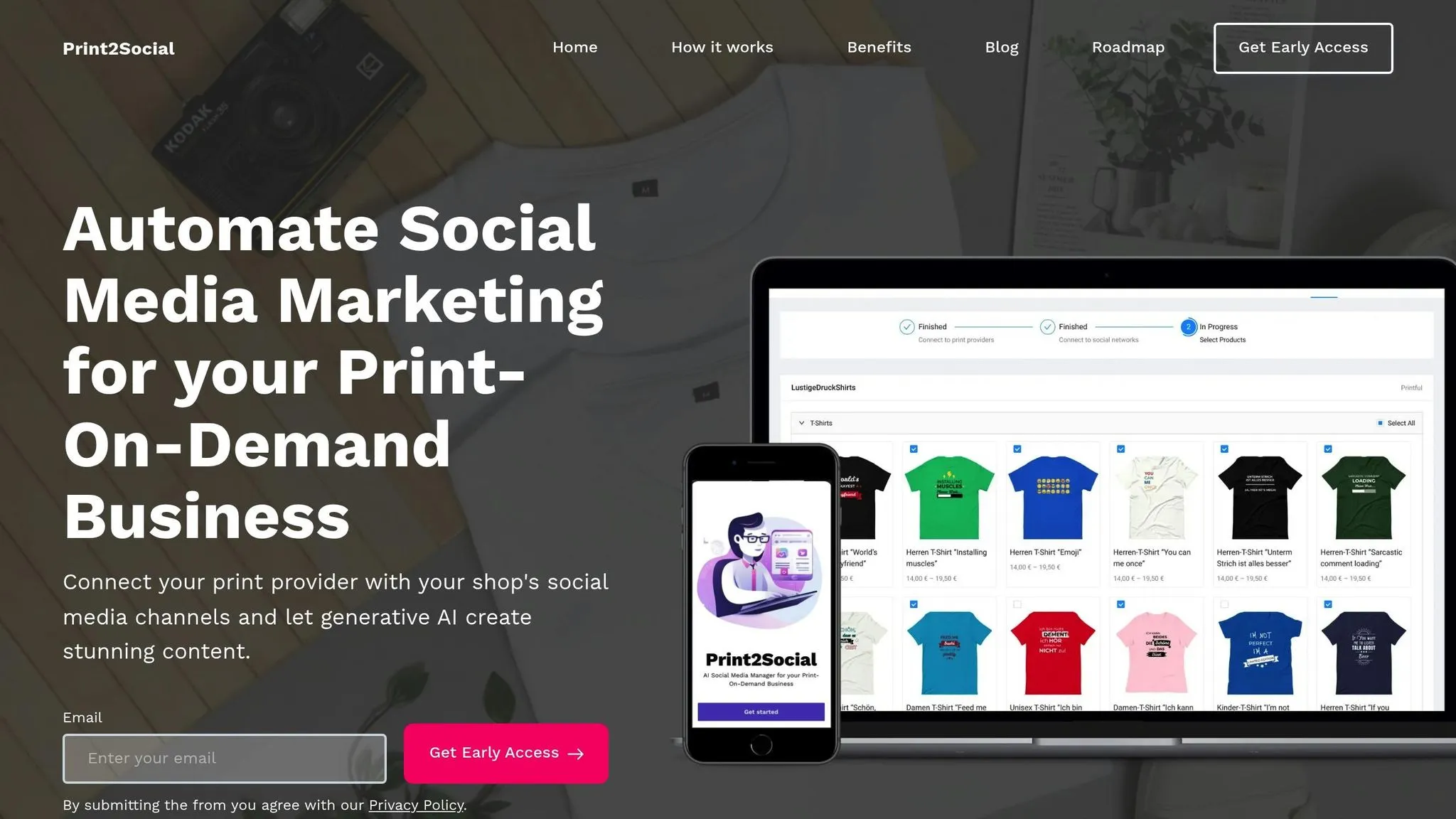
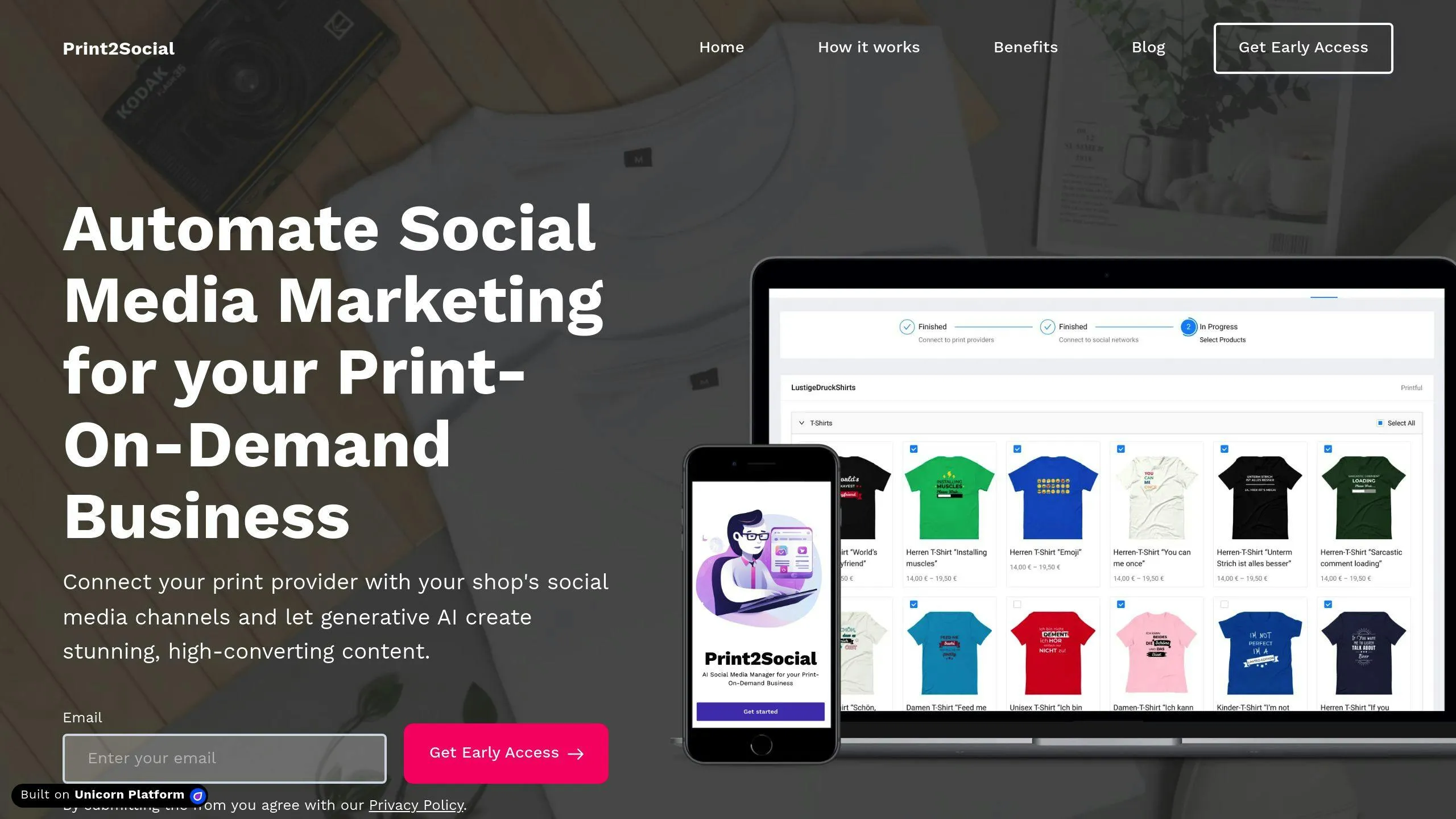
Print2Social is redefining how print-on-demand businesses handle social media marketing. Powered by AI-driven automation, this platform connects directly to POD providers and social media accounts, simplifying the entire promotional process. Here’s what it does: for every product, Print2Social generates 12 images, 8 video clips, and 20 posts.

This robust content creation ensures businesses maintain a steady social media presence while staying in step with current fashion and design trends. The generated content includes a mix of promotional, educational, and engagement-focused posts, keeping audiences engaged and interested.

But the benefits of AI don’t stop at marketing. It also plays a key role in refining production strategies.

When social media tasks are automated, businesses gain more time to focus on production planning. AI insights make this process more strategic and data-driven. Here’s how businesses can use AI to optimize their operations:

Planning Aspect

AI Implementation

Business Benefit

Inventory Forecasting

Trend prediction analysis

Minimize overstock risks

Design Prioritization

Engagement metrics tracking

Concentrate production on popular designs

Seasonal Planning

Historical data analysis

Allocate resources more effectively

Common Issues and Solutions in AI Trend Analysis

Section titled “Common Issues and Solutions in AI Trend Analysis”

Accurate trend predictions start with reliable data. To achieve this, businesses should:

  • Pull data from a variety of sources and keep it updated by cross-checking with trusted industry references.
  • Ensure data consistency by integrating pipelines from platforms like social media, e-commerce, and search analytics.
  • Confirm trends by systematically cross-referencing multiple data points.

For print-on-demand businesses, staying ahead of market shifts is vital. Tools like Print2Social’s AI-powered platform can help by:

  • Identifying spikes in keyword usage.
  • Tracking engagement within specific categories.
  • Spotting emerging style and color preferences.

Reacting quickly to these insights allows businesses to stay nimble and better prepared for ongoing market evaluations.

After adapting to market changes, it’s equally important to keep a close eye on performance to ensure AI predictions stay accurate. Effective strategies include:

  • Comparing predicted trends with actual outcomes, such as sales conversion rates and customer interactions.
  • Monitoring both short-term metrics (like daily sales changes) and long-term patterns (such as seasonal trends).
  • Leveraging real-time analytics to pinpoint areas for improvement and refine forecasting models.

Print2Social’s analytics dashboard consolidates these insights, offering real-time updates that help businesses fine-tune their strategies effectively.

As we’ve explored, AI isn’t just a buzzword - it’s a game-changer for businesses, especially in the fast-paced world of print-on-demand fashion. By tapping into AI-driven trend forecasting and automation, companies can make smarter decisions and operate more efficiently.

With automated platforms taking over repetitive tasks, business owners can shift their focus to big-picture strategies, like innovative designs and long-term planning. But AI’s role doesn’t stop at predicting trends. It also helps brands stay consistently active and relevant by managing diverse content creation with ease.

What makes AI truly impactful is its ability to scale operations without sacrificing quality. Whether you’re managing a handful of designs or an extensive catalog, AI ensures consistency and efficiency. To unlock its full potential, businesses should:

  • Automate Repetitive Tasks: Delegate tasks like content creation and scheduling to AI, freeing up time for creative and strategic efforts.
  • Use Data to Guide Decisions: Rely on AI-generated insights to shape design choices and marketing campaigns.
  • Maintain Brand Consistency: Let AI handle diverse content production while keeping your brand’s identity intact.

The future of the fashion industry will belong to those who embrace AI’s capabilities. By blending trend forecasting with automated marketing, businesses can set themselves up for lasting success in the ever-evolving market of 2025 and beyond.

Section titled “How does AI analyze social media data to forecast fashion trends for print-on-demand businesses?”

AI uses powerful algorithms to sift through massive amounts of social media data, such as trending hashtags, popular posts, and user engagement. By spotting patterns in colors, designs, and styles that are resonating online, it can accurately forecast upcoming fashion trends.

For print-on-demand businesses, this kind of insight is a game-changer. It allows you to stay ahead by designing products that align with what’s currently popular. Tools like Print2Social take it a step further by integrating these trends into your marketing content, helping you connect with your audience more effectively and boost sales.

How can AI tools like Print2Social improve marketing and planning for print-on-demand fashion businesses?

Section titled “How can AI tools like Print2Social improve marketing and planning for print-on-demand fashion businesses?”

AI-powered tools like Print2Social make marketing and production planning easier for print-on-demand fashion businesses by automating essential tasks. It connects directly with your fulfillment providers and social media accounts, simplifying the process of creating and scheduling promotional content.

Thanks to its generative AI features, Print2Social can produce high-quality images and short videos customized for your products. It can generate up to 20 unique social media posts per item, saving you time while keeping your branding consistent. Plus, it helps you stay on top of trends so you can focus on growing your business.

How can print-on-demand businesses trust AI trend predictions and quickly respond to market changes?

Section titled “How can print-on-demand businesses trust AI trend predictions and quickly respond to market changes?”

AI-powered trend predictions can be a game-changer when paired with a forward-thinking strategy. To get the most accurate insights, businesses should rely on AI tools that pull data from a variety of sources, like social media trends, customer behavior patterns, and industry reports. Keeping a close eye on these insights on a regular basis can help you anticipate and respond to new market demands.

Speed and adaptability are key. Prioritize flexibility in both your production processes and marketing strategies. For instance, tools like Print2Social make it easier to react to trends by automating the creation and scheduling of promotional content based on popular designs. By using AI tools effectively and staying informed, you can align your products and campaigns with shifting market trends and customer needs.

Ultimate Guide To Feedback-Driven Social Media Marketing

Want to improve your social media marketing? Start by listening to your customers. Feedback-driven strategies help you create better content, refine products, and connect with your audience. Here’s what this guide covers:

  • Why feedback matters: 71% of consumers recommend brands they enjoy on social media.
  • How to gather feedback: Use tools like Hootsuite or Sprout Social to track customer sentiment.
  • Turn feedback into action: Analyze comments, reviews, and user-generated content to improve your marketing.
  • Boost performance: Posts based on feedback see 85% higher sales growth.

Learn how to collect, analyze, and use customer feedback to strengthen your social media strategy.

How to Get Customer Feedback Online (6 Best Ways)

Section titled “How to Get Customer Feedback Online (6 Best Ways)”

Data highlights that 77% of consumers feel more positive about brands that actively seek and act on customer feedback. Here’s how you can effectively gather insights from your customers.

Using the right tools to track customer sentiment and engagement is essential. These platforms are particularly useful for print-on-demand businesses:

Tool

Key Features

Best For

Hootsuite

Multi-platform monitoring, unified inbox

General brand monitoring

Sprout Social

Sentiment analysis, trend tracking

Understanding customer insights

Mention

Real-time brand mention alerts

Quick response management

Talkwalker

Visual analytics, image recognition

Tracking product photos

For a tailored approach, check out Print2Social (https://print2social.com). Its AI-driven features are specifically designed for print-on-demand businesses.

A great example of effective monitoring comes from Printful. In 2022, they used Hootsuite to streamline their customer feedback process. This resulted in a 28% increase in positive sentiment, a 15% faster response time, and a 10% rise in repeat customers.

Next, let’s dive into how direct surveys and reviews can provide deeper insights.

Systematic feedback collection through surveys and reviews can provide valuable insights. Timing is key - send surveys 1–2 weeks after delivery to capture accurate impressions.

  • Use tools like Mailchimp to automate survey distribution.
  • Include both rating scales and open-ended questions for detailed feedback.
  • Offer incentives like discount codes to encourage honest responses.
  • Ensure reviews are collected across multiple platforms for broader visibility.

“96% of unhappy customers don’t complain directly to companies, but 91% of those will simply leave and never come back”.

In addition to surveys, photos and videos from customers can offer a richer understanding of their experience.

User-generated content (UGC) can significantly impact your business, with conversion rates increasing by 161% when UGC is included. Here’s how to encourage customers to share their content:

  • Create Branded Hashtag Campaigns
    Design easy-to-remember hashtags for customers to use when sharing their photos. Highlight these hashtags on packaging inserts and in post-purchase emails.
  • Run Photo Contests
    Organize contests where customers can win prizes like store credit or exclusive designs. This not only generates content but also fosters community engagement.
  • Leverage Packaging
    Include branded inserts with clear instructions on how to share photos or videos. Add hashtags or QR codes that link directly to your social platforms.

Making it easy for customers to share their experiences while offering them value in return is key. Real customer content often connects with audiences better than polished marketing materials, as it captures genuine experiences with your products.

Once you’ve collected customer feedback, the next step is figuring out how to turn it into actionable insights.

AI tools today can categorize comments with an impressive 97% accuracy. This helps businesses quickly spot sentiment trends and patterns. Here’s how these tools can help:

Analysis Type

Tool Features

Business Impact

Sentiment Analysis

Breaks feedback into positive, negative, and neutral categories

Tracks how customers feel about your brand

Topic Detection

Identifies recurring themes and keywords

Helps shape your content strategy

Trend Tracking

Monitors sentiment shifts in real-time

Allows quick responses to issues

For example, Print2Social users can rely on its AI to analyze feedback from multiple social platforms. This makes it easier to detect trends specifically tied to print-on-demand products. These insights can then guide the analysis of visual content.

Visual content shared by customers can be a goldmine. Studies show that 80% of consumers are more likely to buy from brands that feature customer photos or videos in their campaigns. A strong example is Sephora, which used visual recognition AI to analyze Instagram posts. The result? A 22% boost in conversion rates for the products they featured.

Key areas to analyze in customer-shared visuals include:

  • Product placement: How and where products are being used
  • Color schemes: Which colors resonate most with your audience
  • Environmental context: The settings or scenarios in which your products are used

By analyzing these factors, you can identify recurring themes and prioritize actions that align with your customers’ preferences.

Adidas showed the power of theme analysis in June 2023. By using AI to analyze 500,000 Instagram comments, they achieved a 28% increase in positive sentiment and a 12% rise in engagement rates.

“Companies that regularly analyze customer feedback themes see a 15-20% increase in customer satisfaction scores”.

To pinpoint and act on common themes:

  • Collect feedback from diverse sources like social media, reviews, and direct messages.
  • Use tools like text mining and topic modeling to uncover patterns.
  • Prioritize themes based on their frequency, sentiment intensity, and potential business impact.

This structured approach ensures you’re focusing on what matters most to your customers.

Posts shaped by customer feedback consistently outperform generic content, delivering 85% higher sales growth compared to competitors.

Print2Social simplifies the process of turning customer feedback into engaging social media posts. By focusing on what your audience values, you can produce content that truly resonates.

Content Type

Customer Feedback Source

Implementation Strategy

Product Showcases

Customer Reviews

Highlight top-rated product features

Educational Content

Common Questions

Answer frequently asked questions

Social Proof

User Photos/Videos

Share authentic customer experiences

Product Updates

Feature Requests

Announce updates inspired by user input

Take Airbnb’s 2022 Instagram strategy as an example. By showcasing user-generated content, they saw an 18% increase in engagement and a 25% rise in bookings from Instagram traffic within six months. These results underline the power of listening to your audience.

Retail brands typically see an average engagement rate of 0.68% on Instagram and 0.13% on Facebook. To surpass these numbers, experiment with your content:

  • Test posting times and frequency
  • Compare performance across formats (e.g., videos vs. images)
  • Evaluate responses to different calls-to-action
  • Track how features resonate with your audience

“Brands that engage and respond to customer service requests over social media see a 20-40% increase in customer spending”.

Use these insights to fine-tune your strategy and adapt quickly.

Once you’ve identified successful content formats, act fast to stay ahead. Quick adjustments ensure your posts remain relevant and engaging. For example, brands that respond to customer feedback within an hour experience 42% more customer advocacy.

Here’s how to make those updates:

  • Monitor engagement metrics in real time
  • Adjust posting schedules based on performance
  • Respond promptly to comments and messages
  • Scale up content that performs well

If a particular design or post generates strong positive feedback, Print2Social makes it easy to replicate and expand on that success.

“77% of consumers view brands more favorably when they actively seek and implement customer feedback”.

Measuring social media performance is essential for refining your marketing approach. Companies that incorporate social data into their strategies are 1.5 times more likely to see revenue growth.

For print-on-demand businesses, monitoring specific metrics can help gauge social media success. Here are some key ones to track:

Metric

Target Range

How to Calculate

Engagement Rate

1-5%

Total engagements ÷ followers × 100

Conversion Rate

2-5%

Conversions ÷ total visitors × 100

Customer Satisfaction

Over 80%

Average satisfaction score (1-10)

ROI

5:1 to 10:1

(Revenue - Cost) ÷ Cost × 100

Tools like Print2Social’s analytics dashboard simplify tracking these metrics, helping you spot trends and fine-tune your approach.

Breaking your audience into segments can lead to better results. Businesses that segment their customers see up to 10% higher profits compared to those that don’t. A great case study: In 2022, Warby Parker used advanced customer segmentation, boosting engagement rates by 22% and conversion rates by 15% within six months.

To better target your audience, consider these factors:

  • Engagement level: Measure how different groups interact with your posts.
  • Purchase history: Look for patterns in buying behavior.
  • Content preferences: Identify which types of posts perform well with specific groups.
  • Feedback sentiment: Group customers based on their responses and attitudes.

Using these insights, you can keep your strategy flexible and relevant.

Turning feedback and analytics into actionable steps is key.

“73% of marketers believe that their efforts through social media marketing have been ‘somewhat effective’ or ‘very effective’ for their business”.

To stay on top of your game:

  • Review metrics every month to spot trends.
  • Experiment with different content formats and posting schedules.
  • Refine your targeting based on how different segments perform.
  • Adapt your product offerings in response to customer input.

Advanced tools like IBM Watson’s Natural Language Understanding can help analyze sentiment, while Print2Social makes it easier to adjust strategies on the fly.

Using the insights you’ve gathered, here’s how to put feedback-driven social media marketing into action.

Feedback-driven social media marketing requires a structured approach to improve both engagement and customer satisfaction.

  1. Use Social Listening Tools
    Companies like Printful show how effective this can be. By using tools like Sprout Social to analyze customer interactions, they saw a 40% boost in user-generated content and a 22% rise in repeat purchases.
  2. Dive Into Customer Insights
    Focus on key areas such as:
    • Tracking sentiment across platforms
    • Spotting recurring feedback themes
    • Brainstorming product improvement ideas
    • Measuring content performance metrics
  3. Stick to an Implementation Timeline

Phase

Duration

Key Activities

Initial Setup

2–4 weeks

Set up monitoring tools and establish benchmarks

Data Collection

1–3 months

Gather feedback and monitor social interactions

Analysis & Planning

2–4 weeks

Review insights and craft a content strategy

Implementation

Ongoing

Roll out the strategy and track results

With these steps mapped out, the right tools can make the process seamless.

Automation tools like Print2Social are designed for businesses in the print-on-demand space.

Integration Setup

  • Sync your store and product catalog
  • Connect your social media accounts
  • Set up automated posting schedules

Content Optimization
Create content that reflects customer feedback. Build a feedback loop where insights shape your content and product updates:

  • Review content weekly based on engagement data
  • Evaluate performance monthly
  • Adjust your strategy every quarter

How to use social media for customer feedback and insights?

Section titled “How to use social media for customer feedback and insights?”

Combining technology with a personal touch is key to managing customer feedback on social media. Start by setting up social listening tools across all platforms. Since 67% of consumers turn to social media for customer service inquiries, responding quickly is critical for maintaining your brand’s reputation.

Once you’ve got social listening in place, organize your feedback process. Create a system where urgent issues are addressed immediately, general questions are answered within 24 hours, and positive feedback is acknowledged in a genuine way. Regularly review sentiment trends, and consider using AI tools to handle larger volumes of interactions efficiently.

Engaging with your audience is essential - 71% of consumers who enjoy a brand’s social media presence are more likely to recommend it. For print-on-demand businesses, this could mean using Instagram Stories polls to gather design feedback or encouraging customers to use branded hashtags to showcase their purchases. These actions ensure feedback directly shapes your social media approach.

Turn feedback into actionable improvements. For example, some brands have used customer input to boost sales.

“78% of consumers want brands to use social media to help them interact with each other”.

For print-on-demand businesses, tools like Print2Social can simplify feedback analysis and content creation. These tools help you spot trending designs and customer preferences while keeping your interactions authentic. Integrating feedback into your workflow strengthens the overall strategy outlined in this guide.

Merch by Amazon Automation

: Boost Your POD Business

Want to supercharge your Merch by Amazon business? Automation is the key. Here’s what you need to know:

  • What it is: Use tools to handle uploads, pricing, and marketing automatically
  • Why it matters: Save time, reduce errors, and scale your business effortlessly
  • Main areas to automate:
    1. Design creation
    2. Product listings
    3. Pricing adjustments
    4. Marketing
    5. Inventory management
    6. Performance analysis

Quick comparison of automation tools:

Tool

Function

Key Benefit

Merch Titans

Design upload

Multi-platform support

Merch Lister Pro

Product listings

2-click listing creation

Amazon Automate Pricing

Pricing

24/7 price updates

Print2Social

Marketing

Automated social media posts

Orderhive

Inventory

Real-time stock updates

Merch Analytics

Performance tracking

AI-powered insights

Automation can transform your Merch by Amazon business, but remember to keep your brand consistent and mix in human checks for quality control. Stay ahead by embracing AI tools, focusing on eco-friendly products, and personalizing your offerings.

Merch by Amazon

Automating Merch by Amazon can boost your efficiency and profits. Here are the key areas to focus on:

AI tools can create designs in bulk, saving you time. Merch Titans Automation lets you upload designs to multiple POD marketplaces at once, working on both Windows and Mac.

“It gave me all my time back. Uploading and writing went from hours per day to minutes… It’s made my life so much easier.” - Matt Carlett, MerchDesignFactory.com

Tools like Merch Lister Pro streamline the listing process. Create profiles to save Brand Name, Title, Price, Bullet Points, Description, and Color Selections. Fill in all info with just 2 clicks or a keyboard shortcut.

“HUGE TIMESAVER. I’m blown away by how much easier it makes uploading. It pays for itself every day.” - RJ Martinez, Merch by Amazon Mastermind

Use tools that change prices based on market conditions. Amazon’s Automate Pricing feature lets you set pricing rules that update 24/7.

Feature

Amazon Repricing Tool

Third-Party Pricing Tool

Cost

Free with pro selling plan

Often has extra fees

Features

Basic repricing

More advanced options

Reporting

Basic analytics

Usually more robust

Want to boost your Merch by Amazon sales without breaking a sweat? Let’s dive into marketing automation.

Print2Social

Print2Social is like having a personal assistant for your Merch by Amazon social media. It helps you:

  • Post across platforms on autopilot
  • Manage everything in one spot
  • Keep your brand message consistent

Set it up once, and watch your social presence thrive while you focus on designing.

Email marketing isn’t just powerful - it’s a money-making machine for Merch sellers. Here’s the scoop:

  • For every $1 you spend, you could make $36 back
  • It’s cheaper than most other marketing tactics
  • It builds lasting customer relationships

Ready to crush it with email? Here’s how:

  1. Add sign-up forms to your website
  2. Use customer data to make emails personal
  3. Always include a clear next step (CTA) in your emails

Check out this simple email game plan:

Email Type

What to Say

When to Send

Why It Works

Welcome

“Thanks for joining! Here’s 10% off”

Right after sign-up

Gets that first sale

New Stuff

“Fresh designs just dropped!”

Weekly

Shows off new merch

Cart Reminder

“Hey, you forgot something!”

1 hour after cart abandon

Saves lost sales

Set these up once, and you’ll keep customers coming back - no daily grind required.

Managing inventory for your Merch by Amazon business can be tricky. But with the right tools, you can keep your stock levels perfect without breaking a sweat.

Forget manually checking your inventory. Smart tools can do the work for you:

  • Orderhive: Real-time inventory updates across platforms. It’s like having a stock assistant.
  • Zoho Inventory: Works with major e-commerce sites. Great for managing Merch by Amazon stock alongside other platforms.

Pro Tip: Set up reorder points in your software. When stock hits that level, it’ll trigger a reorder. No more “out of stock” surprises!

Selling on multiple platforms? Keeping your inventory in sync is key. Here’s how:

Tool

Function

Key Benefit

Mintsoft

Manages stock, orders, shipping

Interactive warehouse map, automated label printing

TradeGecko (Quickbooks Commerce)

Real-time inventory updates

Prevents overselling, keeps stock accurate

These tools help you:

  • Avoid overselling
  • Keep stock levels accurate everywhere
  • Save time on updates

Tracking your Merch by Amazon business can be overwhelming. But automated performance analysis makes it a breeze.

Performance dashboards give you a quick overview of your business. Here’s how to set one up:

  1. Pick your metrics: Focus on sales, royalties, and product performance.
  2. Choose a tool: Many sellers use Merch Analytics.
  3. Connect your data: Link your Amazon account to your tool.
  4. Customize your view: Highlight what’s important to you.

“Check your dashboard weekly to spot trends and make quick adjustments.”

AI isn’t just futuristic tech. It’s your growth secret weapon. Here’s how:

AI Feature

What It Does

Pattern recognition

Finds sales trends

Predictive analysis

Suggests potential bestsellers

Pricing optimization

Finds the profit sweet spot

Here’s a real example:

A seller uploaded their CSV reports to Merch Analytics. The tool showed that 86% of their sales were t-shirts, with 65% being men’s items. This led them to focus on men’s t-shirt designs, boosting their sales.

Remember: AI is a tool, not a decision-maker. Use its insights to guide you, not rule you.

Automation can supercharge your Merch by Amazon business. Let’s look at how to use it for adding products and improving customer service.

Want to boost your catalog size and sales? Here’s how to automate product creation:

1. Use AI for design generation

AI tools can crank out unique designs fast:

These tools help you hit that sweet spot of 20-40 shirts per niche that top sellers swear by.

2. Automate product uploads

Tools like PrintJourney can make listing products a breeze:

  • Upload designs to multiple sales channels automatically
  • Keep product info synced across platforms

This saves you time and keeps things consistent as you grow.

3. Plan ahead with a content calendar

Map out key events and holidays for the year. Start designing and uploading shirts 3 months before each event. This way, you’ll:

  • Catch early sales
  • Get more eyeballs on your stuff with timely launches

Great customer service is a must for growth. Here’s how to automate it:

1. Use AI-powered chatbots

ChatGPT can handle common customer questions. This:

  • Cuts down response times
  • Frees you up for trickier issues

2. Set up automated email responses

Create templates for FAQs. This ensures:

  • Your messaging stays consistent
  • Customers get quick answers

3. Use tools for review management

Automate collecting and responding to customer reviews. This helps you:

  • Keep your brand image shiny
  • Spot areas where you can do better

Solving Problems in Merch by Amazon Automation

Section titled “Solving Problems in Merch by Amazon Automation”

Automating your Merch by Amazon business can be great, but it’s not all smooth sailing. Let’s tackle two big issues head-on.

Automation can make your brand look messy. Here’s how to fix that:

  1. Set up brand guidelines Write down your brand’s style rules. Think colors, fonts, and design must-haves.
  2. Use templates Create go-to designs and listing formats. It’ll keep everything looking the same.
  3. Regular audits Look over your stuff weekly. Catch any weird-looking items fast.

Automation saves time, but you can’t ditch the human touch. Here’s why:

In 2013, Solid Gold Bomb’s automated system created shirt slogans like “Keep Calm and Rape On”. Yikes. That’s what happens when no one’s watching the robots.

  1. Avoid policy violations Amazon’s rules are tough. Human eyes catch things machines miss.
  2. Two-step review process
    • Let computers catch basic stuff
    • Have humans look for tricky issues
  3. Use tools smartly The Merch Security Chrome extension flags iffy words. But don’t trust it 100% - always do a final human check.
  4. Watch out with AI designs AI tools like MidJourney are fast, but they might accidentally copy stuff. Always double-check what they make.
  5. Handle customer service right Auto-replies are handy, but get a real person on complex problems.

What’s Next for Merch by Amazon Automation

Section titled “What’s Next for Merch by Amazon Automation”

The print-on-demand world is changing fast. Here’s what’s coming to Merch by Amazon:

  1. AI-powered design tools

AI is shaking up design creation. Tools like MidJourney and DALL-E can whip up unique designs from text prompts. This means you can create more designs, faster.

  1. Smart inventory management

Amazon Business is rolling out new inventory control features. These tools track stock levels and reorder automatically. While it’s for Amazon Business now, similar tech could hit Merch by Amazon soon.

  1. Advanced marketing automation

AI is making marketing a breeze. ChatGPT and its cousins can help with product descriptions, ad copy, and marketing emails. Less time on marketing, more time on creating.

Want to stay ahead in Merch by Amazon? Try these:

  1. Jump into AI tools

Start playing with AI design tools now. They’re your ticket to cranking out more designs.

Tool

Monthly Cost

What It Does

MidJourney

$10 - $120

Makes AI images

DALL-E 3

$20 (with ChatGPT Plus)

Turns text into images

ChatGPT

Free - $20

Generates text, helps with marketing

  1. Go green

Customers love eco-friendly stuff. Think about using green materials and shouting about ethical production.

  1. Get personal

People dig unique items. Look into custom designs or limited editions.

  1. Streamline your work

Use tools like PODtomatic to automate uploads. It can post up to 200 products a day. Time is money, right?

  1. Keep your ear to the ground

Watch what Amazon Business is up to. Their new features might be a sneak peek at what’s coming for Merch by Amazon.

Merch by Amazon automation is a game-changer. It lets you focus on what really matters: great designs and business growth.

Here’s why it’s so important:

  • It saves time. You can automate uploads, listings, and pricing.
  • It boosts efficiency. Tools like PODtomatic can post up to 200 products a day.
  • It improves marketing. Print2Social automates social media and email campaigns.
  • It manages inventory better. Auto-monitoring prevents stockouts and overstocking.
  • It provides data insights. Automated dashboards help refine your strategy.

Amazon handles production, shipping, and customer service. You earn royalties (12% to 37%) without upfront costs.

To make the most of automation:

1. Use free tools like Merch Dominator for trend research.

2. Try AI-powered design tools to create more designs faster.

3. Use PPC automation tools like AiHello AutoPilot for 24/7 ad management.

4. Keep an eye on Amazon’s Best Sellers list for trends.

5. Sync Amazon sales with QuickBooks using PayTraQer for easier accounting.

AI Social Media Marketing for Print-on-Demand 2025

AI is revolutionizing print-on-demand (POD) social media marketing in 2025. Here’s what you need to know:

  • AI tools create designs and content faster
  • Smart targeting groups customers more effectively
  • AI chatbots handle most customer questions
  • AI manages social posts and tracks sentiment
  • AR/VR offer virtual try-ons and 3D product views

The POD market is booming, set to hit $9.9 billion by 2027. Businesses using AI see 20-30% more revenue on average.

Quick Comparison:

Feature

Without AI

With AI

Design Creation

Manual, time-consuming

Fast, automated

Customer Targeting

Broad, less effective

Precise, personalized

Customer Service

Human-dependent

24/7 AI support

Social Media Management

Time-intensive

Automated, consistent

Product Visualization

Static images

Interactive AR/VR

To succeed in 2025, POD businesses must embrace AI while keeping ethics in mind. The future of POD marketing is smart, interactive, and data-driven.

AI in social media marketing is your digital sidekick. It’s not just fancy tech - it’s a game-changer for print-on-demand businesses aiming to crush it in 2025.

Here’s the scoop: AI tools do the heavy lifting. They write posts, create images, and even pick the best times to share your content. But that’s just the start.

Let’s dive in:

1. Content Creation

AI doesn’t just throw random posts at the wall. It learns what clicks with your audience and crafts content that hits home. For example:

  • FeedHive’s AI Writing Assistant churns out posts from simple prompts. It’s your 24/7 content machine.
  • Jasper.ai keeps your brand voice consistent across platforms. No more Jekyll and Hyde vibes between networks.

2. Audience Targeting

AI is a pro at spotting your ideal customers. It sifts through data to find patterns humans might miss. Check this out:

  • AdCreative.ai helps businesses boost conversion rates by up to 14 times. How? By creating ads that speak directly to the right people.

3. Performance Prediction

Want to know how a post will perform before you hit publish? AI’s got you covered:

  • FeedHive’s AI predicts post performance. It’s like having a crystal ball for your social strategy.

4. Automation

AI handles the tedious tasks, freeing you up for big-picture thinking:

  • Buffer uses AI to auto-tailor your posts for each platform. No more manual tweaking for every network.

Here are the key players in the AI social media game:

Tool

Function

Why It Rocks

Natural Language Processing (NLP)

Decodes and analyzes text

Gauges brand sentiment

Predictive Analytics

Forecasts trends

Keeps you ahead of the curve

Computer Vision

Analyzes visuals

Creates more engaging content

These tools team up to make your social media marketing smarter, faster, and more effective.

Print-on-demand (POD) is set to explode by 2025. The numbers are impressive:

  • Global POD market: $9.9 billion by 2027
  • CAGR: 25.8% from 2023 to 2030
  • Projected market size: $59.3 billion by 2032

But it’s not just about growth. POD is changing the game for entrepreneurs and businesses.

Here’s what’s happening:

AI-Powered Personalization

AI is making custom product creation a breeze. Tools like MidJourney let you create unique designs in minutes. Then, you can fine-tune them in Canva or Photoshop.

The result? Products that customers can’t resist.

Sustainability Matters

By 2025, eco-friendly practices will be a must. POD businesses using renewable resources and ethical manufacturing will stand out.

Niche Markets Thrive

POD isn’t just t-shirts anymore. Niche markets are taking off:

  • Custom leggings (GearBunch)
  • Personalized maps (iLikeMaps)
  • Quirky wallpapers (Sharp Shirter)

The key? Find your unique angle.

Global Reach, Local Touch

E-commerce is going global. But success means thinking local. POD businesses need to tailor their designs and marketing for different cultures.

AI Streamlines Operations

AI isn’t just for design. It’s transforming the entire POD process:

AI Application

Benefit

Demand Forecasting

Cuts waste, saves money

Inventory Management

Automates restocking

Order Processing

Speeds up fulfillment

Customer Service

24/7 support with chatbots

The Challenges

It’s not all smooth sailing. POD in 2025 faces some hurdles:

  • Fierce competition (only 24% of POD merchants last 3+ years)
  • Need for constant innovation
  • Balancing automation with human touch

The Bottom Line

POD in 2025 is about using AI while staying human. It’s about creating products people love, not just churning out more stuff.

As Travis Ross says:

“The opportunities for using AI in print-on-demand are only limited by your own imagination.”

The future of POD is bright. But only for those who can keep up.

AI is shaking up print-on-demand (POD) businesses in 2025. Here’s how it’s speeding up design and content creation:

No design skills? No problem. AI tools are making it easy:

  • MidJourney: Create realistic images via Discord. Fast and unique.
  • DALL-E: Turn text into images. Bring your ideas to life.
  • Visme: Make pro designs quickly. Popular with POD sellers.

Quick comparison:

Tool

Best For

Starting Price

MidJourney

Realistic images

$10/month

DALL-E

Text-to-image

$20/month

Visme

Professional designs

Free plan available

Start with templates to save time and spark ideas.

Video is king in social media marketing. AI makes it simple:

  • Synthesia: Text to video with AI avatars. Used by Reuters and Amazon.
  • CapCut: Auto-captions and script generation. Great for short promos.
  • Descript: Edit videos using transcripts. Quick content cleanup.

Cost breakdown:

Tool

Features

Price

Synthesia

60+ video templates, 160+ AI avatars

From $22/month

CapCut

Auto-captions, script generation

Free, Pro at $9.99/month

Descript

Transcript-based editing

Free plan, paid from $12/month

“Synthesia let me create channels in English, Spanish and Portuguese. I never thought I’d have this before.” - Arturo V.

AI tools can help you create videos in multiple languages, expanding your global reach.

AI is shaking up how print-on-demand businesses find and connect with customers. Let’s dive into AI’s role in customer targeting for 2025.

AI now sorts customers into groups based on what they like, do, and buy. This helps businesses send the right messages to the right people.

Here’s the scoop on AI grouping:

  • It digs into past purchases, website visits, and social media activity
  • It spots patterns to group similar customers
  • These groups help businesses craft better marketing plans

Take Teikametrics. It uses AI to crunch sales data, showing which products are hot and helping businesses nail their pricing and marketing.

AI Tool

What It Does

How It Helps

Teikametrics

Crunches sales data

Spots top products, guides pricing

Printful AI

Forecasts demand

Keeps stock levels on point

ActiveCampaign AI

Groups customers

Personalizes marketing

These AI tools don’t just group customers. They also:

1. Predict Customer Wants

AI looks at past purchases to guess what customers might want next. This helps businesses suggest the right products at the right time.

2. Supercharge Ads

By knowing customer groups better, businesses can create ads that speak directly to what each group cares about. Result? More clicks and sales.

3. Uncover New Customers

AI can spot patterns that reveal who else might love a product, even if they’re new to the business.

“When customers feel a company gets them and knows what they need, they stick around and buy more.” - Senior Executive and Consultant

AI Features on Social Media for Print-on-Demand

Section titled “AI Features on Social Media for Print-on-Demand”

Social media platforms are upping their game for print-on-demand businesses in 2025. Facebook and Instagram are rolling out AI tools that make selling and customer service easier than ever.

AI is making it a breeze for customers to buy directly on social media. Here’s what’s new:

  • AI recommends products based on user preferences
  • Visual search finds similar items from a photo
  • AI chatbots help customers find and buy products

Real-world wins:

Brand

AI Tool

Result

H&M

Heyday Chatbot

Faster service, more online sales

Fresh (Beauty)

Meta’s Advantage+

5x return on ad spend, 42% more conversions

Meta is going all-in on AI for advertisers. They’re launching tools that can create entire ads—images, text, and all. This is huge for print-on-demand sellers without big design teams.

“The updated generative AI features will be available in Ads Manager through Advantage+ creative, optimizing ad campaign creation.” - Meta announcement

AI is making the whole social media experience smoother:

1. Customer Service: AI chatbots handle up to 75% of customer questions, working 24/7.

2. Content Creation: AI tools help draft captions, pick hashtags, and create images.

3. Smart Scheduling: Tools like Hootsuite use AI to optimize post timing.

The best part? This tech isn’t just for big players. Small print-on-demand shops can use these AI tools to compete with the giants.

As we look to 2025, these AI features are becoming must-haves for print-on-demand success on social media.

AI is shaking up social media for print-on-demand businesses in 2025. It’s not just about posting anymore - AI’s got its fingers in every pie, from timing to customer insights.

AI tools are making social media posting a snap:

  • SocialBee’s AI Copilot whips up entire campaigns in 5 minutes flat.
  • FeedHive automatically recycles your top posts, saving you time and boosting engagement.
  • Vista Social lets you juggle multiple social accounts from one spot.

Check out what these AI tools can do:

Tool

Cool Feature

Why It’s Awesome

SocialBee

AI Copilot

Builds campaigns in minutes

Pallyy

Visual calendar

Makes scheduling a breeze

FeedHive

Auto-reposting

More reach, less work

Vista Social

Multi-channel dashboard

One-stop-shop for all accounts

AI isn’t just a posting pro - it’s got ears too:

  • It tracks brand mentions across social media in real-time.
  • It can tell if people are singing your praises or throwing shade.
  • It sniffs out new trends in your industry.

Brand24 is a standout here. It not only tracks mentions but also does automatic sentiment analysis. You can quickly gauge the vibe around your print-on-demand products without drowning in comments.

“AI sentiment analysis is like having a finger on the pulse of your brand’s reputation.” - AI industry insight

For print-on-demand businesses, this is gold. You can:

  1. Spot product issues fast
  2. See which styles are hot
  3. Catch and fix customer service snags quickly

AI’s not just changing the game - it’s rewriting the rulebook for social media management in print-on-demand.

AI is shaking up print-on-demand businesses in 2025. But it’s not all fun and games. Here’s how to use AI responsibly in your social media marketing:

Data protection isn’t just nice to have - it’s a must. Here’s the deal:

  • Tell customers what data you’re collecting and why
  • Use top-notch security to keep hackers out
  • Don’t hoard data - delete it when you’re done

“Our digital economy has a big privacy problem.” - Marco Iansiti, Harvard Business School

To stay legal and keep customers happy:

1. Be open

Explain how AI helps you serve customers better. Put it in plain English on your website and social media.

2. Mix it up

Use diverse teams when building AI systems. It helps catch bias early.

3. Keep an eye on things

Test your AI regularly. Make sure it’s not making unfair choices.

4. Humans in the loop

Don’t let AI run wild. Have real people oversee important decisions.

“AI isn’t ready to fly solo yet.” - Arjun Narayan, SmartNews

5. Stay sharp

AI and privacy laws are changing fast. Keep learning and adapting.

By 2025, AI won’t just be creating content for print-on-demand businesses - it’ll be crucial for measuring success too. Here’s how AI helps track marketing results:

AI crunches data faster than humans ever could. It spots trends and gives insights to help businesses make smart choices.

Here’s what AI can do for your marketing metrics:

  1. Track engagement like a pro

AI goes beyond likes and shares:

  • Analyzes comment sentiment
  • Spots trending hashtags
  • Predicts top-performing posts

Hootsuite’s AI can predict post performance before you publish. This helps businesses fine-tune content for maximum impact.

  1. Link social media to sales

AI connects social media activity to actual sales, showing which campaigns really work.

Metric

Meaning

Importance

Conversion Rate

% of viewers who buy

Shows if posts lead to sales

Cost Per Lead

Money spent per potential customer

Helps budget marketing

Customer Lifetime Value

Total value a customer brings

Shows if you’re attracting the right buyers

  1. Spot trends early

AI scans millions of posts to find what’s hot. This helps businesses jump on trends before competitors.

“AI isn’t just about automation. It’s about prediction. By 2025, we expect AI to predict campaign ROI with 95% accuracy.” - CEO of INM Digital

  1. Personalize at scale

AI tailors content to individual users, boosting engagement and sales. By 2025, 80% of customer interactions will likely be AI-personalized. For print-on-demand, this could mean showing designs based on past likes and purchases.

  1. Automate reporting

AI tools create clear, visual reports in minutes. This frees up time to act on insights instead of just gathering data.

Remember: AI is a tool, not a replacement for human creativity. Use these insights to guide your strategy, but don’t let numbers control every decision. The best marketing still needs a human touch.

What’s Next for AI in Print-on-Demand Marketing

Section titled “What’s Next for AI in Print-on-Demand Marketing”

AI is set to shake up print-on-demand marketing by 2025. But the real kicker? AR and VR.

Here’s how AR and VR will flip the script on social media for print-on-demand:

1. Virtual Fitting Rooms

AR lets customers “try on” products before buying. Think:

  • T-shirts you can “wear” through your phone
  • Wall art that pops up on your actual walls
  • Custom mugs chilling on your kitchen counter

Result? Fewer returns, happier customers.

2. VR Shopping Experiences

VR will create immersive shopping worlds. Picture this:

  • 3D product galleries you can walk through
  • Real-time design customization
  • Chatting with other shoppers in virtual space

It’s like a product launch party, but in VR.

3. AR Social Filters

Remember Snapchat’s face filters? Now imagine:

  • “Wearing” your latest designs in posts
  • Custom artwork that comes to life
  • Shareable AR experiences tied to new products

It’s free marketing, courtesy of your customers.

4. Smart Personalization

AR and VR interactions = tons of data. This means:

  • Products tailored to individual tastes
  • Ads that hit the mark every time

5. Bridging Online and Offline

QR codes on products could unlock AR experiences:

  • T-shirt designs that animate when scanned
  • Business cards showcasing 3D portfolios
  • Posters that launch AR games

It’s like hiding Easter eggs in your products.

AR/VR Feature

POD Benefit

Virtual Try-On

Fewer returns, more confident buyers

VR Galleries

Next-level online shopping

AR Filters

Free social media buzz

Data Insights

Spot-on personalization

QR-AR Combo

Products that do tricks

The future of print-on-demand? It’s immersive, interactive, and AI-powered. Brands that jump on this tech train will leave the competition in the dust.

AI is changing the game for POD businesses on social media in 2025. Here’s what you need to know:

AI tools now help POD sellers create designs and content faster. This frees up time for strategy instead of getting bogged down in repetitive tasks.

Smart AI systems group customers more effectively, leading to targeted marketing and better sales.

AI chatbots handle most customer questions without human help. For example, Photobucket saw faster response times and happier customers after implementing AI.

AI also manages social media posts and tracks online customer sentiment, keeping your profiles active without constant babysitting.

But it’s not all roses. As AI grows, so does the need to use it responsibly. More countries are passing AI laws to keep things in check.

AR and VR are also shaking things up, offering virtual try-ons and 3D product views.

The POD market is booming, set to more than double by 2025. Businesses using AI are seeing 20-30% more revenue on average.

AI Feature

POD Benefit

Content Creation

Faster production

Customer Targeting

Focused marketing

Chatbots

Better service

Social Media Tools

Consistent presence

AR/VR

Interactive experiences

To win in 2025, POD businesses need to jump on the AI train while keeping ethics in mind. The future of POD marketing is smart, interactive, and data-driven. Adapt or get left behind.

It depends on what you need. Here are some solid options:

AI Tool

Good For

Cost

MidJourney

Lifelike images

$10-$120/month

DALL-E

Words to pictures

$20/month (unlimited)

Remove.bg

Zapping backgrounds

From $1.99/image

MidJourney? Clean interface, crazy-real images. DALL-E? Even newbies can turn text into pics. Remove.bg? Quick and easy background removal.

By 2025, AI in marketing will be all about:

1. Mapping customer journeys in real-time

2. Instant multi-channel insights

3. Beefed-up data privacy

AI will help marketers get the big picture on customer behavior, FAST. Result? Campaigns that hit the mark.

For POD businesses, this means:

  • Pinpointing the right customers
  • Product suggestions that feel tailor-made
  • Ads that actually work

Take Amazon. They’re already using AI to show you stuff based on what you’ve been eyeing. By 2025, this could be the norm for POD marketing.

AI Social Media Marketing for Print-on-Demand Sales 2024

AI is transforming social media marketing for print-on-demand businesses in 2024. Here’s what you need to know:

  • AI automates tasks, provides customer insights, and creates personalized content
  • It helps find target audiences and predict market trends
  • Key benefits include time savings and improved marketing effectiveness

AI Application

Benefit

Content creation

Generates posts, captions, and designs

Audience targeting

Identifies ideal customers

Chatbots

Provides 24/7 customer service

Market prediction

Spots trends and manages inventory

Ad optimization

Improves ad placement and pricing

To succeed with AI in print-on-demand:

  1. Choose the right AI tools for your needs
  2. Start small and gradually expand AI use
  3. Train your team on AI capabilities
  4. Monitor AI performance and adjust as needed
  5. Stay updated on new AI developments

By leveraging AI effectively, print-on-demand businesses can boost sales, save time, and stay ahead of competitors in the rapidly growing market.

AI in social media marketing uses computer programs to help businesses do marketing tasks better and faster. These programs can learn, solve problems, and make choices like humans do.

AI helps machines do tasks that usually need human smarts. For social media marketing, AI can:

  • Look at lots of information
  • Find patterns
  • Guess what users might do next

This helps businesses make better marketing plans.

AI makes social media marketing different in many ways. Here’s what it can do:

AI Capability

Benefit for Marketers

Task automation

Save time on routine work

Data analysis

Understand customers better

Content creation

Make posts that fit each user

Customer service

Use chatbots to answer questions

Trend prediction

Spot new market opportunities

With these tools, businesses can run better marketing campaigns that reach the right people and get better results.

The print-on-demand industry is growing fast. In 2024, it’s expected to be worth $6.25 billion. From 2023 to 2032, it might grow by 25.6% each year. This growth is happening because:

  • More people want custom-made products
  • Online shopping is becoming more popular
  • Digital printing is getting better

New trends in print-on-demand include:

Trend

Description

AI-made designs

Using computers to create new product designs

Selling on many platforms

Offering products on different websites and apps

Using data for marketing

Looking at customer information to make better ads

Going green

Using materials that are better for the environment

Print-on-demand businesses face some challenges:

  1. Too many competitors
  2. Always needing new ideas
  3. Keeping customers interested

To deal with these issues, businesses can:

Problem

Solution

High competition

Use AI to work faster and smarter

Need for new ideas

Look at customer data to make better products

Standing out

Build a strong brand and give great customer service

Businesses can also try selling new types of products like:

  • Custom home decorations
  • Pet items
  • Sports clothes

AI Social Media Tactics for Print-on-Demand

Section titled “AI Social Media Tactics for Print-on-Demand”

Here are some ways AI can help print-on-demand businesses with social media marketing.

AI tools can help make social media posts faster and better. They can:

  • Create designs for posts
  • Write captions and product descriptions
  • Find popular topics and hashtags

This saves time and keeps your brand’s look and voice the same across posts.

AI can help you find the right customers by:

  • Looking at customer data
  • Spotting patterns in what people like and do
  • Helping make ads for specific groups of people

This can help you reach new customers and sell more.

AI Audience Targeting Benefits

Find ideal customers

Create custom ads

Reach new market segments

AI chatbots can help customers all day, every day. They can:

  • Answer questions quickly
  • Solve simple problems
  • Give a personal touch to customer service

This makes customers happier and can save you money on support staff.

AI can help you plan better by:

  • Spotting market trends
  • Helping manage inventory
  • Finding new product ideas

This can help you avoid having too much or too little stock and stay ahead of what customers want.

AI can make your ads work better by:

  • Choosing where to show ads
  • Picking the right people to see ads
  • Changing prices based on demand

AI Ad Improvement Areas

Ad placement

Target audience

Dynamic pricing

This can help you get more sales from your ad spending.

AI tools can help print-on-demand businesses do better on social media. These tools can make work easier and help sell more products. Here are some useful AI tools for social media marketing in print-on-demand:

AI writing tools help make good content quickly. They can write:

  • Product descriptions
  • Social media posts
  • Blog articles

Some popular AI writing tools are:

Tool Name

What It Does

Jasper

Writes various types of content

WordLift

Helps with SEO writing

Content Blossom

Creates blog posts and articles

These tools save time and keep your brand’s voice the same in all posts.

These tools help plan and check social media posts. They can:

  • Schedule posts
  • Look at how well posts do
  • Find trends

Some good AI social media managers are:

Tool Name

Main Features

Hootsuite

Manages multiple social accounts

Buffer

Schedules and analyzes posts

Sprout Social

Provides detailed reports

These tools help make your social media work better.

AI design tools help make good-looking designs for products. They can:

  • Make mockups
  • Edit pictures
  • Create new designs

Here are some useful AI design tools:

Tool Name

What It’s Good For

Midjourney

Creating unique images

Adobe Sensei

Editing and enhancing photos

Printful’s Image Upscaler

Making images bigger and clearer

These tools help make nice designs quickly, even if you’re not a design expert.

Here’s how to start using AI in your marketing:

  1. Check your current plan: Look at how you market now and find where AI can help.
  2. Pick the right AI tools: Choose tools that fit what you want to do. Look for ones that help make content, find customers, and guess what will sell.
  3. Teach your AI: Give your AI tools information about your brand so they can work the way you want.
  4. Watch and fix: Keep an eye on how your AI tools are doing and make changes if needed.

To use AI well in your print-on-demand business:

Tip

What to Do

Start small

Use one or two AI tools at first, then add more later

Train your team

Make sure everyone knows how to use the AI tools

Check AI work

Look at how the AI is doing and fix any problems

Keep learning

Stay up to date with new AI tools and ideas

These tips will help you use AI to make your marketing better without getting overwhelmed.

When using AI for social media marketing in print-on-demand, it’s key to track how well it’s working. Here are some numbers to keep an eye on:

Metric

What It Means

Conversion rates

How many people buy or sign up

Return on Ad Spend (ROAS)

Money made for each dollar spent on ads

Customer Acquisition Cost (CAC)

How much it costs to get a new customer

Customer Lifetime Value (CLV)

How much a customer spends over time

Engagement rates

How many people like, share, or comment on posts

AI can help you understand your marketing better. Here’s how:

1. Guessing what customers will do: AI looks at past data to help you plan for the future.

2. Checking what customers think: AI can read comments and reviews to see if people like your products.

3. Finding groups of customers: AI can sort customers into groups based on what they like and do. This helps you make better ads for each group.

AI Data Use

How It Helps

Future guessing

Plan ahead for marketing

Customer feelings

Improve products and service

Customer groups

Make better, more targeted ads

Using AI for social media marketing in print-on-demand sales in 2024 means thinking about what’s right and keeping people’s information safe. As AI gets better, we need to make sure we use it in ways that respect people’s privacy and follow the rules about data protection.

When using AI in marketing, we need to be careful about:

  • Getting permission before collecting people’s data
  • Being clear about how we use and keep data
  • Making sure AI doesn’t treat some groups unfairly

To use AI the right way:

  1. Ask people if it’s okay to use their data
  2. Tell people how you’ll use their information
  3. Check that AI treats everyone fairly

It’s very important to protect the information we collect from customers. Here’s what marketers need to do:

What to Do

Why It’s Important

Follow data protection rules

To respect people’s rights

Get permission to use data

To be fair and legal

Let people see and change their data

To give control to customers

Keep data safe from hackers

To protect customer information

To keep data safe, marketers should:

  • Use strong passwords
  • Encrypt data (make it hard to read)
  • Update computer systems regularly

The print-on-demand industry keeps changing, and AI is helping shape its future. As AI gets better, we’ll see more new ways to use it in this business.

New AI tools are coming that will change print-on-demand marketing:

AI Technology

What It Does

Generative Adversarial Networks (GANs)

Makes very real-looking designs for more personal products

Natural Language Processing (NLP)

Helps chatbots understand and answer customers better

Computer Vision

Looks at what customers like and suggests designs

These tools can help make new designs faster and easier.

To keep up with new AI, print-on-demand businesses should:

  • Keep learning about new AI tools
  • Train workers to use AI well
  • Try out new AI tools
  • Use AI to make customers happier

By doing these things, businesses can stay ahead and do better than others.

How to Prepare

Why It Helps

Learn about new AI

Helps you know what’s coming

Train workers

Makes sure everyone can use new tools

Try new AI tools

Lets you find what works best

Focus on customers

Makes people want to buy from you again

As AI keeps changing, businesses that use it well will do better in print-on-demand.

AI is changing how print-on-demand businesses do social media marketing in 2024. It helps companies work better, make customers happier, and sell more products. AI can do many things, from making content to guessing what will sell well.

AI is not just a tool, but a helper that can make businesses do better than others. By using AI, print-on-demand companies can find new ways to grow and work faster.

Here’s what AI can do for print-on-demand businesses:

AI Capability

Benefit

Make content

Create posts and product descriptions quickly

Find customers

Pick the right people to show ads to

Guess trends

Help plan what products to make

Answer questions

Use chatbots to help customers all day

To do well with AI in print-on-demand, businesses should:

  • Keep learning about new AI tools
  • Teach workers how to use AI
  • Try out different AI tools
  • Use AI to make customers happy

As AI keeps getting better, it will be a big part of how print-on-demand businesses work. Companies that use AI well will do better than those that don’t.

How can AI be used in social media marketing?

Section titled “How can AI be used in social media marketing?”

AI helps businesses do better on social media in several ways:

AI Use

What It Does

Content creation

Makes posts and ads

Social listening

Checks what people say about your brand

Ad targeting

Finds the right people to show ads to

Customer support

Uses chatbots to answer questions all day

Data analysis

Looks at how well your posts are doing

AI tools can:

  • Look at how customers talk to your brand
  • Help you make better social media plans
  • Make your work faster and easier

By using AI, businesses can:

  • Make better posts that people like
  • Find new customers
  • Keep current customers happy
  • Save time on everyday tasks

AI is changing how businesses use social media to sell more products.