Skip to content

guide

8 posts with the tag “guide”

Print On Demand in 2025: Practical Guide & Tactics

The world of print-on-demand (POD) has undergone significant transformations in recent years. What was once an easy-to-enter, low-competition model has evolved into a more nuanced and competitive arena. However, this evolution has also brought new opportunities for savvy entrepreneurs willing to embrace technology, creativity, and innovative approaches. In this article, we’ll explore the current state of POD in 2025 and offer actionable strategies to help small and medium-sized business owners thrive in this dynamic industry.

Is Print-on-Demand Still Worth It in 2025?

Section titled “Is Print-on-Demand Still Worth It in 2025?”

One of the most common questions among entrepreneurs considering POD is whether it is still a viable and profitable business model. The answer is both “yes” and “it depends.” The notion that POD is oversaturated often deters newcomers, but the reality is more complex. While certain niches and products - like custom dog mugs or generic t-shirts - are indeed saturated, untapped opportunities still exist for those who are willing to think outside the box.

Artificial intelligence (AI) has revolutionized the way entrepreneurs can identify and capitalize on unsaturated markets. Tools like ChatGPT can help generate fresh ideas for clever designs, slogans, or niche products that cater to specific audiences. For example, leveraging AI to brainstorm witty gardening-themed t-shirt slogans can uncover opportunities that might otherwise go unnoticed. Combine this with tools like Canva and AI-generated art, and the process of designing and testing new concepts becomes faster and more accessible than ever before.

The key takeaway? Avoid the temptation to copy popular, overdone designs. Instead, use AI to explore unique angles and underserved niches. In today’s POD landscape, creativity and originality are your greatest assets.

Profit Margins: Physical Products vs. Digital Products

Section titled “Profit Margins: Physical Products vs. Digital Products”

A recurring debate in the e-commerce world is whether POD is worth pursuing when compared to selling digital products, which boast higher profit margins. Let’s break down the math:

  • Print-on-Demand Margins: For example, a Bella Canvas 3001 t-shirt might cost $9.13 through a provider like Printify (with a premium account). Depending on the selling price (e.g., $18–$23), the profit margin can range from 27% to 49%. These margins are competitive when compared to traditional physical product businesses, which often have much lower profitability.
  • Digital Product Margins: Digital products, such as design bundles or e-books, can achieve margins of 70–90% since they incur minimal production or shipping costs. However, physical POD products are often perceived to have higher value due to their tangible nature, allowing for higher price points overall.

Ultimately, there’s no need to choose between the two. Many entrepreneurs find success by offering both physical and digital products in their online stores, creating a diversified income stream.

Marketing POD in 2025: Do You Need Paid Ads?

Section titled “Marketing POD in 2025: Do You Need Paid Ads?”

One of the most persistent myths about POD is that paid advertising is required to drive traffic and generate sales. While ads can indeed be a powerful tool, they are far from the only option. In fact, many successful POD businesses thrive using low-cost or free marketing strategies that leverage organic traffic.

  1. Instagram Reels and TikTok Videos: Short video content can go viral and drive significant traffic to your store. For example, a store selling car stickers might film short clips showcasing their products being applied to vehicles.
  2. Content Marketing: Creating meme-style posts or carousel image slides related to your niche can generate engagement and build a loyal audience. For instance, stores targeting accountants or gardeners can share humorous, relatable content that resonates with their target market.
  3. Search Engine Optimization (SEO): Optimizing your Etsy or Shopify store for search engines can result in long-term, passive traffic. Ranking for niche-specific keywords like “funny gardening t-shirts” can help your store appear on the first page of search results, driving organic sales.

Free and low-cost strategies require more time and effort than paid ads, but the long-term benefits - such as a loyal customer base and consistent website traffic - often outweigh the upfront investment.

Time Management and Product Quality: Minimizing Operational Stress

Section titled “Time Management and Product Quality: Minimizing Operational Stress”

One critique of POD is that it isn’t as passive as initially advertised. Many store owners find that managing customer inquiries, complaints, and returns can be time-consuming. However, much of this stress can be minimized by focusing on two key areas: product quality and operational efficiency.

The quality of your POD products can vary significantly depending on the print provider you choose. For example, a previous comparison of providers revealed that while Monster Digital produced vibrant, high-quality prints, other providers like Fulfill Engine struggled with consistency. Ordering samples of your designs before launching them in your store is a crucial step to ensure customer satisfaction and reduce the number of complaints.

Even with quality assurance, customer inquiries are inevitable. The good news is that automating parts of your support process can save time. For instance:

  • Use FAQ sections to address common questions.
  • Implement autoresponders for email inquiries.
  • Focus on clear communication during the order process (e.g., shipping timelines) to reduce confusion.

By prioritizing quality and efficiency, you can turn your POD store into a business that requires minimal daily oversight.

  • Innovation is essential: Avoid saturated markets and use tools like AI to discover unique niches and create compelling designs.
  • Maximize profitability: While physical products have lower margins than digital ones, they can still generate higher profits per sale due to perceived value.
  • Marketing doesn’t have to break the bank: Leverage free and low-cost strategies such as Instagram Reels, TikTok videos, memes, and SEO to generate organic traffic.
  • Quality matters: Choose your print providers carefully and invest in quality control to ensure customer satisfaction.
  • Time management is key: Automate processes wherever possible and create systems to handle customer inquiries efficiently.

The print-on-demand industry in 2025 is far from dead. Instead, it offers a wealth of opportunities for entrepreneurs who are willing to adapt, innovate, and embrace modern tools and strategies. By focusing on niche markets, leveraging AI for creative ideation, and utilizing cost-effective marketing methods, you can build a thriving POD business.

The future of POD may not look like the past, but for business owners ready to evolve with the times, the potential for success has never been greater. Start exploring new possibilities, and let your creativity pave the way to sustainable growth in the digital age.

Source: “Is Print On Demand Still Worth It In 2025?” - Wholesale Ted, YouTube, Aug 19, 2025 - https://www.youtube.com/watch?v=3lx4sXDvmoU

Use: Embedded for reference. Brief quotes used for commentary/review.

How to Scale Print-on-Demand with Meta Ads

Running a print-on-demand (POD) business is an exciting journey, but scaling it to generate consistent and significant profits can be a challenge. For small to medium-sized business owners and entrepreneurs in the POD industry, one of the most powerful tools at your disposal is advertising - specifically, Meta Ads on Facebook and Instagram. These platforms, with their billions of daily users and advanced targeting capabilities, can be the catalyst that takes your business to the next level.

In this article, we’ll break down the essentials of Meta Ads, why they matter, when to use them, and how to implement a proven system for scaling your business efficiently. By the end, you’ll have a clear understanding of how to integrate Meta Ads into your marketing strategy to amplify sales while minimizing risk.

Why Meta Ads Are a Game-Changer for Print-on-Demand Businesses

Section titled “Why Meta Ads Are a Game-Changer for Print-on-Demand Businesses”

In the print-on-demand sector, Meta Ads - advertisements on Facebook and Instagram - are not merely a tool for visibility. They serve as amplifiers for your sales efforts, helping you showcase your best products to the right audience at the right time.

Meta Ads excel in their ability to target users with precision. With over 3 billion daily users across Facebook and Instagram, these platforms offer:

  • Unparalleled Reach: Ads can reach over 68% of Americans aged 13 and older.
  • Advanced AI Optimization: Meta’s AI ensures ads are served to the users most likely to engage or convert.
  • Engagement-Driven Strategy: Ads don’t just generate sales - they also build brand awareness, social proof, and email lists that can benefit your business in the long term.

The Core Purpose of Meta Ads: Amplification

Section titled “The Core Purpose of Meta Ads: Amplification”

The keyword here is amplify. Meta Ads don’t magically create demand for an unappealing product. Instead, they help you scale proven products - those that already show promise within your niche. Here’s an example:

  • A POD entrepreneur launched a mass-appeal product shortly after joining a training program. With Meta Ads, they achieved $35,000 in sales in six weeks and surpassed $200,000 within a year.

This rapid growth wouldn’t have been possible without a winning product and the amplifying effect of Meta Ads.

Timing is crucial when it comes to using Meta Ads effectively. Here are the three main scenarios in which ads can deliver the most value:

Before allocating a substantial budget, use small-scale ads to determine whether a new product has mass appeal. Think of this as a trial run; it’s a controlled way to minimize risk.

Once you’ve identified a product that resonates with your audience, ads allow you to exponentially increase its visibility. This is where the real growth happens, as scaling a proven product often results in significant sales.

Promotional ads can boost sales on already successful products during key sales periods like holidays or seasonal campaigns. However, promotional success largely depends on the product’s existing appeal.

The Six-Figure Sales System: A Proven Strategy for Scaling with Meta Ads

Section titled “The Six-Figure Sales System: A Proven Strategy for Scaling with Meta Ads”

To make the most of Meta Ads, you need a reliable, repeatable system. Enter the Six-Figure Sales System, a three-step process designed to reduce risk, improve results, and maximize profitability.

Begin by leveraging organic marketing channels like social media and email to gauge interest in your products:

  • Social Media Posts: Share new designs with your followers to measure engagement (e.g., likes, comments, or shares).
  • Email Campaigns: Send “New Arrivals” emails to your subscriber list. High click-through rates can indicate interest.

Once you spot a product with high engagement or initial sales, you’ve identified a potential winner.

This phase involves running low-budget ad campaigns - typically between $10 to $25 per day - to test the performance of your product with a broader audience. Run the ad for three days and monitor key metrics such as:

  • Cost per purchase
  • Return on ad spend (ROAS)
  • Engagement rates

If the ad generates profitable results, it’s time to move to the next step.

For successful test campaigns, increase the budget incrementally every three days while closely monitoring performance. This controlled scaling approach ensures you maximize profits without overspending.

At the heart of any successful Meta Ads campaign is a winning design - a product that resonates deeply with your target audience. Without this, even the most well-optimized ad campaigns will struggle to generate sales. Here’s how to identify a winning design:

  • It evokes emotion, relatability, or humor.
  • It appeals to a specific niche with a strong sense of identity.
  • It generates disproportionate engagement during the “Identify” phase.

Meta Ads are not a magic wand - they amplify the appeal of a product that already performs well organically. This is why steps like social media validation and small-scale tests are critical.

Common Misconceptions About Ads (and How to Overcome Them)

Section titled “Common Misconceptions About Ads (and How to Overcome Them)”

Myth 1: Ads guarantee instant success.

  • Reality: Ads amplify what already works. Without a desirable product, they’ll likely fail.

Myth 2: Ads are expensive and risky.

  • Reality: By starting with low budgets and following a system, you can minimize risk and only scale profitable campaigns.

Myth 3: You need a huge ad budget to see results.

  • Reality: Many POD entrepreneurs achieve significant results with small budgets by focusing on products with proven appeal.
  • Meta Ads are amplifiers, not magic solutions: They work best when paired with products that already have mass appeal.
  • Timing is essential: Use ads to test, scale, or promote winning products - not as a first resort.
  • The Six-Figure Sales System reduces risk: Identify, test, and scale products systematically to enhance profitability.
  • Winning designs are non-negotiable: Products must resonate with your audience to succeed.
  • Start small and scale strategically: Low-budget testing allows you to validate products before scaling up.
  • Think long-term: Ads not only drive sales but also help build your email list, social proof, and overall brand presence.

Scaling your print-on-demand business with Meta Ads isn’t about luck - it’s about strategy. By following a proven system like the Six-Figure Sales System, you can test products efficiently, amplify their reach, and achieve exponential growth. Ads allow you to move beyond the limitations of organic marketing and tap into a virtually limitless audience, but only if they’re done thoughtfully and strategically.

Remember, the key to success isn’t just running ads - it’s running the right ads to the right people for the right products. Take a calculated, system-based approach, and you’ll be well on your way to making Meta Ads a cornerstone of your POD success story.

Source: “The Beginner’s Guide To Print on Demand Paid Ads | #019” - Print On Demand Podcast, YouTube, Aug 15, 2025 - https://www.youtube.com/watch?v=HSTkiOpRfqg

Use: Embedded for reference. Brief quotes used for commentary/review.

Ultimate Guide to A/B Testing for POD Social Media

A/B testing helps you figure out what works best for your Print-on-Demand (POD) social media campaigns. By comparing two versions of content - like product images, captions, or posting times - you can use data to improve engagement, clicks, and sales. Here’s what you need to know:

  • What to Test: Experiment with visuals (images vs. videos), captions (headlines, CTAs), hashtags, and posting times.
  • How to Test: Change one element at a time, split your audience evenly, and run tests simultaneously to avoid skewed results.
  • Key Metrics: Focus on conversion rates, click-through rates, and cost per acquisition to measure success.
  • Tools: Platforms like Print2Social simplify testing by automating content creation, scheduling, and performance tracking.

Start small - test a single element like lifestyle vs. product-only images - and build on what works. Use results to refine your strategy for better outcomes over time.

How to Do A/B Testing: 15 Steps for the Perfect Split Test

Section titled “How to Do A/B Testing: 15 Steps for the Perfect Split Test”

What to Test in POD Social Media Campaigns

Section titled “What to Test in POD Social Media Campaigns”

In A/B testing for Print-on-Demand (POD) social media campaigns, you’ll want to pinpoint the elements that truly drive engagement and conversions - like visual formats, ad copy, hashtags, and posting times. The goal? Find what stops people mid-scroll, gets them to click, and ultimately leads them to make a purchase. By carefully testing and refining these elements, you can improve campaign performance and achieve better outcomes.

Visuals are the backbone of any social media campaign, so testing different formats - static images, videos, and carousels - can reveal what resonates most with your audience. To get accurate results, keep all other variables constant and only change the format. For instance:

  • Images: Use high-quality product mockups. Test lifestyle shots against clean studio setups, try different angles, and consider adding overlays that highlight product details like size or fit.
  • Videos: Create short clips (15–30 seconds) that showcase your product in motion or in a lifestyle setting. Experiment with different openings - show the product in action, highlight the design process, or feature a customer using it.

The first three seconds of a video are critical for grabbing attention. Test different thumbnails, pacing, captions, and call-to-action (CTA) placements to see what keeps viewers watching. Key metrics to track include engagement rates, click-through rates, conversions, watch time, and completion rates.

Your ad copy can make or break your campaign. Focus on testing one variable at a time to see what drives action. For example:

  • Headlines: Compare a benefit-driven headline (e.g., Ultra-Soft Cotton That Lasts) with a curiosity-driven one (e.g., The T-Shirt Everyone’s Talking About).
  • Value Propositions: Test whether emphasizing material quality (“Premium Cotton Blend”) or design uniqueness (“Stand-Out Graphics”) performs better.
  • CTAs: Try direct CTAs like “Buy Now” or “Limited-Time Deal” against softer options like “See Styles” or “Browse Designs.” For POD products, customization-focused CTAs like “Make It Your Own” can be particularly effective. Urgency cues like “Ends Tonight” or scarcity messages such as “Only a Few Left” can also boost conversions.

Social proof can play a role too. Compare captions that include snippets of customer reviews with those that don’t. Sometimes a straightforward message outshines one that relies heavily on testimonials. Keep an eye on metrics like click-through and conversion rates to ensure that increased engagement translates into actual sales.

Hashtags and timing might seem like small details, but they can significantly impact your campaign’s reach and engagement.

  • Hashtags: Test different strategies by creating two sets - one narrow and niche-focused (e.g., #HalloweenTee, #SpookyVibes) and another broader (e.g., #Halloween2025, #FallFashion). Use identical content for both sets to measure the trade-off between discoverability and relevance. Track metrics like reach, impressions, and engagement to see which set performs better.
  • Posting Times: Timing matters just as much. Test different time slots based on when your U.S. audience is most active. For example, compare lunch breaks (12:00–1:00 PM) with evening hours (7:00–9:00 PM). Stick to U.S. time zones - like 2:00 PM PT or 5:00 PM ET - and rotate posting days evenly to avoid skewed results. Metrics like reach, engagement, and conversions will help you pinpoint the best times to post.

The beauty of testing hashtags and timing is that these adjustments are quick and easy to implement. Unlike creative tests that require new assets, you can tweak these elements in real-time once you identify winning patterns. Keep in mind that seasonality also plays a big role - what works during back-to-school season might not have the same impact during the holidays. Planning your testing schedule around major selling periods ensures your campaigns stay relevant and effective.

How to Set Up A/B Tests for POD Social Media

Section titled “How to Set Up A/B Tests for POD Social Media”

Running effective A/B tests requires a solid plan and reliable data. The key is to start with clearly defined parameters and ensure your results are actionable. This way, your efforts can directly inform your Print-on-Demand (POD) marketing strategies. Let’s break it down.

Before diving into test creation, it’s crucial to define your goals. What do you want to achieve? For POD businesses, common objectives include increasing click-through rates to product pages, improving conversion rates from social media traffic, boosting engagement rates to expand organic reach, or lowering cost per acquisition for paid campaigns.

Once your goal is clear, choose metrics that align with it. For instance:

  • If driving sales is your focus, track conversion rates and revenue per visitor.
  • If building brand awareness is the priority, monitor reach, impressions, and engagement rates.

Stick to one primary metric and a few secondary ones to keep your analysis focused. Also, establish a minimum sample size before you begin. For social media campaigns, aim for at least 100 conversions per variant to ensure statistical reliability. If your conversion rate is 2%, this means each variant will need around 5,000 visitors - so plan for a testing period of 1–2 weeks, depending on your traffic levels.

Don’t forget to set your confidence level - 95% is the standard for most business decisions. This ensures you can trust your results aren’t just random. Additionally, decide on your minimum detectable effect. For example, if a 10% improvement in conversion rates would make a meaningful difference for your business, design your test to detect changes of that size.

The success of your A/B test depends on how you create and manage your test variants. Start by establishing a control, which is your best-performing content. This will serve as the baseline for comparison.

When crafting your test variant, change only one element at a time. For example, if you’re testing video content versus static images, keep everything else - like captions, hashtags, posting times, and audience targeting - consistent. This way, any performance differences can be traced back to the specific element you’re testing.

Audience splitting is another critical step. Most social platforms allow you to randomly divide your audience, but you can also alternate posting times or target comparable demographics. Ensure your audience segments are large enough and share similar characteristics to avoid skewed results. For instance, don’t test one variant on weekdays and another on weekends, as this could introduce bias.

Run your test variants simultaneously rather than one after the other. This helps you avoid external factors like seasonal trends, breaking news, or algorithm changes that might distort your results. If you’re testing posting times, make sure you’re comparing equivalent days and similar timeframes.

Document everything - differences between variants, schedules, and target audiences. Clear documentation is invaluable for analyzing results and planning future experiments. Once your variants are ready, automation can simplify the testing process.

Print2Social

To streamline your A/B testing efforts, consider using a tool like Print2Social. Its AI-driven features are especially helpful for POD businesses that run frequent tests.

  • Automated content generation: Print2Social allows you to quickly create multiple versions of promotional posts. Simply input product details and testing parameters, and the tool will generate variations in visual styles, captions, or posting formats. This saves time and ensures quality and brand consistency across all test variants.
  • Scheduling automation: Testing posting times or frequencies? Print2Social can handle it. You can set up campaigns to run simultaneously, with posts going live at pre-determined times for different audience segments. This eliminates the need for manual intervention and reduces the risk of errors.
  • Integration with POD providers: Print2Social connects directly to your fulfillment partners, ensuring test content reflects up-to-date product availability and pricing. This is especially useful when testing different designs or products, as it prevents misleading information from reaching your audience.
  • Performance tracking: By linking your social media accounts and store analytics, Print2Social provides a complete view of the customer journey - from the initial social media impression to the final purchase. This helps you measure which variants drive actual sales, not just engagement.
  • Batch processing: During high-demand periods like back-to-school or holiday seasons, you can use Print2Social to prepare and schedule seasonal test campaigns in advance. This allows you to focus on analyzing results and optimizing strategies instead of managing daily posting tasks.

With these tools and strategies in place, your A/B testing process can be more efficient and insightful, helping you make data-driven decisions for your POD business.

Once your A/B test wraps up, the real challenge begins - making sense of the data. Interpreting results correctly is crucial for shaping your print-on-demand (POD) social media strategy. A well-analyzed test can mean the difference between boosting profits and wasting time.

Start by pulling data from all the relevant sources. Social media analytics will give you insights into engagement metrics like likes, shares, and comments. But for POD businesses, the real gold lies in your e-commerce platform and Google Analytics.

To track how each variant performs, use unique UTM parameters. For instance, create UTM codes like utm_campaign=holiday_tshirts_test_a and utm_campaign=holiday_tshirts_test_b. This allows you to see exactly which posts drove traffic and, more importantly, sales. Without this tracking, you’re left guessing which variant turned interest into actual purchases.

Focus on the entire customer journey when analyzing results. For example, a video post might get 500 clicks with a 3% conversion rate (15 sales), while a static image gets 800 clicks but only converts at 1.5% (12 sales). In this case, the video post delivers more meaningful results despite fewer clicks.

Document every detail of your test in a dashboard. Include the dates, audience sizes, any external factors (like holidays or algorithm changes), and technical issues that might have impacted the test. This context is invaluable for understanding your results and planning future experiments.

Once you’ve gathered your data, be aware of common mistakes that can lead to faulty conclusions.

Ending tests too soon is a frequent error. Just because one variant looks like a winner after two days doesn’t mean it will stay ahead. Social media algorithms take time to optimize, and audience behavior varies throughout the week. Give your test at least a full week to get reliable results.

Overlooking external factors can also mislead you. If a major news event dominates social media during your test, it could skew engagement and visibility. Always consider what else was happening during your test period.

Chasing vanity metrics is another trap. High engagement doesn’t always equate to success. A post with 1,000 likes but no sales is less effective than one with 200 likes that generates 10 purchases. For POD campaigns, prioritize metrics that directly impact revenue.

Confusing correlation with causation can lead to false assumptions. For example, if your top-performing post used a specific hashtag, it doesn’t necessarily mean the hashtag caused its success. The product might have been trending, or the timing could have aligned with payday. Look for patterns across multiple tests before making big changes to your strategy.

Avoiding these pitfalls ensures your analysis leads to better decisions, helping you lower acquisition costs and improve conversions.

Clear presentation is key to spotting trends and sharing insights with your team. Use comparison tables to highlight performance differences between your test variants.

Metric

Variant A (Static Image)

Variant B (Video)

Difference

Winner

Impressions

12,500

11,800

-5.6%

A

Clicks

875

590

-32.6%

A

Click-through Rate

7.0%

5.0%

-2.0pp

A

Conversions

26

24

-7.7%

A

Conversion Rate

2.97%

4.07%

+1.1pp

B

Revenue

$520

$600

+15.4%

B

Cost per Acquisition

$8.46

$9.17

+8.4%

A

In this example, the static image drove more traffic, but the video converted better and generated higher revenue - making it the better choice for business goals.

When presenting results, include confidence intervals and statistical significance to ensure your findings are reliable. Flag results that aren’t statistically significant to avoid acting on random fluctuations. Also, provide details like the test duration and sample sizes to give context to your conclusions.

Tailor your tables to the goals of your test. If you’re measuring brand awareness, focus on metrics like reach and engagement. For direct sales campaigns, emphasize conversion rates and revenue. This makes it easier to draw actionable insights and refine your strategy.

Finally, remember that percentage changes often reveal more than absolute numbers. For instance, increasing a conversion rate from 2% to 2.4% represents a 20% improvement - a meaningful result that might be overlooked if you only focus on the 0.4 percentage point difference.

Best Practices for POD Social Media A/B Testing

Section titled “Best Practices for POD Social Media A/B Testing”

For print-on-demand (POD) businesses, A/B testing is more than just a strategy - it’s a way to consistently improve and stay ahead in a competitive market. With the right approach and tools, A/B testing can help you fine-tune your social media campaigns for better engagement and sales.

The best way to begin A/B testing is by focusing on a single variable. This could be anything from the type of image used in an ad to the call-to-action text. Testing one element at a time provides clear, actionable insights that can directly improve your social media efforts. Once you’re comfortable with these basic experiments, you can move on to more complex tests.

For example, let’s say you find that lifestyle images outperform product-only shots. Your next step could be testing different lifestyle settings or varying the demographics of the models used. This step-by-step approach allows you to build on what works, rather than starting from scratch with each test.

Timing also matters. Align your tests with major seasonal shopping periods - like back-to-school, the holidays, or summer vacations. A strategy that works for a Christmas-themed campaign might not be as effective for summer apparel, so tailoring your tests to the season is key.

Don’t forget about audience segmentation. A single design might appeal differently to various groups, so creating test variants for specific demographics can uncover insights about what resonates most with each audience. Similarly, test content across different platforms. A video that performs well on Instagram might not have the same impact on Facebook or TikTok. Running platform-specific tests ensures your content is optimized for each channel’s unique audience.

Finally, use control groups to measure the true impact of your changes. By comparing your test results against a baseline, you can ensure external factors aren’t skewing your data. Document these findings to track how your campaigns evolve and improve over time.

Documenting Insights for Long-Term Success

Section titled “Documenting Insights for Long-Term Success”

Keeping detailed records of your A/B tests is essential for future planning. Don’t just track numbers - make note of the context, such as the season, product type, and target audience. This extra layer of information can help you identify patterns and refine your strategies.

It’s also important to monitor long-term performance. A winning test variant might not just boost short-term engagement - it could continue to drive sales and interactions weeks or even months later. By tracking these trends, you’ll get a better sense of your content’s overall impact.

Use your findings to create seasonal playbooks. For instance, if user-generated content performs better during the holiday season, document that insight. These playbooks will save you time and ensure you focus on strategies that have already proven effective.

Sharing your results with your team is just as important. Whether you’re working with a social media manager or a virtual assistant, clear documentation ensures everyone is on the same page about what’s working. This streamlines future campaigns and helps maintain consistency.

Lastly, consider the lifetime value of customers gained through different test variants. Some campaigns might attract one-time buyers, while others bring in loyal, repeat customers. Understanding these patterns allows you to prioritize strategies that drive long-term profitability.

Streamlining A/B Testing with Print2Social

Section titled “Streamlining A/B Testing with Print2Social”

Managing A/B testing can be time-consuming, but platforms like Print2Social simplify the process. This tool automates A/B testing across multiple social media platforms, making it easier to run frequent experiments and identify winning strategies more quickly.

Print2Social’s AI-driven content generation creates multiple creative variants in minutes, saving you the effort of manual content creation. Automated scheduling ensures your posts go live at the best times for each platform, keeping your data collection consistent and reliable.

Another huge benefit is bulk content creation. For POD businesses with large inventories, Print2Social can generate multiple test variants across your entire product catalog, aligning them with your testing plan. This is especially helpful when managing a wide range of products.

The platform also features a centralized analytics dashboard that consolidates performance data from all your test variants. This makes it easy to track results and decide which strategies to scale. By automating much of the testing process, Print2Social not only saves time but also improves accuracy, helping you make smarter, data-driven decisions for your POD business.

Conclusion: Using A/B Testing to Improve POD Social Media Results

Section titled “Conclusion: Using A/B Testing to Improve POD Social Media Results”

A/B testing takes the guesswork out of POD social media marketing by giving you clear, actionable data on what works best to drive engagement and sales. Instead of relying on assumptions, you can make informed decisions that lead to campaigns with consistent results.

Start simple: test one element at a time. Maybe try a lifestyle image against a product-focused shot or experiment with different caption tones. As you learn what resonates, you can expand to more complex tests involving multiple variables. These small, steady steps help you build a deeper understanding of your audience over time.

Keep detailed records of every test. Note the timing, audience demographics, and any seasonal factors that might influence the results. This documentation not only helps refine future campaigns but also prevents repeating strategies that didn’t work. It’s like building a playbook for success that evolves with your business.

Since social media is always changing - whether it’s shifting consumer tastes, algorithm updates, or new platforms - regular testing is a must. It keeps your content relevant and effective. Tools like Print2Social can make this process easier by automating content creation, scheduling, and analytics. Its AI-driven features allow you to quickly generate test variations and analyze results through a streamlined dashboard, helping you identify winning strategies faster than manual methods ever could.

Ready to dive in? Pick one aspect of your current strategy - like testing video content versus static images or experimenting with posting times - and set up a simple A/B test today. It’s a small step, but it’s the start of a cycle that can lead to continuous improvement and better results.

What mistakes should I avoid when analyzing A/B test results for print-on-demand social media campaigns?

Section titled “What mistakes should I avoid when analyzing A/B test results for print-on-demand social media campaigns?”

Avoid These Mistakes When Analyzing A/B Test Results for Print-on-Demand Social Media Campaigns

Section titled “Avoid These Mistakes When Analyzing A/B Test Results for Print-on-Demand Social Media Campaigns”

When evaluating A/B test results for your print-on-demand social media campaigns, there are a few common missteps that can skew your decisions. Here’s what to watch out for:

  • Jumping to conclusions too soon: Patience is key. Make sure your test runs long enough to collect enough data to be statistically reliable. Acting too quickly could lead to misleading insights.
  • Chasing vanity metrics: Metrics like likes or views might look impressive, but they don’t always tell the full story. Focus on metrics that truly matter, such as click-through rates, conversions, or actual sales, to gauge your campaign’s success.
  • Overlooking audience segmentation: Not all audiences are alike. Break down your results by segments like age, location, or interests. This deeper analysis can reveal how different groups respond to your campaigns.

By steering clear of these pitfalls, you’ll be better equipped to interpret your results and fine-tune your strategy for maximum impact.

What’s the best way to use A/B testing to find the ideal posting times for my print-on-demand social media content?

Section titled “What’s the best way to use A/B testing to find the ideal posting times for my print-on-demand social media content?”

How to Use A/B Testing to Find the Best Posting Times for Your POD Content

Section titled “How to Use A/B Testing to Find the Best Posting Times for Your POD Content”

Figuring out the best times to post your print-on-demand (POD) content on social media can feel like a guessing game, but A/B testing makes it a lot more precise. Start by setting a specific goal - do you want to boost engagement, widen your audience, or drive more clicks? Once that’s clear, pick a few time slots you want to test and create two versions of your post. The content can be identical, but schedule each version for a different time.

After the posts go live, track key metrics like likes, comments, shares, and clicks. These numbers will help you see which time slot gets better results. Keep repeating this process regularly, as audience behaviors can shift over time. With consistent testing, you’ll uncover the posting times that give your content the best chance to shine.

Why are control groups important in A/B testing for social media campaigns in print-on-demand businesses?

Section titled “Why are control groups important in A/B testing for social media campaigns in print-on-demand businesses?”

Control groups are a key element in A/B testing, serving as the baseline to measure your campaign’s impact. Essentially, they’re the audience segment that doesn’t experience the new changes or interventions being tested.

By analyzing the difference in performance between the control group and the test group, you can pinpoint whether any boosts in metrics - like engagement, conversions, or sales - are a direct result of your campaign or simply due to outside influences. This approach ensures your decisions are backed by data and helps refine your social media marketing strategy for stronger outcomes.

How to Create Video Ads for Print-on-Demand

Video ads are a powerful way to market your print-on-demand products. They showcase designs, highlight customization options, and build trust with potential buyers. Here’s what you need to know:

  • Why Video Ads Work: Videos grab attention faster than images, especially on platforms like Instagram, TikTok, and Facebook. They help customers visualize your products in action, boosting confidence to purchase.
  • Key Goals: Drive traffic, increase sales, and build brand awareness. Research shows 89% of people are convinced to buy after watching a video.
  • Top Tools: Beginners can use Canva or iMovie for simplicity, while professionals may prefer Adobe Premiere Pro or DaVinci Resolve. Automated platforms like Print2Social save time by creating and scheduling product videos across social media.
  • Best Practices: Keep videos short (15-30 seconds), use high-quality visuals, and include a clear call-to-action. Tailor content to each platform (e.g., vertical format for TikTok and Instagram).
  • Manual vs. Automated: Manual creation offers customization but is time-intensive. Automated tools streamline the process, especially for businesses with large catalogs.

Video ads can transform your print-on-demand marketing by engaging viewers and driving conversions. Start with standout products, use the right tools, and optimize for different platforms to maximize results.

Picking the right video editing tool can make or break your print-on-demand video marketing efforts. With 91% of businesses using video in 2023, it’s clear how vital this medium has become. Below, we’ll look at some of the top tools for beginners and professionals, plus how Print2Social can save you time and effort.

Video Editing Tools for Beginners and Professionals

Section titled “Video Editing Tools for Beginners and Professionals”

If you’re new to video editing, simplicity and quality are key. Canva is a great choice, offering drag-and-drop features that make creating product videos a breeze. Another solid option is iMovie, known for its user-friendly interface and powerful background removal tools. With a 4.2/5 rating from over 175,000 App Store reviews, it proves free software can deliver impressive results.

For small businesses looking to level up, Filmora offers a balance of ease and advanced features like motion tracking and chroma effects. It’s perfect for showcasing custom designs on products. Priced at $39.99 annually or $8.99 monthly, Filmora holds a 4.7/5 rating from over 72,800 App Store users.

If you’re creating videos on your phone, InShot is a standout option. With a mobile-friendly interface and a 4.9/5 rating from 2.1 million App Store reviews, it’s ideal for social media ads. InShot Pro is available for just $17.99 per year.

For professionals, advanced tools take your content to the next level. Adobe Premiere Pro offers a flexible interface, excellent stabilization tools, and reliable performance, earning it a 4.5 (Outstanding) rating. DaVinci Resolve is another powerhouse, known for its motion graphics and audio editing features, though it requires a more powerful computer and has a steeper learning curve. Meanwhile, CyberLink PowerDirector 365 combines speed, AI tools, and professional-grade features, earning a 5.0 (Exemplary) rating. It’s beginner-friendly yet packed with the tools needed to make high-quality print-on-demand content.
Print2Social

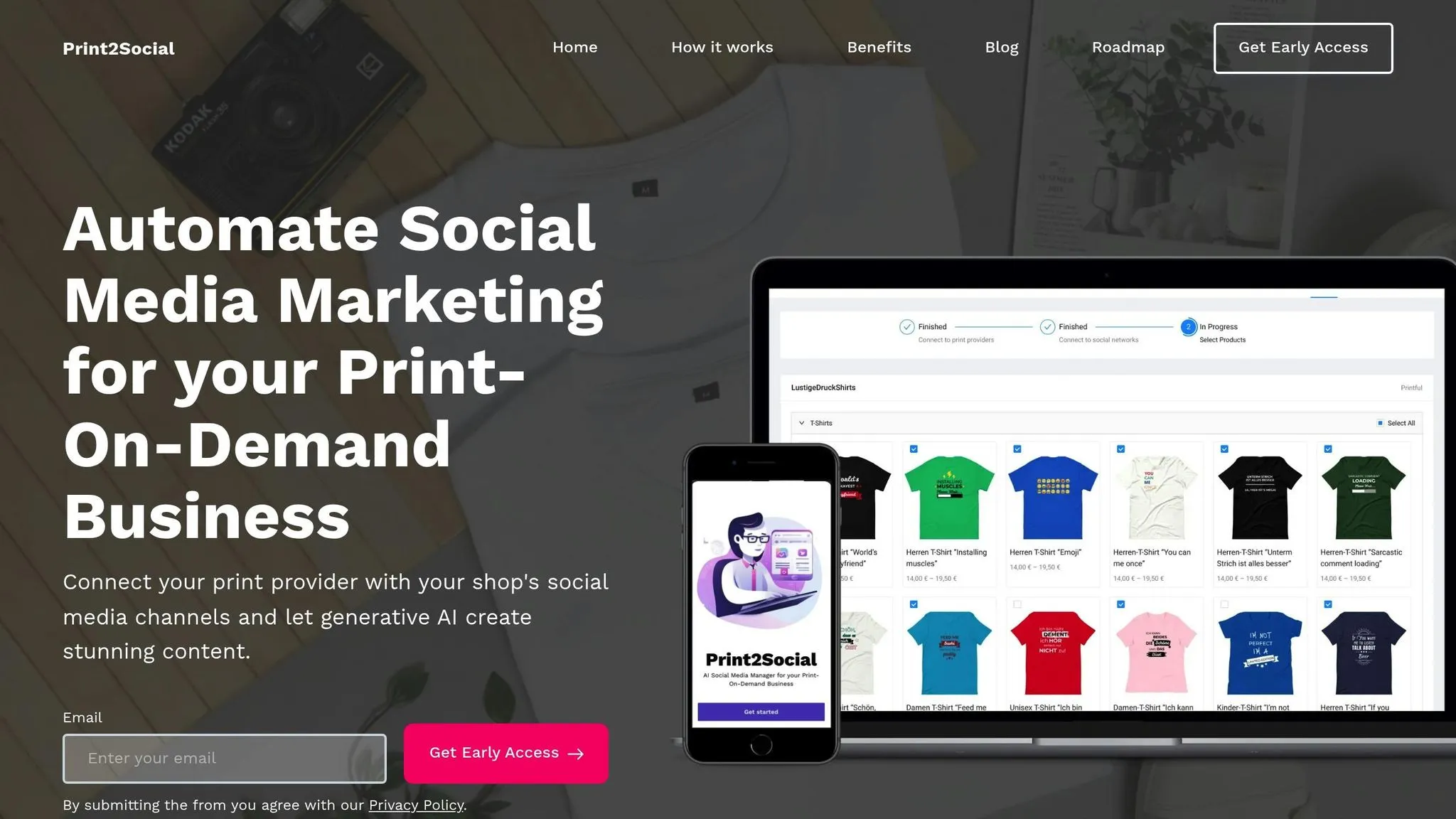
Print2Social takes the hassle out of video ad creation for print-on-demand businesses. Instead of manually crafting videos for each product, this platform connects directly to your fulfillment providers and automatically generates promotional videos featuring your designs.

Here’s how it works: Print2Social pulls your store inventory and creates dynamic video content showcasing your products in action. This automated system eliminates the need to edit videos for every new product or design. Even better, it schedules these videos across your social media accounts, ensuring you maintain a consistent presence without constant hands-on effort.

This is especially useful if you manage a large product catalog. Traditional video editing requires creating separate videos for each product variation, which can be time-consuming. Print2Social’s AI handles this by producing multiple video formats optimized for various platforms, from Instagram to TikTok. It takes care of everything from product visualization to posting, leaving you more time to focus on creating new designs.

When deciding on a tool, think about your budget and production needs. Free options like iMovie and DaVinci Resolve work well for occasional creators, while subscription-based tools like Adobe Premiere Rush ($9.99/month) cater to more frequent production demands.

Ease of use is another factor. Tools with drag-and-drop functionality and clear interfaces help reduce the learning curve, especially for teams. For example, Vimeo Create, rated 4.8/5 by 49,000 App Store reviewers, offers marketing-specific templates and starts at $20/month for its Starter plan.

For print-on-demand businesses juggling multiple products, integration is critical. Look for tools that sync with your e-commerce and marketing platforms. This can streamline your workflow and save time.

Scalability is also important. Choose software that can grow with your business. KineMaster offers a free basic plan with premium features available for $49.99 annually. With a 4.2/5 rating from 5.82 million Google Play reviews, it’s a flexible option for creators at any level.

Finally, take advantage of free trials and demos before committing. Whether you go for a manual or automated tool, the right choice can make your video ads more engaging and efficient to produce.

Creating video ads for your print-on-demand business might seem like a big task, but breaking it down into manageable steps can make the process much simpler. Here’s how to create eye-catching, effective ads that drive sales and elevate your brand.

Start by picking your standout products - the ones that are either your bestsellers or have a unique appeal. Think about items that will grab your audience’s attention, like a custom phone case with trendy artwork or a personalized mug featuring seasonal designs. These types of products often perform better than standard options.

Focus on what makes these products special. For example, if you’re offering custom T-shirts, highlight their personalization options, such as adding custom text or choosing from a wide range of designs. Unique features like eco-friendly materials or premium finishes should be front and center in your video.

Structure your ad to maximize engagement:

  • Start strong: Use a bold hook in the first three seconds to grab attention - this could be a compelling visual or an intriguing question.
  • Showcase the product: Demonstrate how it works or looks in action.
  • End with a clear call to action: Encourage viewers to “Shop now” or “Customize yours today”, focusing on one or two key benefits.

Keep your video short and sweet - 15 to 30 seconds is the sweet spot. This length allows you to deliver your message effectively without losing your audience’s interest.

With your content planned, it’s time to focus on visuals that bring your message to life.

Designing High-Quality Visuals and Messaging

Section titled “Designing High-Quality Visuals and Messaging”

Visual quality can make or break your ad. Use high-resolution images and video clips to present your products professionally. Blurry or poorly lit visuals can quickly turn potential customers away.

To make your products shine:

  • Use dynamic camera angles and close-ups to emphasize details like print quality or unique features.
  • Show your product in action, whether it’s being worn, used, or displayed.

Add clear text overlays to communicate key points, especially since many viewers watch videos without sound. Use bold, easy-to-read fonts and contrasting colors to ensure your message stands out - especially on mobile screens. Subtle branding, such as your logo or brand colors, can reinforce recognition without overshadowing the product.

When it comes to messaging, focus on benefits rather than just listing features. For example, “Design your own look” is far more engaging than “Customizable product available.” Combine expressive visuals with direct, benefit-driven text to make your ad impactful, even for viewers who aren’t listening.

Once your visuals and messaging are ready, adapt them for different platforms to maximize their reach.

Each social media platform has its own quirks, so tailoring your video ads to fit their requirements is crucial for success.

  • Instagram and Facebook: Stick to square (1:1) or vertical (4:5, 9:16) formats. While videos can be up to 60 seconds, shorter ads (15-30 seconds) are more likely to hold attention.
  • TikTok: Use vertical (9:16) format and aim for snappy content - 9 to 15 seconds works best. Start with a punchy intro to grab viewers instantly and consider using trending sounds or quick transitions to match the platform’s vibe.
  • YouTube: Horizontal (16:9) format is standard here. Bumper ads should be 6-15 seconds, while skippable ads can go up to 30 seconds. YouTube gives you a bit more room for storytelling, so you can take a few extra seconds to set the stage.

Make sure all your videos are shot in high definition (at least 1080p) to maintain quality across platforms. Optimize file sizes to ensure fast loading, as slow videos can hurt performance and cost you views.

Adapt your style to fit the platform’s audience. TikTok users love casual, trendy content, while Facebook and Instagram users might prefer polished, professional visuals. Instagram Stories are ideal for behind-the-scenes clips or interactive elements like polls and stickers.

Take advantage of platform-specific features to boost engagement. For instance, Instagram’s stickers or TikTok’s trending hashtags can help your ad gain visibility. Finally, test different versions of your ads to learn what works best. A/B testing hooks, visuals, and messaging will help you fine-tune your approach. Always preview your ads on the platform before publishing to ensure they look and perform as intended.

Best Practices for Video Advertising on Social Media

Section titled “Best Practices for Video Advertising on Social Media”

Once you’ve planned and created your video ads, the next step is tailoring them for social media platforms. To make your campaigns more effective, it’s essential to align your content with each platform’s unique features and audience preferences.

Every social media platform has its own style and technical requirements, and understanding these nuances can significantly impact your ad’s performance.

  • Instagram: Use a vertical 9:16 format for Reels and Stories, but stick to 4:5 for Feed posts. Remember to keep the top and bottom 14-20% of Stories free of important content to avoid it being cropped.
  • TikTok: Stick to a 9:16 vertical format with videos between 5 and 60 seconds. Opt for a casual, organic look that feels native to the platform. Shorter, authentic clips (21-34 seconds) tend to perform best.
  • Facebook: Square (1:1) or vertical (4:5) formats work well here. Keep your videos concise - shorter videos generally outperform longer ones.

“Think about how to make someone stop the scroll in the first two seconds and not keep scrolling away… The first two seconds, the hook, is incredibly important.” - Savannah Sanchez, TikTok marketing partner, The Social Savannah

TikTok’s audience gravitates toward ads that feel authentic and creator-made, not overly polished. Savannah Sanchez emphasizes that ads with a natural, smartphone-filmed vibe tend to outperform studio-quality productions on TikTok.

“We see ads that are around 30 seconds long that do the best on TikTok… Ensure videos appear natural, mimicking casual smartphone filming and native editing. They shouldn’t look like it’s from the studio or too overproduced. Looking like it’s actually made from a creator is really important.” - Savannah Sanchez, TikTok marketing partner, The Social Savannah

When it comes to costs, TikTok often delivers lower CPMs, while Meta platforms like Facebook and Instagram tend to have higher conversion rates. Google Ads, on the other hand, command premium CPMs.

Engaging Viewers with Interactive Elements

Section titled “Engaging Viewers with Interactive Elements”

Once your video format is optimized for the platform, the next step is to actively engage your audience. Adding interactive features can transform passive viewers into active participants, which is especially effective for showcasing customizable products.

  • Polls and questions: Instagram Stories are a great place to use these features. You could ask viewers to vote on their favorite design for a custom phone case or pick a preferred color for a new apparel line.
  • Clickable links and call-to-action buttons: Make sure these are clearly visible and use action-driven language like “Shop Now” or “Customize Yours Today.” On TikTok, pairing a strong call-to-action with an exclusive offer or limited-time deal can drive urgency and boost click-through rates.

“To get a good click-through rate on your ad, consider having a very strong offer or deal or a limited-time special… Having a high sense of urgency paired with an offer is what works well on TikTok since they are so price-conscious.” - Savannah Sanchez, TikTok marketing partner, The Social Savannah

  • Trending sounds and hashtags: These can significantly increase your content’s visibility, especially on TikTok. For example, MERIT, a vegan cosmetics brand, used trending songs in their TikTok ads while highlighting a free gift bag for first-time buyers. This combination of interactive elements and a compelling offer drove immediate action.
  • User-generated content (UGC): Encourage your customers to share videos of themselves using your products. Incorporating these clips into your ads adds authenticity and builds trust, showing real people enjoying your items.

Analyzing and Refining Video Ad Performance

Section titled “Analyzing and Refining Video Ad Performance”

Creating a video ad is just the beginning. Ongoing analysis and adjustments are critical to achieving long-term success. Focus on metrics that align with your business objectives rather than vanity numbers.

  • Key performance indicators (KPIs): Metrics like view count, watch time, engagement rate, and conversions are essential, but their definitions vary by platform. For instance, TikTok counts a view instantly, Instagram counts it after 3 seconds, and YouTube requires 30 seconds of viewing. Knowing these differences ensures you’re interpreting your data accurately.
  • Video completion rates: A completion rate of 70% or higher suggests your content is holding viewers’ attention. Since 90% of ad recall happens within the first six seconds, it’s crucial to front-load your most compelling content.
  • A/B testing: Experiment with different creative elements to see what resonates. For example, try testing various hooks in the first two seconds, different video lengths, or contrasting styles like lifestyle shots versus close-ups of your product.

“While view count is an attractive metric, I care more about average watch time and retention rate. These tell me if the content is actually resonating.” - Mariam (MJ) Ordubadi, Head of Marketing at Aequilibrium

  • Audience retention analysis: Pinpoint where viewers drop off and adjust accordingly. If you notice a consistent drop-off around the 10-second mark, evaluate whether your content loses momentum or if your call-to-action appears too early.
  • Cross-platform performance comparison: A video that performs well on Instagram may need adjustments for TikTok due to differences in audience preferences and algorithms. Tools like Print2Social can simplify this process by automatically tracking performance across platforms and offering actionable insights specific to print-on-demand businesses.

Finally, don’t overlook qualitative feedback. Comments and shares can reveal what truly resonates with your audience, offering valuable clues for refining future campaigns. Combining these insights with quantitative metrics ensures your video ads continue to improve and deliver results.

When you’re creating video ads for your print-on-demand business, you’ve got two main options: roll up your sleeves and do it manually, or let AI-powered tools handle the heavy lifting. Each method comes with its own set of perks and challenges.

Going the manual route gives you total creative control. You can fine-tune every detail - messaging, visuals, and your brand voice - exactly how you want it. But here’s the tradeoff: it’s time-consuming and requires solid design skills. Planning, filming, editing, and optimizing for different platforms can take hours, sometimes even days, to produce just one ad.

On the flip side, automated tools use AI to simplify the process. These platforms can whip up professional-looking video ads in minutes. That means you can create multiple ad variations for different products or campaigns without spending endless hours at your desk.

Interestingly, the print-on-demand industry hasn’t fully embraced automation yet. Back in 2020, only 7% of Print Service Providers in North America had adopted a mostly or fully automated workflow across their departments. This leaves room for businesses ready to jump in early and take advantage of these tools.

While manual creation lets you customize every aspect of your ads, it can quickly become overwhelming as your product catalog grows. Imagine trying to create individual ads for dozens - or even hundreds - of designs across various product categories. It’s just not practical.

That’s where automated tools like Print2Social come in. These platforms connect directly to your print-on-demand providers and social media accounts, cutting out the need for manual file transfers or tedious data entry. They even handle scheduling, so your ads can go live without you lifting a finger.

Automation doesn’t mean you have to sacrifice quality or your brand’s identity. The best strategy often blends AI efficiency with human creativity. For example, you can use automation to handle the bulk of the work but still add personal touches to make your content stand out from generic templates. Plus, automation can help you save money, speed up production, and maintain high-quality designs.

Here’s a quick comparison of the two approaches:

Comparison Table: Manual vs. Automated Creation

Section titled “Comparison Table: Manual vs. Automated Creation”

Factor

Manual Video Ad Creation

Automated Video Ad Creation (e.g., Print2Social)

Time Investment

High – requires significant time per video

Low – much faster creation process

Scalability

Limited – hard to scale quickly

High – easily create videos for multiple products

Customization

Full control over every detail

Some limitations depending on the tool

POD Provider Integration

Manual or workaround solutions needed

Seamless integration with POD platforms

Scheduling Automation

Requires manual scheduling

Automated scheduling available

Which method should you choose? It depends on your business size and goals. If you’re running a small operation with a limited product line, manual creation might work just fine. But for larger businesses with extensive catalogs, automation is the way to go.

Whatever approach you take, always test your video ads before launching. This is especially key for AI-generated content - check for resolution, color accuracy, and overall visual quality. The goal is to maintain top-notch standards while maximizing efficiency and reach.

If you’re unsure where to start, try a hybrid strategy. Use automation to handle the bulk of your video creation needs, but manually craft ads for your best-sellers or seasonal campaigns. This way, you get the best of both worlds: efficiency and a personal touch that keeps your brand unique.

As we’ve explored in this guide, the power of effective video ads lies in their ability to create an emotional connection while driving action. Video advertising works because it taps into emotions, compelling viewers to engage and respond. The growing investment in video ads - highlighted by the massive projected spend for 2024 - shows just how vital they’ve become.

To craft impactful video ads, focus on the essentials: a strong opening hook, early branding, optimization for silent viewing, and a clear, actionable call to action. Keep in mind the ABCDs of effective video ads: Attention, Branding, Connection, and Direction. These principles apply whether you’re creating ads manually or leveraging automated tools.

“Video ads are the best type of ads today. They are approximately 60,000 times more effective than walls of text.” - Enrique Vazquez Aguilera

This quote perfectly captures the unmatched influence of video ads and highlights the importance of choosing the right method for creating them. For businesses with large product catalogs, like print-on-demand operations, automation can be a game-changer. Tools such as Print2Social simplify the process by generating 12 images and 8 short videos per product - resulting in 20 unique social media posts for each item. Achieving this level of output manually, while maintaining quality, would be nearly impossible.

Print2Social goes a step further by streamlining workflows. It automates file transfers and schedules posts, saving countless hours of manual effort. The platform also ensures a balanced mix of content types, combining promotional, engagement-focused, and educational posts - key ingredients in a successful social media strategy.

Modern tools also take care of platform-specific technical requirements, freeing you to concentrate on crafting your brand’s message and voice.

Finally, remember to continuously test, analyze, and refine your ads based on performance data. Whether you’re relying on AI-driven tools or creating ads by hand, prioritizing high-quality visuals and consistent branding will set your print-on-demand business apart. These principles complete the roadmap to mastering video ads and ensuring your success in the competitive world of print-on-demand.

What are the advantages of using tools like Print2Social to create video ads for your print-on-demand business?

Section titled “What are the advantages of using tools like Print2Social to create video ads for your print-on-demand business?”

Using tools such as Print2Social can make managing your print-on-demand marketing much easier. These platforms handle tasks like video creation, scheduling posts on social media, and integrating products seamlessly. By automating these processes, you save valuable time and cut down on repetitive work, leaving you free to focus on expanding your business.

What’s more, AI-powered platforms like Print2Social can craft personalized and engaging content that truly connects with your audience. This doesn’t just improve customer interaction - it can also drive sales and help establish a stronger brand presence. For print-on-demand businesses, automation is a game-changer, offering efficiency and scalability without the need for a large team.

How can I create video ads that perform well on Instagram, TikTok, and Facebook?

Section titled “How can I create video ads that perform well on Instagram, TikTok, and Facebook?”

How to Create Effective Video Ads for Instagram, TikTok, and Facebook

Section titled “How to Create Effective Video Ads for Instagram, TikTok, and Facebook”

When crafting video ads for Instagram, TikTok, and Facebook, it’s essential to tailor your content to match the vibe and preferences of each platform. Here’s how you can make your videos stand out:

On Instagram and TikTok, the focus is all about short, visually captivating videos. Use trending sounds, hashtags, and features like Reels or Stories to grab attention quickly. These platforms thrive on creativity and fast-paced, eye-catching content that hooks viewers in seconds.

For Facebook, your approach should be slightly different. Optimize your videos for feed viewing by delivering clear messaging and including strong calls-to-action. Keep your videos short, add captions for viewers who watch without sound, and experiment with different formats to discover what resonates most with your audience.

To make the process easier, tools like Print2Social can help you design and schedule video ads tailored to each platform automatically. Don’t forget to keep an eye on performance metrics - regular analysis will help you fine-tune your strategy and boost engagement across all platforms.

How can I make my video ads more engaging with interactive elements?

Section titled “How can I make my video ads more engaging with interactive elements?”

To make your video ads stand out, try incorporating interactive elements that invite viewers to actively participate. Think clickable hotspots, polls, quizzes, or call-to-action buttons - these features grab attention and encourage viewers to stick around longer.

Another approach is to use branching storylines, where viewers can choose how the story unfolds, or shoppable overlays that allow them to explore and purchase products directly from the ad. These techniques not only make your ads more engaging but also create a more personalized experience, which can lead to higher conversions.

How To Analyze Competitor Social Media Tactics

Here’s how competitor analysis can help:

  • Identify posting patterns: Learn the best times and frequency for posting.
  • Understand engagement trends: Track likes, comments, shares, and audience activity.
  • Spot opportunities: Find market gaps and avoid common mistakes.
  • Refine your content: Discover what works and apply it to your strategy.

Use tools like Print2Social to automate data collection and content creation, saving time while improving efficiency.

  1. Find competitors using hashtags like #PODmerch or #customapparel.
  2. Track metrics like engagement, growth, and content performance.
  3. Analyze content types, visuals, and audience interaction patterns.
  4. Leverage automation to streamline tracking and content creation.

Quick Tip: Regularly review data to stay updated on trends and adjust your strategy for better results.

How to Do a Competitor Analysis on Social Media

Section titled “How to Do a Competitor Analysis on Social Media”

Understanding your competitors is key to refining your social media strategy. Here’s how you can identify and monitor your rivals effectively.

Competitors generally fall into two categories:

  • Direct competitors: Businesses offering similar print-on-demand (POD) products to the same audience.
  • Indirect competitors: Companies selling different products but vying for the attention of your target customers.

To create a competitor list:

  • Search for industry-specific hashtags like #PODmerch, #customapparel, and #printondemand to discover sellers.
  • Keep an eye on trending designs and popular product categories in your niche.
  • Identify businesses that cater to the same audience as you.
  • Observe engagement on competitor product posts to gauge their reach.

Focus on competitors that align with your business size and target audience. For instance, a small custom t-shirt shop doesn’t need to compare itself to large retail chains.

Once you’ve identified your competitors, the next step is analyzing their social media activity.

Take a closer look at your competitors’ social media activity, especially on platforms that resonate with your audience. Tools like Print2Social can simplify tracking their posting habits and engagement metrics.

Here’s how to map their presence effectively:

  • Document platform activity: Note which platforms they use most frequently.
  • Track posting frequency: Monitor how often they post on each platform.
  • Analyze content mix: Look at the balance between promotional posts, educational content, and audience engagement.
  • Record engagement patterns: Identify when their audience is most active and responsive.

Platform Activity Tracking

What to Monitor

Post Frequency

Number of posts daily or weekly

Content Types

Product showcases, behind-the-scenes, customer highlights

Peak Engagement Times

Days and times with the highest engagement

Response Rate

How quickly they respond to comments and messages

To analyze competitors effectively, focus on specific metrics that reveal their social media performance. Here are the key areas to monitor:

Metric Category

Key Indicators to Track

Engagement

Likes, comments, shares, saves

Growth

Weekly/monthly follower increases

Content Performance

Post reach, click-through rates

Audience Response

Comment sentiment, response times

Posting Patterns

Frequency, timing, platform usage

Monitor these metrics consistently over 30–90 days. This timeframe helps you identify patterns and trends that can lead to actionable insights.

Organize your data efficiently with the right tools and processes.

Tracking Competitor Data

  • Create a dedicated spreadsheet for each competitor.
  • Record daily metrics, campaign activities, and content themes.

For a more automated approach, consider using AI-powered tools like Print2Social. These tools can help you track content performance and identify trends while you focus on managing your social media efforts.

Once you’ve gathered structured data, dig deeper into your competitor’s content strategies by examining the following:

Content Types

  • Product highlights
  • Educational posts
  • Behind-the-scenes content
  • Customer reviews or testimonials
  • Promotions and special offers

Visual Elements
Evaluate how competitors use visuals like photos, videos, graphics, and consistent branding to enhance their posts.

Engagement Trends
Pay attention to how different content performs:

  • Posts that get the most saves
  • Content driving the highest number of comments
  • Shares generated by specific posts
  • How timing affects engagement levels

For print-on-demand businesses, tools like Print2Social can simplify this process by generating multiple content variations. This allows you to test strategies inspired by competitor insights and refine your approach.

Looking at how your competitors operate can help you refine your approach by highlighting what works and where there’s room for improvement.

Dive into how competitors interact with their audience to pick up effective social media tactics. Pay attention to these key areas:

Response Time and Quality
Monitor how quickly and effectively competitors reply to comments and messages. Take note of whether they:

  • Address customers personally (using their names)
  • Provide clear and helpful solutions
  • Maintain a consistent tone and style
  • Follow up on unresolved issues

Community Building Activities
Check out how competitors build and engage their communities. Here are some common approaches:

Activity Type

Purpose

Common Formats

User-Generated Content

Build trust through real input

Customer photos, reviews, testimonials

Live Sessions

Foster real-time interaction

Q&As, product demos, behind-the-scenes

Interactive Posts

Encourage audience participation

Polls, quizzes, discussion prompts

Community Challenges

Create shared experiences

Hashtag campaigns, themed contests

Next, evaluate the types of content that generate the most engagement.

To keep up with trends, focus on creating varied and engaging content. Tools like Print2Social, which can produce 12 images and 8 short videos per product, show how AI can streamline content creation.

Content Categories That Drive Engagement

  • Educational Content
    Share posts that solve problems or provide valuable information to build credibility.
  • Product Showcases
    Highlight your products through:
    • Lifestyle photos
    • Tutorial videos
    • Customer success stories
    • Feature highlights
  • Engagement-Focused Posts
    Use content designed to spark interaction, such as polls, questions, or games.

Once you’ve identified high-performing content, take a deeper look at each competitor’s overall strategy to spot their strengths and weaknesses.

Platform Effectiveness
Analyze how well competitors perform on different platforms by reviewing:

  • Engagement rates
  • Growth in followers
  • Performance of their content
  • Audience demographics

Content Strategy Assessment

Area

What to Analyze

Why It Matters

Content Quality

Visual appeal, clear messaging

Shapes audience’s first impressions

Posting Consistency

Frequency, timing patterns

Impacts visibility and algorithm success

Campaign Success

Effectiveness of promotions

Highlights what resonates with the audience

Brand Voice

Style and tone of communication

Shows how they position themselves

Use the insights from your competitor analysis to pinpoint areas where your business can stand out and perform better.

Look for areas where your print-on-demand business can make a mark. Some opportunities to consider:

  • Product Lifestyle Content
    Show your products in everyday settings. Use tools like Print2Social’s AI image generator to create diverse and engaging lifestyle images.
  • Video Demonstrations
    Highlight product features and quality through automated video demos. These can help customers better understand your offerings.
  • Behind-the-Scenes Content
    Build trust by sharing how your designs are created or how your production process works.
  • Educational Material
    Solve customer challenges with practical guides and usage tips. This type of content can position your brand as helpful and knowledgeable.

Engagement Opportunities
Pay attention to times when competitors see lower engagement, such as early mornings, late nights, weekends, or certain holidays. Use this data to schedule your posts strategically and stand out during those quieter periods.

Underserved Audience Segments
Look for customer groups your competitors might be ignoring. For instance, if they focus on younger audiences, consider crafting content that resonates with older demographics.

Once you’ve identified these gaps, set clear, measurable goals to make the most of these opportunities.

Create achievable goals by comparing your metrics to competitor benchmarks. Focus on gradually improving engagement metrics like post interactions, story views, video watch time, and responsiveness. Here’s how you can approach it:

  1. Post Frequency
    Study how often competitors post and find a rhythm that works for your audience. Use Print2Social’s automation tools to maintain consistency.
  2. Content Mix
    Balance your strategy by incorporating a variety of content types. Include product showcases, educational posts, engagement-driven content, and behind-the-scenes glimpses to cover all bases.
  3. Growth Metrics
    Track key indicators like follower growth, reach, impressions, click-through rates, and conversions from social traffic. These metrics will help you measure progress and refine your approach.

Monitoring and Adjustment
Keep a close eye on your performance data and tweak your strategy as needed. If something isn’t working, take advantage of Print2Social’s content generation tools to test new ideas quickly and efficiently.

Automation tools can simplify your workflow by helping you monitor competitors and execute content strategies more efficiently. Print2Social offers AI-powered features to make this process easier:

Content Creation and Analysis

  • Generate lifestyle images and video demos automatically.
  • Test strategies with different types of content.
  • Balance your posts between promotional, educational, and engaging material.

Scheduling Made Easier

  • Post at optimal times based on platform guidelines.
  • Keep a consistent posting schedule.
  • Automate content distribution across multiple channels.

These tools not only save time but also help you stay competitive. The next step is ensuring your strategy stays up-to-date with current trends.

Automation tools don’t just save time - they also make it easier to adjust your strategy as needed. Staying on top of trends and competitor activity requires regular updates. Here’s how you can set up an effective routine:

Monitoring Schedule
Establish a schedule to track competitor activity consistently:

  • Daily: Check for new posts and engagement stats.
  • Weekly: Review content themes and performance trends.
  • Monthly: Evaluate your overall strategy and tweak automation settings.

Adjusting Your Strategy
Leverage automation tools to fine-tune your strategy based on competitor insights:

  • Content Tweaks: Identify which types of content perform best and adjust your automated content creation to reflect these trends. Keep your brand voice consistent while experimenting with variations.
  • Better Timing: Use engagement and audience activity data to post at the best times.
  • Measure Success: Compare your automated content’s performance to competitor benchmarks. Use this data to refine your AI settings and posting strategies.

Staying Adaptable
While automation simplifies many tasks, it’s essential to remain flexible. Keep an eye on market shifts and trends, and regularly review your automated systems to ensure they align with your goals. This balance between automation and adaptability will help you stay ahead.

Analyzing competitors’ social media performance is a key driver of success in the print-on-demand market. By tracking metrics and studying their content, businesses can uncover opportunities and set clear growth targets.

To make this process effective, regular monitoring and actionable takeaways are essential. A consistent approach ensures that automation tools can be used to their full potential.

Automation simplifies this effort. Tools like Print2Social use AI to help businesses by:

  • Generating a variety of visual content automatically
  • Creating balanced content suited for different platforms
  • Scheduling posts effortlessly
  • Fine-tuning brand messaging for better engagement

Leading print-on-demand companies combine competitor analysis with automation to stay ahead. As discussed earlier, Print2Social takes care of content creation and scheduling, freeing up businesses to focus on scaling and innovation.

Competitor analysis is an ongoing effort. Use the insights you gather to adjust and improve your strategy. With the right tools and a structured approach, you can turn competitor data into actionable steps that deliver real results.

Ultimate Guide To Feedback-Driven Social Media Marketing

Want to improve your social media marketing? Start by listening to your customers. Feedback-driven strategies help you create better content, refine products, and connect with your audience. Here’s what this guide covers:

  • Why feedback matters: 71% of consumers recommend brands they enjoy on social media.
  • How to gather feedback: Use tools like Hootsuite or Sprout Social to track customer sentiment.
  • Turn feedback into action: Analyze comments, reviews, and user-generated content to improve your marketing.
  • Boost performance: Posts based on feedback see 85% higher sales growth.

Learn how to collect, analyze, and use customer feedback to strengthen your social media strategy.

How to Get Customer Feedback Online (6 Best Ways)

Section titled “How to Get Customer Feedback Online (6 Best Ways)”

Data highlights that 77% of consumers feel more positive about brands that actively seek and act on customer feedback. Here’s how you can effectively gather insights from your customers.

Using the right tools to track customer sentiment and engagement is essential. These platforms are particularly useful for print-on-demand businesses:

Tool

Key Features

Best For

Hootsuite

Multi-platform monitoring, unified inbox

General brand monitoring

Sprout Social

Sentiment analysis, trend tracking

Understanding customer insights

Mention

Real-time brand mention alerts

Quick response management

Talkwalker

Visual analytics, image recognition

Tracking product photos

For a tailored approach, check out Print2Social (https://print2social.com). Its AI-driven features are specifically designed for print-on-demand businesses.

A great example of effective monitoring comes from Printful. In 2022, they used Hootsuite to streamline their customer feedback process. This resulted in a 28% increase in positive sentiment, a 15% faster response time, and a 10% rise in repeat customers.

Next, let’s dive into how direct surveys and reviews can provide deeper insights.

Systematic feedback collection through surveys and reviews can provide valuable insights. Timing is key - send surveys 1–2 weeks after delivery to capture accurate impressions.

  • Use tools like Mailchimp to automate survey distribution.
  • Include both rating scales and open-ended questions for detailed feedback.
  • Offer incentives like discount codes to encourage honest responses.
  • Ensure reviews are collected across multiple platforms for broader visibility.

“96% of unhappy customers don’t complain directly to companies, but 91% of those will simply leave and never come back”.

In addition to surveys, photos and videos from customers can offer a richer understanding of their experience.

User-generated content (UGC) can significantly impact your business, with conversion rates increasing by 161% when UGC is included. Here’s how to encourage customers to share their content:

  • Create Branded Hashtag Campaigns
    Design easy-to-remember hashtags for customers to use when sharing their photos. Highlight these hashtags on packaging inserts and in post-purchase emails.
  • Run Photo Contests
    Organize contests where customers can win prizes like store credit or exclusive designs. This not only generates content but also fosters community engagement.
  • Leverage Packaging
    Include branded inserts with clear instructions on how to share photos or videos. Add hashtags or QR codes that link directly to your social platforms.

Making it easy for customers to share their experiences while offering them value in return is key. Real customer content often connects with audiences better than polished marketing materials, as it captures genuine experiences with your products.

Once you’ve collected customer feedback, the next step is figuring out how to turn it into actionable insights.

AI tools today can categorize comments with an impressive 97% accuracy. This helps businesses quickly spot sentiment trends and patterns. Here’s how these tools can help:

Analysis Type

Tool Features

Business Impact

Sentiment Analysis

Breaks feedback into positive, negative, and neutral categories

Tracks how customers feel about your brand

Topic Detection

Identifies recurring themes and keywords

Helps shape your content strategy

Trend Tracking

Monitors sentiment shifts in real-time

Allows quick responses to issues

For example, Print2Social users can rely on its AI to analyze feedback from multiple social platforms. This makes it easier to detect trends specifically tied to print-on-demand products. These insights can then guide the analysis of visual content.

Visual content shared by customers can be a goldmine. Studies show that 80% of consumers are more likely to buy from brands that feature customer photos or videos in their campaigns. A strong example is Sephora, which used visual recognition AI to analyze Instagram posts. The result? A 22% boost in conversion rates for the products they featured.

Key areas to analyze in customer-shared visuals include:

  • Product placement: How and where products are being used
  • Color schemes: Which colors resonate most with your audience
  • Environmental context: The settings or scenarios in which your products are used

By analyzing these factors, you can identify recurring themes and prioritize actions that align with your customers’ preferences.

Adidas showed the power of theme analysis in June 2023. By using AI to analyze 500,000 Instagram comments, they achieved a 28% increase in positive sentiment and a 12% rise in engagement rates.

“Companies that regularly analyze customer feedback themes see a 15-20% increase in customer satisfaction scores”.

To pinpoint and act on common themes:

  • Collect feedback from diverse sources like social media, reviews, and direct messages.
  • Use tools like text mining and topic modeling to uncover patterns.
  • Prioritize themes based on their frequency, sentiment intensity, and potential business impact.

This structured approach ensures you’re focusing on what matters most to your customers.

Posts shaped by customer feedback consistently outperform generic content, delivering 85% higher sales growth compared to competitors.

Print2Social simplifies the process of turning customer feedback into engaging social media posts. By focusing on what your audience values, you can produce content that truly resonates.

Content Type

Customer Feedback Source

Implementation Strategy

Product Showcases

Customer Reviews

Highlight top-rated product features

Educational Content

Common Questions

Answer frequently asked questions

Social Proof

User Photos/Videos

Share authentic customer experiences

Product Updates

Feature Requests

Announce updates inspired by user input

Take Airbnb’s 2022 Instagram strategy as an example. By showcasing user-generated content, they saw an 18% increase in engagement and a 25% rise in bookings from Instagram traffic within six months. These results underline the power of listening to your audience.

Retail brands typically see an average engagement rate of 0.68% on Instagram and 0.13% on Facebook. To surpass these numbers, experiment with your content:

  • Test posting times and frequency
  • Compare performance across formats (e.g., videos vs. images)
  • Evaluate responses to different calls-to-action
  • Track how features resonate with your audience

“Brands that engage and respond to customer service requests over social media see a 20-40% increase in customer spending”.

Use these insights to fine-tune your strategy and adapt quickly.

Once you’ve identified successful content formats, act fast to stay ahead. Quick adjustments ensure your posts remain relevant and engaging. For example, brands that respond to customer feedback within an hour experience 42% more customer advocacy.

Here’s how to make those updates:

  • Monitor engagement metrics in real time
  • Adjust posting schedules based on performance
  • Respond promptly to comments and messages
  • Scale up content that performs well

If a particular design or post generates strong positive feedback, Print2Social makes it easy to replicate and expand on that success.

“77% of consumers view brands more favorably when they actively seek and implement customer feedback”.

Measuring social media performance is essential for refining your marketing approach. Companies that incorporate social data into their strategies are 1.5 times more likely to see revenue growth.

For print-on-demand businesses, monitoring specific metrics can help gauge social media success. Here are some key ones to track:

Metric

Target Range

How to Calculate

Engagement Rate

1-5%

Total engagements ÷ followers × 100

Conversion Rate

2-5%

Conversions ÷ total visitors × 100

Customer Satisfaction

Over 80%

Average satisfaction score (1-10)

ROI

5:1 to 10:1

(Revenue - Cost) ÷ Cost × 100

Tools like Print2Social’s analytics dashboard simplify tracking these metrics, helping you spot trends and fine-tune your approach.

Breaking your audience into segments can lead to better results. Businesses that segment their customers see up to 10% higher profits compared to those that don’t. A great case study: In 2022, Warby Parker used advanced customer segmentation, boosting engagement rates by 22% and conversion rates by 15% within six months.

To better target your audience, consider these factors:

  • Engagement level: Measure how different groups interact with your posts.
  • Purchase history: Look for patterns in buying behavior.
  • Content preferences: Identify which types of posts perform well with specific groups.
  • Feedback sentiment: Group customers based on their responses and attitudes.

Using these insights, you can keep your strategy flexible and relevant.

Turning feedback and analytics into actionable steps is key.

“73% of marketers believe that their efforts through social media marketing have been ‘somewhat effective’ or ‘very effective’ for their business”.

To stay on top of your game:

  • Review metrics every month to spot trends.
  • Experiment with different content formats and posting schedules.
  • Refine your targeting based on how different segments perform.
  • Adapt your product offerings in response to customer input.

Advanced tools like IBM Watson’s Natural Language Understanding can help analyze sentiment, while Print2Social makes it easier to adjust strategies on the fly.

Using the insights you’ve gathered, here’s how to put feedback-driven social media marketing into action.

Feedback-driven social media marketing requires a structured approach to improve both engagement and customer satisfaction.

  1. Use Social Listening Tools
    Companies like Printful show how effective this can be. By using tools like Sprout Social to analyze customer interactions, they saw a 40% boost in user-generated content and a 22% rise in repeat purchases.
  2. Dive Into Customer Insights
    Focus on key areas such as:
    • Tracking sentiment across platforms
    • Spotting recurring feedback themes
    • Brainstorming product improvement ideas
    • Measuring content performance metrics
  3. Stick to an Implementation Timeline

Phase

Duration

Key Activities

Initial Setup

2–4 weeks

Set up monitoring tools and establish benchmarks

Data Collection

1–3 months

Gather feedback and monitor social interactions

Analysis & Planning

2–4 weeks

Review insights and craft a content strategy

Implementation

Ongoing

Roll out the strategy and track results

With these steps mapped out, the right tools can make the process seamless.

Automation tools like Print2Social are designed for businesses in the print-on-demand space.

Integration Setup

  • Sync your store and product catalog
  • Connect your social media accounts
  • Set up automated posting schedules

Content Optimization
Create content that reflects customer feedback. Build a feedback loop where insights shape your content and product updates:

  • Review content weekly based on engagement data
  • Evaluate performance monthly
  • Adjust your strategy every quarter

How to use social media for customer feedback and insights?

Section titled “How to use social media for customer feedback and insights?”

Combining technology with a personal touch is key to managing customer feedback on social media. Start by setting up social listening tools across all platforms. Since 67% of consumers turn to social media for customer service inquiries, responding quickly is critical for maintaining your brand’s reputation.

Once you’ve got social listening in place, organize your feedback process. Create a system where urgent issues are addressed immediately, general questions are answered within 24 hours, and positive feedback is acknowledged in a genuine way. Regularly review sentiment trends, and consider using AI tools to handle larger volumes of interactions efficiently.

Engaging with your audience is essential - 71% of consumers who enjoy a brand’s social media presence are more likely to recommend it. For print-on-demand businesses, this could mean using Instagram Stories polls to gather design feedback or encouraging customers to use branded hashtags to showcase their purchases. These actions ensure feedback directly shapes your social media approach.

Turn feedback into actionable improvements. For example, some brands have used customer input to boost sales.

“78% of consumers want brands to use social media to help them interact with each other”.

For print-on-demand businesses, tools like Print2Social can simplify feedback analysis and content creation. These tools help you spot trending designs and customer preferences while keeping your interactions authentic. Integrating feedback into your workflow strengthens the overall strategy outlined in this guide.

Ultimate Guide to AI Brand Storytelling for POD

AI tools are transforming how Print-on-Demand (POD) businesses connect with their audience. By combining automation with creativity, these tools help craft personalized, engaging stories that highlight brand values and products. Here’s what you’ll learn:

  • Why AI matters for POD storytelling: It helps scale content creation, personalize messages, and streamline workflows.
  • Top AI tools to consider: Tools like Print2Social, Adobe Sensei, and Wondr AI stand out for their ability to create visuals, automate posts, and analyze performance.
  • How to use AI effectively: Define your brand’s voice, create tailored content, and use AI analytics to refine your strategy.
  • Ethical and practical tips: Stay transparent about AI use, review content for accuracy, and balance automation with human creativity.

Quick Comparison of AI Tools for POD Storytelling

Section titled “Quick Comparison of AI Tools for POD Storytelling”

Tool

POD Integration

Visual Generation

Content Automation

Print2Social

Full support

Images and videos

Yes

Adobe Sensei

Limited

Advanced visuals

Yes

Wondr AI

Yes

Yes

Yes

AI is not here to replace creativity - it’s here to enhance it. Start small, track results, and adapt your storytelling to resonate with your audience.

Wondr AI

Selecting AI Tools for POD Brand Storytelling

Section titled “Selecting AI Tools for POD Brand Storytelling”

Recent research highlights that 61% of marketers see AI as a key part of their marketing strategy [3].

When choosing AI tools for POD brand storytelling, it’s important to focus on tools with features that align with your goals. Here’s a breakdown of what to prioritize:

Feature Category

Key Capabilities

Business Impact

Content & Visual Creation

AI-generated text, images, mockups, videos

Boosts storytelling effectiveness

Platform Integration

Links with POD providers

Simplifies product promotion

Automation & Analytics

Scheduling, posting, performance tracking

Enables data-backed storytelling

One standout option is Print2Social, a tool tailored specifically for POD businesses.

Print2Social

Print2Social connects directly with POD platforms to streamline the creation of product-focused social media content. It offers AI-generated visuals, videos, and scheduling features, making it easier to manage your brand’s online presence.

Not all AI tools are built the same when it comes to storytelling for POD. Here’s a quick comparison:

Tool

POD Integration

Visual Generation

Content Automation

Print2Social

Full platform support

Images and videos

Yes

Adobe Sensei

Limited

Advanced visuals

Yes

Wondr AI

Yes

Yes

Yes

Each tool offers unique strengths, but the ability to create engaging, data-informed narratives is essential for POD businesses.

“Generative AI revolutionizes brand storytelling by using data and machine learning to create high-quality narratives in seconds.” [1]

Ultimately, the best tool will depend on your specific needs and storytelling objectives.

For POD (Print-On-Demand) businesses, where variety and customization are central, tools like ChatGPT and Jasper AI can help shape stories that emphasize unique designs while staying in tune with customer preferences [1]. By analyzing customer feedback and market trends, AI pinpoints key brand elements that resonate with your target audience.

Here’s how AI can assist in brand storytelling:

Brand Element

AI Application

Business Impact

Brand Identity

Sentiment analysis, AI content guides

Consistent and clear messaging

Visual Identity

Style transfer algorithms

Unified and appealing aesthetics

Once your brand’s identity is clearly mapped out, the next step is to bring it to life with creative, AI-driven content.

AI tools like DALL-E and Jasper AI can create custom visuals and copy tailored specifically for POD products [4][5]. Platforms like Print2Social streamline this process by automating social media posts with AI-generated visuals and videos, making content creation much easier for busy businesses.

AI shines when it comes to understanding customer behavior and crafting targeted content. Tools like PrintJourney analyze data to optimize content for specific customer segments, ensuring it remains relevant and engaging [4][2].

Here are some ways to target different groups:

Audience Segment

AI Application

Content Focus

Customer Segments

Predictive analytics, purchase history

Introductory and loyalty content

Social Followers

Engagement patterns

Platform-specific visuals

The key to successful AI storytelling is blending automation with your brand’s personality. Use AI to enhance your natural voice, not replace it. This ensures your POD business stays connected to its audience while reaping the benefits of AI’s speed and scalability.

Using AI Brand Storytelling on Social Media

Section titled “Using AI Brand Storytelling on Social Media”

Once you’ve nailed down your brand story, the next step is using AI to share it effectively across social media platforms.

AI-powered tools have transformed how POD (Print-on-Demand) businesses handle their social media presence. Tools like Print2Social, mentioned earlier, automate content creation and scheduling, integrating effortlessly with POD platforms to simplify workflows. These tools save time and effort on manual tasks, letting businesses focus on big-picture planning.

Automation Aspect

AI Capability

Business Impact

Content Creation

Generates product mockups and promotional videos

Saves time and cuts costs

Post Scheduling

Automates timing based on audience activity

Boosts engagement opportunities

Platform Integration

Links with major POD providers and social platforms

Simplifies workflow management

Refining Social Media Strategies with AI Insights

Section titled “Refining Social Media Strategies with AI Insights”

AI analytics tools give businesses a deep dive into how their social media content performs. By tracking metrics like likes, comments, and shares, businesses can see what resonates with their audience. These tools also help identify top-performing posts, allowing businesses to fine-tune posting schedules and social strategies.

This data-driven approach ensures businesses can adapt and create content that connects with their audience. It’s all about understanding what works and doubling down on it.

Expanding Reach with AI-Generated Visuals and Videos

Section titled “Expanding Reach with AI-Generated Visuals and Videos”

AI tools can craft visuals tailored for social platforms, showcasing products in engaging, shareable formats. These visuals and videos not only grab attention but also maintain consistent storytelling across all platforms, reinforcing your brand’s identity.

Content Type

AI Application & Benefits

Product Mockups

Places products in lifestyle settings for eye-catching visuals

Video Content

Auto-generated promotional clips to drive engagement

Social Media Posts

Pre-made templates for cohesive, branded content

The real trick is finding the right balance between automation and authenticity. While AI can handle tasks like content creation and scheduling, your brand voice needs to stay true and relatable. Regularly reviewing and tweaking AI-generated content ensures you hit the mark while maximizing your social media impact.

Section titled “Best Practices and Trends in AI Brand Storytelling for POD”

To build trust with your audience, it’s crucial to be transparent about using AI in your content creation. Ethical practices ensure your brand stories connect with people and maintain credibility.

Ethical Aspect

Implementation Strategy

Business Impact

Transparency & Bias Prevention

Clearly label AI-generated content, use diverse datasets

Builds trust and promotes inclusivity

Content Accuracy

Regularly review AI outputs with human oversight

Protects brand credibility

By addressing these ethical issues, businesses can establish stronger connections with their audience while staying competitive.

AI is reshaping how print-on-demand (POD) brands engage with their customers through interactive and tailored content.

Trend

Application

Impact on POD Business

Real-time Content Adaptation

Adjusts messaging based on user interactions

Boosts content performance

Interactive Storytelling

Creates dynamic and engaging product showcases

Drives customer engagement

Dynamic Ad Personalization

Customizes ads to individual preferences

Improves conversion rates

By tapping into these advancements, POD brands can create more engaging and effective content.

To make the most of AI tools, focus on integrating them into your workflow while keeping your brand’s voice intact.

Success Factor

Implementation Guide

Expected Outcome

Tool Integration & Training

Select AI tools that align with POD operations and train staff

Streamlined workflows

Content Review

Regularly evaluate AI-generated content for quality

Ensures consistent messaging

Research shows that 61% of employees experience greater productivity when using AI tools in their work [2]. This highlights the importance of treating AI as a collaborative resource rather than a full replacement for human creativity.

When using AI for storytelling, consider these steps:

  • Start with small, manageable automation tasks.
  • Track how your content performs with metrics.
  • Update AI prompts based on audience feedback and engagement.
  • Keep human oversight to maintain your brand’s authenticity.

Balancing automation with a personal touch is key. By applying these strategies and staying aware of the latest trends, POD businesses can craft stories that truly connect with their audience.

AI-driven storytelling is changing the game for POD businesses, making it easier to create personalized, engaging content at scale. By integrating AI tools into their processes, brands can better connect with audiences while keeping their messaging genuine.

Impact Area

Key Advantage

Business Outcome

Content Creation

Automated, tailored narratives

Stronger brand engagement

Operational Efficiency

Simplified workflows

Lower operational costs

Marketing Reach

Data-informed content delivery

Better audience targeting

“Gen AI is not a replacement for human creativity in branding. It’s a co-creator that allows marketing managers and teams to create more immersive, hyper-personalized stories by tapping into AI’s data-driven knowledge about your brand and its audience” [1].

To succeed with AI-powered brand storytelling, businesses need to combine tech with genuine, relatable messaging. Tools like Print2Social make this possible by automating social media management while keeping the brand voice intact.

Phase

Action Items

Expected Results

Planning & Setup

Set clear goals and pick the right tools

Better engagement metrics

Execution & Analysis

Use automation and monitor performance

A more consistent brand identity

Here’s how to get started:

  • Set clear objectives and choose AI tools that align with your brand’s needs.
  • Automate content creation, analyze metrics, and adjust strategies based on insights.

POD storytelling works best when AI and human creativity come together. Generative AI can help produce visual content and automate social media, enabling brands to deliver personalized, engaging experiences. By taking these steps, POD businesses can stay competitive and craft stories that truly connect with their audience [1][2].

Here are answers to some common questions to help POD businesses make the most of AI tools for social media content creation.

Is there an AI that creates social media posts?

Section titled “Is there an AI that creates social media posts?”

Yes, there are several AI tools designed to create social media posts, especially for POD businesses. For example, Print2Social integrates with POD providers to automate content creation and scheduling. Another option is SocialPilot, which supports content creation across multiple social platforms [6].

Which AI tool is best for social media content writing?

Section titled “Which AI tool is best for social media content writing?”

The ideal AI tool depends on the specific needs of your POD business. Below is a comparison of some popular options:

Tool

Key Features

Best For

Print2Social

Automated product showcasing, content scheduling, design templates

POD businesses wanting a smooth product-to-post setup

Sprinklr

Advanced curation, multi-platform management, detailed analytics

Larger POD operations needing enterprise-level insights

Hookle

Easy content generation, simple posting tools, basic analytics

Smaller POD businesses new to AI-driven automation

These tools cater to different business sizes and goals, offering features like automated workflows and in-depth analytics [4][2].

As AI tools improve, they can help businesses not only create content but also enhance storytelling to keep up with changing trends.

Cost-Based vs Value-Based Pricing Guide 2024

Choosing the right pricing strategy can make or break your print-on-demand (POD) business. Here’s what you need to know about cost-based and value-based pricing:

  • Cost-based pricing: Add up costs + markup
  • Value-based pricing: Set price based on perceived customer value

Key differences:

  1. Calculation: Cost-based is simple math, value-based is more complex
  2. Profit potential: Value-based can lead to higher profits
  3. Market position: Value-based helps you stand out
  4. Customer focus: Value-based prioritizes customer perception

Which to choose? It depends on your:

  • Product uniqueness
  • Market willingness to pay
  • Brand strength
  • Long-term goals

Many businesses use both. Start with cost-based to ensure profitability, then incorporate value-based elements as you grow.

Remember: Review and adjust your pricing regularly to stay competitive and maximize profits.

Quick Comparison:

Factor

Cost-Based

Value-Based

Calculation

Simple

Complex

Profit Potential

Predictable

Potentially Higher

Market Position

Vulnerable

Can Be Unique

Best For

High-Volume Markets

High-Value Products

Pricing methods are how businesses figure out what to charge for their stuff. For print-on-demand (POD) businesses, picking the right method can make a huge difference.

Let’s break it down:

Cost-Oriented Pricing: This is all about your production costs. It’s simple, but it might not match what people are willing to pay.

Market-Oriented Pricing: This looks at things like what customers think, how much they want your product, and what your competitors are doing. It’s more flexible but needs more research.

For POD businesses, knowing these is key. If you’re selling custom t-shirts, cost-oriented pricing might just look at material and printing costs. But market-oriented pricing might think about how cool your design is or if it’s beach season.

Your pricing can really shake things up for your POD business:

1. Profitability

It’s all about making sure you’re not losing money. Let’s say your custom mug costs $9.7 to make. If you price it at $11.64 (that’s a 20% profit margin), you’re covering costs. But if people think your mug is super awesome, you might be leaving money on the table.

2. Customer Perception

How you price stuff changes how people see it. Think about Walmart versus Starbucks. Walmart’s low prices attract bargain hunters, while Starbucks’ higher prices make people think “fancy coffee.”

3. Competitive Edge

Your prices can make you stand out. Check this out: In March 2023, a POD company launched eco-friendly t-shirts. They used value-based pricing, charging 30% more than others. But they made a big deal about the sustainable materials. Result? Sales jumped 45% in just one month.

4. Market Position

Pricing helps show where you fit in the market. Are you going for the luxury crowd or trying to be the budget-friendly option?

“The right pricing strategy - cost-based or value-based - depends on your industry, market and customer perception.” - Flintfox

Here’s a real-world example:

In 2022, a POD business selling custom phone cases switched up their pricing. They went from cost-based to value-based pricing. They bumped up prices by 25% but really played up their unique designs and how tough their cases were. The outcome? Profit margins shot up 40% and they kept 15% more customers.

Cost-based pricing is a simple way for print-on-demand businesses to set prices. It’s all about covering costs and making a profit. Here’s how it works:

  1. Add up all your costs
  2. Decide on your markup
  3. Do some simple math

Let’s break it down:

1. Calculate your costs

For a POD t-shirt, this might include:

  • Base cost of the shirt
  • Printing fees
  • Shipping
  • Platform fees
  • Design costs

2. Choose your markup

In fashion, markups usually range from 30% to 60%.

3. Do the math

Use this formula:

Total Costs + (Total Costs × Markup Percentage) = Selling Price

Here’s a real-world example:

In 2023, NovaTomato, a POD hoodie seller, had a total cost of $49.90 per hoodie. With a 40% markup, they priced their hoodie at $69.86.

Cost-based pricing fits POD like a glove. Here’s why:

Know your numbers

Be thorough. Don’t forget about taxes. Shopify reminds us:

“Taxes may need to be charged based on customer location, including sales tax, VAT, and GST.”

Keep an eye on competitors

Your costs matter, but so do market prices. If you’re way off, you might need to adjust.

Quick decisions

Need to price a new product fast? Cost-based pricing has your back.

Stay flexible

The POD world moves fast. Keep checking your numbers and be ready to change.

Tell your story

Some businesses use pricing to build trust. Take Everlane:

They show the cost to make each item and their markup, which is 2-3x compared to the industry average of 5-6x.

While not strictly POD, it shows how pricing can be part of your brand.

Cost-based pricing gives you a solid start. It covers your costs and ensures profit. But it’s just one tool. As you grow, explore other methods to stay competitive in the POD market.

Value-based pricing isn’t about production costs. It’s about what customers think your product is worth. For print-on-demand businesses, it’s a way to boost profits and stand out.

The key? Understanding what makes your product special to customers. Here’s the process:

1. Find out what customers value

Talk to your target audience. What do they love about your products? The design? The quality? Something else?

2. Look at the competition

Check out similar products. How much do they cost? How is yours different or better?

3. Set a price that reflects value

Use what you’ve learned to pick a price that shows off your product’s worth.

4. Test and adjust

Try different prices. See what works best.

Here’s a real-world example:

Luxe Prints, a POD company selling custom wall art, switched to value-based pricing in 2022. They hiked prices by 35% on their most unique designs, focusing on artistry and exclusivity. The result? Sales stayed steady, but profits jumped 40% in just three months.

Value-based pricing fits print-on-demand like a glove. Here’s why:

Unique designs are key: One-of-a-kind artwork can command higher prices. People pay more for something they can’t get elsewhere.

Quality matters: Better-looking, longer-lasting prints? That’s added value.

Tell your story: Your brand’s story can boost perceived value. Maybe your shirts are eco-friendly or support a cause.

Here’s how some POD businesses are making it work:

1. Customization premium

Offer personalization at a higher price. People will pay more for something made just for them.

2. Limited editions

Create scarcity with limited runs. This can justify higher prices.

3. Bundle deals

Package related items together at a slight discount, but still at a value-based price.

Check out this success story:

In 2023, ThreadTales, a POD t-shirt company, launched a line of shirts with AI-generated art based on customers’ personal stories. They priced these at $49.99, nearly double their standard designs. Despite the higher price, sales beat expectations by 75% in the first month. Proof that customers valued the unique, personal touch.

Let’s dive into how cost-based and value-based pricing stack up for print-on-demand businesses:

Cost-based pricing? It’s simple math. Add up your costs, slap on a markup, and boom - you’ve got your price. Value-based pricing? It’s trickier. You’re trying to figure out what customers think your product is worth.

Cost-based pricing guarantees you cover your costs and make a steady profit. But value-based pricing? It can be a game-changer.

Take Luxe Prints. They switched to value-based pricing in 2022, bumping up prices by 35% on their unique designs. The result? Profits shot up 40% in just three months. And they didn’t lose customers.

Cost-based pricing can leave you vulnerable if competitors can produce cheaper. But value-based pricing? It can help you stand out.

Look at ThreadTales. They priced their AI-generated art shirts at $49.99 - double their standard designs. It positioned them as a premium brand. Sales beat expectations by 75% in the first month.

Cost-based pricing ignores how customers see your product. Value-based pricing is ALL about customer perception.

Apple’s a pro at this. They use cost-plus pricing as a starting point, but their strategy leans heavily on value-based principles. They charge premium prices, reflecting the unique value they offer. It’s why they’re seen as a luxury tech brand.

Cost-based pricing can make you complacent. Set your markup and you’re done. Value-based pricing pushes you to keep improving to justify higher prices.

Different industries favor different methods. Supermarkets often use cost-based pricing for everyday items. Specialist medical services? They often go for value-based pricing, focusing on patient outcomes rather than just costs.

Here’s a quick comparison:

Factor

Cost-Based Pricing

Value-Based Pricing

Calculation

Simple

Complex

Profit Potential

Predictable

Potentially Higher

Market Position

Vulnerable

Can Be Unique

Customer Focus

Low

High

Innovation Driver

Low

High

Best For

High-Volume Markets

High-Value Products

Michael Stanisz from Revenue Management Labs says: “Value is subjective, and companies are often estimating the hypothetical value customers will benefit from.”

For print-on-demand businesses? Start with cost-based pricing to ensure profitability. Then, as you get to know your market, mix in value-based elements. Stay flexible and keep an eye on both your costs and what your customers think.

Choosing between cost-based and value-based pricing for your print-on-demand business isn’t simple. It depends on your products, market, and goals. Let’s break it down:

Cost-based pricing works when:

  • You’re new and need to ensure profits
  • Your products are similar to competitors’
  • You’re selling basic items
  • You want to compete on price

Value-based pricing fits if:

  • You offer unique products
  • Your market values quality over price
  • You have a strong brand
  • You want to maximize profits on premium items

Here’s a real example:

CustomTees, a print-on-demand t-shirt company, switched to value-based pricing for their limited edition designs in 2022. They hiked prices by 40%, focusing on exclusivity and artistry. The result? 25% more profits in 6 months, without losing sales.

To decide, ask yourself:

  1. How unique are my products?
  2. What will my market pay?
  3. How strong is my brand?
  4. What are my long-term goals?

You’re not stuck with one method. Many businesses use both. You might price standard products based on cost and premium items based on value.

Darshit Singh from ClippedCode says: “Cost-based pricing generally results in competitive prices.” True, but don’t ignore the power of perceived value in print-on-demand.

After choosing your pricing strategy, you need to promote effectively. That’s where tools like Print2Social come in handy.

Print2Social is an AI tool for social media management, made for print-on-demand businesses. It can showcase your products across platforms. Here’s how it helps:

1. AI-powered content

It creates product images and videos automatically.

2. Targeted promotion

You can highlight specific products, whether they’re priced based on cost or value.

3. Consistent branding

It keeps your brand image consistent, which is key for value-based pricing.

4. Smart scheduling

Automated posting keeps your products visible, supporting your pricing strategy.

Tools like Print2Social help you show your products’ value to your audience, no matter how you price them. This can justify higher prices for premium items or show off competitive pricing for standard ones.

Want to shake up your print-on-demand business? Changing your pricing strategy might do the trick. Here’s how to do it:

1. Analyze Your Market

Dig into your competitors and industry trends. CustomTees, a print-on-demand t-shirt company, spent two months doing this in 2023. They found customers would pay up to 40% more for limited edition designs. That’s huge!

2. Define Your Value Proposition

What makes your products special? CustomTees nailed it with exclusive artwork and top-notch printing. They even backed it up with data: 78% of their customers said their designs were way better than the competition.

3. Set Strategic Goals

Know what you want. CustomTees aimed for a 25% profit boost without losing sales. Having a clear target helps you measure success.

4. Calculate New Rates

Play with the numbers. CustomTees used a pricing tool to test different scenarios. They ended up bumping their premium line by 35%.

5. Communicate Changes Effectively

Don’t blindside your customers. CustomTees gave a two-month heads up about their price increase. They made sure to highlight why their products were worth it.

6. Test and Refine

Start small. CustomTees tried their new prices with 10% of their customers for a month. This let them see how people reacted and make tweaks.

7. Monitor and Adjust

Keep a close eye on things after you change prices. CustomTees checked sales, feedback, and profits weekly. They saw a 5% dip in sales at first, but profits jumped 30% in the first quarter.

Don’t set it and forget it. Top companies look at their prices every three months and adjust twice a year. As Cody Arsenault, Founder of CodyArsenault.com, puts it:

“Whatever pricing strategy you choose, it’s important to have a clear plan backed by market research.”

Changing your prices isn’t easy, but it can pay off big time if you do it right.

Picking the right pricing strategy for your print-on-demand business is crucial. Here’s what you need to know:

Cost-based pricing is simple but might not maximize profits. It’s good for:

  • New businesses
  • Products similar to competitors
  • Basic items with clear costs

Value-based pricing focuses on what customers think your product is worth. It’s great for:

  • Unique or premium products
  • Strong brands with loyal fans
  • Businesses looking to boost profits

You don’t have to stick to just one method. Many successful businesses mix it up.

Take CustomTees, for example. They switched to value-based pricing for their limited edition designs in 2022. The result? They made 25% more profit in just 6 months, without losing any sales.

Here’s what to do:

  1. Check out your market and competitors
  2. Figure out what makes your product special
  3. Set clear goals
  4. Try different pricing strategies
  5. Tell your customers about any changes
  6. Keep an eye on how it’s going and make changes if needed

Don’t set your prices and forget about them. Top companies look at their prices every three months and make changes twice a year.

As you work on your pricing, think about using tools like Print2Social to show off your products on social media. This AI tool can help you highlight what’s special about your products and back up your pricing decisions with targeted content.

“No matter what pricing strategy you pick, make sure you have a solid plan based on market research.” - Cody Arsenault, Founder of CodyArsenault.com