Skip to content

social-media

14 posts with the tag “social-media”

Content Idea Generator for Ecommerce

Unlock Endless Inspiration with an Ecommerce Content Idea Generator

Section titled “Unlock Endless Inspiration with an Ecommerce Content Idea Generator”

Running an online store is no small feat. Between managing inventory, customer service, and sales, finding time to brainstorm fresh content can feel impossible. That’s where a tool designed to spark creativity for ecommerce businesses comes in handy. It’s like having a marketing expert on speed dial, ready to help you craft blogs, social media posts, or email campaigns that grab attention.

Content isn’t just filler—it’s a way to connect with your customers and stand out in a crowded market. A well-crafted Instagram reel can showcase your product’s personality, while a thoughtful newsletter might turn a one-time buyer into a loyal fan. The challenge? Coming up with ideas that feel authentic and align with your goals. Tools that generate tailored suggestions for online stores take the guesswork out of the process, offering actionable angles whether you’re aiming to educate your audience or boost your bottom line.

Don’t let a blank page slow you down. With the right resource, you can tap into a stream of ideas that fit your niche and keep your audience engaged. Try it out and watch your content game level up!

How does this tool come up with content ideas for my store?

Section titled “How does this tool come up with content ideas for my store?”

Great question! Our Ecommerce Content Idea Generator pulls from a huge database of proven content frameworks and trends specific to ecommerce. When you input your niche, content type, and goal, it matches those details to relevant ideas and customizes them for your business. Think of it as a brainstorming buddy who’s already done the heavy lifting—plus, it keeps an eye on what’s working for competitors in your space.

Can I use this tool for any type of online store or product?

Section titled “Can I use this tool for any type of online store or product?”

Absolutely, it’s built for all kinds of ecommerce businesses! Whether you’re selling pet toys, fitness gear, or luxury candles, the tool adapts to your niche. Just pop in your product category, and it’ll generate ideas that resonate with your specific audience. If your niche is super unique, it’ll still pull together creative angles by analyzing broader trends and tailoring them to fit.

Are the content ideas practical to implement right away?

Section titled “Are the content ideas practical to implement right away?”

Yes, that’s the whole point! Each idea comes with a short description and actionable steps to get started. For example, if you get a suggestion for a ‘how-to’ blog post, we’ll include tips like which pain points to address or what visuals to pair with it. You can take these ideas and run with them immediately, or use them as a springboard for something even more tailored to your brand.

Ultimate Guide to A/B Testing for POD Social Media

A/B testing helps you figure out what works best for your Print-on-Demand (POD) social media campaigns. By comparing two versions of content - like product images, captions, or posting times - you can use data to improve engagement, clicks, and sales. Here’s what you need to know:

  • What to Test: Experiment with visuals (images vs. videos), captions (headlines, CTAs), hashtags, and posting times.
  • How to Test: Change one element at a time, split your audience evenly, and run tests simultaneously to avoid skewed results.
  • Key Metrics: Focus on conversion rates, click-through rates, and cost per acquisition to measure success.
  • Tools: Platforms like Print2Social simplify testing by automating content creation, scheduling, and performance tracking.

Start small - test a single element like lifestyle vs. product-only images - and build on what works. Use results to refine your strategy for better outcomes over time.

How to Do A/B Testing: 15 Steps for the Perfect Split Test

Section titled “How to Do A/B Testing: 15 Steps for the Perfect Split Test”

What to Test in POD Social Media Campaigns

Section titled “What to Test in POD Social Media Campaigns”

In A/B testing for Print-on-Demand (POD) social media campaigns, you’ll want to pinpoint the elements that truly drive engagement and conversions - like visual formats, ad copy, hashtags, and posting times. The goal? Find what stops people mid-scroll, gets them to click, and ultimately leads them to make a purchase. By carefully testing and refining these elements, you can improve campaign performance and achieve better outcomes.

Visuals are the backbone of any social media campaign, so testing different formats - static images, videos, and carousels - can reveal what resonates most with your audience. To get accurate results, keep all other variables constant and only change the format. For instance:

  • Images: Use high-quality product mockups. Test lifestyle shots against clean studio setups, try different angles, and consider adding overlays that highlight product details like size or fit.
  • Videos: Create short clips (15–30 seconds) that showcase your product in motion or in a lifestyle setting. Experiment with different openings - show the product in action, highlight the design process, or feature a customer using it.

The first three seconds of a video are critical for grabbing attention. Test different thumbnails, pacing, captions, and call-to-action (CTA) placements to see what keeps viewers watching. Key metrics to track include engagement rates, click-through rates, conversions, watch time, and completion rates.

Your ad copy can make or break your campaign. Focus on testing one variable at a time to see what drives action. For example:

  • Headlines: Compare a benefit-driven headline (e.g., Ultra-Soft Cotton That Lasts) with a curiosity-driven one (e.g., The T-Shirt Everyone’s Talking About).
  • Value Propositions: Test whether emphasizing material quality (“Premium Cotton Blend”) or design uniqueness (“Stand-Out Graphics”) performs better.
  • CTAs: Try direct CTAs like “Buy Now” or “Limited-Time Deal” against softer options like “See Styles” or “Browse Designs.” For POD products, customization-focused CTAs like “Make It Your Own” can be particularly effective. Urgency cues like “Ends Tonight” or scarcity messages such as “Only a Few Left” can also boost conversions.

Social proof can play a role too. Compare captions that include snippets of customer reviews with those that don’t. Sometimes a straightforward message outshines one that relies heavily on testimonials. Keep an eye on metrics like click-through and conversion rates to ensure that increased engagement translates into actual sales.

Hashtags and timing might seem like small details, but they can significantly impact your campaign’s reach and engagement.

  • Hashtags: Test different strategies by creating two sets - one narrow and niche-focused (e.g., #HalloweenTee, #SpookyVibes) and another broader (e.g., #Halloween2025, #FallFashion). Use identical content for both sets to measure the trade-off between discoverability and relevance. Track metrics like reach, impressions, and engagement to see which set performs better.
  • Posting Times: Timing matters just as much. Test different time slots based on when your U.S. audience is most active. For example, compare lunch breaks (12:00–1:00 PM) with evening hours (7:00–9:00 PM). Stick to U.S. time zones - like 2:00 PM PT or 5:00 PM ET - and rotate posting days evenly to avoid skewed results. Metrics like reach, engagement, and conversions will help you pinpoint the best times to post.

The beauty of testing hashtags and timing is that these adjustments are quick and easy to implement. Unlike creative tests that require new assets, you can tweak these elements in real-time once you identify winning patterns. Keep in mind that seasonality also plays a big role - what works during back-to-school season might not have the same impact during the holidays. Planning your testing schedule around major selling periods ensures your campaigns stay relevant and effective.

How to Set Up A/B Tests for POD Social Media

Section titled “How to Set Up A/B Tests for POD Social Media”

Running effective A/B tests requires a solid plan and reliable data. The key is to start with clearly defined parameters and ensure your results are actionable. This way, your efforts can directly inform your Print-on-Demand (POD) marketing strategies. Let’s break it down.

Before diving into test creation, it’s crucial to define your goals. What do you want to achieve? For POD businesses, common objectives include increasing click-through rates to product pages, improving conversion rates from social media traffic, boosting engagement rates to expand organic reach, or lowering cost per acquisition for paid campaigns.

Once your goal is clear, choose metrics that align with it. For instance:

  • If driving sales is your focus, track conversion rates and revenue per visitor.
  • If building brand awareness is the priority, monitor reach, impressions, and engagement rates.

Stick to one primary metric and a few secondary ones to keep your analysis focused. Also, establish a minimum sample size before you begin. For social media campaigns, aim for at least 100 conversions per variant to ensure statistical reliability. If your conversion rate is 2%, this means each variant will need around 5,000 visitors - so plan for a testing period of 1–2 weeks, depending on your traffic levels.

Don’t forget to set your confidence level - 95% is the standard for most business decisions. This ensures you can trust your results aren’t just random. Additionally, decide on your minimum detectable effect. For example, if a 10% improvement in conversion rates would make a meaningful difference for your business, design your test to detect changes of that size.

The success of your A/B test depends on how you create and manage your test variants. Start by establishing a control, which is your best-performing content. This will serve as the baseline for comparison.

When crafting your test variant, change only one element at a time. For example, if you’re testing video content versus static images, keep everything else - like captions, hashtags, posting times, and audience targeting - consistent. This way, any performance differences can be traced back to the specific element you’re testing.

Audience splitting is another critical step. Most social platforms allow you to randomly divide your audience, but you can also alternate posting times or target comparable demographics. Ensure your audience segments are large enough and share similar characteristics to avoid skewed results. For instance, don’t test one variant on weekdays and another on weekends, as this could introduce bias.

Run your test variants simultaneously rather than one after the other. This helps you avoid external factors like seasonal trends, breaking news, or algorithm changes that might distort your results. If you’re testing posting times, make sure you’re comparing equivalent days and similar timeframes.

Document everything - differences between variants, schedules, and target audiences. Clear documentation is invaluable for analyzing results and planning future experiments. Once your variants are ready, automation can simplify the testing process.

Print2Social

To streamline your A/B testing efforts, consider using a tool like Print2Social. Its AI-driven features are especially helpful for POD businesses that run frequent tests.

  • Automated content generation: Print2Social allows you to quickly create multiple versions of promotional posts. Simply input product details and testing parameters, and the tool will generate variations in visual styles, captions, or posting formats. This saves time and ensures quality and brand consistency across all test variants.
  • Scheduling automation: Testing posting times or frequencies? Print2Social can handle it. You can set up campaigns to run simultaneously, with posts going live at pre-determined times for different audience segments. This eliminates the need for manual intervention and reduces the risk of errors.
  • Integration with POD providers: Print2Social connects directly to your fulfillment partners, ensuring test content reflects up-to-date product availability and pricing. This is especially useful when testing different designs or products, as it prevents misleading information from reaching your audience.
  • Performance tracking: By linking your social media accounts and store analytics, Print2Social provides a complete view of the customer journey - from the initial social media impression to the final purchase. This helps you measure which variants drive actual sales, not just engagement.
  • Batch processing: During high-demand periods like back-to-school or holiday seasons, you can use Print2Social to prepare and schedule seasonal test campaigns in advance. This allows you to focus on analyzing results and optimizing strategies instead of managing daily posting tasks.

With these tools and strategies in place, your A/B testing process can be more efficient and insightful, helping you make data-driven decisions for your POD business.

Once your A/B test wraps up, the real challenge begins - making sense of the data. Interpreting results correctly is crucial for shaping your print-on-demand (POD) social media strategy. A well-analyzed test can mean the difference between boosting profits and wasting time.

Start by pulling data from all the relevant sources. Social media analytics will give you insights into engagement metrics like likes, shares, and comments. But for POD businesses, the real gold lies in your e-commerce platform and Google Analytics.

To track how each variant performs, use unique UTM parameters. For instance, create UTM codes like utm_campaign=holiday_tshirts_test_a and utm_campaign=holiday_tshirts_test_b. This allows you to see exactly which posts drove traffic and, more importantly, sales. Without this tracking, you’re left guessing which variant turned interest into actual purchases.

Focus on the entire customer journey when analyzing results. For example, a video post might get 500 clicks with a 3% conversion rate (15 sales), while a static image gets 800 clicks but only converts at 1.5% (12 sales). In this case, the video post delivers more meaningful results despite fewer clicks.

Document every detail of your test in a dashboard. Include the dates, audience sizes, any external factors (like holidays or algorithm changes), and technical issues that might have impacted the test. This context is invaluable for understanding your results and planning future experiments.

Once you’ve gathered your data, be aware of common mistakes that can lead to faulty conclusions.

Ending tests too soon is a frequent error. Just because one variant looks like a winner after two days doesn’t mean it will stay ahead. Social media algorithms take time to optimize, and audience behavior varies throughout the week. Give your test at least a full week to get reliable results.

Overlooking external factors can also mislead you. If a major news event dominates social media during your test, it could skew engagement and visibility. Always consider what else was happening during your test period.

Chasing vanity metrics is another trap. High engagement doesn’t always equate to success. A post with 1,000 likes but no sales is less effective than one with 200 likes that generates 10 purchases. For POD campaigns, prioritize metrics that directly impact revenue.

Confusing correlation with causation can lead to false assumptions. For example, if your top-performing post used a specific hashtag, it doesn’t necessarily mean the hashtag caused its success. The product might have been trending, or the timing could have aligned with payday. Look for patterns across multiple tests before making big changes to your strategy.

Avoiding these pitfalls ensures your analysis leads to better decisions, helping you lower acquisition costs and improve conversions.

Clear presentation is key to spotting trends and sharing insights with your team. Use comparison tables to highlight performance differences between your test variants.

Metric

Variant A (Static Image)

Variant B (Video)

Difference

Winner

Impressions

12,500

11,800

-5.6%

A

Clicks

875

590

-32.6%

A

Click-through Rate

7.0%

5.0%

-2.0pp

A

Conversions

26

24

-7.7%

A

Conversion Rate

2.97%

4.07%

+1.1pp

B

Revenue

$520

$600

+15.4%

B

Cost per Acquisition

$8.46

$9.17

+8.4%

A

In this example, the static image drove more traffic, but the video converted better and generated higher revenue - making it the better choice for business goals.

When presenting results, include confidence intervals and statistical significance to ensure your findings are reliable. Flag results that aren’t statistically significant to avoid acting on random fluctuations. Also, provide details like the test duration and sample sizes to give context to your conclusions.

Tailor your tables to the goals of your test. If you’re measuring brand awareness, focus on metrics like reach and engagement. For direct sales campaigns, emphasize conversion rates and revenue. This makes it easier to draw actionable insights and refine your strategy.

Finally, remember that percentage changes often reveal more than absolute numbers. For instance, increasing a conversion rate from 2% to 2.4% represents a 20% improvement - a meaningful result that might be overlooked if you only focus on the 0.4 percentage point difference.

Best Practices for POD Social Media A/B Testing

Section titled “Best Practices for POD Social Media A/B Testing”

For print-on-demand (POD) businesses, A/B testing is more than just a strategy - it’s a way to consistently improve and stay ahead in a competitive market. With the right approach and tools, A/B testing can help you fine-tune your social media campaigns for better engagement and sales.

The best way to begin A/B testing is by focusing on a single variable. This could be anything from the type of image used in an ad to the call-to-action text. Testing one element at a time provides clear, actionable insights that can directly improve your social media efforts. Once you’re comfortable with these basic experiments, you can move on to more complex tests.

For example, let’s say you find that lifestyle images outperform product-only shots. Your next step could be testing different lifestyle settings or varying the demographics of the models used. This step-by-step approach allows you to build on what works, rather than starting from scratch with each test.

Timing also matters. Align your tests with major seasonal shopping periods - like back-to-school, the holidays, or summer vacations. A strategy that works for a Christmas-themed campaign might not be as effective for summer apparel, so tailoring your tests to the season is key.

Don’t forget about audience segmentation. A single design might appeal differently to various groups, so creating test variants for specific demographics can uncover insights about what resonates most with each audience. Similarly, test content across different platforms. A video that performs well on Instagram might not have the same impact on Facebook or TikTok. Running platform-specific tests ensures your content is optimized for each channel’s unique audience.

Finally, use control groups to measure the true impact of your changes. By comparing your test results against a baseline, you can ensure external factors aren’t skewing your data. Document these findings to track how your campaigns evolve and improve over time.

Documenting Insights for Long-Term Success

Section titled “Documenting Insights for Long-Term Success”

Keeping detailed records of your A/B tests is essential for future planning. Don’t just track numbers - make note of the context, such as the season, product type, and target audience. This extra layer of information can help you identify patterns and refine your strategies.

It’s also important to monitor long-term performance. A winning test variant might not just boost short-term engagement - it could continue to drive sales and interactions weeks or even months later. By tracking these trends, you’ll get a better sense of your content’s overall impact.

Use your findings to create seasonal playbooks. For instance, if user-generated content performs better during the holiday season, document that insight. These playbooks will save you time and ensure you focus on strategies that have already proven effective.

Sharing your results with your team is just as important. Whether you’re working with a social media manager or a virtual assistant, clear documentation ensures everyone is on the same page about what’s working. This streamlines future campaigns and helps maintain consistency.

Lastly, consider the lifetime value of customers gained through different test variants. Some campaigns might attract one-time buyers, while others bring in loyal, repeat customers. Understanding these patterns allows you to prioritize strategies that drive long-term profitability.

Streamlining A/B Testing with Print2Social

Section titled “Streamlining A/B Testing with Print2Social”

Managing A/B testing can be time-consuming, but platforms like Print2Social simplify the process. This tool automates A/B testing across multiple social media platforms, making it easier to run frequent experiments and identify winning strategies more quickly.

Print2Social’s AI-driven content generation creates multiple creative variants in minutes, saving you the effort of manual content creation. Automated scheduling ensures your posts go live at the best times for each platform, keeping your data collection consistent and reliable.

Another huge benefit is bulk content creation. For POD businesses with large inventories, Print2Social can generate multiple test variants across your entire product catalog, aligning them with your testing plan. This is especially helpful when managing a wide range of products.

The platform also features a centralized analytics dashboard that consolidates performance data from all your test variants. This makes it easy to track results and decide which strategies to scale. By automating much of the testing process, Print2Social not only saves time but also improves accuracy, helping you make smarter, data-driven decisions for your POD business.

Conclusion: Using A/B Testing to Improve POD Social Media Results

Section titled “Conclusion: Using A/B Testing to Improve POD Social Media Results”

A/B testing takes the guesswork out of POD social media marketing by giving you clear, actionable data on what works best to drive engagement and sales. Instead of relying on assumptions, you can make informed decisions that lead to campaigns with consistent results.

Start simple: test one element at a time. Maybe try a lifestyle image against a product-focused shot or experiment with different caption tones. As you learn what resonates, you can expand to more complex tests involving multiple variables. These small, steady steps help you build a deeper understanding of your audience over time.

Keep detailed records of every test. Note the timing, audience demographics, and any seasonal factors that might influence the results. This documentation not only helps refine future campaigns but also prevents repeating strategies that didn’t work. It’s like building a playbook for success that evolves with your business.

Since social media is always changing - whether it’s shifting consumer tastes, algorithm updates, or new platforms - regular testing is a must. It keeps your content relevant and effective. Tools like Print2Social can make this process easier by automating content creation, scheduling, and analytics. Its AI-driven features allow you to quickly generate test variations and analyze results through a streamlined dashboard, helping you identify winning strategies faster than manual methods ever could.

Ready to dive in? Pick one aspect of your current strategy - like testing video content versus static images or experimenting with posting times - and set up a simple A/B test today. It’s a small step, but it’s the start of a cycle that can lead to continuous improvement and better results.

What mistakes should I avoid when analyzing A/B test results for print-on-demand social media campaigns?

Section titled “What mistakes should I avoid when analyzing A/B test results for print-on-demand social media campaigns?”

Avoid These Mistakes When Analyzing A/B Test Results for Print-on-Demand Social Media Campaigns

Section titled “Avoid These Mistakes When Analyzing A/B Test Results for Print-on-Demand Social Media Campaigns”

When evaluating A/B test results for your print-on-demand social media campaigns, there are a few common missteps that can skew your decisions. Here’s what to watch out for:

  • Jumping to conclusions too soon: Patience is key. Make sure your test runs long enough to collect enough data to be statistically reliable. Acting too quickly could lead to misleading insights.
  • Chasing vanity metrics: Metrics like likes or views might look impressive, but they don’t always tell the full story. Focus on metrics that truly matter, such as click-through rates, conversions, or actual sales, to gauge your campaign’s success.
  • Overlooking audience segmentation: Not all audiences are alike. Break down your results by segments like age, location, or interests. This deeper analysis can reveal how different groups respond to your campaigns.

By steering clear of these pitfalls, you’ll be better equipped to interpret your results and fine-tune your strategy for maximum impact.

What’s the best way to use A/B testing to find the ideal posting times for my print-on-demand social media content?

Section titled “What’s the best way to use A/B testing to find the ideal posting times for my print-on-demand social media content?”

How to Use A/B Testing to Find the Best Posting Times for Your POD Content

Section titled “How to Use A/B Testing to Find the Best Posting Times for Your POD Content”

Figuring out the best times to post your print-on-demand (POD) content on social media can feel like a guessing game, but A/B testing makes it a lot more precise. Start by setting a specific goal - do you want to boost engagement, widen your audience, or drive more clicks? Once that’s clear, pick a few time slots you want to test and create two versions of your post. The content can be identical, but schedule each version for a different time.

After the posts go live, track key metrics like likes, comments, shares, and clicks. These numbers will help you see which time slot gets better results. Keep repeating this process regularly, as audience behaviors can shift over time. With consistent testing, you’ll uncover the posting times that give your content the best chance to shine.

Why are control groups important in A/B testing for social media campaigns in print-on-demand businesses?

Section titled “Why are control groups important in A/B testing for social media campaigns in print-on-demand businesses?”

Control groups are a key element in A/B testing, serving as the baseline to measure your campaign’s impact. Essentially, they’re the audience segment that doesn’t experience the new changes or interventions being tested.

By analyzing the difference in performance between the control group and the test group, you can pinpoint whether any boosts in metrics - like engagement, conversions, or sales - are a direct result of your campaign or simply due to outside influences. This approach ensures your decisions are backed by data and helps refine your social media marketing strategy for stronger outcomes.

Social Media Demographics Trends for POD Businesses

In 2025, social media is a key driver for Print-on-Demand (POD) businesses, with 62.6% of the global population active on these platforms and users spending an average of 2 hours and 21 minutes daily. Knowing where your audience is and how they interact is crucial for success. Here’s what you need to know:

  • Top Platforms: Facebook (3.065B users) leads in direct purchases, Instagram (2B users) excels in product discovery, and TikTok (2B users) dominates Gen Z engagement. YouTube has become the most-used platform in the U.S.
  • Demographics Matter: Millennials (69.2% active) and Gen Z (63% use TikTok for discovery) are key groups. Each platform has unique age and gender dynamics.
  • Content Trends: Short-form video is king, with vertical videos achieving 90% higher completion rates. Platform-specific content, like TikTok’s creative videos or Pinterest’s searchable pins, drives engagement.
  • AI Tools: Automating content creation, scheduling, and real-time adjustments saves time and boosts results. Tools like Print2Social simplify targeting and improve efficiency.
  • Emerging Trends: Private communities, social commerce, and AI integration are reshaping marketing strategies. Social search is growing, with platforms competing with traditional search engines.

Key Takeaway: POD businesses must use platform-specific strategies, leverage AI for efficiency, and stay ahead of shifting trends to connect with their target audiences effectively.

BusinessGuide360.com

Major Social Media Platforms and Their Demographics in 2025

Section titled “Major Social Media Platforms and Their Demographics in 2025”

For print-on-demand (POD) businesses, tailoring content to match the audience of each social media platform can significantly boost engagement and sales. By understanding the demographics of these platforms, POD businesses can fine-tune their strategies to connect with their ideal customers.

Each social media platform attracts distinct audiences based on age, gender, and how users interact with content. These differences directly influence product discovery and purchasing behavior.

Platform

Monthly Users

Largest Age Group

Gender Split

POD Benefit

Facebook

3.065 billion

25–34 (31.1%)

56.8% Male, 43.2% Female

Direct purchases (39% of social buyers)

Instagram

2 billion

18–24 (31.7%)

50.6% Male, 49.4% Female

Product discovery (61% of users)

TikTok

2 billion

25–34 (35.3%)

55.7% Male, 44.3% Female

Product discovery (77% of Gen Z users)

Pinterest

553 million

18–24 (46%)

69.4% Female, 22.6% Male

Brand discovery (80% of weekly users)

YouTube

2+ billion

25–34 (21.7%)

54% Male, 46% Female

Long-form product showcases

These insights provide a foundation for creating platform-specific content that aligns with user preferences and behaviors.

Short-form video is dominating the social space, with vertical videos achieving 90% higher completion rates compared to horizontal formats. However, each platform has its own content style that resonates with its audience:

  • Facebook: Focus on community-driven posts and direct sales strategies. With 39% of consumers making purchases directly on Facebook and organic reach averaging only 2.2%, targeted ads are crucial.
  • Instagram: Visual storytelling thrives here. High-quality product photos, behind-the-scenes content, and user-generated posts (seen as 2.4 times more relatable) perform well. Organic reach is around 9.5%.
  • TikTok: Creativity and authenticity are key. Short videos that educate, entertain, or inspire while showcasing products in real-life scenarios tend to succeed. TikTok’s algorithm favors content that holds viewers’ attention.
  • Pinterest: This platform acts as a visual search engine. Optimizing pins with relevant keywords, alt text, and clear captions improves product visibility.
  • YouTube: Ideal for detailed product demonstrations, tutorials, and brand storytelling. Longer videos work well for showcasing the design process or sharing customer testimonials.

“In 2025, we’ll see brands begin to shun big name influencers in favor of nurturing their communities. Brands are going to invest more in nurturing relationships with loyal customers, loyal followers, the people that are always logging in to engage with them or watch their videos and stories and we’re going to see more collaborative content.”
– Alison Battisby, Founder of Avocado Social and DMI Lecturer

As social media continues to evolve, new platforms and trends are reshaping how businesses connect with their audiences.

Emerging platforms and shifting trends are opening up fresh opportunities for POD businesses:

  • Threads: Positioned as a text-based platform, Threads offers a chance for businesses to establish an early presence as users explore new social experiences.
  • AI Integration: Over 80% of marketers report that AI tools save time and improve workflows. For POD businesses, AI can assist with content creation, scheduling, and social listening while maintaining a consistent brand voice.
  • Social Commerce: With social media ad spending projected to hit $276.7 billion in 2025, platforms are becoming essential shopping hubs. Stores with active social accounts see 32% higher sales compared to those without.
  • Private Communities: These spaces are gaining traction for fostering deeper customer relationships. Sixty-six percent of branded communities report improved customer retention, and 76% of internet users participate in online groups.
  • Social Search: Social platforms are increasingly competing with traditional search engines. In February 2025, 94.4% of internet users visited social networks, compared to 82.3% using search engines. Optimizing posts with hashtags, keywords, and searchable captions is now a must.
  • Authenticity and Community: Consumers are prioritizing authentic connections, with 90% valuing honesty when choosing brands. Engagement rises by 28% when brands mix user-generated content with their own.
Section titled “How Demographic Trends Change POD Marketing Strategies”

With 5.24 billion active social media users and 94.2% of internet users engaging on these platforms, print-on-demand (POD) businesses can no longer rely on generic, one-size-fits-all strategies. Instead, they need to focus on connecting with audiences where they spend their time online. Today’s consumers are more selective about the brands they follow and the content they engage with, pushing businesses to adopt more deliberate and platform-specific marketing approaches.

Using Multiple Platforms to Reach Different Audiences

Section titled “Using Multiple Platforms to Reach Different Audiences”

People now interact across a variety of platforms, and this shift calls for POD businesses to rethink single-platform strategies. Instead, they need tailored approaches to reach different demographic groups. For instance, Millennials, who remain highly active online, often use multiple platforms for different purposes. They might discover products on Instagram, finalize their purchasing decisions on Facebook, and turn to TikTok for customer support or reviews.

Each platform has its own audience dynamics, so businesses need to craft strategies that match the preferences of these users while maintaining a cohesive brand identity. As part of this shift, video content has become a key tool for engaging audiences across platforms.

Video continues to dominate social media, with platforms like TikTok and YouTube leading the charge. TikTok users spend an average of 47 minutes a day on the app, while YouTube users clock in at 49 minutes daily. This creates a significant window for POD brands to showcase their products in engaging ways. High-quality, authentic video content can highlight product features, share behind-the-scenes looks at production, and tell compelling brand stories.

Platforms like TikTok and Instagram thrive on relatable and visually appealing videos, making them ideal for demonstrating the quality and uniqueness of POD products. Whether it’s a quick tutorial, a customer testimonial, or a sneak peek into the design process, video content helps build trust and capture attention.

Focusing on Niche Communities and Specific Interests

Section titled “Focusing on Niche Communities and Specific Interests”

In addition to leveraging broad platforms and video trends, targeting niche communities can significantly enhance marketing efforts. Many consumers are moving away from large, general platforms and gravitating toward spaces where they can connect with others who share their interests.

By focusing on specific communities, POD businesses can foster deeper connections and build trust, which often translates into loyal customers and higher returns on investment. For example, campaigns tailored to LGBTQ+ audiences or pet lovers have shown that personalized messaging resonates more strongly and drives better engagement.

Identifying groups that align with a brand’s products and values is crucial. Whether it’s dog lovers, coffee aficionados, or fitness enthusiasts, creating products and marketing messages that speak directly to these communities often yields better results than generic approaches. This strategy allows businesses to stand out and build meaningful relationships with their audience.

Using AI Tools for Social Media Demographics

Section titled “Using AI Tools for Social Media Demographics”

Juggling multiple social platforms while keeping up with ever-changing audience demographics can feel like an uphill battle for POD (Print-on-Demand) business owners. Thankfully, AI tools are stepping in to make this process far more manageable by providing insights that save time and effort.

In fact, 63% of US B2B marketers in 2023 attributed AI to improving their revenue and lead generation efforts. Let’s explore how AI simplifies targeting, scheduling, and real-time adjustments to maximize social media engagement.

AI tools shine when it comes to analyzing demographic data and creating content that connects with specific audience groups. By tapping into platform-specific demographics, trending topics, and user behavior, these tools can craft content that feels tailored and relevant. For example, brands using AI for social media management have reported cutting content creation time in half, and personalized recommendations have been shown to increase engagement by up to 60%.

A standout example of this is Print2Social, a platform that links directly to POD providers and social accounts to automate content creation. It evaluates your products and generates custom images and videos designed to suit the preferences of each platform. Think of dynamic, fast-paced videos for TikTok’s younger crowd versus polished, informative posts for Facebook’s broader audience.

Another great illustration is Heinz’s “Draw Ketchup” campaign in 2023. By using an AI-powered image generator to produce visuals for social media and print ads, the campaign racked up over 850 million impressions worldwide.

Managing Multiple Platforms with Scheduling

Section titled “Managing Multiple Platforms with Scheduling”

AI doesn’t just help create content - it ensures it’s delivered at just the right time. Managing a consistent presence across various platforms becomes easier with AI scheduling tools. These tools analyze when your audience is most active on each channel and adjust posting times accordingly. More than 55% of global influencers say AI has made their workflows faster and more efficient.

Platforms like Print2Social take this further by automating the scheduling process while adapting each post to maintain the unique tone of each platform. This frees up time for POD business owners to focus on product development and customer service. Businesses using AI in their marketing strategies have also reported savings of up to 37%.

One of AI’s most impactful abilities is processing real-time data to fine-tune strategies on the go. Companies that incorporate real-time insights into their advertising efforts have seen up to a 20% boost in returns on marketing investments. For instance, Naomi Simson, the owner of RedBalloon, leveraged AI for targeting, testing, and ad budgeting, slashing marketing costs by 25% and achieving a staggering 3,000% return on ad spend.

AI tools continuously monitor engagement rates, demographic shifts, and emerging trends. With global data volumes reaching around 44 zettabytes daily in 2020 and growing rapidly, these insights allow POD businesses to stay ahead of the curve. They can quickly adjust content strategies and refine targeting methods, ensuring their messaging remains relevant.

“The future of social media is AI-powered, and the brands that embrace this technology will be the ones that thrive in the years to come.” - Ragy Thomas, CEO of Sprinklr

Section titled “Keeping Up with Social Media Demographics Trends”

The social media world doesn’t stand still. With a large portion of the global population actively engaging on social platforms daily, it’s clear that trends shift fast. For POD (Print-On-Demand) businesses, this means staying aware of where your customers spend their time and how they interact online. To keep up, you need reliable data and a flexible marketing strategy that evolves as quickly as your audience does.

Having access to accurate, up-to-date data is key to making informed decisions. Trusted platforms like Sprout Social, DataReportal, Pew Research Center, and Statista are excellent resources for understanding demographic shifts and usage trends. For instance, DataReportal aggregates information from sources like the Global Web Index to provide a detailed picture of how people are using social platforms.

But don’t stop there. Your own analytics can reveal patterns specific to your audience. Tools like Facebook Insights, Instagram Analytics, and TikTok Analytics offer detailed demographic breakdowns, helping you spot shifts that may not align with broader market trends. Social listening tools are another valuable resource - they track conversations about your products and industry, providing early insights into emerging trends. For POD businesses, these tools are invaluable for aligning your product promotions with customer interests as they evolve.

The US market offers a mix of opportunities and challenges for POD businesses. For example, YouTube has now overtaken Facebook as the most-used social platform in the United States. This shift highlights the growing importance of video content in your marketing strategy. But it’s not just about the platform - it’s also about the approach.

American audiences often prefer brands that feel relatable and authentic. They respond well to behind-the-scenes content, user-generated posts, and brands that address social issues openly. To connect with this audience, focus on storytelling that ties your products to real-life experiences. Humor, seasonal content tied to holidays like Halloween and Christmas, and designs that celebrate regional pride can also boost engagement.

Tools like Print2Social make it easier to tailor your content for different platforms. For example, a Halloween campaign can feature fast-paced, attention-grabbing videos on TikTok while offering more polished, lifestyle-oriented content on Facebook - all while maintaining a consistent brand voice.

Social media moves fast, and so should your marketing strategy. Businesses that incorporate real-time insights into their campaigns can see up to a 20% boost in their marketing ROI. For POD businesses, this means constant testing and refinement to keep up with changing audience behaviors.

A/B testing is a great way to figure out what works best. Experiment with content types, posting times, hashtags, and visuals. Measure engagement, follower growth, and conversion rates to determine what’s effective. The 70:20:10 rule is a helpful guideline: dedicate 70% of your content to proven strategies, 20% to refining those strategies, and 10% to trying out new ideas.

If you notice a demographic shift - like a surge in younger users - it might be time to adjust your design style and messaging to better connect with that audience.

Real-time data analysis can also help you jump on trending topics and viral moments. If you see a spike in engagement around a specific event or theme, quickly create content that links your POD products to that trend. This kind of agility can make a big impact during busy shopping seasons or cultural moments. AI tools can simplify this process, helping you adapt your strategy in real-time and stay ahead of the curve.

Conclusion: Using Demographics for POD Success

Section titled “Conclusion: Using Demographics for POD Success”

Grasping social media demographics is crucial for the survival and growth of print-on-demand (POD) businesses in 2025. As of January 2025, 246 million Americans - about 72.5% of the population - are active on social media, spending an average of 2 hours and 8 minutes daily on these platforms. This vast audience offers an incredible opportunity for POD businesses to connect with potential customers where they already spend their time.

The data reveals some valuable insights for targeting. Millennials continue to dominate as the most active users, while Gen Z females spend nearly 3 hours daily online. Notably, 77% of Gen Z users rely on TikTok for discovering products, and 61% of Instagram users use the platform for making purchases.

Platform preferences are also evolving. YouTube has now surpassed Facebook as the most popular platform in the U.S.. However, Facebook still leads in driving direct purchases at 39%, followed by TikTok at 36% and Instagram at 29%. With U.S. social commerce sales projected to exceed $90 billion in 2025, these platforms are essential for effective POD marketing strategies.

It’s not just about volume when it comes to content. Quality and meaningful engagement resonate more with audiences than a barrage of posts. Social media users today value authentic interactions with brands, which opens the door for POD businesses to build stronger, more genuine relationships with their customers through thoughtful and creative content. These demographic insights provide a roadmap for businesses aiming for long-term success.

Armed with these insights, POD businesses need to refine their strategies to meet changing consumer expectations. The POD industry is expanding at a 26% compound annual growth rate (CAGR), with average profit margins hovering around 20%. Additionally, shifting consumer priorities offer new opportunities - 80% of consumers now express a willingness to pay more for sustainable products.

To stay competitive, POD businesses must embrace AI-driven tools to keep pace with rapid changes in demographics and consumer behavior. Tools like Print2Social can help businesses remain agile, enabling them to automate cross-platform content creation and scheduling. This ensures that content is tailored to the unique preferences of each platform while saving significant time and effort.

The key to thriving in this evolving landscape is adaptability. Social media demographics will continue to shift, and new platforms will emerge. POD businesses that invest in real-time data analysis and AI-powered automation will be better equipped to respond to these changes. With 132.7K monthly searches for “print-on-demand” globally, the growing interest in the industry underscores the importance of staying flexible and responsive to consumer demands.

How can Print-on-Demand businesses use AI tools to improve their social media marketing?

Section titled “How can Print-on-Demand businesses use AI tools to improve their social media marketing?”

How AI Tools Can Boost Social Media Marketing for POD Businesses

Section titled “How AI Tools Can Boost Social Media Marketing for POD Businesses”

Print-on-Demand (POD) businesses can take advantage of AI tools to simplify and improve their social media marketing efforts. Platforms like Print2Social are designed to handle tasks like creating eye-catching promotional images and videos, scheduling posts at the best times, and directly linking with POD providers and social media accounts. The result? Less time spent on repetitive tasks and more consistent, far-reaching campaigns.

On top of that, AI tools can analyze trends, recommend tailored content, and support social listening to ensure your marketing stays fresh and engaging. These features allow POD businesses to focus on building their brand while keeping their social media presence active and impactful.

Section titled “What social media demographic trends should POD businesses focus on in 2025?”

In 2025, Gen Z and Millennials will continue to dominate social media, shaping trends and driving engagement. Platforms like YouTube, Instagram, TikTok, and X will remain their go-to spaces for connection and content. Among these groups, young women aged 16 to 24 stand out, actively engaging with an average of 7–8 platforms each month. Millennials aren’t far behind, with nearly 70% regularly using social media.

For print-on-demand businesses, this means one thing: creating visually appealing and relatable content is essential. To capture the attention of these younger audiences, focus on designs and products that feel genuine and align with their interests. Social media is the perfect stage to showcase your brand and turn engagement into sales.

How do short-form videos on TikTok and Instagram impact product discovery and engagement for print-on-demand businesses?

Section titled “How do short-form videos on TikTok and Instagram impact product discovery and engagement for print-on-demand businesses?”

Short-Form Videos: A Powerful Tool for POD Businesses in 2025

Section titled “Short-Form Videos: A Powerful Tool for POD Businesses in 2025”

Platforms like TikTok and Instagram have completely transformed how products are discovered and how brands engage with consumers. For print-on-demand (POD) businesses, short-form videos are a golden opportunity to showcase products in quick, eye-catching ways that leave a lasting impression.

Here’s the deal: Over half of Gen Z now finds products through TikTok and Instagram. That makes these platforms a must for connecting with younger, tech-savvy shoppers. Short videos not only spark viral moments but also create genuine connections by sharing relatable stories and tapping into niche communities. For POD brands, it’s the perfect way to spotlight unique designs, demonstrate how products are used, or even offer a behind-the-scenes look. These videos don’t just grab attention - they build trust and drive sales.

How AI Predicts ROI for Social Media Ads

AI is reshaping how businesses measure and predict the return on investment (ROI) for social media ads. By analyzing massive datasets and using predictive algorithms, AI offers precise insights into campaign performance, helping businesses optimize ad spend, target the right audience, and improve results. Here’s what you need to know:

  • ROI Basics: ROI measures the revenue generated compared to marketing costs. For social media ads, metrics like CAC (Customer Acquisition Cost), ROAS (Return on Ad Spend), and conversion rates are key for evaluation.
  • AI’s Role: Traditional methods rely on past performance, while AI predicts future outcomes by analyzing customer behavior, trends, and real-time data. This leads to more accurate forecasts and smarter decisions.
  • Key Benefits: AI enhances targeting, automates ad placements, and improves campaign efficiency. Businesses using AI often see a 20–30% boost in ROI.
  • Real-Life Examples: Companies like Nike and Sephora have leveraged AI to cut costs, increase engagement, and achieve better results across platforms.

AI tools, such as Print2Social, streamline content creation, audience targeting, and campaign optimization, making them valuable for print-on-demand businesses. By integrating store data with AI platforms, businesses can refine strategies, reduce costs, and maximize ROI.

Leveraging AI for Guaranteed ROI Success With Christine Westbury

Section titled “Leveraging AI for Guaranteed ROI Success With Christine Westbury”

Data and Metrics AI Uses for ROI Predictions

Section titled “Data and Metrics AI Uses for ROI Predictions”

AI thrives on high-quality, diverse data to predict how your social media ads will perform. By understanding the type of data AI relies on and how it processes this information, you can refine your print-on-demand marketing strategy and get the most out of AI’s predictive capabilities.

AI uses four main data categories to forecast ad performance: historical data, audience data, ad format data, and placement data. Each type offers insights that help AI identify patterns and predict how successful future campaigns might be.

Metrics like engagement rates, click-through rates (CTR), conversion rates, and average order value (AOV) play a big role in these predictions. For example, a good engagement rate on social media typically ranges between 1% and 6%. Consistent engagement patterns often indicate steady future performance.

  • Click-through rates (CTR): This metric shows how appealing your ads are to potential customers. AI analyzes CTR data to figure out which headlines, visuals, and calls-to-action drive the most clicks, helping you identify ad variations that generate the most traffic.
  • Conversion rates and average order value (AOV): These metrics go beyond clicks to reveal how many users actually make a purchase and how much they spend. This data helps AI estimate the revenue your campaigns are likely to generate.

The impact of AI in marketing is clear. For instance, Nike used AI to analyze customer data from social media campaigns, resulting in a 30% boost in Instagram engagement and a 20% drop in ad spending while improving conversion rates. Similarly, Sephora leveraged AI for Instagram audience targeting, achieving a 40% increase in CTR and cutting cost-per-acquisition by 15%. These examples highlight how AI can transform print-on-demand marketing efforts.

  • Ad spend data: AI uses this information to allocate budgets more effectively, predicting which campaigns and platforms will deliver the best returns.
  • Audience demographics and behavior: Details like age, location, interests, purchase history, and browsing habits help AI identify your most valuable customer segments. This data also supports cross-channel integration, which further sharpens AI’s predictions.

Why Cross-Channel Data Integration Matters

Section titled “Why Cross-Channel Data Integration Matters”

Cross-channel integration takes AI’s forecasting to the next level by combining data from various platforms. Whether it’s Facebook, Instagram, TikTok, email marketing, or your website, merging these data streams gives AI a complete view of the customer journey.

Eliminating data silos allows AI to analyze customer behavior across platforms instead of focusing on isolated interactions. This unified view helps AI track how customers move between channels and understand their full path to purchase, significantly improving prediction accuracy.

Marketers who use multiple channels see a 24% higher conversion rate compared to those relying on a single channel. Moreover, 71% of marketers agree that multi-channel strategies lead to better ROI.

AI’s ability to recognize patterns across channels is a game changer. It can uncover connections between touchpoints that might otherwise go unnoticed. For example, AI might reveal that Instagram engagement often leads to higher conversion rates on Facebook ads or that email subscribers tend to spend more when they click through social media campaigns.

One retail brand integrated email, social media ads, and in-store promotions, resulting in a 25% increase in customer engagement and a 15% rise in conversions due to personalized, data-driven strategies. They also optimized their ad spend by shifting budgets from underperforming channels to those delivering better results.

Real-time optimization is another advantage of cross-channel integration. AI can monitor campaign performance across platforms, analyze key metrics, and make adjustments on the fly to improve results. This allows campaigns to evolve and adapt as new data becomes available.

For print-on-demand businesses, cross-channel integration is especially useful. AI can determine which products perform best on specific platforms, identify the most engaging content types for each channel, and predict which campaigns will deliver the highest ROI. For instance, Klarna used AI to streamline its marketing efforts, cutting marketing costs by 37% - a savings of $10 million annually.

The bottom line? Accurate, integrated data is essential. When AI has access to high-quality information from all your channels, it can help you allocate your marketing budget more effectively and achieve better results from your social media campaigns.

AI takes ROI prediction far beyond traditional calculations, offering actionable insights by analyzing ad data and forecasting performance. By understanding how these algorithms work, you can make smarter choices about your marketing budget and campaigns.

Machine Learning Methods for ROI Prediction

Section titled “Machine Learning Methods for ROI Prediction”

AI uses several machine learning techniques to predict how your social media ads will perform. At its core, it relies on predictive analytics and statistical modeling, employing tools like regression analysis, time series forecasting, and classification models to uncover patterns in your historical data.

Advanced models such as Random Forests, Gradient Boosting Machines, and neural networks dig deep into past performance, identifying complex relationships between variables and pinpointing the factors that drive success. These tools excel at processing massive datasets, giving you a clearer picture of what works and what doesn’t.

Natural Language Processing (NLP) adds another layer by analyzing the sentiment in social media posts and comments. This helps AI gauge customer opinions and predict which messaging strategies will resonate with different audience segments.

The impact of AI in marketing is hard to ignore. Companies using AI report a 20–30% boost in marketing precision and a significant cut in wasted ad spend. On top of that, marketers leveraging AI automation see an average 14.5% increase in sales productivity and an 11.8% drop in marketing costs.

For print-on-demand businesses, AI offers even more tailored benefits. It can predict which product designs will sell best on different platforms, suggest optimal pricing strategies, and forecast seasonal demand. By analyzing factors like trending topics, these algorithms help you stay ahead of the curve.

And it doesn’t stop there - AI continuously improves its predictions by adapting to real-time data.

Static predictions based on old data only tell part of the story. Modern AI systems shine in their ability to adapt in real time, updating forecasts as new information rolls in. This is especially important in fast-changing markets where consumer behavior can shift overnight.

Real-time processing allows AI to spot trends and adjust forecasts instantly. For example, if a new creative trend starts gaining traction online, AI can quickly update its ROI predictions. This ability to adapt on the fly ensures print-on-demand advertisers can optimize their budgets and campaigns for maximum impact.

While most businesses - about 80% - still rely on outdated data for critical decisions, those using real-time AI can respond immediately to market changes. This agility leads to better-performing campaigns and higher ROI.

Spotify is a great example of this in action. By tweaking ads in real time based on user activity, Spotify keeps its messaging relevant as listening habits shift. This strategy helps maintain engagement and reduces ad fatigue.

Coca-Cola has also embraced real-time AI, creating video ads tailored to individual user preferences. This approach has boosted engagement while cutting ad costs.

In another instance, a mid-sized e-commerce business used machine learning to refine its targeting during a campaign. The result? A 30% reduction in overall costs compared to traditional methods. The AI system monitored performance metrics in real time, focusing on the most promising audience segments.

UPS Capital provides yet another compelling example. Their DeliveryDefense™ Address Confidence system uses real-time data and machine learning to assign confidence scores for delivery locations. By analyzing factors like neighborhood data, weather, and delivery patterns, the system improves delivery success rates while reducing risks.

AI systems continuously process data from various sources - social media, website activity, purchase trends, and external market signals. These algorithms spot anomalies, detect emerging patterns, and flag opportunities or risks.

For print-on-demand campaigns, this means budgets can be reallocated, audience targeting can shift, and creative elements can be adjusted - all automatically. AI handles these changes in real time, ensuring your campaigns stay effective without requiring manual intervention.

Adding AI Tools to Print-on-Demand Marketing

Section titled “Adding AI Tools to Print-on-Demand Marketing”

Bringing AI into your print-on-demand marketing strategy can reshape how you create content, target customers, and optimize campaigns. By integrating AI tools with your store data, you can unlock new levels of efficiency and precision.

Connecting Store and Product Data to AI Tools

Section titled “Connecting Store and Product Data to AI Tools”

Effective AI marketing starts with connecting your store’s data to the AI tools. For these tools to generate accurate predictions and relevant content, they need access to key information like your product catalog, sales history, and customer data. Many AI platforms achieve this through API integrations, which allow them to automatically pull details about your products, designs, pricing, and inventory. Most modern e-commerce platforms make these integrations straightforward.

Take Print2Social as an example. This platform links directly to Printful accounts via API, enabling it to gather detailed data about stores and products. It also connects to social media accounts, such as Facebook Pages and Instagram, to streamline marketing efforts. Setting it up involves connecting your store, granting social media access, and syncing data. Once linked, the AI tracks trending products and seasonal sales patterns automatically.

AI doesn’t stop at data collection - it also simplifies backend processes. It automates tasks like supplier selection, pricing adjustments, and inventory management in real-time. This integrated data becomes the backbone for smarter campaign decisions and more accurate ROI predictions.

Automating Content Creation and Scheduling

Section titled “Automating Content Creation and Scheduling”

AI tools can save you hours by automating the creation and scheduling of marketing content. From a centralized dashboard, these tools generate visuals, captions, and hashtags tailored for multiple platforms. The process begins by providing the AI with a detailed content brief that outlines your target audience, core messages, and goals. Many AI writing assistants can even adapt to your brand’s tone and guidelines, ensuring a consistent voice across all channels.

In June 2025, Vendasta’s Social Marketing Pro showcased how powerful this can be. The platform allowed a marketing agency to import a café client’s website and blog into its database. Using AI prompts, the team generated a week’s worth of customized posts, added local touches, and scheduled them across Instagram, Facebook, X, and LinkedIn - all from one platform.

One user described the efficiency gains from AI content creation:

“It literally writes better content than I do myself in 1/10th of the time and is already keyword-optimized.” - Stephen G. B.

Platforms like Print2Social take automation a step further by generating images and videos featuring your specific products and designs. The AI creates posts that showcase your items in appealing contexts and schedules them for optimal posting times based on audience activity. While AI can handle the heavy lifting, human oversight is key to ensuring the content meets quality standards. Reviewing and fine-tuning AI-generated posts ensures accuracy and aligns them with your brand’s goals.

AI doesn’t just help with content - it also takes your ad performance to the next level. By analyzing user behavior, interests, and engagement patterns, AI tools can deliver highly personalized ads that resonate with specific audience segments. These tools go beyond basic demographics, incorporating shopping habits and interaction history to refine audience targeting.

AI also handles campaign optimization automatically. It adjusts bids, allocates budgets, and monitors performance in real-time. For print-on-demand businesses, this means you can test different product presentations, design angles, and promotional messages without needing extensive manual A/B testing.

Data shows that AI-driven ads significantly improve engagement and conversion rates. Platforms like YouTube, Facebook, TikTok, Instagram, and X offer precise targeting options, and AI can help you identify which platform works best for each product category. It also adjusts budget allocations to maximize returns.

AI’s real-time optimization capabilities are another game-changer. By testing different tones, headlines, and posting times, it continuously refines campaigns to boost engagement. For print-on-demand businesses, AI insights can predict which designs will perform well, suggest competitive pricing strategies, and forecast seasonal demand. This shift from guesswork to data-backed decisions leads to smarter advertising and better ROI predictions.

AI-generated ROI forecasts can help turn good campaigns into outstanding ones by offering actionable insights. The trick is knowing how to interpret the data and make smart adjustments based on what you learn.

Modern AI dashboards are packed with key metrics that can guide your decisions. Pay close attention to figures like incremental revenue, customer lifetime value (CLV), cost per acquisition (CPA), engagement rates, and forecasting accuracy. For example, tracking the true engagement rate - calculated as Total Engagements ÷ Actual Reach × 100 - can help you focus on meaningful interactions rather than just surface-level metrics. While a typical social media engagement rate falls between 1–6%, the real value lies in deeper interactions like thoughtful comments and shares, not just likes.

These dashboards also let you dive into real-time analytics and customize views to examine specific campaign elements. Look for patterns that reveal how customers move through your sales funnel. Businesses using AI for marketing often see a 20–30% increase in ROI compared to traditional approaches. Another crucial insight: about 88% of shopping carts are abandoned on average, but roughly 65% of purchases come from returning customers. These data points can guide strategic adjustments that improve overall performance.

Adjusting Campaigns Based on AI Predictions

Section titled “Adjusting Campaigns Based on AI Predictions”

AI insights aren’t just numbers - they’re tools for action. Start by reallocating budgets toward audience segments and product categories that AI identifies as top performers. If forecasts suggest certain products or designs will resonate more during specific periods, adjust your promotions to match.

For example, one agency used machine learning to personalize content for different audience groups, resulting in a 35% jump in engagement, a 25% boost in conversions, and a 40% improvement in customer retention. Another agency leveraged predictive analytics to refine ad targeting and spending, achieving 20% higher click-through rates, 15% lower customer acquisition costs, and a 50% increase in return on ad spend. These examples highlight how AI can help create targeted campaigns that deliver better results.

Experiment with posting frequencies and content types, and use tools like UTM parameters to track performance. This process of continuous optimization is key - advertisers using AI-driven campaigns typically see an 18% lift in conversions without increasing their cost per action.

Once you’ve fine-tuned your campaigns, it’s critical to compare AI predictions with actual results. Regularly doing this helps refine models and improve future forecasts. Here’s an example of how to break down the data:

Metric

Predicted ROI

Actual ROI

Difference

Notes

Revenue Generated

$10,000

$8,000

-$2,000

Lower than expected due to ad saturation

Cost of Campaign

$2,000

$2,000

$0

Budget maintained as planned

ROI Percentage

400%

300%

-100%

Still above the 5:1 benchmark

Click-Through Rate

2%

1.5%

-0.5%

Seasonal decline in engagement

Conversion Rate

1%

0.8%

-0.2%

Product pricing adjustments needed

When discrepancies arise, dig into the reasons behind them. Were there unexpected market changes, seasonal trends, or execution issues? Use these insights to improve future forecasts. Implement strong tracking systems and build custom attribution models to better understand how different touchpoints contribute to ROI. Keep an eye on changing social media algorithms and platform updates, adjusting your metrics as needed.

Set up a reporting schedule that aligns with your business goals and use the findings to refine your strategies. A 5:1 ratio - earning $5 for every $1 spent - is a solid benchmark for social media campaigns. When your results consistently hit or exceed this mark, it’s a clear sign that your AI predictions and campaign tweaks are on the right track.

AI-powered ROI forecasting is changing how print-on-demand businesses approach social media advertising. By making decisions based on data, businesses can achieve higher profits while improving the accuracy of their ROI predictions. Let’s explore how AI benefits print-on-demand advertising and how tools like Print2Social simplify these processes.

Key Benefits for Print-on-Demand Businesses

Section titled “Key Benefits for Print-on-Demand Businesses”

The impact of AI on advertising goes far beyond just saving time. One of the most immediate benefits is efficiency - AI can perform complex analyses in seconds. This frees up your time to focus on creative strategies and growing your business instead of spending hours crunching numbers.

AI also delivers better targeting and smarter budget allocation, leading to stronger campaign performance. By analyzing massive datasets in real time, AI identifies patterns and audience behaviors that help you craft ads tailored to your customers. According to research from McKinsey & Company, AI-driven dynamic pricing can boost revenue by 2–5% and improve profit margins by 5–10%. For print-on-demand businesses with tight margins, these gains can be the difference between barely breaking even and achieving solid profitability.

Another major advantage is fraud detection. With an estimated $84 billion lost to ad fraud in 2023 - and projections suggesting this could exceed $170 billion by 2028 - AI plays a critical role in protecting your ad spend. It detects unusual click patterns, filters out non-human traffic, and ensures your campaigns reach genuine audiences. This protection becomes even more important as you scale your campaigns across multiple platforms.

AI also boosts engagement and conversion rates. For instance, social media posts assisted by AI achieved a 5.87% engagement rate, compared to 4.82% for non-AI-generated content. Additionally, 61% of media and entertainment companies already use AI to enhance content production, while 55% rely on it to cut operational costs.
Print2Social

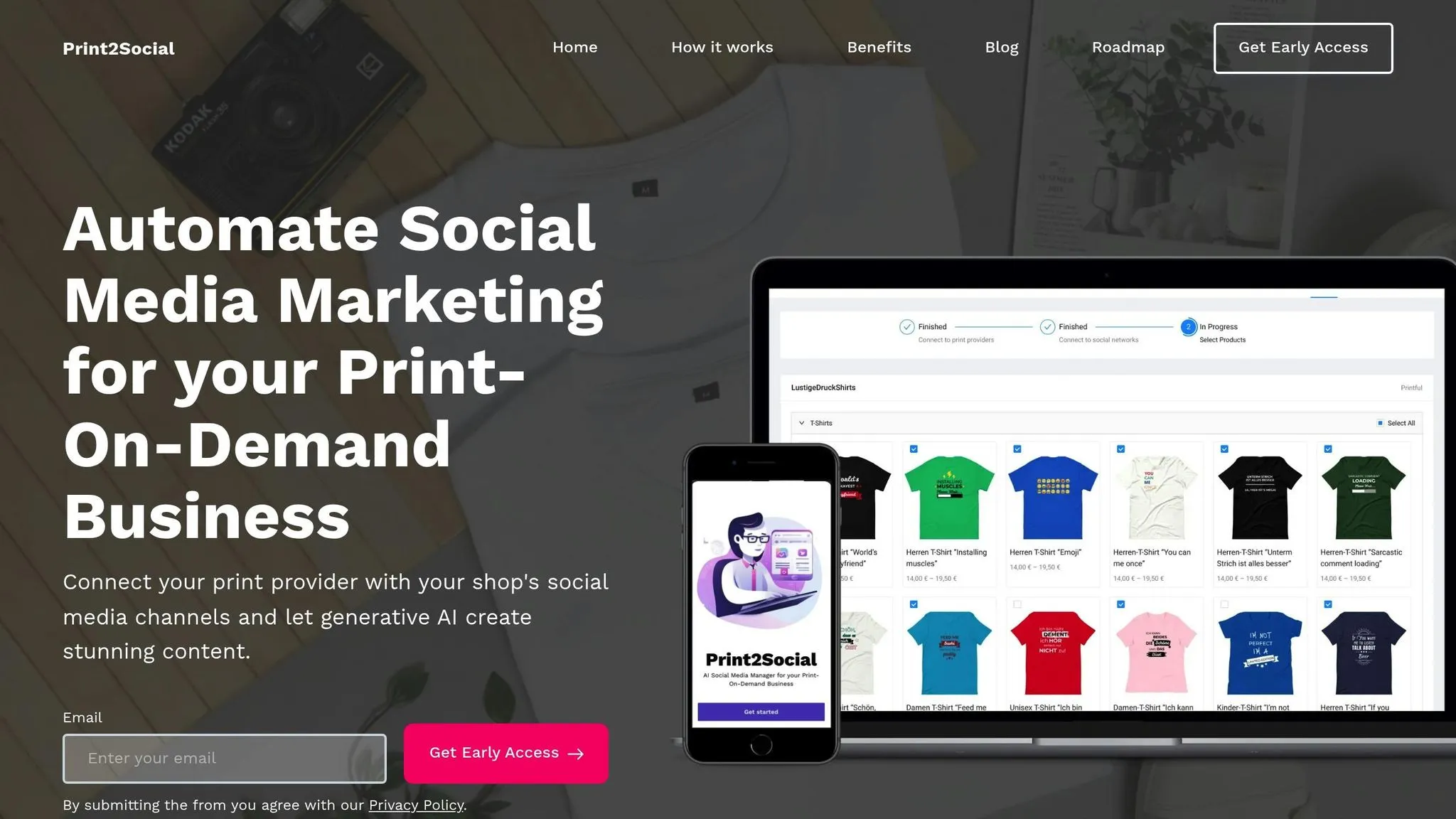
Print2Social makes it easy for print-on-demand businesses to embrace these AI-driven benefits. Designed to integrate seamlessly with platforms like Printful and social media accounts, Print2Social streamlines workflows without requiring advanced technical skills.

Through the Print2Social interface, you can select specific products or categories to promote. The AI then generates 12 images and 8 short videos per product, including mockups, lifestyle photos, and video clips, giving you plenty of creative options for optimization.

In addition, the platform creates 20 unique social media posts per product. These posts balance promotional, engagement, and educational content, keeping your audience interested without overwhelming them with sales messages. The AI ensures the content aligns with your brand’s voice and style, offering multiple variations for flexibility.

Print2Social doesn’t stop at content creation - it also automates scheduling and optimization. You can review and tweak AI-generated posts before publishing, ensuring your brand’s authenticity remains intact. Meanwhile, AI’s predictive capabilities help you maximize your ROI by fine-tuning content for better performance.

“Artificial intelligence, however, is rewriting the rules of audience insights.” - Lineup

What sets Print2Social apart is its all-in-one integration. The platform handles everything from fetching product data to creating and scheduling content. This eliminates the need to juggle multiple tools or platforms, making it easier to adopt AI-driven strategies without investing in extra software or technical expertise. By simplifying these processes, Print2Social allows you to focus on growing your business while leveraging AI to its fullest potential.

How does AI enhance the effectiveness of social media ad campaigns?

Section titled “How does AI enhance the effectiveness of social media ad campaigns?”

AI takes social media ad campaigns to the next level by diving deep into user data to pinpoint the most relevant audience for your ads. It doesn’t just stop at identifying potential viewers - it predicts which users are more likely to engage or take action, ensuring your ads land in front of the right people at the perfect moment.

On top of that, AI fine-tunes bidding strategies by analyzing key factors like user behavior, ad performance, and shifting market trends. The result? Smarter spending that cuts down on wasted budgets and boosts your return on investment (ROI). With these processes automated, businesses can focus their energy on crafting compelling content while seeing improved campaign performance.

What data does AI analyze to forecast ROI for social media ads, and why is cross-channel integration crucial?

Section titled “What data does AI analyze to forecast ROI for social media ads, and why is cross-channel integration crucial?”

AI leverages a combination of first-party data (like customer behavior and purchase history), third-party data (such as industry trends), and historical campaign performance to estimate ROI for social media ads. This approach uncovers patterns and provides more precise predictions about potential outcomes.

Cross-channel integration is equally important. It ensures a unified brand presence across platforms, which strengthens customer trust and loyalty. Additionally, it sharpens targeting accuracy and improves attribution insights, helping businesses pinpoint the strategies that deliver the best ROI.

How can print-on-demand businesses use AI tools like Print2Social to boost their marketing and maximize ROI?

Section titled “How can print-on-demand businesses use AI tools like Print2Social to boost their marketing and maximize ROI?”

Print-on-demand businesses can take advantage of AI-powered tools like Print2Social to simplify their social media marketing efforts and achieve stronger results. These tools handle tasks like content creation, product integration, and post scheduling, making it easier to maintain consistent interaction with your audience while saving valuable time.

AI also enables the creation of highly targeted campaigns that align with your customers’ interests, helping to improve ad performance and boost returns. For businesses in the U.S., this translates to increased sales and profitability, all while cutting down on the manual work involved in managing social media marketing.

How AI Helps POD Businesses Scale Social Media

AI is transforming how print-on-demand (POD) businesses manage social media by automating tasks and boosting efficiency. Here’s how AI tools like Print2Social make it easier to grow your POD business online:

  • Saves Time: Automates content creation, scheduling, and repetitive tasks.
  • Creates Better Content: Generates product images, videos, and posts tailored to your audience.
  • Optimizes Posting: Finds the best times to post based on audience behavior and trends.
  • Improves Reach Across Platforms: Customizes content for Instagram, Pinterest, TikTok, and Facebook.
  • Tracks Performance: Analyzes engagement and adjusts strategies in real-time.

With AI, you can focus on growing your business while maintaining a consistent, high-quality social media presence.

AI technology has transformed how print-on-demand (POD) businesses approach social media content. Print2Social’s AI system takes the hassle out of manual content creation by generating 12 product images and 8 short videos for every item in your catalog. This results in a variety of content tailored for different audiences.

Here’s what the AI creates:

Content Type

Examples

Static Images

Product mockups, lifestyle shots, flat lays

Video Content

Product demos, lifestyle clips

Post Types

Promotional, educational, engagement-driven

By analyzing trends and customer behavior, the AI ensures your content stays relevant and engaging while aligning with your brand’s voice. Plus, it integrates directly with scheduling tools to maximize your audience reach.

AI-powered tools take the guesswork out of scheduling by analyzing engagement patterns to pinpoint the best times to post. Here’s what the system evaluates:

  • Past engagement trends
  • Time zone variations
  • Platform activity peaks
  • Seasonal shifts in behavior

These data-driven insights help ensure your posts land at the right time to capture the most attention.

Getting started is simple, thanks to a streamlined four-step process:

1. Store Connection: Link your POD store to Print2Social to sync your product catalog.

2. Product Selection: Pick specific items or categories to promote across social platforms.

3. Content Generation: Let the AI create 20 unique pieces of content for each product.

4. Schedule Review: Check the AI-crafted content calendar and tweak it if needed before posts go live.

“Easily link your print-on-demand shops and social media accounts in just a few clicks.” - Print2Social

This automated system slashes the time spent on social media management while delivering high-quality, engaging content to fuel growth for POD businesses.

Social Media Platform Selection for U.S. Market

Section titled “Social Media Platform Selection for U.S. Market”

Print2Social’s AI helps identify the most effective social media channels for print-on-demand (POD) products by analyzing product categories and audience demographics.

Platform

Best Content Types

Ideal Product Categories

Instagram

Lifestyle photos, Stories

Apparel, accessories, home decor

Pinterest

Product pins, collections

Wall art, home goods, seasonal items

TikTok

Short-form videos

Trendy apparel, statement pieces

Facebook

Mixed media, carousels

Custom gifts, family-focused items

For example, when it comes to apparel, the AI generates Instagram-ready lifestyle photos and TikTok videos that showcase products in everyday settings. These tailored insights ensure your content aligns with platform-specific preferences.

Print2Social goes beyond basic analytics by providing detailed performance insights to fine-tune your social media strategy. It tracks key metrics to highlight the platforms delivering the best results.

The AI evaluates:

  • Engagement rates on each platform
  • Conversion rates for different content types
  • Patterns in audience growth
  • Peak activity times for optimal posting

Using this data, Print2Social’s AI adjusts your strategy in real time. If it notices higher engagement for certain product categories on a platform, it prioritizes creating and scheduling similar content for that channel.

Here’s how Print2Social simplifies cross-platform management:

  • Analyzes performance data to create and schedule optimized content
  • Adjusts posting schedules based on real-time engagement insights
  • Recommends content formats tailored to each platform’s audience preferences

This data-driven method helps your POD business maintain a strong presence on the most relevant social platforms while maximizing engagement with your U.S. audience.

Print2Social’s AI simplifies managing multiple social media accounts while keeping your brand’s message consistent. It automatically pulls products from your print-on-demand (POD) store and creates a variety of posts tailored to your audience. These posts include a mix of promotional, educational, and interactive content, helping your brand stay active and relevant on all platforms. This automation makes it easier to keep up with trends and quickly analyze customer feedback.

AI tools make it easier to react to market trends and customer feedback in real time. By tracking engagement patterns, the system helps fine-tune your content based on live performance data. Here’s how it works:

Response Type

AI Action

Business Impact

Customer Sentiment

Adjusts tone and messaging style

Builds stronger audience connection

Design Preferences

Highlights best-performing items

Boosts interest and sales potential

Seasonal Demand

Optimizes promotion timing

Captures peak sales opportunities

The system also generates multiple versions of posts to test what works best. Once it identifies successful elements, it integrates them into future strategies. These insights help businesses refine their content approach and see real improvements in key metrics.

Print2Social connects your POD store directly to your social media accounts, streamlining everything from product selection to scheduling posts. Using AI to create and time posts not only ensures a polished social media presence but also saves time on manual tasks. Performance data consistently shows increased engagement rates and audience growth across the platforms it manages, making it a powerful tool for scaling your online presence.

Copy This 100% Automatic AI Print On Demand System (Make …

Section titled “Copy This 100% Automatic AI Print On Demand System (Make …”

Conclusion: AI Tools for POD Business Success

Section titled “Conclusion: AI Tools for POD Business Success”

AI tools have reshaped how print-on-demand (POD) businesses handle their social media efforts. By automating essential marketing tasks, these tools help businesses grow efficiently while keeping their audience engaged across various platforms.

Here’s how AI makes a difference for POD businesses:

Saving Time and Resources: Automation takes over tasks like content creation and scheduling, freeing up business owners to focus on bigger-picture strategies instead of daily social media chores.

Improving Content Quality: AI ensures a mix of promotional, educational, and engaging posts. It also creates visually appealing content that keeps audiences interested while maintaining a consistent brand image.

Supporting Scalable Growth: Unlike traditional methods that often require more staff to handle growth, AI tools keep performance steady as your business expands, managing your product catalog efficiently without extra labor.

Growth Factor

AI’s Role

Time Savings

Handles repetitive tasks

Content Quality

Produces polished visuals

Balanced Marketing

Ensures a diverse content mix

Scalability

Manages growth effortlessly

AI tools are becoming essential for POD businesses aiming to maintain a strong social media presence. By automating repetitive tasks and delivering high-quality content, these tools provide the support needed for steady and effective growth in today’s competitive market. They build on the strategies discussed earlier, offering a solid foundation for ongoing success.

How can AI determine the best times for a print-on-demand business to post on social media?

Section titled “How can AI determine the best times for a print-on-demand business to post on social media?”

AI-powered tools analyze a variety of factors to identify the optimal times for posting on social media. These factors can include audience activity patterns, engagement trends, and platform-specific insights. By leveraging this data, AI ensures your posts reach the largest and most engaged audience possible.

For print-on-demand businesses, tools like Print2Social make this process seamless by automating the analysis and scheduling of posts. This allows you to focus on growing your business while your social media strategy runs efficiently in the background.

What kind of content can AI create for a print-on-demand business, and how does it optimize posts for different social media platforms?

Section titled “What kind of content can AI create for a print-on-demand business, and how does it optimize posts for different social media platforms?”

AI can create a variety of content tailored to the needs of print-on-demand businesses, such as product mockups (including lifestyle photos, flat lays, and static images) and short videos like product showcases or lifestyle clips. These assets are designed to highlight your products and engage your audience effectively.

To optimize for different platforms, AI generates unique posts that combine these visuals into promotional, educational, and engagement-focused content. It adjusts formats and styles to suit each social media channel, ensuring your posts resonate with the intended audience and maximize reach. By automating this process, AI helps streamline your marketing efforts and saves valuable time.

Section titled “How can AI tools like Print2Social help POD businesses adapt to customer feedback and market trends quickly?”

AI tools like Print2Social empower print-on-demand (POD) businesses to stay agile by streamlining social media management. By leveraging generative AI, these tools can analyze market trends and customer preferences, enabling businesses to create timely and relevant content that resonates with their audience.

For example, Print2Social connects directly to your POD fulfillment providers and social media accounts, allowing it to fetch product details and generate promotional posts automatically. This means you can quickly respond to customer feedback or trending topics by showcasing tailored products in engaging formats like images and videos. The automated scheduling feature ensures your posts go live at the optimal time, keeping your brand visible and responsive in a fast-paced market.

Which Platform Is The Easiest for Growing Followers in 2025

TikTok emerges as the clear frontrunner for ease of follower growth in 2025, with its algorithm design and engagement metrics significantly outpacing competitors. While each platform offers unique advantages for different types of content creators, the data strongly indicates that new accounts can gain traction fastest on TikTok, followed by Instagram, with other platforms presenting greater challenges for organic growth.

TikTok continues to dominate as the platform where gaining followers is most accessible, particularly for new accounts with no established audience. This advantage stems from several key factors that make the platform uniquely positioned for rapid growth:

TikTok’s algorithm stands apart from other platforms by focusing primarily on content quality rather than account size. Unlike platforms that prioritize existing popularity, TikTok’s For You Page can propel unknown creators to viral status overnight. The platform is explicitly designed to “promote content based on engagement rather than follower count, making it possible for anyone to go viral”.

This algorithmic approach means that a compelling video from a brand-new account has nearly the same chance of being seen as content from established creators. As one analysis directly states, “It’s easier to grow and go viral on TikTok because its algorithm favors content that engages users regardless of the creator’s follower count”.

The numbers strongly support TikTok’s position as the growth leader. In 2025, TikTok maintains an organic engagement rate of 2.50%, dramatically outperforming Instagram (0.50%) and Facebook/X (both at 0.15%). This engagement advantage translates directly to faster follower acquisition.

Additionally, TikTok posts generate substantially more interaction, averaging “66 comments each, representing a 73% increase year-over-year,” compared to Instagram’s 24 comments per post. This higher engagement rate creates a virtuous cycle for follower growth.

TikTok’s short-form video format is particularly conducive to viral sharing. The platform offers multiple creative tools that make producing engaging content accessible even to beginners:

“TikTok’s meteoric rise in popularity has made it a prime platform for those looking to gain followers quickly… Even new accounts can achieve viral status with the right content… [with] short-form videos that appeal to short attention spans [and] built-in editing features”.

While not as rapid for growth as TikTok, Instagram remains a strong platform for follower acquisition, though with different dynamics:

Instagram’s introduction of Reels was a direct response to TikTok’s success, and this feature has become the platform’s most powerful growth driver. However, Instagram’s algorithm tends to “lean towards showing content from accounts that users already follow”, creating a higher initial barrier for new accounts.

Despite the higher barrier to entry, Instagram offers sophisticated tools for targeted growth. The platform’s hashtag system, when properly utilized, can help content reach specific audiences interested in particular topics. Additionally, Instagram’s integration with Facebook’s advertising infrastructure provides powerful paid growth options.

Some accounts, particularly those with fewer than 10,000 followers, have seen significant growth through strategic use of Stories, with “a 35% increase in Story reach rate” noted in recent studies.

For creators and brands with strong visual content, Instagram’s image-centric format can be advantageous. The platform remains a “visual powerhouse” where “high engagement” and “effective use of hashtags can significantly increase visibility and attract new followers”.

Twitter (now X) presents a more difficult landscape for follower growth in 2025, though certain strategies can yield results:

Despite various tactics for “boosting Twitter followers in 30 days or less”, the platform’s low organic engagement rate of just 0.15% makes it challenging to gain traction without an established presence or network.

When deciding which platform to prioritize for follower growth, consider:

  1. Starting position: If you’re building from zero, TikTok offers the most level playing field.
  2. Content format strengths: Visual brands may perform better on Instagram, while those who excel at quick, entertaining videos will find TikTok more advantageous.
  3. Target demographic: Though TikTok skews younger, it has broadened its demographic reach in recent years.

The evidence overwhelmingly suggests that TikTok provides the easiest path to follower growth in 2025, particularly for new accounts. Its unique algorithm that prioritizes content quality over creator popularity, combined with the highest engagement rates across major platforms, creates an environment where rapid growth is not just possible but common.

Instagram maintains its position as a strong secondary option, especially for visually-oriented creators who can leverage its multiple content formats. However, Twitter and Facebook present significantly higher challenges for organic follower acquisition due to their mature ecosystems and lower engagement rates.

For most creators and brands starting fresh, focusing initial growth efforts on TikTok will likely yield the fastest follower gains, with Instagram serving as a valuable complementary platform as the audience expands.

How AI Tracks Social Media Content for Print-on-Demand

AI tools like Print2Social make managing social media for print-on-demand businesses easier by automating content creation, scheduling, and performance tracking. Here’s how it works:

  • Content Creation: For each product, AI generates 12 images (e.g., mockups) and 8 videos, ready for social media.
  • Scheduling: Posts are automatically scheduled for peak engagement times, saving you time.
  • Performance Tracking: Tracks key metrics like engagement rate, reach, impressions, click-through rate, and conversions in real time.
  • Insights: Provides actionable data to refine your strategy and improve results.

Metricool

AI tools like Print2Social streamline social media marketing for print-on-demand businesses by handling tasks like content creation, scheduling, and distribution automatically. Once you link your store and social accounts, Print2Social generates and schedules posts for you. It also tracks performance metrics - such as likes, comments, shares, reach, and engagement rate - in real time. This setup allows you to focus on strategy while machine learning works to refine your social media efforts continuously.

Let’s take a closer look at the specific metrics AI tracks to gauge social media performance.

Print2Social

Set up Print2Social in just three steps to streamline your content creation and scheduling process.

  • Connect your print-on-demand provider account to sync your product catalog.
  • Link your social media accounts.
  • Choose specific products or categories you want to promote.

Print2Social creates 12 images (including lifestyle photos and detailed mockups) and 8 short videos for each product. These are then combined into ready-to-review social media posts.

  • Use the content calendar to preview and edit posts.
  • Customize posting times and frequency to match your strategy.
  • Compare different content options and pick the best versions.

Once your posts are scheduled, it’s time to monitor key performance indicators (KPIs) to fine-tune your strategy and boost results.

Keep an eye on these essential metrics to understand how your content is performing:

  • Engagement rate: The ratio of interactions (likes, comments, shares) to impressions.
  • Reach: The number of unique users who viewed your post.
  • Impressions: The total number of times your post was viewed.
  • Click-through rate (CTR): The percentage of clicks compared to impressions.
  • Conversion rate: The percentage of users who completed a desired action (like making a purchase or signing up) after clicking.
  • Follower growth: The net increase in followers over a specific period.

Your dashboard is a powerful tool for tracking and analyzing performance. Here’s how to make the most of it:

  • Monitor scheduled posts alongside live metrics to see how your content is performing in real time.
  • Filter results by platform, date range, or post type to focus on specific campaigns or timeframes.
  • Compare campaign outcomes to identify trends and determine what works best.
  • Export reports for deeper analysis and to share insights with your team.

Use performance metrics and AI insights to fine-tune your content and streamline scheduling processes.

Evaluate visuals, posting times, and content formats to identify what resonates most with your audience. This helps you focus on the formats and themes that deliver the best results.

Print2Social takes care of scheduling posts during high-engagement periods, ensuring consistent output. You can review AI-generated post variations, sync your calendar with optimal engagement windows, and track performance in real time.

AI-powered social media tracking has transformed how print-on-demand businesses handle their online presence and marketing strategies.

By linking your print-on-demand store with your social media accounts, you can automate tasks like content creation, scheduling, and maintaining a consistent feed. This gives you more time to focus on strategic growth.

Use AI tools to gain real-time insights into engagement, reach, and conversions. These insights help fine-tune your posting schedule, improve your content, and scale your print-on-demand business effectively.

How To Analyze Competitor Social Media Tactics

Here’s how competitor analysis can help:

  • Identify posting patterns: Learn the best times and frequency for posting.
  • Understand engagement trends: Track likes, comments, shares, and audience activity.
  • Spot opportunities: Find market gaps and avoid common mistakes.
  • Refine your content: Discover what works and apply it to your strategy.

Use tools like Print2Social to automate data collection and content creation, saving time while improving efficiency.

  1. Find competitors using hashtags like #PODmerch or #customapparel.
  2. Track metrics like engagement, growth, and content performance.
  3. Analyze content types, visuals, and audience interaction patterns.
  4. Leverage automation to streamline tracking and content creation.

Quick Tip: Regularly review data to stay updated on trends and adjust your strategy for better results.

How to Do a Competitor Analysis on Social Media

Section titled “How to Do a Competitor Analysis on Social Media”

Understanding your competitors is key to refining your social media strategy. Here’s how you can identify and monitor your rivals effectively.

Competitors generally fall into two categories:

  • Direct competitors: Businesses offering similar print-on-demand (POD) products to the same audience.
  • Indirect competitors: Companies selling different products but vying for the attention of your target customers.

To create a competitor list:

  • Search for industry-specific hashtags like #PODmerch, #customapparel, and #printondemand to discover sellers.
  • Keep an eye on trending designs and popular product categories in your niche.
  • Identify businesses that cater to the same audience as you.
  • Observe engagement on competitor product posts to gauge their reach.

Focus on competitors that align with your business size and target audience. For instance, a small custom t-shirt shop doesn’t need to compare itself to large retail chains.

Once you’ve identified your competitors, the next step is analyzing their social media activity.

Take a closer look at your competitors’ social media activity, especially on platforms that resonate with your audience. Tools like Print2Social can simplify tracking their posting habits and engagement metrics.

Here’s how to map their presence effectively:

  • Document platform activity: Note which platforms they use most frequently.
  • Track posting frequency: Monitor how often they post on each platform.
  • Analyze content mix: Look at the balance between promotional posts, educational content, and audience engagement.
  • Record engagement patterns: Identify when their audience is most active and responsive.

Platform Activity Tracking

What to Monitor

Post Frequency

Number of posts daily or weekly

Content Types

Product showcases, behind-the-scenes, customer highlights

Peak Engagement Times

Days and times with the highest engagement

Response Rate

How quickly they respond to comments and messages

To analyze competitors effectively, focus on specific metrics that reveal their social media performance. Here are the key areas to monitor:

Metric Category

Key Indicators to Track

Engagement

Likes, comments, shares, saves

Growth

Weekly/monthly follower increases

Content Performance

Post reach, click-through rates

Audience Response

Comment sentiment, response times

Posting Patterns

Frequency, timing, platform usage

Monitor these metrics consistently over 30–90 days. This timeframe helps you identify patterns and trends that can lead to actionable insights.

Organize your data efficiently with the right tools and processes.

Tracking Competitor Data

  • Create a dedicated spreadsheet for each competitor.
  • Record daily metrics, campaign activities, and content themes.

For a more automated approach, consider using AI-powered tools like Print2Social. These tools can help you track content performance and identify trends while you focus on managing your social media efforts.

Once you’ve gathered structured data, dig deeper into your competitor’s content strategies by examining the following:

Content Types

  • Product highlights
  • Educational posts
  • Behind-the-scenes content
  • Customer reviews or testimonials
  • Promotions and special offers

Visual Elements
Evaluate how competitors use visuals like photos, videos, graphics, and consistent branding to enhance their posts.

Engagement Trends
Pay attention to how different content performs:

  • Posts that get the most saves
  • Content driving the highest number of comments
  • Shares generated by specific posts
  • How timing affects engagement levels

For print-on-demand businesses, tools like Print2Social can simplify this process by generating multiple content variations. This allows you to test strategies inspired by competitor insights and refine your approach.

Looking at how your competitors operate can help you refine your approach by highlighting what works and where there’s room for improvement.

Dive into how competitors interact with their audience to pick up effective social media tactics. Pay attention to these key areas:

Response Time and Quality
Monitor how quickly and effectively competitors reply to comments and messages. Take note of whether they:

  • Address customers personally (using their names)
  • Provide clear and helpful solutions
  • Maintain a consistent tone and style
  • Follow up on unresolved issues

Community Building Activities
Check out how competitors build and engage their communities. Here are some common approaches:

Activity Type

Purpose

Common Formats

User-Generated Content

Build trust through real input

Customer photos, reviews, testimonials

Live Sessions

Foster real-time interaction

Q&As, product demos, behind-the-scenes

Interactive Posts

Encourage audience participation

Polls, quizzes, discussion prompts

Community Challenges

Create shared experiences

Hashtag campaigns, themed contests

Next, evaluate the types of content that generate the most engagement.

To keep up with trends, focus on creating varied and engaging content. Tools like Print2Social, which can produce 12 images and 8 short videos per product, show how AI can streamline content creation.

Content Categories That Drive Engagement

  • Educational Content
    Share posts that solve problems or provide valuable information to build credibility.
  • Product Showcases
    Highlight your products through:
    • Lifestyle photos
    • Tutorial videos
    • Customer success stories
    • Feature highlights
  • Engagement-Focused Posts
    Use content designed to spark interaction, such as polls, questions, or games.

Once you’ve identified high-performing content, take a deeper look at each competitor’s overall strategy to spot their strengths and weaknesses.

Platform Effectiveness
Analyze how well competitors perform on different platforms by reviewing:

  • Engagement rates
  • Growth in followers
  • Performance of their content
  • Audience demographics

Content Strategy Assessment

Area

What to Analyze

Why It Matters

Content Quality

Visual appeal, clear messaging

Shapes audience’s first impressions

Posting Consistency

Frequency, timing patterns

Impacts visibility and algorithm success

Campaign Success

Effectiveness of promotions

Highlights what resonates with the audience

Brand Voice

Style and tone of communication

Shows how they position themselves

Use the insights from your competitor analysis to pinpoint areas where your business can stand out and perform better.

Look for areas where your print-on-demand business can make a mark. Some opportunities to consider:

  • Product Lifestyle Content
    Show your products in everyday settings. Use tools like Print2Social’s AI image generator to create diverse and engaging lifestyle images.
  • Video Demonstrations
    Highlight product features and quality through automated video demos. These can help customers better understand your offerings.
  • Behind-the-Scenes Content
    Build trust by sharing how your designs are created or how your production process works.
  • Educational Material
    Solve customer challenges with practical guides and usage tips. This type of content can position your brand as helpful and knowledgeable.

Engagement Opportunities
Pay attention to times when competitors see lower engagement, such as early mornings, late nights, weekends, or certain holidays. Use this data to schedule your posts strategically and stand out during those quieter periods.

Underserved Audience Segments
Look for customer groups your competitors might be ignoring. For instance, if they focus on younger audiences, consider crafting content that resonates with older demographics.

Once you’ve identified these gaps, set clear, measurable goals to make the most of these opportunities.

Create achievable goals by comparing your metrics to competitor benchmarks. Focus on gradually improving engagement metrics like post interactions, story views, video watch time, and responsiveness. Here’s how you can approach it:

  1. Post Frequency
    Study how often competitors post and find a rhythm that works for your audience. Use Print2Social’s automation tools to maintain consistency.
  2. Content Mix
    Balance your strategy by incorporating a variety of content types. Include product showcases, educational posts, engagement-driven content, and behind-the-scenes glimpses to cover all bases.
  3. Growth Metrics
    Track key indicators like follower growth, reach, impressions, click-through rates, and conversions from social traffic. These metrics will help you measure progress and refine your approach.

Monitoring and Adjustment
Keep a close eye on your performance data and tweak your strategy as needed. If something isn’t working, take advantage of Print2Social’s content generation tools to test new ideas quickly and efficiently.

Automation tools can simplify your workflow by helping you monitor competitors and execute content strategies more efficiently. Print2Social offers AI-powered features to make this process easier:

Content Creation and Analysis

  • Generate lifestyle images and video demos automatically.
  • Test strategies with different types of content.
  • Balance your posts between promotional, educational, and engaging material.

Scheduling Made Easier

  • Post at optimal times based on platform guidelines.
  • Keep a consistent posting schedule.
  • Automate content distribution across multiple channels.

These tools not only save time but also help you stay competitive. The next step is ensuring your strategy stays up-to-date with current trends.

Automation tools don’t just save time - they also make it easier to adjust your strategy as needed. Staying on top of trends and competitor activity requires regular updates. Here’s how you can set up an effective routine:

Monitoring Schedule
Establish a schedule to track competitor activity consistently:

  • Daily: Check for new posts and engagement stats.
  • Weekly: Review content themes and performance trends.
  • Monthly: Evaluate your overall strategy and tweak automation settings.

Adjusting Your Strategy
Leverage automation tools to fine-tune your strategy based on competitor insights:

  • Content Tweaks: Identify which types of content perform best and adjust your automated content creation to reflect these trends. Keep your brand voice consistent while experimenting with variations.
  • Better Timing: Use engagement and audience activity data to post at the best times.
  • Measure Success: Compare your automated content’s performance to competitor benchmarks. Use this data to refine your AI settings and posting strategies.

Staying Adaptable
While automation simplifies many tasks, it’s essential to remain flexible. Keep an eye on market shifts and trends, and regularly review your automated systems to ensure they align with your goals. This balance between automation and adaptability will help you stay ahead.

Analyzing competitors’ social media performance is a key driver of success in the print-on-demand market. By tracking metrics and studying their content, businesses can uncover opportunities and set clear growth targets.

To make this process effective, regular monitoring and actionable takeaways are essential. A consistent approach ensures that automation tools can be used to their full potential.

Automation simplifies this effort. Tools like Print2Social use AI to help businesses by:

  • Generating a variety of visual content automatically
  • Creating balanced content suited for different platforms
  • Scheduling posts effortlessly
  • Fine-tuning brand messaging for better engagement

Leading print-on-demand companies combine competitor analysis with automation to stay ahead. As discussed earlier, Print2Social takes care of content creation and scheduling, freeing up businesses to focus on scaling and innovation.

Competitor analysis is an ongoing effort. Use the insights you gather to adjust and improve your strategy. With the right tools and a structured approach, you can turn competitor data into actionable steps that deliver real results.

10 Ways to Use Reviews for Social Media Growth

Customer reviews are a powerful tool for boosting your social media presence. They provide social proof, user-generated content, and valuable feedback to improve your products and engage your audience. Here’s how you can use them effectively:

  • Turn Reviews into Posts: Share customer quotes with product images or videos.
  • Create Review Videos: Use tools to make dynamic videos from testimonials.
  • Engage with Reviews: Reply to both positive and negative feedback to build trust.
  • Improve Products: Use feedback to refine your offerings and share updates.
  • Run Contests: Encourage customers to share reviews through contests.
  • Collaborate with Influencers: Blend reviews into influencer content.
  • Highlight Patterns in Stories: Share recurring themes from reviews.
  • Weekly Features: Post a standout review every week.
  • Add Reviews to Ads: Use testimonials in social media ads for credibility.
  • Leverage AI Tools: Automate the process with tools like Print2Social.

How To Market Your Business On Social Media

Section titled “How To Market Your Business On Social Media”

Turn positive customer reviews into engaging social media content that builds trust and encourages interaction. By transforming reviews into visually appealing posts, you can highlight customer experiences and connect with new audiences.

How to Make Reviews Stand Out

Tools like Print2Social make it simple to convert reviews into eye-catching visuals. These AI-driven platforms can automatically create professional posts by combining customer testimonials with product images or video clips.

Tips for Crafting Review-Based Posts

To create effective posts from customer reviews, consider these tips:

  • Use quotes that emphasize key product benefits.
  • Pair reviews with images showing the product in action.
  • Tag customers (with their consent) to encourage engagement.
  • Add product links so viewers can shop easily.

These approaches help you create content that resonates with your audience and keeps them engaged.

Mixing It Up

Keep your content fresh by alternating between different types of review-based posts. For example, combine customer quotes, product photos, and video testimonials to tell a well-rounded story about your brand.

Why Automation Helps

Using automation tools ensures a steady stream of content while maintaining a good balance between promotional, engaging, and informative posts. This keeps your social media strategy consistent and effective.

Turn customer reviews into engaging video content to boost your social media presence. Videos consistently perform better than static posts, making them a must-have for growing your audience.

Platforms like Print2Social use AI to transform written reviews into dynamic videos, saving time while keeping the quality consistent. For each product, the tool generates eight variations, allowing you to test and improve quickly.

Here are some effective formats for showcasing reviews:

  • Product-focused videos: Combine testimonials with product visuals.
  • Lifestyle clips: Add review text to real-life usage scenarios.
  • Animated designs: Use quotes creatively with mockups or animations.

To make your review-based videos stand out, pay attention to these details:

  • Keep them short and attention-grabbing.
  • Use clear, easy-to-read text overlays.
  • Highlight the product visually throughout the video.
  • Add music that complements the tone.
  • End with a strong call-to-action.

AI tools like Print2Social simplify the process by blending visuals and reviews into professional-quality videos. This automation helps maintain a consistent look and feel across all your content.

Try different approaches - product showcases, lifestyle clips, or animations - to see what resonates with your audience. Regularly tweak your formats to keep your videos fresh and engaging.

Engaging with reviews on social media isn’t just about visibility - it’s about building stronger connections with your customers.

Responding to reviews quickly shows customers you value their time and feedback. A prompt reply can leave a lasting impression.

Craft thoughtful replies that make customers feel appreciated. Here’s how:

  • Address them by name and mention specific details from their review.
  • Highlight their positive experience to reinforce it.
  • Encourage future interactions, like returning or sharing more feedback.

For example:

“Thanks for your feedback, Sarah! We’re thrilled you loved our custom hoodies. Can’t wait to serve you again!”

Turning Negative Reviews Into Opportunities

Section titled “Turning Negative Reviews Into Opportunities”

Negative reviews can be tricky, but they’re also a chance to show your commitment to improvement. Here’s a simple approach:

  • Acknowledge the issue without being defensive.
  • Offer to resolve it privately after a brief, empathetic public reply.
  • Once resolved, update the thread to let others see how you handled it.

This approach not only addresses the issue but also shows transparency and care.

AI tools, like Print2Social, can help make responding to reviews more efficient. They can:

  • Analyze sentiment to prioritize reviews.
  • Suggest tailored response templates.
  • Monitor your response times and engagement levels.
  • Schedule follow-ups to keep the conversation going.

Use customer feedback to refine your products while also boosting your presence on social media. Build a system that turns this feedback into actionable improvements.

Sort customer reviews into categories like:

  • Print quality
  • Material durability
  • Size accuracy
  • Design clarity
  • Shipping experience

Tracking these categories regularly helps you spot recurring issues and measure progress over time.

Address common concerns directly. For example, if customers mention sizing problems, update your size charts, add detailed fitting guides, or include comparison photos to make it easier for customers to choose the right size.

Use social media to highlight product updates with before-and-after visuals. Include customer testimonials and reviews that prompted these changes to show you’re listening and taking action.

Monitor how your updates perform by tracking metrics like likes, shares, comments, and customer sentiment. Pay attention to new reviews that reflect customer responses to your improvements.

Save time by using tools like Print2Social to automate social media updates. This allows you to focus on analyzing feedback and implementing changes more efficiently. Automating these processes ensures you stay responsive without sacrificing time.

Turn customer reviews into contests to boost engagement and build social proof for your print-on-demand business. These contests not only increase visibility but also encourage customers to share their experiences in creative ways.

Create contests with clear rules and appealing rewards. Keep participation straightforward to ensure you receive quality entries. Here are some ideas:

  • Photo Review Challenge: Invite customers to share photos of themselves using your products along with their honest reviews.
  • Video Testimonial Contest: Ask for short video reviews showcasing your product’s features.
  • Creative Review Stories: Encourage customers to share unique or unexpected ways they use your products.

Motivate participation with tiered prizes that encourage effort and creativity. Here’s an example prize structure:

Prize Tier

Reward Type

Requirements

Grand Prize

$250 store credit

Best photo or video review

Runner-up

$100 store credit

Top 3 detailed written reviews

Participation

15% discount code

All valid review submissions

Use multiple channels to spread the word and maximize participation:

  • Pin announcements to your social media profiles.
  • Create branded hashtags to track entries easily.
  • Showcase winning entries to inspire others.
  • Use Instagram Stories highlights to feature ongoing contests.

These strategies will help your contest gain traction and encourage more entries.

Set clear guidelines to maintain the integrity of your contests:

  • Require proof of purchase for eligibility.
  • Specify minimum review length requirements.
  • Ask customers to include details about the product.
  • Request original photos or videos that show the product in use.

These steps ensure the reviews are genuine and useful, both for your business and future customers.

Track important metrics to evaluate the contest’s impact:

  • Total review submissions
  • Social media engagement levels
  • Hashtag usage
  • Customer participation trends
  • Conversion rates from contest-related traffic

Analyzing these metrics will help you refine future contests for even better results.

Simplify the process with tools like Print2Social. These can help you schedule, manage, and track your contests, so you can focus on reviewing entries and picking winners.

Combine influencer marketing with customer reviews to strengthen your print-on-demand brand. Here’s how to seamlessly integrate reviews into influencer content.

Choose Reviews That Match the Influencer’s Style

Section titled “Choose Reviews That Match the Influencer’s Style”

Pick reviews that align with the influencer’s tone and audience. Focus on real testimonials that showcase specific product features or benefits the influencer can naturally highlight in their content.

Incorporate customer feedback into various content formats:

Content Type

How to Add Reviews

Purpose

Instagram Stories

Overlay verified customer quotes on images

Build trust and show transparency

YouTube Reviews

Include testimonials in b-roll footage

Add social proof

TikTok Videos

Use review screenshots during transitions

Make content feel relatable and engaging

Transform plain text reviews into shareable visuals. Tools like Print2Social can help by:

  • Turning customer feedback into eye-catching graphics.
  • Creating short videos featuring product reviews.
  • Designing custom visuals that combine influencer content with testimonials.

Authenticity matters. Make sure influencers:

  • Use verified customer reviews.
  • Have creative freedom in how they present the reviews.
  • Share their own experiences alongside the testimonials.
  • Clearly label sponsored content to maintain transparency.

Track how well these posts perform by analyzing:

  • Engagement rates on posts featuring reviews.
  • Click-through rates to product pages.
  • Conversion rates from influencer-shared content.
  • Audience reactions and feedback.

These metrics can help you fine-tune your strategy for better results.

Once you’ve found what works, expand your efforts by:

  • Repurposing successful posts for other platforms.
  • Adapting review content for specific social channels.
  • Encouraging influencers to share reviews in multiple formats.
  • Building a consistent message across all touchpoints.

Print2Social can simplify the process, helping you maintain consistent branding while scaling your influencer campaigns effectively.

7. Share Review Patterns in Social Stories

Section titled “7. Share Review Patterns in Social Stories”

Turn recurring themes from customer reviews into engaging Stories content that resonates with your audience.

Break down customer feedback into key themes to guide your content:

Theme Type

What to Look For

Story Content Ideas

Product Quality

Mentions of durability, materials

Before/after wear tests

Customer Service

Response time, issue resolution

Behind-the-scenes support clips

Design Features

Popular style elements, print quality

Close-up product showcases

Shipping Experience

Delivery speed, packaging quality

Unboxing highlights

This structure helps you craft Stories that reflect both the strengths and challenges highlighted in reviews.

Turn these themes into a series of Stories that feel connected and purposeful. Use tools to ensure visuals are consistent and polished.

Go beyond celebrating positive feedback by tackling areas for improvement:

  • Highlight reviews, share quick tutorials, and showcase success stories to underline key benefits.
  • Be transparent about concerns raised in reviews.
  • Explain the steps you’ve taken to address these concerns.
  • Offer behind-the-scenes glimpses of ongoing improvements.

Design your Stories with these tips to make them visually appealing and interactive:

  • Use brand colors to differentiate feedback categories.
  • Create custom Story highlights for each major theme.
  • Add interactive polls to engage with recurring feedback.
  • Include product tags for easy navigation to items.

Measure the impact of your review-based Stories by monitoring these metrics:

Metric

What It Tracks

Why It Matters

Story Completion Rate

Percentage watching full story

Indicates content relevance

Tap Forward Rate

Number of quick forwards

Highlights less engaging segments

Reply Rate

Direct responses to stories

Shows audience connection

Link Clicks

Visits to product pages

Reflects purchase interest

Use this data to refine your approach, focusing on the themes that resonate most with your audience.

Use customer reviews to create a weekly feature that builds trust and keeps your audience engaged. Highlight real experiences to showcase your products in a relatable way.

Develop a template that aligns with your brand and makes reviews stand out. Include:

  • A consistent look (colors, fonts, and layout)
  • A featured review alongside a product image
  • Key product details
  • Customer tags (make sure you have their permission)
  • A clear call-to-action to drive engagement

Schedule your review posts ahead of time. Rotate through different product categories each week to keep things fresh and appeal to a wider audience. Automating this process can help you stay on track without extra hassle.

Use tools like Print2Social to simplify your workflow. These tools can help you create and schedule visuals for each review, turning them into attention-grabbing images or videos while keeping your social media calendar organized.

Take your review posts to the next level by:

  • Pairing customer photos with professional product images
  • Highlighting standout product features
  • Adding helpful details like sizing or care instructions
  • Tying posts to seasonal trends or popular themes

Pay attention to metrics like engagement, click-through rates, and comments. Use this data to tweak your posting schedule and refine your content for better results.

Get more customers to share their experiences by:

  • Offering incentives like discounts or entry into contests
  • Promoting a branded hashtag for reviews
  • Showing how customer feedback influences your products and services

Adding reviews to your social media ads can boost customer trust and improve visibility. Reviews act as social proof, helping potential buyers feel more confident about your product and encouraging them to take action.

Choose reviews that highlight your product’s strengths or address common customer concerns. These should clearly showcase how your product solves problems or stands out from competitors. Pair these reviews with eye-catching product images to create ads that grab attention and drive clicks.

To streamline the process, you can use tools like Print2Social to create multiple ad variations. This allows you to test different formats and messages to see what works best for your audience.

Keep an eye on key metrics like click-through rates and conversions. Testing and refining your ads will help you get the best possible results.

Print2Social

Print2Social helps you turn customer reviews into eye-catching social media posts, perfect for print-on-demand businesses. Using AI, it creates visual content like product images and video clips, paired with testimonials to boost social proof.

Here’s how to make the most of Print2Social:

  • Connect Your Accounts: Link your print-on-demand shops and social media profiles to streamline your product catalog and reviews in one place.
  • Generate Visual Content: Use AI to produce lifestyle images and promotional videos that highlight customer testimonials. Each product gets 12 images and 8 video clips, giving you 20 unique posts.
  • Schedule Posts: Plan the timing of your posts to maximize visibility and engagement across different platforms.

These features make it easy to incorporate customer feedback into your social media strategy.

Use customer reviews and AI tools to boost your social media presence. This approach transforms everyday feedback into a powerful way to connect with your audience.

By consistently sharing real customer experiences and automating content creation with AI, you can strengthen your online presence. Tools like Print2Social simplify this process for print-on-demand businesses, helping them create up to 20 unique posts per product (12 images and 8 videos). This ensures a constant flow of engaging content.

Here’s how to get started:

  • Review Your Feedback: Gather and organize customer reviews from all platforms.
  • Pick Your Platforms: Focus on social media channels where your audience spends the most time.
  • Automate the Process: Link your print-on-demand store with your social accounts to streamline content creation.

Start today by turning customer feedback into actionable content. Build stronger connections with your audience, monitor engagement, and refine your strategy as needed.

Combining customer feedback with AI-driven tools is the next step in social media marketing. Print-on-demand businesses can use these strategies to create a reliable, time-efficient social media presence.

Ultimate Guide To Feedback-Driven Social Media Marketing

Want to improve your social media marketing? Start by listening to your customers. Feedback-driven strategies help you create better content, refine products, and connect with your audience. Here’s what this guide covers:

  • Why feedback matters: 71% of consumers recommend brands they enjoy on social media.
  • How to gather feedback: Use tools like Hootsuite or Sprout Social to track customer sentiment.
  • Turn feedback into action: Analyze comments, reviews, and user-generated content to improve your marketing.
  • Boost performance: Posts based on feedback see 85% higher sales growth.

Learn how to collect, analyze, and use customer feedback to strengthen your social media strategy.

How to Get Customer Feedback Online (6 Best Ways)

Section titled “How to Get Customer Feedback Online (6 Best Ways)”

Data highlights that 77% of consumers feel more positive about brands that actively seek and act on customer feedback. Here’s how you can effectively gather insights from your customers.

Using the right tools to track customer sentiment and engagement is essential. These platforms are particularly useful for print-on-demand businesses:

Tool

Key Features

Best For

Hootsuite

Multi-platform monitoring, unified inbox

General brand monitoring

Sprout Social

Sentiment analysis, trend tracking

Understanding customer insights

Mention

Real-time brand mention alerts

Quick response management

Talkwalker

Visual analytics, image recognition

Tracking product photos

For a tailored approach, check out Print2Social (https://print2social.com). Its AI-driven features are specifically designed for print-on-demand businesses.

A great example of effective monitoring comes from Printful. In 2022, they used Hootsuite to streamline their customer feedback process. This resulted in a 28% increase in positive sentiment, a 15% faster response time, and a 10% rise in repeat customers.

Next, let’s dive into how direct surveys and reviews can provide deeper insights.

Systematic feedback collection through surveys and reviews can provide valuable insights. Timing is key - send surveys 1–2 weeks after delivery to capture accurate impressions.

  • Use tools like Mailchimp to automate survey distribution.
  • Include both rating scales and open-ended questions for detailed feedback.
  • Offer incentives like discount codes to encourage honest responses.
  • Ensure reviews are collected across multiple platforms for broader visibility.

“96% of unhappy customers don’t complain directly to companies, but 91% of those will simply leave and never come back”.

In addition to surveys, photos and videos from customers can offer a richer understanding of their experience.

User-generated content (UGC) can significantly impact your business, with conversion rates increasing by 161% when UGC is included. Here’s how to encourage customers to share their content:

  • Create Branded Hashtag Campaigns
    Design easy-to-remember hashtags for customers to use when sharing their photos. Highlight these hashtags on packaging inserts and in post-purchase emails.
  • Run Photo Contests
    Organize contests where customers can win prizes like store credit or exclusive designs. This not only generates content but also fosters community engagement.
  • Leverage Packaging
    Include branded inserts with clear instructions on how to share photos or videos. Add hashtags or QR codes that link directly to your social platforms.

Making it easy for customers to share their experiences while offering them value in return is key. Real customer content often connects with audiences better than polished marketing materials, as it captures genuine experiences with your products.

Once you’ve collected customer feedback, the next step is figuring out how to turn it into actionable insights.

AI tools today can categorize comments with an impressive 97% accuracy. This helps businesses quickly spot sentiment trends and patterns. Here’s how these tools can help:

Analysis Type

Tool Features

Business Impact

Sentiment Analysis

Breaks feedback into positive, negative, and neutral categories

Tracks how customers feel about your brand

Topic Detection

Identifies recurring themes and keywords

Helps shape your content strategy

Trend Tracking

Monitors sentiment shifts in real-time

Allows quick responses to issues

For example, Print2Social users can rely on its AI to analyze feedback from multiple social platforms. This makes it easier to detect trends specifically tied to print-on-demand products. These insights can then guide the analysis of visual content.

Visual content shared by customers can be a goldmine. Studies show that 80% of consumers are more likely to buy from brands that feature customer photos or videos in their campaigns. A strong example is Sephora, which used visual recognition AI to analyze Instagram posts. The result? A 22% boost in conversion rates for the products they featured.

Key areas to analyze in customer-shared visuals include:

  • Product placement: How and where products are being used
  • Color schemes: Which colors resonate most with your audience
  • Environmental context: The settings or scenarios in which your products are used

By analyzing these factors, you can identify recurring themes and prioritize actions that align with your customers’ preferences.

Adidas showed the power of theme analysis in June 2023. By using AI to analyze 500,000 Instagram comments, they achieved a 28% increase in positive sentiment and a 12% rise in engagement rates.

“Companies that regularly analyze customer feedback themes see a 15-20% increase in customer satisfaction scores”.

To pinpoint and act on common themes:

  • Collect feedback from diverse sources like social media, reviews, and direct messages.
  • Use tools like text mining and topic modeling to uncover patterns.
  • Prioritize themes based on their frequency, sentiment intensity, and potential business impact.

This structured approach ensures you’re focusing on what matters most to your customers.

Posts shaped by customer feedback consistently outperform generic content, delivering 85% higher sales growth compared to competitors.

Print2Social simplifies the process of turning customer feedback into engaging social media posts. By focusing on what your audience values, you can produce content that truly resonates.

Content Type

Customer Feedback Source

Implementation Strategy

Product Showcases

Customer Reviews

Highlight top-rated product features

Educational Content

Common Questions

Answer frequently asked questions

Social Proof

User Photos/Videos

Share authentic customer experiences

Product Updates

Feature Requests

Announce updates inspired by user input

Take Airbnb’s 2022 Instagram strategy as an example. By showcasing user-generated content, they saw an 18% increase in engagement and a 25% rise in bookings from Instagram traffic within six months. These results underline the power of listening to your audience.

Retail brands typically see an average engagement rate of 0.68% on Instagram and 0.13% on Facebook. To surpass these numbers, experiment with your content:

  • Test posting times and frequency
  • Compare performance across formats (e.g., videos vs. images)
  • Evaluate responses to different calls-to-action
  • Track how features resonate with your audience

“Brands that engage and respond to customer service requests over social media see a 20-40% increase in customer spending”.

Use these insights to fine-tune your strategy and adapt quickly.

Once you’ve identified successful content formats, act fast to stay ahead. Quick adjustments ensure your posts remain relevant and engaging. For example, brands that respond to customer feedback within an hour experience 42% more customer advocacy.

Here’s how to make those updates:

  • Monitor engagement metrics in real time
  • Adjust posting schedules based on performance
  • Respond promptly to comments and messages
  • Scale up content that performs well

If a particular design or post generates strong positive feedback, Print2Social makes it easy to replicate and expand on that success.

“77% of consumers view brands more favorably when they actively seek and implement customer feedback”.

Measuring social media performance is essential for refining your marketing approach. Companies that incorporate social data into their strategies are 1.5 times more likely to see revenue growth.

For print-on-demand businesses, monitoring specific metrics can help gauge social media success. Here are some key ones to track:

Metric

Target Range

How to Calculate

Engagement Rate

1-5%

Total engagements ÷ followers × 100

Conversion Rate

2-5%

Conversions ÷ total visitors × 100

Customer Satisfaction

Over 80%

Average satisfaction score (1-10)

ROI

5:1 to 10:1

(Revenue - Cost) ÷ Cost × 100

Tools like Print2Social’s analytics dashboard simplify tracking these metrics, helping you spot trends and fine-tune your approach.

Breaking your audience into segments can lead to better results. Businesses that segment their customers see up to 10% higher profits compared to those that don’t. A great case study: In 2022, Warby Parker used advanced customer segmentation, boosting engagement rates by 22% and conversion rates by 15% within six months.

To better target your audience, consider these factors:

  • Engagement level: Measure how different groups interact with your posts.
  • Purchase history: Look for patterns in buying behavior.
  • Content preferences: Identify which types of posts perform well with specific groups.
  • Feedback sentiment: Group customers based on their responses and attitudes.

Using these insights, you can keep your strategy flexible and relevant.

Turning feedback and analytics into actionable steps is key.

“73% of marketers believe that their efforts through social media marketing have been ‘somewhat effective’ or ‘very effective’ for their business”.

To stay on top of your game:

  • Review metrics every month to spot trends.
  • Experiment with different content formats and posting schedules.
  • Refine your targeting based on how different segments perform.
  • Adapt your product offerings in response to customer input.

Advanced tools like IBM Watson’s Natural Language Understanding can help analyze sentiment, while Print2Social makes it easier to adjust strategies on the fly.

Using the insights you’ve gathered, here’s how to put feedback-driven social media marketing into action.

Feedback-driven social media marketing requires a structured approach to improve both engagement and customer satisfaction.

  1. Use Social Listening Tools
    Companies like Printful show how effective this can be. By using tools like Sprout Social to analyze customer interactions, they saw a 40% boost in user-generated content and a 22% rise in repeat purchases.
  2. Dive Into Customer Insights
    Focus on key areas such as:
    • Tracking sentiment across platforms
    • Spotting recurring feedback themes
    • Brainstorming product improvement ideas
    • Measuring content performance metrics
  3. Stick to an Implementation Timeline

Phase

Duration

Key Activities

Initial Setup

2–4 weeks

Set up monitoring tools and establish benchmarks

Data Collection

1–3 months

Gather feedback and monitor social interactions

Analysis & Planning

2–4 weeks

Review insights and craft a content strategy

Implementation

Ongoing

Roll out the strategy and track results

With these steps mapped out, the right tools can make the process seamless.

Automation tools like Print2Social are designed for businesses in the print-on-demand space.

Integration Setup

  • Sync your store and product catalog
  • Connect your social media accounts
  • Set up automated posting schedules

Content Optimization
Create content that reflects customer feedback. Build a feedback loop where insights shape your content and product updates:

  • Review content weekly based on engagement data
  • Evaluate performance monthly
  • Adjust your strategy every quarter

How to use social media for customer feedback and insights?

Section titled “How to use social media for customer feedback and insights?”

Combining technology with a personal touch is key to managing customer feedback on social media. Start by setting up social listening tools across all platforms. Since 67% of consumers turn to social media for customer service inquiries, responding quickly is critical for maintaining your brand’s reputation.

Once you’ve got social listening in place, organize your feedback process. Create a system where urgent issues are addressed immediately, general questions are answered within 24 hours, and positive feedback is acknowledged in a genuine way. Regularly review sentiment trends, and consider using AI tools to handle larger volumes of interactions efficiently.

Engaging with your audience is essential - 71% of consumers who enjoy a brand’s social media presence are more likely to recommend it. For print-on-demand businesses, this could mean using Instagram Stories polls to gather design feedback or encouraging customers to use branded hashtags to showcase their purchases. These actions ensure feedback directly shapes your social media approach.

Turn feedback into actionable improvements. For example, some brands have used customer input to boost sales.

“78% of consumers want brands to use social media to help them interact with each other”.

For print-on-demand businesses, tools like Print2Social can simplify feedback analysis and content creation. These tools help you spot trending designs and customer preferences while keeping your interactions authentic. Integrating feedback into your workflow strengthens the overall strategy outlined in this guide.

How AI Helps Turn Feedback Into Social Media Content

AI simplifies turning customer feedback into engaging social media posts. It analyzes feedback to find patterns, detects sentiment, and creates tailored content. Tools like Print2Social automate visuals, post ideas, and scheduling, saving time and ensuring consistency. Here’s how AI helps:

  • Feedback Analysis: Identifies themes, emotions, and trends.
  • Content Creation: Generates posts, testimonials, and visuals.
  • Automation: Schedules posts at optimal times.
  • Performance Insights: Tracks metrics like engagement and sentiment to refine strategies.

AI bridges customer feedback and impactful social media content, blending automation with human creativity for better results.

This Social Media AI System Creates Unique Content Daily!

Section titled “This Social Media AI System Creates Unique Content Daily!”

AI tools can process large amounts of unstructured customer feedback, helping businesses extract useful insights for crafting focused social media content.

Section titled “Finding Patterns and Trends in Feedback with AI”

AI goes beyond simple keyword searches, identifying themes, context, and shifts in sentiment within customer feedback.

Analysis Type

Purpose & Benefit

Topic Modeling

Pinpoints key themes, ensuring content aligns with what matters to your audience.

Entity Recognition

Highlights specific products or features for creating tailored posts.

Trend Detection

Monitors shifts in customer interests to optimize content timing.

“AI algorithms can be trained on large, multiple datasets to quickly analyze the sentiments expressed in customer feedback.” - Zonka Feedback Blog [1]

Sorting Feedback by Sentiment and Importance

Section titled “Sorting Feedback by Sentiment and Importance”

AI sentiment analysis helps sort feedback by tone and urgency, making it easier to prioritize:

  • Use positive experiences for testimonials or success stories.
  • Address recurring issues with helpful, educational content.
  • Spot emerging problems that need immediate attention.
  • Gather product improvement ideas for future feature announcements.

This method ensures urgent concerns are addressed promptly while cataloging positive feedback for later use. It creates a balance between resolving immediate issues and planning for long-term growth. By organizing and prioritizing feedback, AI turns raw data into actionable ideas for impactful social media content.

Once feedback is analyzed and sorted, the next step is using these insights to craft engaging social media posts.

AI tools can analyze sentiment, keywords, and length to pinpoint the most impactful testimonials, formatting them for better engagement. Prioritize specific, detailed feedback that aligns with what your audience values.

Testimonial Type

Best Use Case

Impact

Product Quality

Showcases durability and materials

Builds trust by highlighting reliability

Customer Service

Highlights support and responsiveness

Reinforces satisfaction and care

Design Features

Focuses on standout elements

Demonstrates advantages over competitors

Once you have the right testimonials, AI can turn them into eye-catching formats to grab attention on social media.

Tools like Print2Social can transform customer feedback into compelling visuals, such as infographics that emphasize satisfaction rates or other key data points.

When crafting visual content from feedback, consider these approaches:

  • Data visualization: Turn satisfaction rates or ratings into simple, engaging charts.
  • Quote graphics and comparisons: Create visuals featuring standout testimonials or before-and-after images (e.g., a design concept versus the final product).
  • Customer success metrics: Highlight improvement stats or other measurable wins in a visual format.

AI can also propose creative ideas for posts based on recurring themes in your customer feedback.

AI tools like Print2Social can analyze customer feedback to generate relevant post ideas, helping businesses save time while staying on-brand. Pairing AI-generated visuals, testimonials, and post ideas ensures your social media campaigns feel connected and impactful.

Tips for AI-generated posts:

  • Highlight real customer experiences.
  • Focus on specific product benefits mentioned in feedback.
  • Use clear calls-to-action to drive engagement.
  • Stay consistent with your brand’s voice.
  • Experiment with different content formats to see what resonates.

“AI algorithms can identify and categorize feedback into positive, negative, and neutral categories, making it easier to select and showcase relevant feedback in social media posts.”

With Print2Social, you can even link directly to print-on-demand providers, automatically generating posts featuring products that have received glowing reviews. This ensures your content remains timely and relevant.

AI Tools for Social Media Content Creation

Section titled “AI Tools for Social Media Content Creation”

Print2Social

Print2Social makes social media management easier for print-on-demand businesses by connecting directly with POD providers and automating content creation tasks. With its AI capabilities, it produces polished visuals and schedules posts to reach audiences at the right time. It also uses customer feedback to fine-tune content, ensuring it aligns with audience interests.

Feature

Benefit

Application

POD Integration

Automatic product fetching

Quickly access your catalog for promotion

AI Content Generation

Automated image and video creation

Produce eye-catching visuals with your designs

Smart Scheduling

Automated posting at optimal times

Keep a consistent social media presence

Feedback Analysis

Pattern and trend identification

Tailor content to customer preferences

To get the most out of tools like Print2Social, businesses should adopt techniques that work with AI’s strengths.

Keep Data Updated for Personalization
Ensure your product catalog and customer feedback are always up to date. This helps AI tools create content that feels relevant and appeals to specific audience groups.

Balance AI and Human Input
AI can handle repetitive tasks efficiently, but don’t overlook the value of human creativity. Use AI as a starting point, then refine its content to keep your brand voice personal and relatable.

“AI can quickly analyze large volumes of customer feedback to identify patterns, trends, and sentiments, providing businesses with actionable insights to create engaging social media content.”

Best Practices for Using AI Tools

  • Link all your social media accounts to maintain a unified presence across platforms.
  • Set up workflows to automate content creation based on product performance metrics.
  • Regularly review AI-generated posts to ensure they align with your brand’s message.
  • Prioritize data security to protect customer information.

Tracking the Success of Feedback-Based Posts

Section titled “Tracking the Success of Feedback-Based Posts”

To understand how well your feedback-based posts are connecting with your audience, focus on these key metrics:

Metric Type

What to Track

Why It Matters

Engagement & Reach

Likes, shares, comments, impressions

Tracks audience interaction and how far your content spreads

Action Metrics

Click-through rate, conversions

Reflects the direct business impact of your content

Sentiment Analysis

Positive/negative reactions

Shows how your content resonates emotionally

For a clearer picture, calculate engagement as a percentage of your follower base. Posts that spark meaningful conversations often deliver more value than those with just surface-level interactions.

Once you’ve gathered engagement data, AI tools can help turn it into actionable insights, refining your content strategy for better results.

Improving Content with AI Performance Insights

Section titled “Improving Content with AI Performance Insights”

AI tools excel at analyzing performance data, making it easier to fine-tune your content and eliminate guesswork. Here’s what AI can help with:

  • Identifying the best times to post
  • Highlighting content formats that perform well
  • Pinpointing topics that resonate with your audience
  • Recognizing effective language patterns

“AI-powered customer feedback analysis can help businesses understand not just what customers say, but also why they say it, by identifying recurring themes, emotional undertones, and the root causes of customer frustration” [1]

Review your metrics regularly to spot patterns and adjust your strategy. While AI is great for crunching numbers, your brand expertise is essential for turning those insights into impactful decisions. A blend of AI-driven data and human intuition leads to smarter content planning.

Conclusion: Using AI to Create Better Social Media Content

Section titled “Conclusion: Using AI to Create Better Social Media Content”

With performance data in hand, businesses can fine-tune their strategies. Here’s where AI steps in to revolutionize social media content creation.

AI has reshaped how businesses turn customer feedback into engaging social media campaigns. With over 5.04 billion active social media users as of early 2024, managing content efficiently and at scale is more important than ever.

AI simplifies the process by analyzing feedback, generating visuals, and optimizing post schedules. This ensures a steady flow of targeted content. Platforms like Print2Social show how AI can adapt feedback for specific industries, such as print-on-demand.

“AI is changing the game. It’ll support your social media strategy with content generation, sentiment analysis, and big data insights.” [1]

By focusing on customer feedback, businesses can craft content that connects with their audience on a personal level. Combining AI automation with human creativity helps maintain a consistent brand voice and builds trust.

As AI tools grow more sophisticated, they will offer even better ways to turn feedback into compelling social media content. The key is using these tools wisely while staying connected to your audience.

How to share customer feedback on social media?

Section titled “How to share customer feedback on social media?”

Using AI tools can simplify the process of turning customer feedback into engaging social media content. Here’s how you can make the most of customer testimonials:

Keep it short and focused. Share testimonials that emphasize key benefits to grab attention quickly.

Make it visually engaging. Tools like Print2Social can transform plain text into branded images, videos, or infographics that match your product’s style.

Best Practice

How to Do It

Visual Content

Turn customer quotes into infographics or branded visuals

Verification

Include customer names and photos to boost trust

Timing

Use AI tools to find the best times to post

Engagement

Share feedback with context to connect with your audience

Stay transparent. Always get permission before sharing personal details from customers.

Leverage AI for efficiency. AI platforms can help you:

  • Analyze feedback to find the most engaging testimonials
  • Create visually appealing formats
  • Schedule posts for the best times
  • Monitor performance metrics to improve your approach

5 AI Content Curation Tools for Social Media

Looking for AI tools to manage your social media content? Here are the top 5 tools and what they do best:

  1. SocialPilot ($35/month) - Best for managing multiple accounts across 20+ platforms
  2. BuzzSumo ($99/month) - Excels at finding trending topics and viral content
  3. Feedly ($8/month) - Smart RSS reader with AI recommendations
  4. UpContent (Contact sales) - Combines manual and automated curation
  5. Print2Social (Contact sales) - Built for print-on-demand businesses

44% of businesses now use AI tools for content creation. These tools help you:

  • Find relevant content faster
  • Schedule posts at optimal times
  • Track performance metrics
  • Generate AI-powered content
  • Save 15-20 hours per week on content management

Quick Comparison:

Tool

Main Strength

Best For

Starting Price

SocialPilot

Multi-platform management

Small businesses

$35/month

BuzzSumo

Trend detection

Content marketers

$99/month

Feedly

Smart content discovery

Individual creators

$8/month

UpContent

Hybrid curation approach

Social media teams

Contact sales

Print2Social

POD-specific features

POD businesses

Contact sales

Want to know which tool fits your needs? Let’s break down each option in detail.

AI has reshaped the way businesses manage their social media content, offering noticeable boosts in both efficiency and performance. In fact, 44% of businesses already leveraging AI for content creation report clear improvements in their digital marketing efforts.

One standout benefit? AI-powered content curation saves you a ton of time. Instead of manually hunting for content across various platforms, these tools can quickly scan and sort through massive amounts of data, delivering high-quality, relevant material tailored to your audience’s interests. Social media managers can save as many as 15–20 hours each week simply by automating content discovery and curation.

“AI-based content curation tools automate the process of finding and sharing relevant content, saving you time and effort. They help ensure that the content you share is high-quality and resonates with your audience, enhancing engagement and establishing your brand as a thought leader.” - Influencer Marketing Hub

Another game-changer is AI’s data-driven insights. These tools go beyond curation - they analyze engagement trends, identify the best times to post, and track content performance metrics. For example, platforms like BuzzSumo and Feedly use advanced algorithms to uncover trending topics and even forecast how specific content might perform.

For print-on-demand businesses, AI is especially handy. Many platforms can now generate product images, write catchy captions, and schedule posts to hit at peak engagement times - all without lifting a finger. This smooth process guarantees consistent branding and helps amplify your reach and interaction rates.

Here’s a breakdown of how AI enhances different aspects of content management:

Aspect

AI-Driven Benefits

Impact

Content Discovery

Automatically identifies trending and relevant topics

Cuts research time by 70%

Scheduling

Smart timing based on audience activity patterns

Boosts engagement rates by 35%

Analytics

Tracks performance and provides predictive insights

Refines content strategies using data

Engagement

Automates replies and evaluates audience sentiment

Strengthens audience relationships

SocialPilot

SocialPilot makes managing social media easier, especially for businesses juggling multiple accounts and heavy posting schedules. Supporting over 20 social platforms, it’s designed to simplify your social media strategy and save you time.

One of its standout features is the AI-powered content discovery engine, which finds relevant industry content, trending topics, and viral posts that your audience will love. This tool can save social media managers as much as 12 hours a week on content research and curation.

Another highlight is its smart scheduling system. By analyzing past engagement data, the platform identifies the best times to post for maximum visibility and interaction. Businesses using this feature have reported engagement rates increasing by up to 35%.

“SocialPilot’s AI-powered scheduling has transformed how we manage our clients’ social media presence. We’ve seen engagement rates increase by nearly 40% since implementing their smart posting times feature”, says the product team behind SocialPilot.

For teams managing multiple accounts, SocialPilot offers strong collaboration tools, including built-in approval workflows. Its analytics dashboard provides real-time insights into content performance, enabling teams to make smart, data-informed decisions about their strategies.

Here’s a quick look at how its plans cater to different types of businesses:

Plan Type

Best For

Key Features

Monthly Posts

Professional

Small Businesses

50 accounts, Basic Analytics

200/day

Business

Growing Teams

100 accounts, Advanced Analytics

500/day

Agency

Large Organizations

500 accounts, Custom Workflows

2,000/day

SocialPilot also integrates easily with other tools, making it a smooth addition to your existing workflow. Plus, their around-the-clock customer support ensures help is always available. If you’re curious, the 14-day free trial is a great way to explore everything SocialPilot has to offer before making a commitment.

BuzzSumo

BuzzSumo is a go-to platform for finding and sharing attention-grabbing social media content. With its AI-driven technology, it scans millions of articles and social media posts every day, pinpointing trending topics and high-engagement material tailored to your target audience.

The platform’s content discovery tool does more than typical keyword searches. It leverages AI to spot patterns and engagement trends across different social networks. This lets businesses see which content types resonate most in their industry and with their audience.

“BuzzSumo’s AI-powered content discovery has revolutionized how we approach content curation. We’re now able to identify trending topics hours before they peak, giving us a significant advantage in our social media strategy”, shares the BuzzSumo product team.

One of the most useful tools in BuzzSumo is its performance analytics dashboard. This feature breaks down key performance metrics, such as:

Metric Type

What It Measures

Why It Matters

Engagement Rate

Likes, shares, comments

Shows how well your content connects

Content Format

Videos, articles, images

Tells you which formats your audience prefers

Peak Times

Posting time performance

Helps you post at the right times

Topic Trends

Rising and falling topics

Guides what topics to focus on

BuzzSumo also integrates with popular social media management tools, so adding curated content into your workflow is a breeze. Plans start at $99 per month, providing businesses with a consistent way to stay active and relevant on social media.

What sets BuzzSumo apart? Its AI not only finds content but keeps refining its recommendations based on what your audience likes. This automatic adjustment helps ensure your strategy stays aligned with your audience’s evolving interests.

Feedly

Feedly offers a standout approach to AI-driven content curation with its intelligent assistant, Leo. This tool completely rethinks how businesses discover and organize social media content, going well beyond standard RSS feed management. Leo learns from your interactions, making content recommendations increasingly relevant over time.

With Feedly’s customized organization tools, you can build feeds tailored to specific topics, industries, or sources. For example, if you’re monitoring industry updates, Leo will sort related articles into specific boards while weeding out unnecessary duplicates or irrelevant content.

Feature

Function

Benefit

Leo AI

Smart content recommendation

Suggests articles based on your habits

Custom Feeds

Organizes content by topic

Simplifies finding what you need

Cross-Platform Access

Works on web and mobile

Curate content anywhere

Content Filtering

Screens articles for relevance

Saves time by reducing clutter

“Leo, our AI assistant, processes millions of articles daily to surface the most relevant content for each user’s specific interests and industry focus”, shares the Feedly development team.

Feedly also integrates with popular sharing tools, making it simpler to manage and schedule social media updates. This connection streamlines the flow from discovering content to sharing it, saving time and effort. Their professional plan starts at $8/month, though a free version is available for basic content gathering.

What sets Feedly apart is Leo’s ability to learn as you use it. The more you interact with content, the better it gets at picking out articles and sources that matter most to you. This doesn’t just save time - it boosts efficiency, letting you spend more energy engaging with your audience.

UpContent

UpContent strikes a middle ground between fully manual and completely automated content curation, offering a more flexible way to discover and share engaging content. Its discovery system uses AI to sift through multiple sources, picking articles that match your social media goals.

One standout feature is its filtering system, which goes beyond basic keyword matching. The AI examines the context and relevance of content. For example, if you’re focused on digital marketing, it knows to prioritize articles about digital strategies rather than general marketing topics - saving you from irrelevant results.

Feature

What It Does

Benefit

Smart Discovery

AI-driven content search

Cuts down time spent hunting for articles

Contextual Analysis

Focuses on relevance over keywords

Delivers higher-quality content

Platform Integration

Works with leading social tools

Simplifies your workflow

Custom Filters

Fine-tunes content selection

Keeps everything aligned with your brand voice

One of UpContent’s strengths lies in its ability to integrate with popular tools like Buffer and Hootsuite. This supports a smooth workflow, letting you directly schedule and share curated posts without leaving your existing social media management platform.

“UpContent serves as a bridge between manual and automated curation, offering businesses the flexibility to maintain their unique voice while leveraging AI to streamline the discovery process”, says the UpContent development team.

Its filter customization is another key feature. You can set specific parameters like content type, trusted publishers, and relevance to your niche. This means the content showing up in your social feeds is always on point and maintains a level of professionalism across the board.

UpContent’s hybrid approach is especially useful. It automates the tedious parts of content discovery but still gives you control to ensure content feels genuine and fits your brand. This balance helps businesses stay authentic while cutting down the time it takes to find the right articles.

Print2Social

Print2Social is an AI-powered content tool designed specifically for print-on-demand businesses. Its goal? To take the hassle out of creating and scheduling promotional content for social media.

This tool shines because of its direct integration with print-on-demand suppliers. It connects to fulfillment providers, pulls in product catalogs, and automatically generates social media-ready promotional content. No more manual imports or time-consuming content creation.

Feature

Purpose

Benefit to Business

Store Integration

Syncs with POD providers

Makes product selection easier

AI Content Generation

Produces images and videos

Saves time on creative tasks

Automated Scheduling

Manages post calendars

Keeps social media consistent

Custom Content

Aligns with brand guidelines

Protects brand identity

Powered by generative AI, Print2Social does more than schedule posts. It rolls out fully packaged social media content, pairing eye-catching images and videos with effective product highlights. This allows businesses to stay active on social platforms without devoting endless hours to the process.

“Print2Social serves as a bridge between print-on-demand operations and social media marketing, automating the content creation process while maintaining brand authenticity”, says Dipl.-Ing. Samir Alibabic, founder of Print2Social.

What really sets Print2Social apart is its ability to match your brand’s unique voice. The AI isn’t confined to cookie-cutter templates - it adjusts to your specific branding needs and marketing strategies. That way, the posts not only save time but also feel perfectly in sync with your business.

For print-on-demand brands, this platform takes the guesswork out of showcasing new products. It simplifies both the creative and logistical parts of social media marketing, giving entrepreneurs more bandwidth to focus on designing and selling their products.

Let’s break down what these AI content curation tools bring to the table in terms of features and costs. Each option caters to different needs, making it easier to find the right match for your business goals and budget.

Tool

Core Features

Best For

Monthly Price

Scoop.it

Content discovery engine, Topic pages, CRM integration

Content marketers, Small teams

$15 (Pro), $79 (Business)

ContentStudio

Social media management, Content curation, Analytics

Marketing agencies, Large teams

$49

Feedly

Smart RSS reader, AI recommendations

Individual creators, Content researchers

$8

UpContent

Smart Sort, Social media integration

Social media managers

Contact sales

Print2Social

POD integration, AI content generation

Print-on-demand businesses

Contact sales

Feedly stands out as the most affordable option at $8 per month. This makes it perfect for solo creators or small businesses diving into content curation. Its AI recommendation system learns your preferences over time, making discovery quick and efficient.

Meanwhile, ContentStudio goes beyond curation with tools for managing social media, offering analytics and collaboration capabilities. Priced at $49 a month, it’s an excellent fit for growing teams or agencies looking for an all-in-one solution.

“The integration of AI in content curation tools has transformed how businesses approach social media management, making it possible to maintain an active presence across multiple platforms without sacrificing quality or authenticity,” shares a Scoop.it product specialist.

Scoop.it provides flexibility through its tiered pricing. At $15/month, the Pro tier covers basic curation, while the $79/month Business plan unlocks features like CRM integrations and customizable topic pages - ideal for content marketers juggling multiple streams.

UpContent places a heavy emphasis on audience engagement with its Smart Sort technology, which ranks curated content based on how likely it is to resonate with your audience. Pricing details aren’t public, but its focus on engagement makes it appealing for social media teams.

Finally, Print2Social is tailored specifically for print-on-demand businesses. Its combination of AI-generated content and e-commerce integration can make it a game-changer for that niche, though you’ll need to contact sales for pricing details.

When selecting a tool, think about what matters most to your workflow:

  • How much content you need to manage
  • Team size and collaboration features
  • Integration with tools you already use
  • Budget constraints
  • Industry-specific functionality (e.g., Print2Social’s focus on print-on-demand)

The goal is to choose a solution that balances automation, supports your brand voice, and enhances your content strategy - all without exceeding your budget.

When choosing an AI content curation tool for your social media strategy, it’s crucial to focus on features that fit your business needs. Recent data from Semrush shows that 44% of businesses use AI for content creation, emphasizing how essential these tools have become in today’s marketing landscape.

The right tool can make or break your content curation efforts. Here are a few key factors to consider as you evaluate your options:

1. Content Discovery Options
Different tools approach content discovery in unique ways. For example, BuzzSumo specializes in finding trending topics and offering performance analytics, while Feedly uses an AI-driven system to tailor content feeds to your industry. Decide which approach aligns best with your goals.

2. Time-Saving Automation
Tools like SocialPilot (priced at $35/month) simplify labor-intensive tasks like scheduling and distributing content across platforms. By automating these processes, your team can dedicate more time to strategy development and audience engagement.

“AI tools can analyze vast amounts of data to uncover trends, making it easier for businesses to identify and share content that resonates with their audience”, says an expert from Fastlearner.ai.

3. Industry-Focused Tools
In niche industries, specialized tools can give you an edge. For instance, Print2Social is designed for print-on-demand businesses, featuring automated product promotions and AI-generated visuals. Such targeted tools often outperform one-size-fits-all solutions for specific niches.

4. Budget and ROI
Pricing can range from Feedly’s $8 monthly plan to BuzzSumo’s more feature-rich $99 monthly option. Weigh the tool’s features against your budget, but also consider the potential for saving time and boosting engagement - key aspects of a solid ROI.

5. Integration with Existing Tools
Seamless integration is a must. Look at how well the curation tool works within your current workflow. For example, UpContent offers smart sorting to enhance social media platforms, while Print2Social connects users directly to POD fulfillment services, making content creation practically effortless.


The best tools don’t just automate your workflow - they help keep your brand’s voice consistent and genuine. Prioritize tools with the features you need for your industry and content goals, and don’t lose sight of your budget in the process.

AI content creation tools are advanced software that use machine learning to simplify tasks like managing social media content. These tools are becoming increasingly popular in businesses, offering features such as content discovery, scheduling, and platform integration.

Here’s a breakdown of what they do:

Content Discovery and Analysis
AI tools can sift through endless online content to find material that fits your industry and appeals to your audience. For instance, Feedly’s AI system (priced at $8/month) processes millions of articles to provide tailored content recommendations, making it easier to stay relevant in your niche.

Automated Scheduling and Distribution
These tools take the hassle out of posting by automating the process. A good example is Scoop.it’s Business plan ($79/month), which can determine the best times to post and handle distribution across different platforms for you.

“AI-powered content curation tools reduce manual effort by up to 60% while maintaining consistent engagement rates across social media channels”, according to UpContent’s research team.

Integration Capabilities
Most AI tools connect seamlessly with your existing systems and platforms. For example, Print2Social is designed for businesses using print-on-demand workflows, automating both content creation and promotional activities through its AI functionalities.

These tools not only save time but also keep your content engaging and relevant. From analyzing engagement trends to suggesting posting schedules and trending topics, they’re a game-changer for efficient social media management.

AI Social Media Marketing for Print-on-Demand 2025

AI is revolutionizing print-on-demand (POD) social media marketing in 2025. Here’s what you need to know:

  • AI tools create designs and content faster
  • Smart targeting groups customers more effectively
  • AI chatbots handle most customer questions
  • AI manages social posts and tracks sentiment
  • AR/VR offer virtual try-ons and 3D product views

The POD market is booming, set to hit $9.9 billion by 2027. Businesses using AI see 20-30% more revenue on average.

Quick Comparison:

Feature

Without AI

With AI

Design Creation

Manual, time-consuming

Fast, automated

Customer Targeting

Broad, less effective

Precise, personalized

Customer Service

Human-dependent

24/7 AI support

Social Media Management

Time-intensive

Automated, consistent

Product Visualization

Static images

Interactive AR/VR

To succeed in 2025, POD businesses must embrace AI while keeping ethics in mind. The future of POD marketing is smart, interactive, and data-driven.

AI in social media marketing is your digital sidekick. It’s not just fancy tech - it’s a game-changer for print-on-demand businesses aiming to crush it in 2025.

Here’s the scoop: AI tools do the heavy lifting. They write posts, create images, and even pick the best times to share your content. But that’s just the start.

Let’s dive in:

1. Content Creation

AI doesn’t just throw random posts at the wall. It learns what clicks with your audience and crafts content that hits home. For example:

  • FeedHive’s AI Writing Assistant churns out posts from simple prompts. It’s your 24/7 content machine.
  • Jasper.ai keeps your brand voice consistent across platforms. No more Jekyll and Hyde vibes between networks.

2. Audience Targeting

AI is a pro at spotting your ideal customers. It sifts through data to find patterns humans might miss. Check this out:

  • AdCreative.ai helps businesses boost conversion rates by up to 14 times. How? By creating ads that speak directly to the right people.

3. Performance Prediction

Want to know how a post will perform before you hit publish? AI’s got you covered:

  • FeedHive’s AI predicts post performance. It’s like having a crystal ball for your social strategy.

4. Automation

AI handles the tedious tasks, freeing you up for big-picture thinking:

  • Buffer uses AI to auto-tailor your posts for each platform. No more manual tweaking for every network.

Here are the key players in the AI social media game:

Tool

Function

Why It Rocks

Natural Language Processing (NLP)

Decodes and analyzes text

Gauges brand sentiment

Predictive Analytics

Forecasts trends

Keeps you ahead of the curve

Computer Vision

Analyzes visuals

Creates more engaging content

These tools team up to make your social media marketing smarter, faster, and more effective.

Print-on-demand (POD) is set to explode by 2025. The numbers are impressive:

  • Global POD market: $9.9 billion by 2027
  • CAGR: 25.8% from 2023 to 2030
  • Projected market size: $59.3 billion by 2032

But it’s not just about growth. POD is changing the game for entrepreneurs and businesses.

Here’s what’s happening:

AI-Powered Personalization

AI is making custom product creation a breeze. Tools like MidJourney let you create unique designs in minutes. Then, you can fine-tune them in Canva or Photoshop.

The result? Products that customers can’t resist.

Sustainability Matters

By 2025, eco-friendly practices will be a must. POD businesses using renewable resources and ethical manufacturing will stand out.

Niche Markets Thrive

POD isn’t just t-shirts anymore. Niche markets are taking off:

  • Custom leggings (GearBunch)
  • Personalized maps (iLikeMaps)
  • Quirky wallpapers (Sharp Shirter)

The key? Find your unique angle.

Global Reach, Local Touch

E-commerce is going global. But success means thinking local. POD businesses need to tailor their designs and marketing for different cultures.

AI Streamlines Operations

AI isn’t just for design. It’s transforming the entire POD process:

AI Application

Benefit

Demand Forecasting

Cuts waste, saves money

Inventory Management

Automates restocking

Order Processing

Speeds up fulfillment

Customer Service

24/7 support with chatbots

The Challenges

It’s not all smooth sailing. POD in 2025 faces some hurdles:

  • Fierce competition (only 24% of POD merchants last 3+ years)
  • Need for constant innovation
  • Balancing automation with human touch

The Bottom Line

POD in 2025 is about using AI while staying human. It’s about creating products people love, not just churning out more stuff.

As Travis Ross says:

“The opportunities for using AI in print-on-demand are only limited by your own imagination.”

The future of POD is bright. But only for those who can keep up.

AI is shaking up print-on-demand (POD) businesses in 2025. Here’s how it’s speeding up design and content creation:

No design skills? No problem. AI tools are making it easy:

  • MidJourney: Create realistic images via Discord. Fast and unique.
  • DALL-E: Turn text into images. Bring your ideas to life.
  • Visme: Make pro designs quickly. Popular with POD sellers.

Quick comparison:

Tool

Best For

Starting Price

MidJourney

Realistic images

$10/month

DALL-E

Text-to-image

$20/month

Visme

Professional designs

Free plan available

Start with templates to save time and spark ideas.

Video is king in social media marketing. AI makes it simple:

  • Synthesia: Text to video with AI avatars. Used by Reuters and Amazon.
  • CapCut: Auto-captions and script generation. Great for short promos.
  • Descript: Edit videos using transcripts. Quick content cleanup.

Cost breakdown:

Tool

Features

Price

Synthesia

60+ video templates, 160+ AI avatars

From $22/month

CapCut

Auto-captions, script generation

Free, Pro at $9.99/month

Descript

Transcript-based editing

Free plan, paid from $12/month

“Synthesia let me create channels in English, Spanish and Portuguese. I never thought I’d have this before.” - Arturo V.

AI tools can help you create videos in multiple languages, expanding your global reach.

AI is shaking up how print-on-demand businesses find and connect with customers. Let’s dive into AI’s role in customer targeting for 2025.

AI now sorts customers into groups based on what they like, do, and buy. This helps businesses send the right messages to the right people.

Here’s the scoop on AI grouping:

  • It digs into past purchases, website visits, and social media activity
  • It spots patterns to group similar customers
  • These groups help businesses craft better marketing plans

Take Teikametrics. It uses AI to crunch sales data, showing which products are hot and helping businesses nail their pricing and marketing.

AI Tool

What It Does

How It Helps

Teikametrics

Crunches sales data

Spots top products, guides pricing

Printful AI

Forecasts demand

Keeps stock levels on point

ActiveCampaign AI

Groups customers

Personalizes marketing

These AI tools don’t just group customers. They also:

1. Predict Customer Wants

AI looks at past purchases to guess what customers might want next. This helps businesses suggest the right products at the right time.

2. Supercharge Ads

By knowing customer groups better, businesses can create ads that speak directly to what each group cares about. Result? More clicks and sales.

3. Uncover New Customers

AI can spot patterns that reveal who else might love a product, even if they’re new to the business.

“When customers feel a company gets them and knows what they need, they stick around and buy more.” - Senior Executive and Consultant

AI Features on Social Media for Print-on-Demand

Section titled “AI Features on Social Media for Print-on-Demand”

Social media platforms are upping their game for print-on-demand businesses in 2025. Facebook and Instagram are rolling out AI tools that make selling and customer service easier than ever.

AI is making it a breeze for customers to buy directly on social media. Here’s what’s new:

  • AI recommends products based on user preferences
  • Visual search finds similar items from a photo
  • AI chatbots help customers find and buy products

Real-world wins:

Brand

AI Tool

Result

H&M

Heyday Chatbot

Faster service, more online sales

Fresh (Beauty)

Meta’s Advantage+

5x return on ad spend, 42% more conversions

Meta is going all-in on AI for advertisers. They’re launching tools that can create entire ads—images, text, and all. This is huge for print-on-demand sellers without big design teams.

“The updated generative AI features will be available in Ads Manager through Advantage+ creative, optimizing ad campaign creation.” - Meta announcement

AI is making the whole social media experience smoother:

1. Customer Service: AI chatbots handle up to 75% of customer questions, working 24/7.

2. Content Creation: AI tools help draft captions, pick hashtags, and create images.

3. Smart Scheduling: Tools like Hootsuite use AI to optimize post timing.

The best part? This tech isn’t just for big players. Small print-on-demand shops can use these AI tools to compete with the giants.

As we look to 2025, these AI features are becoming must-haves for print-on-demand success on social media.

AI is shaking up social media for print-on-demand businesses in 2025. It’s not just about posting anymore - AI’s got its fingers in every pie, from timing to customer insights.

AI tools are making social media posting a snap:

  • SocialBee’s AI Copilot whips up entire campaigns in 5 minutes flat.
  • FeedHive automatically recycles your top posts, saving you time and boosting engagement.
  • Vista Social lets you juggle multiple social accounts from one spot.

Check out what these AI tools can do:

Tool

Cool Feature

Why It’s Awesome

SocialBee

AI Copilot

Builds campaigns in minutes

Pallyy

Visual calendar

Makes scheduling a breeze

FeedHive

Auto-reposting

More reach, less work

Vista Social

Multi-channel dashboard

One-stop-shop for all accounts

AI isn’t just a posting pro - it’s got ears too:

  • It tracks brand mentions across social media in real-time.
  • It can tell if people are singing your praises or throwing shade.
  • It sniffs out new trends in your industry.

Brand24 is a standout here. It not only tracks mentions but also does automatic sentiment analysis. You can quickly gauge the vibe around your print-on-demand products without drowning in comments.

“AI sentiment analysis is like having a finger on the pulse of your brand’s reputation.” - AI industry insight

For print-on-demand businesses, this is gold. You can:

  1. Spot product issues fast
  2. See which styles are hot
  3. Catch and fix customer service snags quickly

AI’s not just changing the game - it’s rewriting the rulebook for social media management in print-on-demand.

AI is shaking up print-on-demand businesses in 2025. But it’s not all fun and games. Here’s how to use AI responsibly in your social media marketing:

Data protection isn’t just nice to have - it’s a must. Here’s the deal:

  • Tell customers what data you’re collecting and why
  • Use top-notch security to keep hackers out
  • Don’t hoard data - delete it when you’re done

“Our digital economy has a big privacy problem.” - Marco Iansiti, Harvard Business School

To stay legal and keep customers happy:

1. Be open

Explain how AI helps you serve customers better. Put it in plain English on your website and social media.

2. Mix it up

Use diverse teams when building AI systems. It helps catch bias early.

3. Keep an eye on things

Test your AI regularly. Make sure it’s not making unfair choices.

4. Humans in the loop

Don’t let AI run wild. Have real people oversee important decisions.

“AI isn’t ready to fly solo yet.” - Arjun Narayan, SmartNews

5. Stay sharp

AI and privacy laws are changing fast. Keep learning and adapting.

By 2025, AI won’t just be creating content for print-on-demand businesses - it’ll be crucial for measuring success too. Here’s how AI helps track marketing results:

AI crunches data faster than humans ever could. It spots trends and gives insights to help businesses make smart choices.

Here’s what AI can do for your marketing metrics:

  1. Track engagement like a pro

AI goes beyond likes and shares:

  • Analyzes comment sentiment
  • Spots trending hashtags
  • Predicts top-performing posts

Hootsuite’s AI can predict post performance before you publish. This helps businesses fine-tune content for maximum impact.

  1. Link social media to sales

AI connects social media activity to actual sales, showing which campaigns really work.

Metric

Meaning

Importance

Conversion Rate

% of viewers who buy

Shows if posts lead to sales

Cost Per Lead

Money spent per potential customer

Helps budget marketing

Customer Lifetime Value

Total value a customer brings

Shows if you’re attracting the right buyers

  1. Spot trends early

AI scans millions of posts to find what’s hot. This helps businesses jump on trends before competitors.

“AI isn’t just about automation. It’s about prediction. By 2025, we expect AI to predict campaign ROI with 95% accuracy.” - CEO of INM Digital

  1. Personalize at scale

AI tailors content to individual users, boosting engagement and sales. By 2025, 80% of customer interactions will likely be AI-personalized. For print-on-demand, this could mean showing designs based on past likes and purchases.

  1. Automate reporting

AI tools create clear, visual reports in minutes. This frees up time to act on insights instead of just gathering data.

Remember: AI is a tool, not a replacement for human creativity. Use these insights to guide your strategy, but don’t let numbers control every decision. The best marketing still needs a human touch.

What’s Next for AI in Print-on-Demand Marketing

Section titled “What’s Next for AI in Print-on-Demand Marketing”

AI is set to shake up print-on-demand marketing by 2025. But the real kicker? AR and VR.

Here’s how AR and VR will flip the script on social media for print-on-demand:

1. Virtual Fitting Rooms

AR lets customers “try on” products before buying. Think:

  • T-shirts you can “wear” through your phone
  • Wall art that pops up on your actual walls
  • Custom mugs chilling on your kitchen counter

Result? Fewer returns, happier customers.

2. VR Shopping Experiences

VR will create immersive shopping worlds. Picture this:

  • 3D product galleries you can walk through
  • Real-time design customization
  • Chatting with other shoppers in virtual space

It’s like a product launch party, but in VR.

3. AR Social Filters

Remember Snapchat’s face filters? Now imagine:

  • “Wearing” your latest designs in posts
  • Custom artwork that comes to life
  • Shareable AR experiences tied to new products

It’s free marketing, courtesy of your customers.

4. Smart Personalization

AR and VR interactions = tons of data. This means:

  • Products tailored to individual tastes
  • Ads that hit the mark every time

5. Bridging Online and Offline

QR codes on products could unlock AR experiences:

  • T-shirt designs that animate when scanned
  • Business cards showcasing 3D portfolios
  • Posters that launch AR games

It’s like hiding Easter eggs in your products.

AR/VR Feature

POD Benefit

Virtual Try-On

Fewer returns, more confident buyers

VR Galleries

Next-level online shopping

AR Filters

Free social media buzz

Data Insights

Spot-on personalization

QR-AR Combo

Products that do tricks

The future of print-on-demand? It’s immersive, interactive, and AI-powered. Brands that jump on this tech train will leave the competition in the dust.

AI is changing the game for POD businesses on social media in 2025. Here’s what you need to know:

AI tools now help POD sellers create designs and content faster. This frees up time for strategy instead of getting bogged down in repetitive tasks.

Smart AI systems group customers more effectively, leading to targeted marketing and better sales.

AI chatbots handle most customer questions without human help. For example, Photobucket saw faster response times and happier customers after implementing AI.

AI also manages social media posts and tracks online customer sentiment, keeping your profiles active without constant babysitting.

But it’s not all roses. As AI grows, so does the need to use it responsibly. More countries are passing AI laws to keep things in check.

AR and VR are also shaking things up, offering virtual try-ons and 3D product views.

The POD market is booming, set to more than double by 2025. Businesses using AI are seeing 20-30% more revenue on average.

AI Feature

POD Benefit

Content Creation

Faster production

Customer Targeting

Focused marketing

Chatbots

Better service

Social Media Tools

Consistent presence

AR/VR

Interactive experiences

To win in 2025, POD businesses need to jump on the AI train while keeping ethics in mind. The future of POD marketing is smart, interactive, and data-driven. Adapt or get left behind.

It depends on what you need. Here are some solid options:

AI Tool

Good For

Cost

MidJourney

Lifelike images

$10-$120/month

DALL-E

Words to pictures

$20/month (unlimited)

Remove.bg

Zapping backgrounds

From $1.99/image

MidJourney? Clean interface, crazy-real images. DALL-E? Even newbies can turn text into pics. Remove.bg? Quick and easy background removal.

By 2025, AI in marketing will be all about:

1. Mapping customer journeys in real-time

2. Instant multi-channel insights

3. Beefed-up data privacy

AI will help marketers get the big picture on customer behavior, FAST. Result? Campaigns that hit the mark.

For POD businesses, this means:

  • Pinpointing the right customers
  • Product suggestions that feel tailor-made
  • Ads that actually work

Take Amazon. They’re already using AI to show you stuff based on what you’ve been eyeing. By 2025, this could be the norm for POD marketing.

AI Social Media Marketing for Print-on-Demand Sales 2024

AI is transforming social media marketing for print-on-demand businesses in 2024. Here’s what you need to know:

  • AI automates tasks, provides customer insights, and creates personalized content
  • It helps find target audiences and predict market trends
  • Key benefits include time savings and improved marketing effectiveness

AI Application

Benefit

Content creation

Generates posts, captions, and designs

Audience targeting

Identifies ideal customers

Chatbots

Provides 24/7 customer service

Market prediction

Spots trends and manages inventory

Ad optimization

Improves ad placement and pricing

To succeed with AI in print-on-demand:

  1. Choose the right AI tools for your needs
  2. Start small and gradually expand AI use
  3. Train your team on AI capabilities
  4. Monitor AI performance and adjust as needed
  5. Stay updated on new AI developments

By leveraging AI effectively, print-on-demand businesses can boost sales, save time, and stay ahead of competitors in the rapidly growing market.

AI in social media marketing uses computer programs to help businesses do marketing tasks better and faster. These programs can learn, solve problems, and make choices like humans do.

AI helps machines do tasks that usually need human smarts. For social media marketing, AI can:

  • Look at lots of information
  • Find patterns
  • Guess what users might do next

This helps businesses make better marketing plans.

AI makes social media marketing different in many ways. Here’s what it can do:

AI Capability

Benefit for Marketers

Task automation

Save time on routine work

Data analysis

Understand customers better

Content creation

Make posts that fit each user

Customer service

Use chatbots to answer questions

Trend prediction

Spot new market opportunities

With these tools, businesses can run better marketing campaigns that reach the right people and get better results.

The print-on-demand industry is growing fast. In 2024, it’s expected to be worth $6.25 billion. From 2023 to 2032, it might grow by 25.6% each year. This growth is happening because:

  • More people want custom-made products
  • Online shopping is becoming more popular
  • Digital printing is getting better

New trends in print-on-demand include:

Trend

Description

AI-made designs

Using computers to create new product designs

Selling on many platforms

Offering products on different websites and apps

Using data for marketing

Looking at customer information to make better ads

Going green

Using materials that are better for the environment

Print-on-demand businesses face some challenges:

  1. Too many competitors
  2. Always needing new ideas
  3. Keeping customers interested

To deal with these issues, businesses can:

Problem

Solution

High competition

Use AI to work faster and smarter

Need for new ideas

Look at customer data to make better products

Standing out

Build a strong brand and give great customer service

Businesses can also try selling new types of products like:

  • Custom home decorations
  • Pet items
  • Sports clothes

AI Social Media Tactics for Print-on-Demand

Section titled “AI Social Media Tactics for Print-on-Demand”

Here are some ways AI can help print-on-demand businesses with social media marketing.

AI tools can help make social media posts faster and better. They can:

  • Create designs for posts
  • Write captions and product descriptions
  • Find popular topics and hashtags

This saves time and keeps your brand’s look and voice the same across posts.

AI can help you find the right customers by:

  • Looking at customer data
  • Spotting patterns in what people like and do
  • Helping make ads for specific groups of people

This can help you reach new customers and sell more.

AI Audience Targeting Benefits

Find ideal customers

Create custom ads

Reach new market segments

AI chatbots can help customers all day, every day. They can:

  • Answer questions quickly
  • Solve simple problems
  • Give a personal touch to customer service

This makes customers happier and can save you money on support staff.

AI can help you plan better by:

  • Spotting market trends
  • Helping manage inventory
  • Finding new product ideas

This can help you avoid having too much or too little stock and stay ahead of what customers want.

AI can make your ads work better by:

  • Choosing where to show ads
  • Picking the right people to see ads
  • Changing prices based on demand

AI Ad Improvement Areas

Ad placement

Target audience

Dynamic pricing

This can help you get more sales from your ad spending.

AI tools can help print-on-demand businesses do better on social media. These tools can make work easier and help sell more products. Here are some useful AI tools for social media marketing in print-on-demand:

AI writing tools help make good content quickly. They can write:

  • Product descriptions
  • Social media posts
  • Blog articles

Some popular AI writing tools are:

Tool Name

What It Does

Jasper

Writes various types of content

WordLift

Helps with SEO writing

Content Blossom

Creates blog posts and articles

These tools save time and keep your brand’s voice the same in all posts.

These tools help plan and check social media posts. They can:

  • Schedule posts
  • Look at how well posts do
  • Find trends

Some good AI social media managers are:

Tool Name

Main Features

Hootsuite

Manages multiple social accounts

Buffer

Schedules and analyzes posts

Sprout Social

Provides detailed reports

These tools help make your social media work better.

AI design tools help make good-looking designs for products. They can:

  • Make mockups
  • Edit pictures
  • Create new designs

Here are some useful AI design tools:

Tool Name

What It’s Good For

Midjourney

Creating unique images

Adobe Sensei

Editing and enhancing photos

Printful’s Image Upscaler

Making images bigger and clearer

These tools help make nice designs quickly, even if you’re not a design expert.

Here’s how to start using AI in your marketing:

  1. Check your current plan: Look at how you market now and find where AI can help.
  2. Pick the right AI tools: Choose tools that fit what you want to do. Look for ones that help make content, find customers, and guess what will sell.
  3. Teach your AI: Give your AI tools information about your brand so they can work the way you want.
  4. Watch and fix: Keep an eye on how your AI tools are doing and make changes if needed.

To use AI well in your print-on-demand business:

Tip

What to Do

Start small

Use one or two AI tools at first, then add more later

Train your team

Make sure everyone knows how to use the AI tools

Check AI work

Look at how the AI is doing and fix any problems

Keep learning

Stay up to date with new AI tools and ideas

These tips will help you use AI to make your marketing better without getting overwhelmed.

When using AI for social media marketing in print-on-demand, it’s key to track how well it’s working. Here are some numbers to keep an eye on:

Metric

What It Means

Conversion rates

How many people buy or sign up

Return on Ad Spend (ROAS)

Money made for each dollar spent on ads

Customer Acquisition Cost (CAC)

How much it costs to get a new customer

Customer Lifetime Value (CLV)

How much a customer spends over time

Engagement rates

How many people like, share, or comment on posts

AI can help you understand your marketing better. Here’s how:

1. Guessing what customers will do: AI looks at past data to help you plan for the future.

2. Checking what customers think: AI can read comments and reviews to see if people like your products.

3. Finding groups of customers: AI can sort customers into groups based on what they like and do. This helps you make better ads for each group.

AI Data Use

How It Helps

Future guessing

Plan ahead for marketing

Customer feelings

Improve products and service

Customer groups

Make better, more targeted ads

Using AI for social media marketing in print-on-demand sales in 2024 means thinking about what’s right and keeping people’s information safe. As AI gets better, we need to make sure we use it in ways that respect people’s privacy and follow the rules about data protection.

When using AI in marketing, we need to be careful about:

  • Getting permission before collecting people’s data
  • Being clear about how we use and keep data
  • Making sure AI doesn’t treat some groups unfairly

To use AI the right way:

  1. Ask people if it’s okay to use their data
  2. Tell people how you’ll use their information
  3. Check that AI treats everyone fairly

It’s very important to protect the information we collect from customers. Here’s what marketers need to do:

What to Do

Why It’s Important

Follow data protection rules

To respect people’s rights

Get permission to use data

To be fair and legal

Let people see and change their data

To give control to customers

Keep data safe from hackers

To protect customer information

To keep data safe, marketers should:

  • Use strong passwords
  • Encrypt data (make it hard to read)
  • Update computer systems regularly

The print-on-demand industry keeps changing, and AI is helping shape its future. As AI gets better, we’ll see more new ways to use it in this business.

New AI tools are coming that will change print-on-demand marketing:

AI Technology

What It Does

Generative Adversarial Networks (GANs)

Makes very real-looking designs for more personal products

Natural Language Processing (NLP)

Helps chatbots understand and answer customers better

Computer Vision

Looks at what customers like and suggests designs

These tools can help make new designs faster and easier.

To keep up with new AI, print-on-demand businesses should:

  • Keep learning about new AI tools
  • Train workers to use AI well
  • Try out new AI tools
  • Use AI to make customers happier

By doing these things, businesses can stay ahead and do better than others.

How to Prepare

Why It Helps

Learn about new AI

Helps you know what’s coming

Train workers

Makes sure everyone can use new tools

Try new AI tools

Lets you find what works best

Focus on customers

Makes people want to buy from you again

As AI keeps changing, businesses that use it well will do better in print-on-demand.

AI is changing how print-on-demand businesses do social media marketing in 2024. It helps companies work better, make customers happier, and sell more products. AI can do many things, from making content to guessing what will sell well.

AI is not just a tool, but a helper that can make businesses do better than others. By using AI, print-on-demand companies can find new ways to grow and work faster.

Here’s what AI can do for print-on-demand businesses:

AI Capability

Benefit

Make content

Create posts and product descriptions quickly

Find customers

Pick the right people to show ads to

Guess trends

Help plan what products to make

Answer questions

Use chatbots to help customers all day

To do well with AI in print-on-demand, businesses should:

  • Keep learning about new AI tools
  • Teach workers how to use AI
  • Try out different AI tools
  • Use AI to make customers happy

As AI keeps getting better, it will be a big part of how print-on-demand businesses work. Companies that use AI well will do better than those that don’t.

How can AI be used in social media marketing?

Section titled “How can AI be used in social media marketing?”

AI helps businesses do better on social media in several ways:

AI Use

What It Does

Content creation

Makes posts and ads

Social listening

Checks what people say about your brand

Ad targeting

Finds the right people to show ads to

Customer support

Uses chatbots to answer questions all day

Data analysis

Looks at how well your posts are doing

AI tools can:

  • Look at how customers talk to your brand
  • Help you make better social media plans
  • Make your work faster and easier

By using AI, businesses can:

  • Make better posts that people like
  • Find new customers
  • Keep current customers happy
  • Save time on everyday tasks

AI is changing how businesses use social media to sell more products.