Skip to content

print-on-demand

27 posts with the tag “print-on-demand”

Print On Demand in 2025: Practical Guide & Tactics

The world of print-on-demand (POD) has undergone significant transformations in recent years. What was once an easy-to-enter, low-competition model has evolved into a more nuanced and competitive arena. However, this evolution has also brought new opportunities for savvy entrepreneurs willing to embrace technology, creativity, and innovative approaches. In this article, we’ll explore the current state of POD in 2025 and offer actionable strategies to help small and medium-sized business owners thrive in this dynamic industry.

Is Print-on-Demand Still Worth It in 2025?

Section titled “Is Print-on-Demand Still Worth It in 2025?”

One of the most common questions among entrepreneurs considering POD is whether it is still a viable and profitable business model. The answer is both “yes” and “it depends.” The notion that POD is oversaturated often deters newcomers, but the reality is more complex. While certain niches and products - like custom dog mugs or generic t-shirts - are indeed saturated, untapped opportunities still exist for those who are willing to think outside the box.

Artificial intelligence (AI) has revolutionized the way entrepreneurs can identify and capitalize on unsaturated markets. Tools like ChatGPT can help generate fresh ideas for clever designs, slogans, or niche products that cater to specific audiences. For example, leveraging AI to brainstorm witty gardening-themed t-shirt slogans can uncover opportunities that might otherwise go unnoticed. Combine this with tools like Canva and AI-generated art, and the process of designing and testing new concepts becomes faster and more accessible than ever before.

The key takeaway? Avoid the temptation to copy popular, overdone designs. Instead, use AI to explore unique angles and underserved niches. In today’s POD landscape, creativity and originality are your greatest assets.

Profit Margins: Physical Products vs. Digital Products

Section titled “Profit Margins: Physical Products vs. Digital Products”

A recurring debate in the e-commerce world is whether POD is worth pursuing when compared to selling digital products, which boast higher profit margins. Let’s break down the math:

  • Print-on-Demand Margins: For example, a Bella Canvas 3001 t-shirt might cost $9.13 through a provider like Printify (with a premium account). Depending on the selling price (e.g., $18–$23), the profit margin can range from 27% to 49%. These margins are competitive when compared to traditional physical product businesses, which often have much lower profitability.
  • Digital Product Margins: Digital products, such as design bundles or e-books, can achieve margins of 70–90% since they incur minimal production or shipping costs. However, physical POD products are often perceived to have higher value due to their tangible nature, allowing for higher price points overall.

Ultimately, there’s no need to choose between the two. Many entrepreneurs find success by offering both physical and digital products in their online stores, creating a diversified income stream.

Marketing POD in 2025: Do You Need Paid Ads?

Section titled “Marketing POD in 2025: Do You Need Paid Ads?”

One of the most persistent myths about POD is that paid advertising is required to drive traffic and generate sales. While ads can indeed be a powerful tool, they are far from the only option. In fact, many successful POD businesses thrive using low-cost or free marketing strategies that leverage organic traffic.

  1. Instagram Reels and TikTok Videos: Short video content can go viral and drive significant traffic to your store. For example, a store selling car stickers might film short clips showcasing their products being applied to vehicles.
  2. Content Marketing: Creating meme-style posts or carousel image slides related to your niche can generate engagement and build a loyal audience. For instance, stores targeting accountants or gardeners can share humorous, relatable content that resonates with their target market.
  3. Search Engine Optimization (SEO): Optimizing your Etsy or Shopify store for search engines can result in long-term, passive traffic. Ranking for niche-specific keywords like “funny gardening t-shirts” can help your store appear on the first page of search results, driving organic sales.

Free and low-cost strategies require more time and effort than paid ads, but the long-term benefits - such as a loyal customer base and consistent website traffic - often outweigh the upfront investment.

Time Management and Product Quality: Minimizing Operational Stress

Section titled “Time Management and Product Quality: Minimizing Operational Stress”

One critique of POD is that it isn’t as passive as initially advertised. Many store owners find that managing customer inquiries, complaints, and returns can be time-consuming. However, much of this stress can be minimized by focusing on two key areas: product quality and operational efficiency.

The quality of your POD products can vary significantly depending on the print provider you choose. For example, a previous comparison of providers revealed that while Monster Digital produced vibrant, high-quality prints, other providers like Fulfill Engine struggled with consistency. Ordering samples of your designs before launching them in your store is a crucial step to ensure customer satisfaction and reduce the number of complaints.

Even with quality assurance, customer inquiries are inevitable. The good news is that automating parts of your support process can save time. For instance:

  • Use FAQ sections to address common questions.
  • Implement autoresponders for email inquiries.
  • Focus on clear communication during the order process (e.g., shipping timelines) to reduce confusion.

By prioritizing quality and efficiency, you can turn your POD store into a business that requires minimal daily oversight.

  • Innovation is essential: Avoid saturated markets and use tools like AI to discover unique niches and create compelling designs.
  • Maximize profitability: While physical products have lower margins than digital ones, they can still generate higher profits per sale due to perceived value.
  • Marketing doesn’t have to break the bank: Leverage free and low-cost strategies such as Instagram Reels, TikTok videos, memes, and SEO to generate organic traffic.
  • Quality matters: Choose your print providers carefully and invest in quality control to ensure customer satisfaction.
  • Time management is key: Automate processes wherever possible and create systems to handle customer inquiries efficiently.

The print-on-demand industry in 2025 is far from dead. Instead, it offers a wealth of opportunities for entrepreneurs who are willing to adapt, innovate, and embrace modern tools and strategies. By focusing on niche markets, leveraging AI for creative ideation, and utilizing cost-effective marketing methods, you can build a thriving POD business.

The future of POD may not look like the past, but for business owners ready to evolve with the times, the potential for success has never been greater. Start exploring new possibilities, and let your creativity pave the way to sustainable growth in the digital age.

Source: “Is Print On Demand Still Worth It In 2025?” - Wholesale Ted, YouTube, Aug 19, 2025 - https://www.youtube.com/watch?v=3lx4sXDvmoU

Use: Embedded for reference. Brief quotes used for commentary/review.

How to Scale Print-on-Demand with Meta Ads

Running a print-on-demand (POD) business is an exciting journey, but scaling it to generate consistent and significant profits can be a challenge. For small to medium-sized business owners and entrepreneurs in the POD industry, one of the most powerful tools at your disposal is advertising - specifically, Meta Ads on Facebook and Instagram. These platforms, with their billions of daily users and advanced targeting capabilities, can be the catalyst that takes your business to the next level.

In this article, we’ll break down the essentials of Meta Ads, why they matter, when to use them, and how to implement a proven system for scaling your business efficiently. By the end, you’ll have a clear understanding of how to integrate Meta Ads into your marketing strategy to amplify sales while minimizing risk.

Why Meta Ads Are a Game-Changer for Print-on-Demand Businesses

Section titled “Why Meta Ads Are a Game-Changer for Print-on-Demand Businesses”

In the print-on-demand sector, Meta Ads - advertisements on Facebook and Instagram - are not merely a tool for visibility. They serve as amplifiers for your sales efforts, helping you showcase your best products to the right audience at the right time.

Meta Ads excel in their ability to target users with precision. With over 3 billion daily users across Facebook and Instagram, these platforms offer:

  • Unparalleled Reach: Ads can reach over 68% of Americans aged 13 and older.
  • Advanced AI Optimization: Meta’s AI ensures ads are served to the users most likely to engage or convert.
  • Engagement-Driven Strategy: Ads don’t just generate sales - they also build brand awareness, social proof, and email lists that can benefit your business in the long term.

The Core Purpose of Meta Ads: Amplification

Section titled “The Core Purpose of Meta Ads: Amplification”

The keyword here is amplify. Meta Ads don’t magically create demand for an unappealing product. Instead, they help you scale proven products - those that already show promise within your niche. Here’s an example:

  • A POD entrepreneur launched a mass-appeal product shortly after joining a training program. With Meta Ads, they achieved $35,000 in sales in six weeks and surpassed $200,000 within a year.

This rapid growth wouldn’t have been possible without a winning product and the amplifying effect of Meta Ads.

Timing is crucial when it comes to using Meta Ads effectively. Here are the three main scenarios in which ads can deliver the most value:

Before allocating a substantial budget, use small-scale ads to determine whether a new product has mass appeal. Think of this as a trial run; it’s a controlled way to minimize risk.

Once you’ve identified a product that resonates with your audience, ads allow you to exponentially increase its visibility. This is where the real growth happens, as scaling a proven product often results in significant sales.

Promotional ads can boost sales on already successful products during key sales periods like holidays or seasonal campaigns. However, promotional success largely depends on the product’s existing appeal.

The Six-Figure Sales System: A Proven Strategy for Scaling with Meta Ads

Section titled “The Six-Figure Sales System: A Proven Strategy for Scaling with Meta Ads”

To make the most of Meta Ads, you need a reliable, repeatable system. Enter the Six-Figure Sales System, a three-step process designed to reduce risk, improve results, and maximize profitability.

Begin by leveraging organic marketing channels like social media and email to gauge interest in your products:

  • Social Media Posts: Share new designs with your followers to measure engagement (e.g., likes, comments, or shares).
  • Email Campaigns: Send “New Arrivals” emails to your subscriber list. High click-through rates can indicate interest.

Once you spot a product with high engagement or initial sales, you’ve identified a potential winner.

This phase involves running low-budget ad campaigns - typically between $10 to $25 per day - to test the performance of your product with a broader audience. Run the ad for three days and monitor key metrics such as:

  • Cost per purchase
  • Return on ad spend (ROAS)
  • Engagement rates

If the ad generates profitable results, it’s time to move to the next step.

For successful test campaigns, increase the budget incrementally every three days while closely monitoring performance. This controlled scaling approach ensures you maximize profits without overspending.

At the heart of any successful Meta Ads campaign is a winning design - a product that resonates deeply with your target audience. Without this, even the most well-optimized ad campaigns will struggle to generate sales. Here’s how to identify a winning design:

  • It evokes emotion, relatability, or humor.
  • It appeals to a specific niche with a strong sense of identity.
  • It generates disproportionate engagement during the “Identify” phase.

Meta Ads are not a magic wand - they amplify the appeal of a product that already performs well organically. This is why steps like social media validation and small-scale tests are critical.

Common Misconceptions About Ads (and How to Overcome Them)

Section titled “Common Misconceptions About Ads (and How to Overcome Them)”

Myth 1: Ads guarantee instant success.

  • Reality: Ads amplify what already works. Without a desirable product, they’ll likely fail.

Myth 2: Ads are expensive and risky.

  • Reality: By starting with low budgets and following a system, you can minimize risk and only scale profitable campaigns.

Myth 3: You need a huge ad budget to see results.

  • Reality: Many POD entrepreneurs achieve significant results with small budgets by focusing on products with proven appeal.
  • Meta Ads are amplifiers, not magic solutions: They work best when paired with products that already have mass appeal.
  • Timing is essential: Use ads to test, scale, or promote winning products - not as a first resort.
  • The Six-Figure Sales System reduces risk: Identify, test, and scale products systematically to enhance profitability.
  • Winning designs are non-negotiable: Products must resonate with your audience to succeed.
  • Start small and scale strategically: Low-budget testing allows you to validate products before scaling up.
  • Think long-term: Ads not only drive sales but also help build your email list, social proof, and overall brand presence.

Scaling your print-on-demand business with Meta Ads isn’t about luck - it’s about strategy. By following a proven system like the Six-Figure Sales System, you can test products efficiently, amplify their reach, and achieve exponential growth. Ads allow you to move beyond the limitations of organic marketing and tap into a virtually limitless audience, but only if they’re done thoughtfully and strategically.

Remember, the key to success isn’t just running ads - it’s running the right ads to the right people for the right products. Take a calculated, system-based approach, and you’ll be well on your way to making Meta Ads a cornerstone of your POD success story.

Source: “The Beginner’s Guide To Print on Demand Paid Ads | #019” - Print On Demand Podcast, YouTube, Aug 15, 2025 - https://www.youtube.com/watch?v=HSTkiOpRfqg

Use: Embedded for reference. Brief quotes used for commentary/review.

10 AI Tools for POD Community Engagement

If you’re running a print-on-demand (POD) business, engaging with your community is essential for growth. AI tools can help you save time, create better content, and connect with your audience more efficiently. Here’s a quick rundown of 10 AI tools that can make a difference:

  • Print2Social: Automates social media posts with product data, integrates with POD platforms, and supports U.S.-specific formatting.
  • Midjourney: Generates stunning artwork from text prompts, ideal for design inspiration and community interaction.
  • DALL-E 3: Creates precise, brand-aligned visuals for products and marketing.
  • Jasper Art: Quickly produces visuals for campaigns while maintaining brand consistency.
  • Canva: Offers templates and AI tools to simplify design tasks, including mockups and social media posts.
  • DreamStudio: Uses Stable Diffusion to create high-quality, unique images from text.
  • Adobe Firefly: Integrates with Creative Cloud to produce professional-grade graphics.
  • TinyWow: Free browser-based tools for image editing, file compression, and more.
  • ChatGPT: Generates content like product descriptions, social media captions, and customer responses.
  • TPOP: Focuses on catalog management and workflow automation for POD businesses.

These tools streamline tasks like content creation, social media management, and design. Whether you’re a beginner or scaling up, there’s something here to fit your needs.

Best Tools for Print On Demand in 2025: AI, Design, and Niche Research

Section titled “Best Tools for Print On Demand in 2025: AI, Design, and Niche Research”

Tool

Main Function

Best Use Case

Pricing

Print2Social

Social media automation

Managing posts and engagement

Subscription-based

Midjourney

AI image generation

Artistic designs

$10–$60/month

DALL-E 3

Precise image creation

Brand-aligned visuals

Pay-per-use

Jasper Art

Marketing visuals

Campaign graphics

$39–$125/month

Canva

Design platform with AI

Templates and mockups

Freemium

DreamStudio

Text-to-image generation

Unique product designs

Credit-based

Adobe Firefly

Professional-grade graphics

Advanced design workflows

Creative Cloud

TinyWow

Utility tools

Quick edits

Free

ChatGPT

AI writing assistant

Content creation

Free/$20/month

TPOP

Catalog management

Streamlining workflows

Custom pricing

AI tools won’t replace your creativity - they’ll enhance it. Start with one or two tools that solve your biggest challenges and expand as you grow.

Print2Social

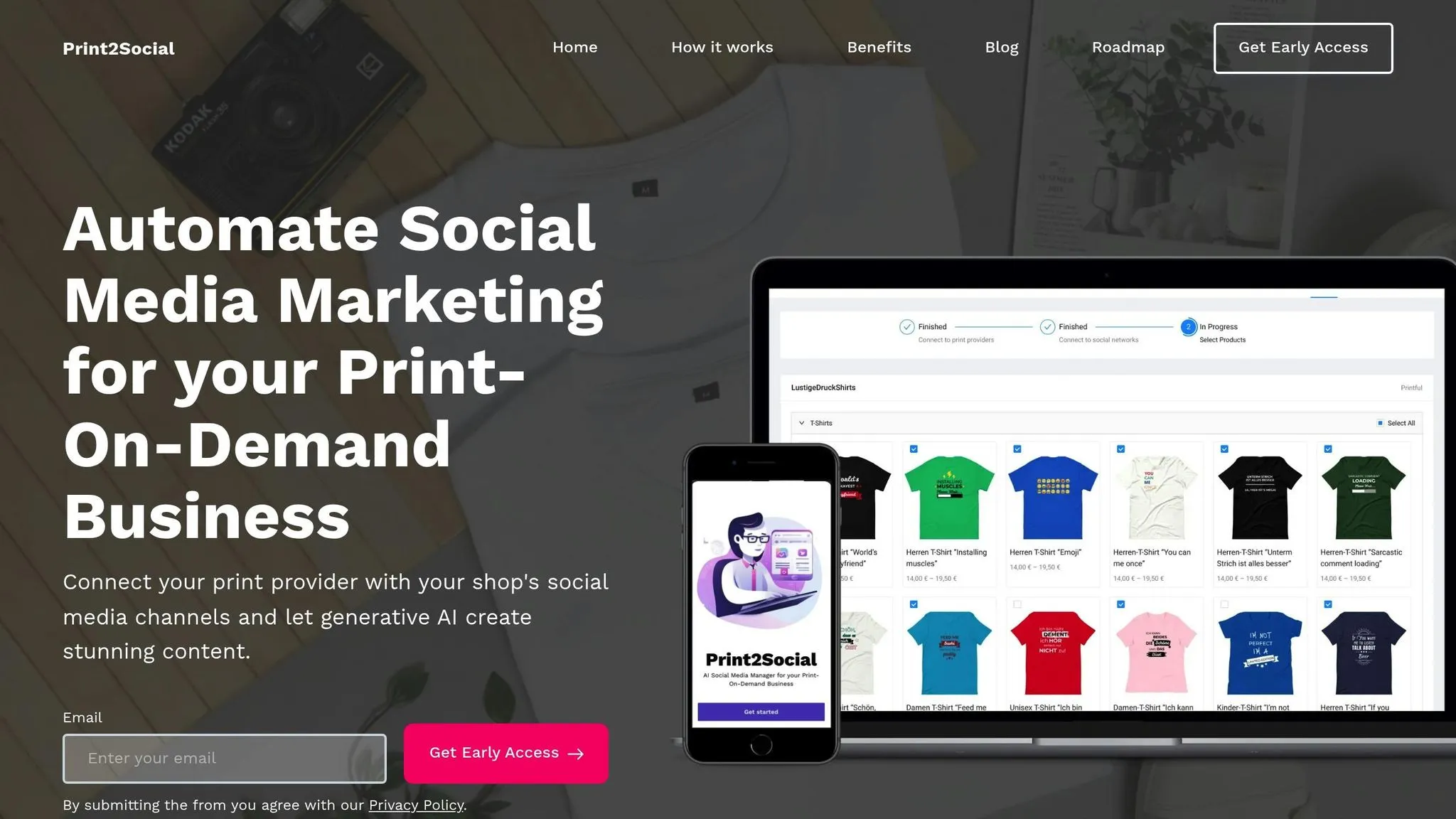
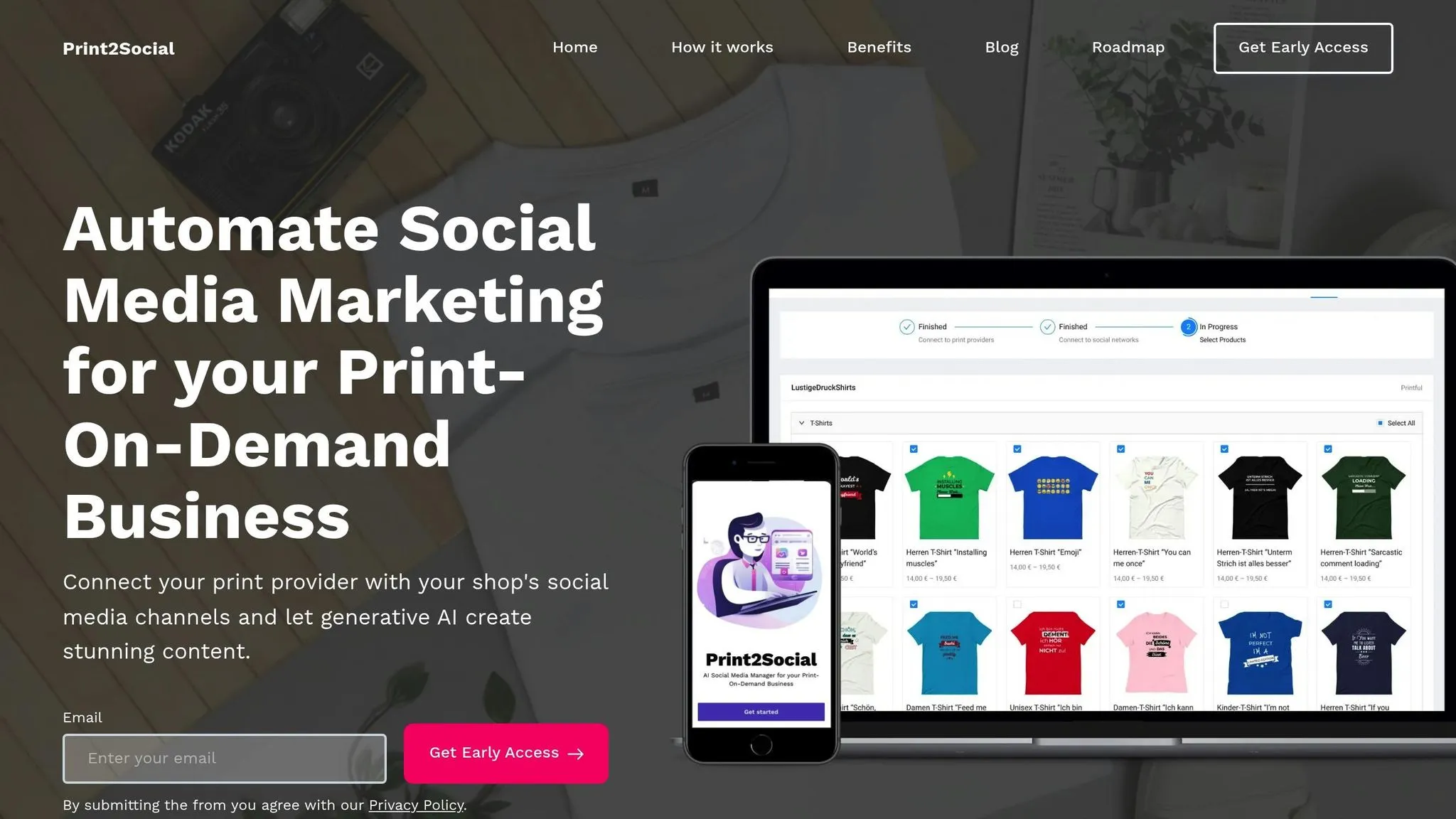
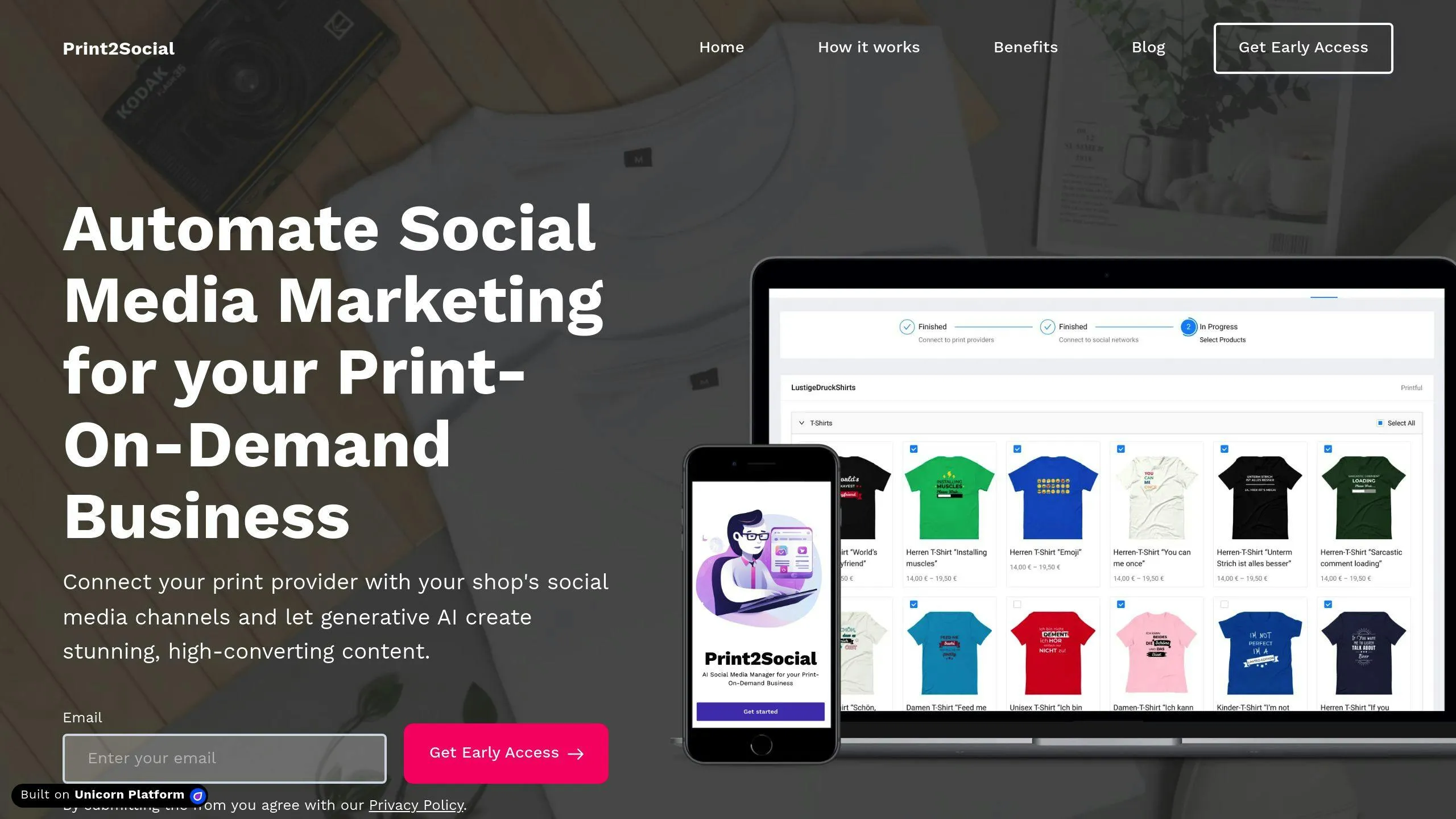
Print2Social is an AI-powered tool tailored to address the challenges of managing POD (Print-On-Demand) catalogs and fulfillment, all while keeping your community actively engaged.

With Print2Social, creating content becomes effortless. Its generative AI automatically transforms live POD data into eye-catching images and videos. By pulling product details directly from your connected POD providers, the platform crafts social media posts showcasing your designs and products without any manual input. The built-in scheduling system ensures posts go live at peak times, even when you’re busy handling other aspects of your business. A study by Forrester highlights that AI-powered automation can cut operational workloads by up to 40%, giving business owners more time to focus on product innovation and customer care.

Seamless Integration with POD Platforms and Social Media

Section titled “Seamless Integration with POD Platforms and Social Media”

Print2Social integrates directly with leading POD providers and e-commerce platforms, syncing your product catalogs and order details automatically. This ensures your content stays accurate and up-to-date. On the social media front, the tool connects with platforms like Facebook, Instagram, and X (formerly Twitter), allowing you to manage all your accounts from one centralized dashboard. This streamlined approach makes it easier to create meaningful, localized interactions with your audience.

If your POD business caters to American customers, Print2Social has you covered. It formats prices in U.S. dollars, follows the MM/DD/YYYY date format, and adapts content to American English spelling. Additionally, you can customize posts to align with U.S.-specific holidays, trends, and cultural moments, ensuring your messages resonate deeply. By aligning with local preferences - both linguistically and culturally - Print2Social helps you build stronger connections with your community.

Engagement is key, and Print2Social excels here too. The platform provides automated comment prompts and AI-generated responses to keep conversations flowing. Its analytics tools track crucial metrics like reach, likes, shares, comments, click-through rates, and follower growth. These insights help you identify what content drives the most interaction, enabling you to refine your strategy and strengthen relationships with your audience.

Print2Social empowers POD businesses to compete with larger brands by automating high-quality content creation and fostering meaningful engagement. Up next, we’ll dive into how tools like Midjourney can take creative expression to the next level for POD communities.

Midjourney

Midjourney transforms text prompts into striking artwork, giving print-on-demand (POD) businesses a wide range of design possibilities that ignite conversations within their communities.

Midjourney simplifies the process of creating stunning artwork from basic text prompts, making it a go-to tool for POD entrepreneurs who constantly need new design ideas. It takes detailed instructions and turns them into images across a variety of styles - whether you’re looking for something photorealistic or leaning toward abstract art. Users can quickly experiment with different ideas by generating, refining, and enhancing designs. This streamlined approach allows businesses to explore creative directions without relying heavily on external designers. It’s a game-changer for POD creators looking to stay agile and innovative.

Midjourney thrives within Discord servers, offering a built-in community space where POD creators can share their designs, receive feedback, and keep an eye on trending styles. Its public gallery acts as both a showcase and a source of inspiration, encouraging creators to learn from each other’s work. Many POD businesses use Midjourney-generated designs to engage their audience on social media. By sharing behind-the-scenes glimpses of their creative process, they encourage followers to interact, comment, and share, deepening community ties. Plus, the platform’s remix and variation tools make it easy to develop cohesive design collections that reflect customer preferences, ensuring a visually appealing and customer-driven product lineup.

DALL-E 3

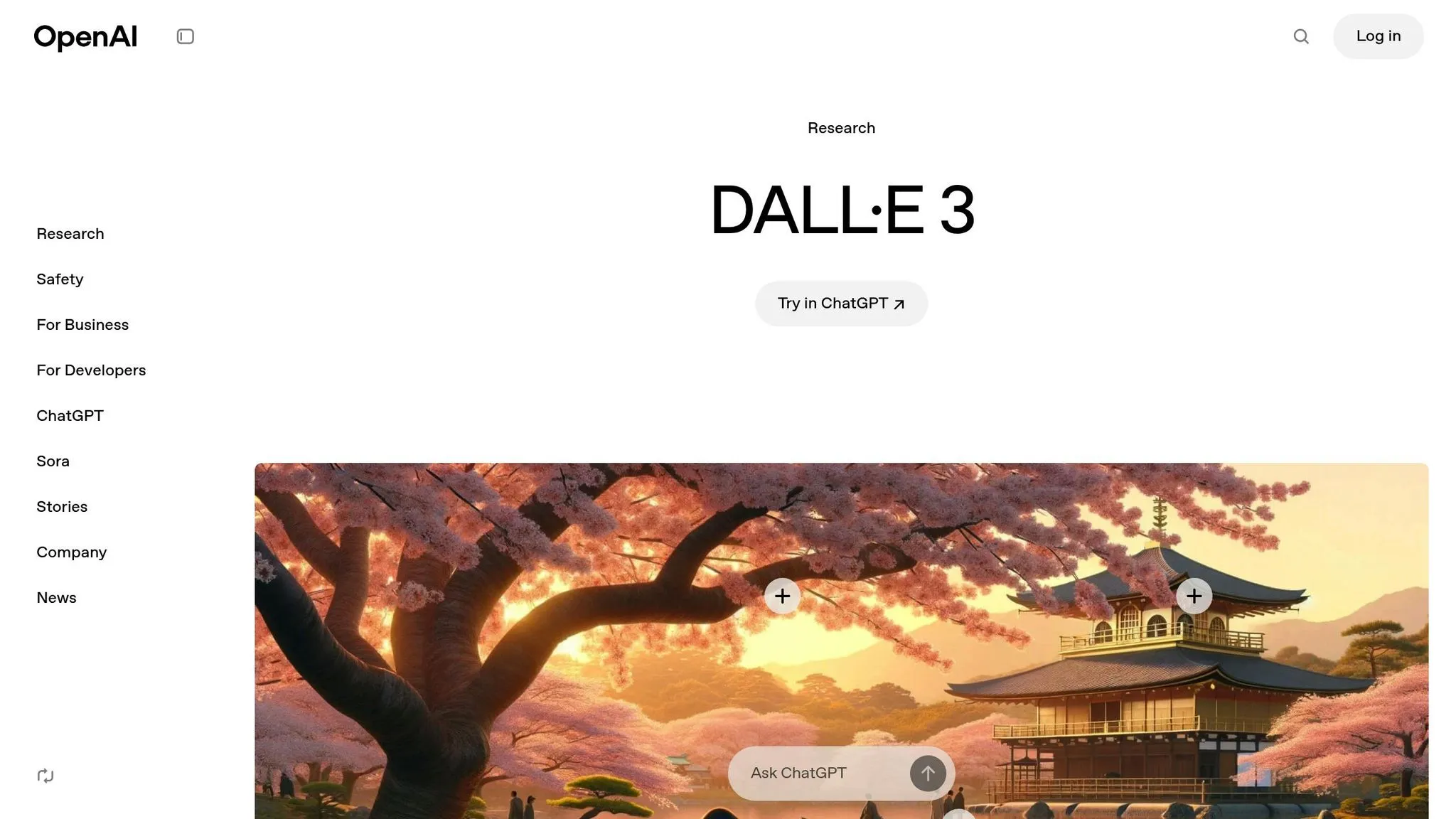
While Midjourney thrives on creative experimentation, DALL-E 3 focuses on precision, helping businesses craft visuals that perfectly align with their brand identity. This AI-powered image generator is a game-changer for print-on-demand businesses, enabling the creation of high-quality, tailored images from detailed text prompts.

DALL-E 3 transforms detailed text prompts into visuals that reflect your brand’s style and message. Its iterative design process lets creators start with a simple idea and refine it through multiple variations. This flexibility allows users to tweak concepts until the images fully align with their branding, making it easier to establish a cohesive visual identity without the guesswork.

Integration with POD Platforms and Social Media

Section titled “Integration with POD Platforms and Social Media”

DALL-E 3 fits seamlessly into existing creative workflows, making it an ideal tool for print-on-demand projects. Whether you’re designing apparel, wall art, or other products, the AI-generated visuals are ready for production. On top of that, these designs can be repurposed for promotional content on social media, ensuring your branding stays consistent across all platforms.

DALL-E 3 doesn’t just streamline design - it also helps build stronger connections with your audience. Its ability to quickly iterate designs means you can respond to customer feedback or adapt to seasonal trends in no time. Plus, the tool’s interactive features allow creators to share their design process with their audience, offering a behind-the-scenes look at how AI enhances creativity. This transparency can foster deeper engagement and make your community feel like part of the journey.

Jasper Art

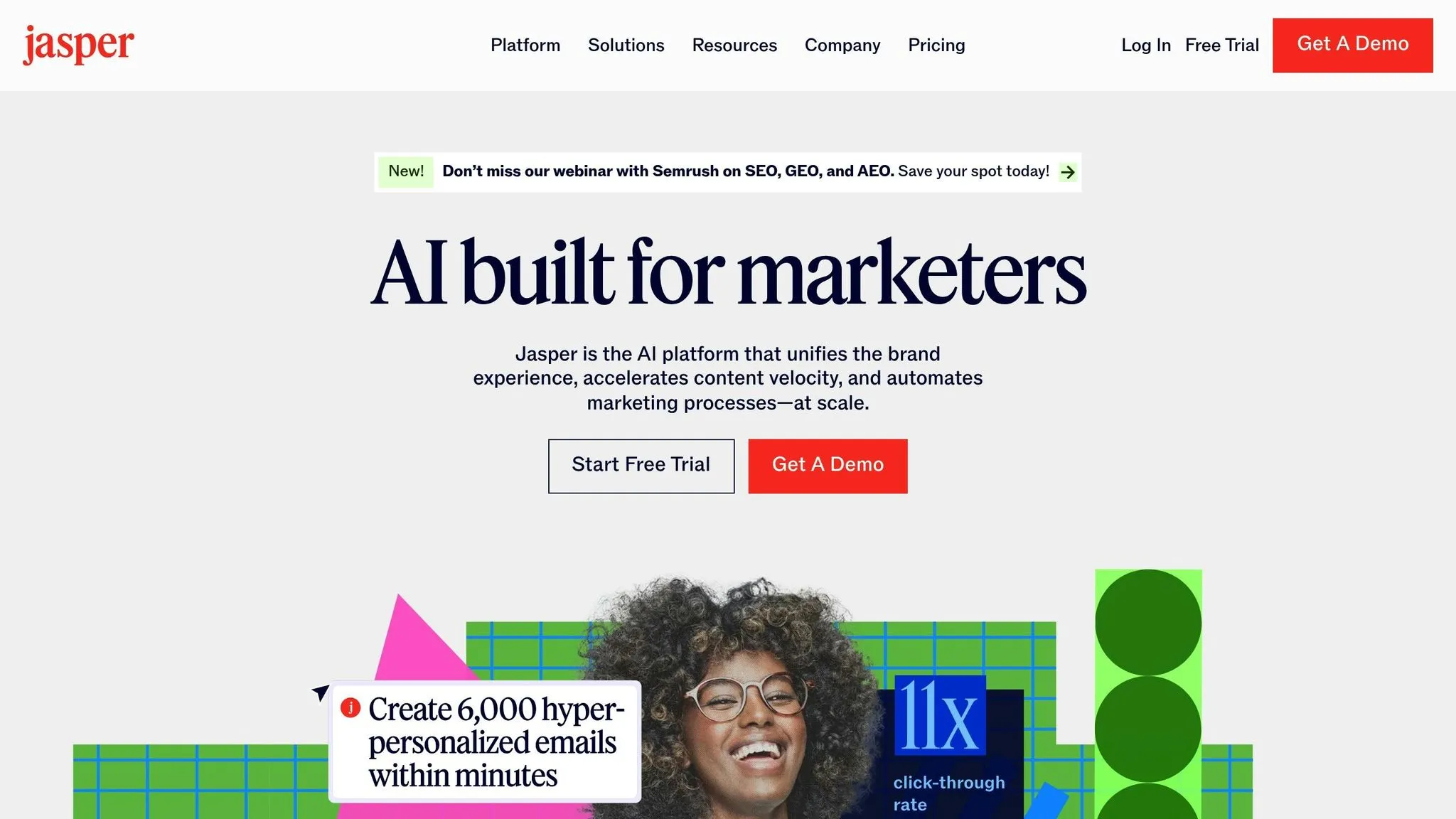
Jasper Art brings a burst of creativity to the table. This AI-driven art generator creates artwork at lightning speed, making it a great fit for print-on-demand products and digital marketing campaigns. Its quick turnaround allows businesses to fine-tune visuals and roll out fresh designs effortlessly, keeping their audience engaged and inspired.

Canva

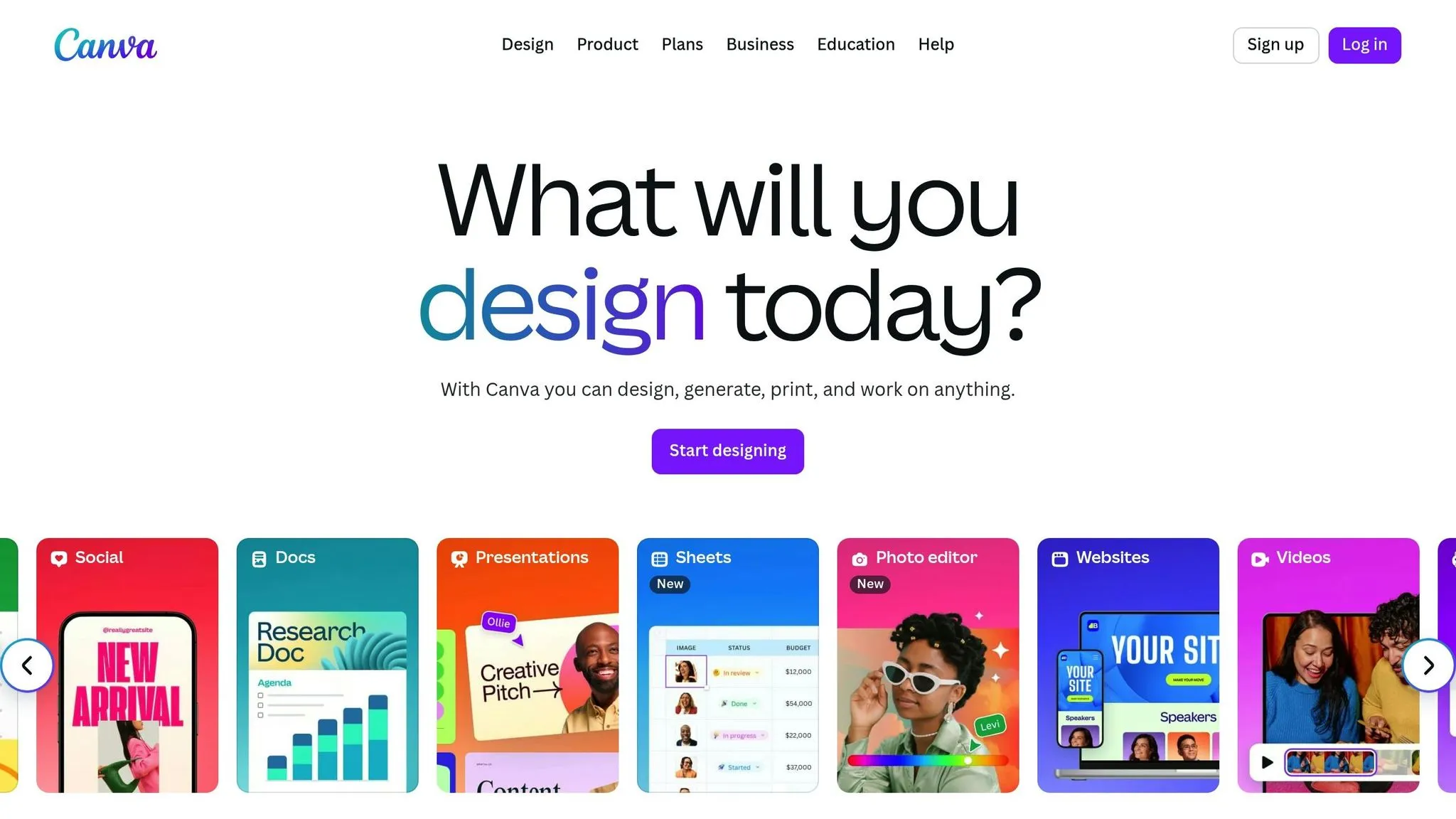
Canva is a user-friendly design platform packed with AI features and a wide range of templates, making it ideal for print-on-demand (POD) businesses - especially those without professional design expertise. Its Magic Design tool uses AI to create custom layouts from your images or text prompts, simplifying the design process for busy entrepreneurs.

Canva’s AI-powered tools make creating content faster and easier. Features like Text to Image, Background Remover, and Magic Resize allow you to:

  • Turn text prompts into unique visuals.
  • Clean up product images for a polished look.
  • Adapt designs to fit any social media format effortlessly.

The Brand Kit feature keeps your marketing materials consistent by storing your brand’s colors, fonts, and logos in one place. On top of that, Canva’s Content Planner lets you schedule posts directly to platforms like Facebook and Instagram, ensuring a steady stream of promotional content even when other business tasks demand your attention.

Integration with POD Platforms and Social Media

Section titled “Integration with POD Platforms and Social Media”

Canva connects seamlessly with platforms like Facebook, Instagram, Twitter, LinkedIn, and Pinterest, allowing you to publish designs directly without leaving the interface. Its Apps marketplace also integrates with tools like Google Drive, Dropbox, and several stock photo services, keeping all your creative resources at your fingertips.

For POD businesses, Canva’s product mockup templates are a game-changer. They let you showcase your designs on items like t-shirts, mugs, and phone cases, creating professional-quality visuals that help customers see how your products will look. This not only enhances your promotional materials but also builds customer trust and boosts sales.

Canva makes collaboration easy with its real-time design tools. Team members or community managers can work together on projects, and the commenting system allows for quick feedback and revisions - all within the platform.

Want to grab attention on social media? Canva’s animation tools bring static designs to life, creating posts that stand out and drive engagement through likes, shares, and comments. For webinars, product launches, or educational content, the presentation maker is an invaluable tool. Plus, its video editing capabilities make it simple to produce behind-the-scenes clips, tutorials, and product demos that strengthen your connection with your audience.

From streamlining content creation to fostering community engagement, Canva equips POD businesses with the tools they need to succeed.

DreamStudio

DreamStudio stands out as a powerful tool for creating text-to-image visuals, particularly for businesses in the print-on-demand (POD) space. By leveraging Stable Diffusion technology, it transforms text descriptions into original, high-quality images - perfect for entrepreneurs looking to produce eye-catching and unique artwork.

At the heart of DreamStudio’s capabilities is its text-to-image generation feature. Simply input a detailed prompt - like “minimalist mountain landscape in watercolor” - and the platform produces stunning visuals tailored to your description.

DreamStudio operates on a pay-per-use credit system, meaning you only pay for the images you create. It also offers the ability to generate multiple variations of a concept, giving you flexibility and creative options without committing to a single design.

Integration with POD Platforms and Social Media

Section titled “Integration with POD Platforms and Social Media”

DreamStudio’s API connects seamlessly with e-commerce platforms such as Shopify and WooCommerce, making it easier to upload personalized product images directly to your store listings. This integration simplifies tasks like creating mockups and promotional visuals, saving time and effort while enhancing your product presentation.

For social media marketing, DreamStudio integrates with platforms like Twitter, Instagram, Slack, Microsoft Teams, and Discord. These connections allow for automated content sharing and real-time collaboration, ensuring your team can create, refine, and post content efficiently across multiple channels.

DreamStudio’s compatibility with Discord and Microsoft Teams makes it an excellent choice for brands focused on community-building. Whether you’re creating custom visuals for community challenges, seasonal promotions, or member appreciation posts, the platform helps keep your audience engaged with fresh, dynamic content.

Its on-demand image creation capabilities make responding to trending topics or audience requests quick and straightforward. With real-time collaboration tools, you can generate and refine multiple design options based on feedback, ensuring your visuals resonate with your community and align with your brand’s goals.

Adobe Firefly

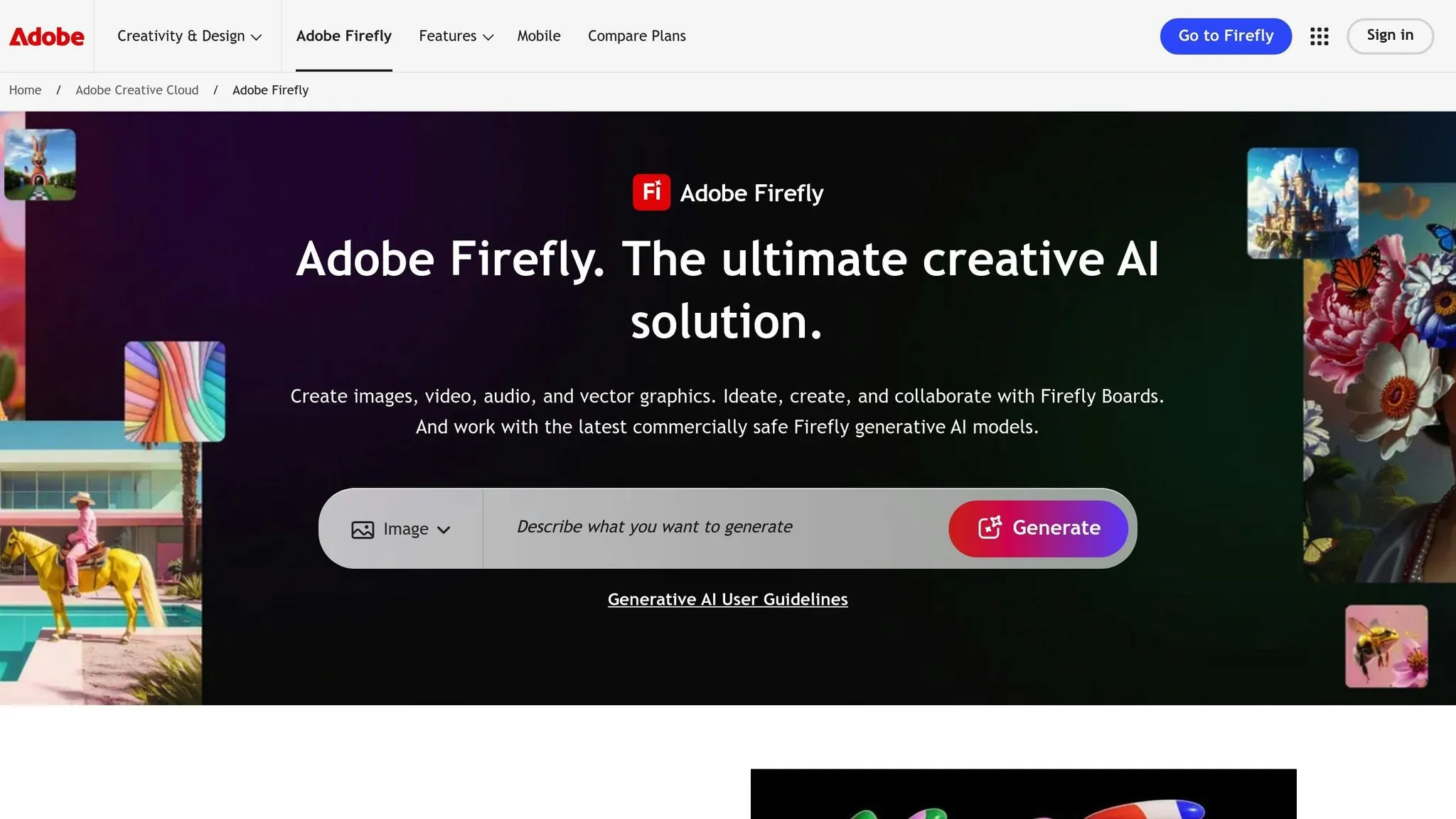
Adobe Firefly is an AI-driven tool designed to help print-on-demand businesses create eye-catching visuals. It transforms simple text prompts into stunning designs, perfect for merchandise like apparel, posters, and home decor.

The tool allows for quick design experimentation, generating multiple visuals in no time. This makes it easier to gather audience feedback and refine your creations, helping you connect better with your community and improve engagement.

What’s more, Firefly works seamlessly with Adobe Creative Cloud. This integration lets you polish your designs using professional-grade tools, ensuring your brand’s look stays consistent across products and marketing materials. Up next, we’ll look at more tools that can amplify your community engagement efforts.

TinyWow

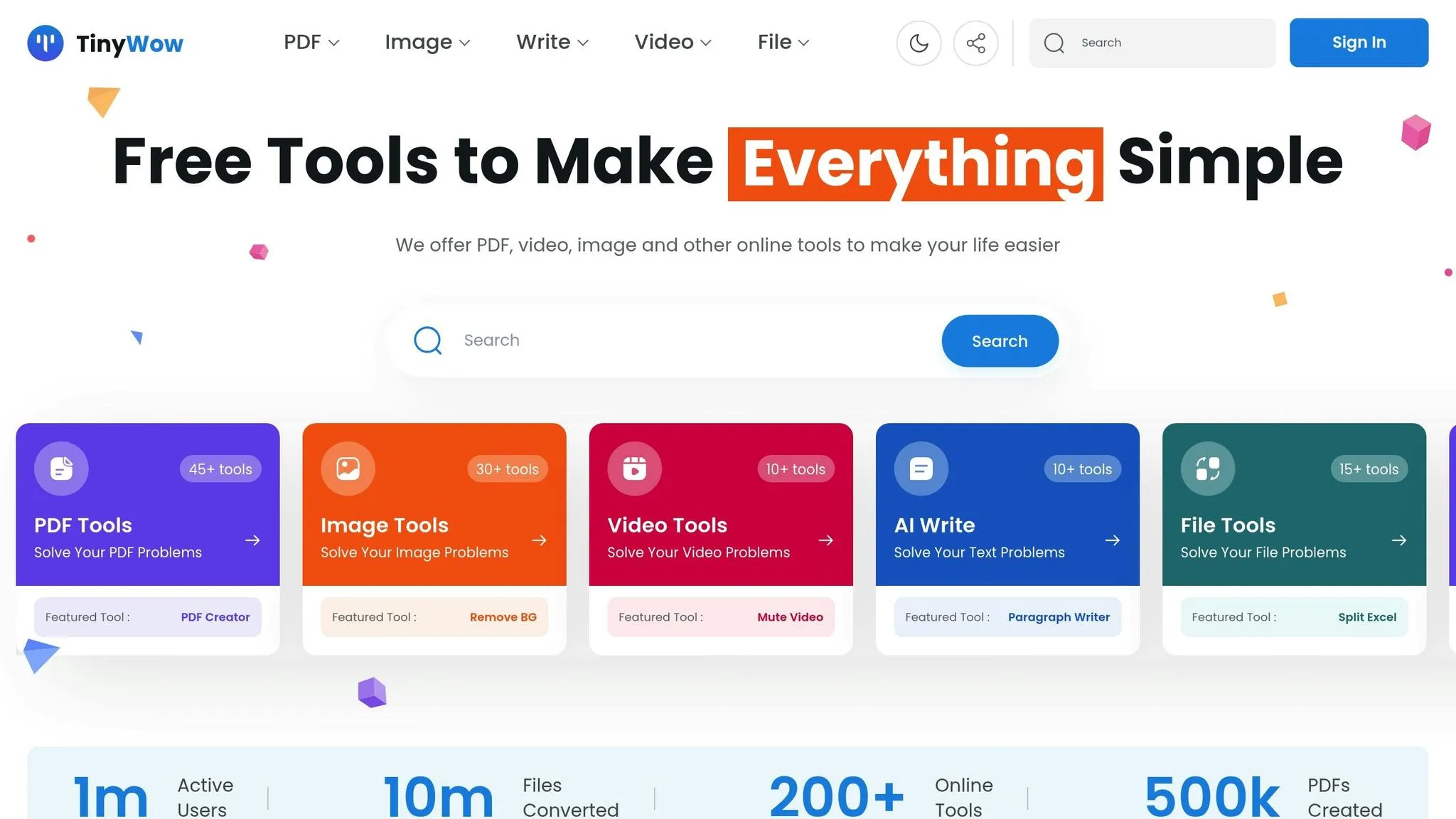
TinyWow is a free, browser-based toolkit packed with handy tools to help print-on-demand businesses polish and prepare their visual content. With its straightforward interface, it simplifies tasks like background removal, PDF editing, and image compression - making it easier to create eye-catching promotional materials for your store.

TinyWow’s background removal tool is perfect for cleaning up product images by eliminating unwanted distractions. Its PDF editing tools are ideal for putting together polished product catalogs, newsletters, or lookbooks, helping you present your marketing materials in a professional and organized way.

The image compression tool reduces file sizes while keeping quality intact, ensuring your website and social media pages load quickly. Since TinyWow runs entirely in your browser, it offers a hassle-free way to fine-tune your visual assets, giving you more time to connect with your audience. These tools provide a solid foundation for building even stronger engagement strategies.

ChatGPT

When it comes to AI tools that boost community engagement, ChatGPT stands out as a game-changer for POD (print-on-demand) businesses. It simplifies content creation and customer interaction, allowing entrepreneurs to stay connected with their audience without spending countless hours crafting messages.

ChatGPT shines in its ability to generate content quickly and effectively. Whether you need product descriptions that emphasize features and benefits, SEO-friendly blog posts to attract organic traffic, or social media captions that spark engagement, this tool has you covered. Its ability to maintain a consistent brand voice ensures that everything from customer emails to product listings feels cohesive and professional. Just provide a few key details, and ChatGPT delivers polished copy in minutes.

Keeping your community engaged is easier with ChatGPT. It can create discussion prompts, Q&A materials, and even personalized responses to connect with your audience. By training the tool with your brand guidelines and frequently asked questions, you can automate responses to common inquiries, improving customer satisfaction while freeing up time for other tasks.

In fact, AI-powered automation like this can reduce workloads by up to 40%, giving managers more time to focus on scaling their business.

For businesses targeting U.S. customers, ChatGPT adapts effortlessly. It uses U.S. English, formats prices in dollars, and aligns with American cultural preferences. Whether you’re planning a Fourth of July sale, a Labor Day promotion, or back-to-school campaigns, ChatGPT ensures your messaging resonates with U.S. audiences by factoring in seasonal trends and regional preferences.

ChatGPT offers a free version with basic features, while the ChatGPT Plus plan - priced at $20/month - provides priority access and advanced capabilities. It also integrates seamlessly with tools like Print2Social, enabling you to create a smooth workflow for both written and visual marketing content. Up next, we’ll dive into how TPOP can further elevate your POD content strategy.

TPOP

TPOP is a handy AI-driven platform designed to simplify catalog management and enhance community interaction for print-on-demand (POD) businesses. It automates catalog updates and connects seamlessly with social media platforms, making it easier to manage workflows and stay engaged with your audience. For more details, you can visit the official TPOP website.

This tool, like others we’ve covered, focuses on improving workflows and fostering meaningful community connections - key ingredients for success in the POD space.

Here’s a handy comparison of AI tools to help you decide which one fits your POD community engagement needs. The table below outlines their functions, benefits, U.S. market support, pricing, and ideal use cases.

Tool

Primary Function

Key POD Benefits

U.S. Market Support

Pricing Model

Best For

Print2Social

AI social media automation

Automated product promotion, direct provider integration, video creation

Full U.S. localization

Subscription-based

Complete social media automation

Midjourney

AI image generation

Custom designs, product mockups

English interface, USD pricing

Monthly subscription ($10–$60)

Creative design generation

DALL-E 3

AI image creation

Product visualization, marketing graphics

Full English support

Pay-per-use ($0.040–$0.120 per image)

High-quality product images

Jasper Art

Marketing-focused AI art

Brand-consistent visuals, marketing materials

U.S.-optimized content

Monthly plans ($39–$125)

Marketing campaign visuals

Canva

Design platform with AI

Template-based designs, social posts

Extensive U.S. templates

Freemium (Pro at ~$14.99/month)

Quick design creation

DreamStudio

Stable Diffusion interface

Artistic product designs, concept art

English interface

Credit-based (e.g., $10 for 1,000 credits)

Artistic design exploration

Adobe Firefly

Enterprise AI design

Professional-grade graphics, brand assets

Full U.S. business support

Integrated with Creative Cloud

Professional design work

TinyWow

Multi-purpose AI tools

Image editing, file conversion

Basic English support

Mostly free with ads

Quick utility tasks

ChatGPT

AI writing assistant

Product descriptions, social media copy

Excellent English capabilities

Free/Subscription at ~$20/month

Content writing and strategy

TPOP

Catalog management

Automated catalog updates, workflow optimization

Limited U.S. features

Custom pricing

Inventory management

  • Streamlined Integration: Tools like Print2Social stand out for their direct integration with POD providers, eliminating the need for manual data entry. This is particularly useful for businesses looking to save time and reduce errors.
  • Content Creation: Print2Social offers a unique edge by generating both images and videos featuring your actual products, which is crucial for POD sales. In contrast, tools like Canva rely on templates, and Midjourney creates artwork without product-specific context.
  • Ease of Use: Platforms like Canva and TinyWow are beginner-friendly with intuitive interfaces, while DreamStudio and Midjourney may require a steeper learning curve. Print2Social strikes a balance with its combination of automation and customizable options.
  • Scalability for Growth: For businesses aiming to scale, Adobe Firefly and Print2Social are equipped to handle enterprise-level workflows. On the other hand, tools like ChatGPT and TinyWow may struggle with high-volume demands as your operations expand.

Each tool offers distinct features tailored to specific needs, whether it’s automation, design, or content creation. Selecting the right one depends on your business goals and the level of integration and scalability you require.

AI tools are reshaping how POD businesses connect with their communities by streamlining workflows and producing personalized, impactful content. These tools take the grind out of manual tasks, allowing businesses to focus on creating meaningful interactions.

The key to success lies in selecting the right tools for your needs. For example, Print2Social simplifies social media management with seamless POD integration, Midjourney and DALL-E 3 craft custom visuals, Canva offers user-friendly design templates, and ChatGPT helps generate compelling copy. Start small - pick one or two tools that address your biggest challenges, and gradually expand your toolkit as your comfort and needs grow.

When choosing tools, consider your budget and technical expertise. Free options like TinyWow and ChatGPT work well for smaller operations, while premium services like Print2Social or Adobe Firefly can help scale your efforts efficiently.

It’s important to remember that AI is not about replacing human creativity but enhancing it. These platforms handle repetitive tasks and spark ideas, giving you more time to focus on strategy, customer relationships, and fostering genuine connections. By blending AI’s efficiency with human insight, you can build a strong foundation for lasting community engagement.

Use these strategies to refine your approach and keep evolving in step with new innovations. AI offers powerful tools, but it’s your creativity and connection with your audience that will truly make the difference.

How do AI tools like Print2Social help POD businesses improve their social media engagement?

Section titled “How do AI tools like Print2Social help POD businesses improve their social media engagement?”

AI tools such as Print2Social simplify how print-on-demand (POD) businesses manage their social media presence by automating essential tasks. With the help of generative AI, these tools create visually appealing images and videos that highlight your products, making it easier to grab attention and encourage interaction.

On top of that, AI-driven scheduling ensures your posts go live at the best possible times, increasing their reach and engagement. By handling both content creation and posting, tools like Print2Social save you time while helping you maintain a steady online presence. This makes it simpler to connect with your audience and expand your brand’s reach.

How do AI tools like Midjourney and DALL-E 3 enhance design creation for print-on-demand products?

Section titled “How do AI tools like Midjourney and DALL-E 3 enhance design creation for print-on-demand products?”

AI tools like Midjourney and DALL-E 3 bring powerful design capabilities to the table, making it easier than ever to create custom visuals for print-on-demand (POD) products. These tools work by using generative AI to craft unique, high-quality images based on your specific input. The result? Eye-catching designs that can be tailored to perfectly match your audience’s preferences.

For POD businesses, these tools are game-changers. They can be used to create product mockups, promotional materials, or even entirely new design ideas - all while saving you time and effort. Plus, with AI on your side, it’s simple to experiment with different styles and adapt to trends, keeping your product lineup fresh and visually appealing.

What should print-on-demand businesses look for in an AI tool to improve content creation and community engagement?

Section titled “What should print-on-demand businesses look for in an AI tool to improve content creation and community engagement?”

When choosing an AI tool for your print-on-demand business, it’s all about finding features that help you save time and work smarter. Opt for tools that can automatically generate engaging, on-brand content - think posts, images, or videos that showcase your products effectively. It’s also crucial that the tool integrates effortlessly with your store, print-on-demand providers, and social media platforms to keep everything running smoothly.

Another key factor? Automation features. Look for tools that can handle tasks like scheduling posts and managing customer interactions. These functions can simplify your marketing process, giving you more time to focus on connecting with your audience and growing your business efficiently.

Ultimate Guide to A/B Testing for POD Social Media

A/B testing helps you figure out what works best for your Print-on-Demand (POD) social media campaigns. By comparing two versions of content - like product images, captions, or posting times - you can use data to improve engagement, clicks, and sales. Here’s what you need to know:

  • What to Test: Experiment with visuals (images vs. videos), captions (headlines, CTAs), hashtags, and posting times.
  • How to Test: Change one element at a time, split your audience evenly, and run tests simultaneously to avoid skewed results.
  • Key Metrics: Focus on conversion rates, click-through rates, and cost per acquisition to measure success.
  • Tools: Platforms like Print2Social simplify testing by automating content creation, scheduling, and performance tracking.

Start small - test a single element like lifestyle vs. product-only images - and build on what works. Use results to refine your strategy for better outcomes over time.

How to Do A/B Testing: 15 Steps for the Perfect Split Test

Section titled “How to Do A/B Testing: 15 Steps for the Perfect Split Test”

What to Test in POD Social Media Campaigns

Section titled “What to Test in POD Social Media Campaigns”

In A/B testing for Print-on-Demand (POD) social media campaigns, you’ll want to pinpoint the elements that truly drive engagement and conversions - like visual formats, ad copy, hashtags, and posting times. The goal? Find what stops people mid-scroll, gets them to click, and ultimately leads them to make a purchase. By carefully testing and refining these elements, you can improve campaign performance and achieve better outcomes.

Visuals are the backbone of any social media campaign, so testing different formats - static images, videos, and carousels - can reveal what resonates most with your audience. To get accurate results, keep all other variables constant and only change the format. For instance:

  • Images: Use high-quality product mockups. Test lifestyle shots against clean studio setups, try different angles, and consider adding overlays that highlight product details like size or fit.
  • Videos: Create short clips (15–30 seconds) that showcase your product in motion or in a lifestyle setting. Experiment with different openings - show the product in action, highlight the design process, or feature a customer using it.

The first three seconds of a video are critical for grabbing attention. Test different thumbnails, pacing, captions, and call-to-action (CTA) placements to see what keeps viewers watching. Key metrics to track include engagement rates, click-through rates, conversions, watch time, and completion rates.

Your ad copy can make or break your campaign. Focus on testing one variable at a time to see what drives action. For example:

  • Headlines: Compare a benefit-driven headline (e.g., Ultra-Soft Cotton That Lasts) with a curiosity-driven one (e.g., The T-Shirt Everyone’s Talking About).
  • Value Propositions: Test whether emphasizing material quality (“Premium Cotton Blend”) or design uniqueness (“Stand-Out Graphics”) performs better.
  • CTAs: Try direct CTAs like “Buy Now” or “Limited-Time Deal” against softer options like “See Styles” or “Browse Designs.” For POD products, customization-focused CTAs like “Make It Your Own” can be particularly effective. Urgency cues like “Ends Tonight” or scarcity messages such as “Only a Few Left” can also boost conversions.

Social proof can play a role too. Compare captions that include snippets of customer reviews with those that don’t. Sometimes a straightforward message outshines one that relies heavily on testimonials. Keep an eye on metrics like click-through and conversion rates to ensure that increased engagement translates into actual sales.

Hashtags and timing might seem like small details, but they can significantly impact your campaign’s reach and engagement.

  • Hashtags: Test different strategies by creating two sets - one narrow and niche-focused (e.g., #HalloweenTee, #SpookyVibes) and another broader (e.g., #Halloween2025, #FallFashion). Use identical content for both sets to measure the trade-off between discoverability and relevance. Track metrics like reach, impressions, and engagement to see which set performs better.
  • Posting Times: Timing matters just as much. Test different time slots based on when your U.S. audience is most active. For example, compare lunch breaks (12:00–1:00 PM) with evening hours (7:00–9:00 PM). Stick to U.S. time zones - like 2:00 PM PT or 5:00 PM ET - and rotate posting days evenly to avoid skewed results. Metrics like reach, engagement, and conversions will help you pinpoint the best times to post.

The beauty of testing hashtags and timing is that these adjustments are quick and easy to implement. Unlike creative tests that require new assets, you can tweak these elements in real-time once you identify winning patterns. Keep in mind that seasonality also plays a big role - what works during back-to-school season might not have the same impact during the holidays. Planning your testing schedule around major selling periods ensures your campaigns stay relevant and effective.

How to Set Up A/B Tests for POD Social Media

Section titled “How to Set Up A/B Tests for POD Social Media”

Running effective A/B tests requires a solid plan and reliable data. The key is to start with clearly defined parameters and ensure your results are actionable. This way, your efforts can directly inform your Print-on-Demand (POD) marketing strategies. Let’s break it down.

Before diving into test creation, it’s crucial to define your goals. What do you want to achieve? For POD businesses, common objectives include increasing click-through rates to product pages, improving conversion rates from social media traffic, boosting engagement rates to expand organic reach, or lowering cost per acquisition for paid campaigns.

Once your goal is clear, choose metrics that align with it. For instance:

  • If driving sales is your focus, track conversion rates and revenue per visitor.
  • If building brand awareness is the priority, monitor reach, impressions, and engagement rates.

Stick to one primary metric and a few secondary ones to keep your analysis focused. Also, establish a minimum sample size before you begin. For social media campaigns, aim for at least 100 conversions per variant to ensure statistical reliability. If your conversion rate is 2%, this means each variant will need around 5,000 visitors - so plan for a testing period of 1–2 weeks, depending on your traffic levels.

Don’t forget to set your confidence level - 95% is the standard for most business decisions. This ensures you can trust your results aren’t just random. Additionally, decide on your minimum detectable effect. For example, if a 10% improvement in conversion rates would make a meaningful difference for your business, design your test to detect changes of that size.

The success of your A/B test depends on how you create and manage your test variants. Start by establishing a control, which is your best-performing content. This will serve as the baseline for comparison.

When crafting your test variant, change only one element at a time. For example, if you’re testing video content versus static images, keep everything else - like captions, hashtags, posting times, and audience targeting - consistent. This way, any performance differences can be traced back to the specific element you’re testing.

Audience splitting is another critical step. Most social platforms allow you to randomly divide your audience, but you can also alternate posting times or target comparable demographics. Ensure your audience segments are large enough and share similar characteristics to avoid skewed results. For instance, don’t test one variant on weekdays and another on weekends, as this could introduce bias.

Run your test variants simultaneously rather than one after the other. This helps you avoid external factors like seasonal trends, breaking news, or algorithm changes that might distort your results. If you’re testing posting times, make sure you’re comparing equivalent days and similar timeframes.

Document everything - differences between variants, schedules, and target audiences. Clear documentation is invaluable for analyzing results and planning future experiments. Once your variants are ready, automation can simplify the testing process.

Print2Social

To streamline your A/B testing efforts, consider using a tool like Print2Social. Its AI-driven features are especially helpful for POD businesses that run frequent tests.

  • Automated content generation: Print2Social allows you to quickly create multiple versions of promotional posts. Simply input product details and testing parameters, and the tool will generate variations in visual styles, captions, or posting formats. This saves time and ensures quality and brand consistency across all test variants.
  • Scheduling automation: Testing posting times or frequencies? Print2Social can handle it. You can set up campaigns to run simultaneously, with posts going live at pre-determined times for different audience segments. This eliminates the need for manual intervention and reduces the risk of errors.
  • Integration with POD providers: Print2Social connects directly to your fulfillment partners, ensuring test content reflects up-to-date product availability and pricing. This is especially useful when testing different designs or products, as it prevents misleading information from reaching your audience.
  • Performance tracking: By linking your social media accounts and store analytics, Print2Social provides a complete view of the customer journey - from the initial social media impression to the final purchase. This helps you measure which variants drive actual sales, not just engagement.
  • Batch processing: During high-demand periods like back-to-school or holiday seasons, you can use Print2Social to prepare and schedule seasonal test campaigns in advance. This allows you to focus on analyzing results and optimizing strategies instead of managing daily posting tasks.

With these tools and strategies in place, your A/B testing process can be more efficient and insightful, helping you make data-driven decisions for your POD business.

Once your A/B test wraps up, the real challenge begins - making sense of the data. Interpreting results correctly is crucial for shaping your print-on-demand (POD) social media strategy. A well-analyzed test can mean the difference between boosting profits and wasting time.

Start by pulling data from all the relevant sources. Social media analytics will give you insights into engagement metrics like likes, shares, and comments. But for POD businesses, the real gold lies in your e-commerce platform and Google Analytics.

To track how each variant performs, use unique UTM parameters. For instance, create UTM codes like utm_campaign=holiday_tshirts_test_a and utm_campaign=holiday_tshirts_test_b. This allows you to see exactly which posts drove traffic and, more importantly, sales. Without this tracking, you’re left guessing which variant turned interest into actual purchases.

Focus on the entire customer journey when analyzing results. For example, a video post might get 500 clicks with a 3% conversion rate (15 sales), while a static image gets 800 clicks but only converts at 1.5% (12 sales). In this case, the video post delivers more meaningful results despite fewer clicks.

Document every detail of your test in a dashboard. Include the dates, audience sizes, any external factors (like holidays or algorithm changes), and technical issues that might have impacted the test. This context is invaluable for understanding your results and planning future experiments.

Once you’ve gathered your data, be aware of common mistakes that can lead to faulty conclusions.

Ending tests too soon is a frequent error. Just because one variant looks like a winner after two days doesn’t mean it will stay ahead. Social media algorithms take time to optimize, and audience behavior varies throughout the week. Give your test at least a full week to get reliable results.

Overlooking external factors can also mislead you. If a major news event dominates social media during your test, it could skew engagement and visibility. Always consider what else was happening during your test period.

Chasing vanity metrics is another trap. High engagement doesn’t always equate to success. A post with 1,000 likes but no sales is less effective than one with 200 likes that generates 10 purchases. For POD campaigns, prioritize metrics that directly impact revenue.

Confusing correlation with causation can lead to false assumptions. For example, if your top-performing post used a specific hashtag, it doesn’t necessarily mean the hashtag caused its success. The product might have been trending, or the timing could have aligned with payday. Look for patterns across multiple tests before making big changes to your strategy.

Avoiding these pitfalls ensures your analysis leads to better decisions, helping you lower acquisition costs and improve conversions.

Clear presentation is key to spotting trends and sharing insights with your team. Use comparison tables to highlight performance differences between your test variants.

Metric

Variant A (Static Image)

Variant B (Video)

Difference

Winner

Impressions

12,500

11,800

-5.6%

A

Clicks

875

590

-32.6%

A

Click-through Rate

7.0%

5.0%

-2.0pp

A

Conversions

26

24

-7.7%

A

Conversion Rate

2.97%

4.07%

+1.1pp

B

Revenue

$520

$600

+15.4%

B

Cost per Acquisition

$8.46

$9.17

+8.4%

A

In this example, the static image drove more traffic, but the video converted better and generated higher revenue - making it the better choice for business goals.

When presenting results, include confidence intervals and statistical significance to ensure your findings are reliable. Flag results that aren’t statistically significant to avoid acting on random fluctuations. Also, provide details like the test duration and sample sizes to give context to your conclusions.

Tailor your tables to the goals of your test. If you’re measuring brand awareness, focus on metrics like reach and engagement. For direct sales campaigns, emphasize conversion rates and revenue. This makes it easier to draw actionable insights and refine your strategy.

Finally, remember that percentage changes often reveal more than absolute numbers. For instance, increasing a conversion rate from 2% to 2.4% represents a 20% improvement - a meaningful result that might be overlooked if you only focus on the 0.4 percentage point difference.

Best Practices for POD Social Media A/B Testing

Section titled “Best Practices for POD Social Media A/B Testing”

For print-on-demand (POD) businesses, A/B testing is more than just a strategy - it’s a way to consistently improve and stay ahead in a competitive market. With the right approach and tools, A/B testing can help you fine-tune your social media campaigns for better engagement and sales.

The best way to begin A/B testing is by focusing on a single variable. This could be anything from the type of image used in an ad to the call-to-action text. Testing one element at a time provides clear, actionable insights that can directly improve your social media efforts. Once you’re comfortable with these basic experiments, you can move on to more complex tests.

For example, let’s say you find that lifestyle images outperform product-only shots. Your next step could be testing different lifestyle settings or varying the demographics of the models used. This step-by-step approach allows you to build on what works, rather than starting from scratch with each test.

Timing also matters. Align your tests with major seasonal shopping periods - like back-to-school, the holidays, or summer vacations. A strategy that works for a Christmas-themed campaign might not be as effective for summer apparel, so tailoring your tests to the season is key.

Don’t forget about audience segmentation. A single design might appeal differently to various groups, so creating test variants for specific demographics can uncover insights about what resonates most with each audience. Similarly, test content across different platforms. A video that performs well on Instagram might not have the same impact on Facebook or TikTok. Running platform-specific tests ensures your content is optimized for each channel’s unique audience.

Finally, use control groups to measure the true impact of your changes. By comparing your test results against a baseline, you can ensure external factors aren’t skewing your data. Document these findings to track how your campaigns evolve and improve over time.

Documenting Insights for Long-Term Success

Section titled “Documenting Insights for Long-Term Success”

Keeping detailed records of your A/B tests is essential for future planning. Don’t just track numbers - make note of the context, such as the season, product type, and target audience. This extra layer of information can help you identify patterns and refine your strategies.

It’s also important to monitor long-term performance. A winning test variant might not just boost short-term engagement - it could continue to drive sales and interactions weeks or even months later. By tracking these trends, you’ll get a better sense of your content’s overall impact.

Use your findings to create seasonal playbooks. For instance, if user-generated content performs better during the holiday season, document that insight. These playbooks will save you time and ensure you focus on strategies that have already proven effective.

Sharing your results with your team is just as important. Whether you’re working with a social media manager or a virtual assistant, clear documentation ensures everyone is on the same page about what’s working. This streamlines future campaigns and helps maintain consistency.

Lastly, consider the lifetime value of customers gained through different test variants. Some campaigns might attract one-time buyers, while others bring in loyal, repeat customers. Understanding these patterns allows you to prioritize strategies that drive long-term profitability.

Streamlining A/B Testing with Print2Social

Section titled “Streamlining A/B Testing with Print2Social”

Managing A/B testing can be time-consuming, but platforms like Print2Social simplify the process. This tool automates A/B testing across multiple social media platforms, making it easier to run frequent experiments and identify winning strategies more quickly.

Print2Social’s AI-driven content generation creates multiple creative variants in minutes, saving you the effort of manual content creation. Automated scheduling ensures your posts go live at the best times for each platform, keeping your data collection consistent and reliable.

Another huge benefit is bulk content creation. For POD businesses with large inventories, Print2Social can generate multiple test variants across your entire product catalog, aligning them with your testing plan. This is especially helpful when managing a wide range of products.

The platform also features a centralized analytics dashboard that consolidates performance data from all your test variants. This makes it easy to track results and decide which strategies to scale. By automating much of the testing process, Print2Social not only saves time but also improves accuracy, helping you make smarter, data-driven decisions for your POD business.

Conclusion: Using A/B Testing to Improve POD Social Media Results

Section titled “Conclusion: Using A/B Testing to Improve POD Social Media Results”

A/B testing takes the guesswork out of POD social media marketing by giving you clear, actionable data on what works best to drive engagement and sales. Instead of relying on assumptions, you can make informed decisions that lead to campaigns with consistent results.

Start simple: test one element at a time. Maybe try a lifestyle image against a product-focused shot or experiment with different caption tones. As you learn what resonates, you can expand to more complex tests involving multiple variables. These small, steady steps help you build a deeper understanding of your audience over time.

Keep detailed records of every test. Note the timing, audience demographics, and any seasonal factors that might influence the results. This documentation not only helps refine future campaigns but also prevents repeating strategies that didn’t work. It’s like building a playbook for success that evolves with your business.

Since social media is always changing - whether it’s shifting consumer tastes, algorithm updates, or new platforms - regular testing is a must. It keeps your content relevant and effective. Tools like Print2Social can make this process easier by automating content creation, scheduling, and analytics. Its AI-driven features allow you to quickly generate test variations and analyze results through a streamlined dashboard, helping you identify winning strategies faster than manual methods ever could.

Ready to dive in? Pick one aspect of your current strategy - like testing video content versus static images or experimenting with posting times - and set up a simple A/B test today. It’s a small step, but it’s the start of a cycle that can lead to continuous improvement and better results.

What mistakes should I avoid when analyzing A/B test results for print-on-demand social media campaigns?

Section titled “What mistakes should I avoid when analyzing A/B test results for print-on-demand social media campaigns?”

Avoid These Mistakes When Analyzing A/B Test Results for Print-on-Demand Social Media Campaigns

Section titled “Avoid These Mistakes When Analyzing A/B Test Results for Print-on-Demand Social Media Campaigns”

When evaluating A/B test results for your print-on-demand social media campaigns, there are a few common missteps that can skew your decisions. Here’s what to watch out for:

  • Jumping to conclusions too soon: Patience is key. Make sure your test runs long enough to collect enough data to be statistically reliable. Acting too quickly could lead to misleading insights.
  • Chasing vanity metrics: Metrics like likes or views might look impressive, but they don’t always tell the full story. Focus on metrics that truly matter, such as click-through rates, conversions, or actual sales, to gauge your campaign’s success.
  • Overlooking audience segmentation: Not all audiences are alike. Break down your results by segments like age, location, or interests. This deeper analysis can reveal how different groups respond to your campaigns.

By steering clear of these pitfalls, you’ll be better equipped to interpret your results and fine-tune your strategy for maximum impact.

What’s the best way to use A/B testing to find the ideal posting times for my print-on-demand social media content?

Section titled “What’s the best way to use A/B testing to find the ideal posting times for my print-on-demand social media content?”

How to Use A/B Testing to Find the Best Posting Times for Your POD Content

Section titled “How to Use A/B Testing to Find the Best Posting Times for Your POD Content”

Figuring out the best times to post your print-on-demand (POD) content on social media can feel like a guessing game, but A/B testing makes it a lot more precise. Start by setting a specific goal - do you want to boost engagement, widen your audience, or drive more clicks? Once that’s clear, pick a few time slots you want to test and create two versions of your post. The content can be identical, but schedule each version for a different time.

After the posts go live, track key metrics like likes, comments, shares, and clicks. These numbers will help you see which time slot gets better results. Keep repeating this process regularly, as audience behaviors can shift over time. With consistent testing, you’ll uncover the posting times that give your content the best chance to shine.

Why are control groups important in A/B testing for social media campaigns in print-on-demand businesses?

Section titled “Why are control groups important in A/B testing for social media campaigns in print-on-demand businesses?”

Control groups are a key element in A/B testing, serving as the baseline to measure your campaign’s impact. Essentially, they’re the audience segment that doesn’t experience the new changes or interventions being tested.

By analyzing the difference in performance between the control group and the test group, you can pinpoint whether any boosts in metrics - like engagement, conversions, or sales - are a direct result of your campaign or simply due to outside influences. This approach ensures your decisions are backed by data and helps refine your social media marketing strategy for stronger outcomes.

Social Media Demographics Trends for POD Businesses

In 2025, social media is a key driver for Print-on-Demand (POD) businesses, with 62.6% of the global population active on these platforms and users spending an average of 2 hours and 21 minutes daily. Knowing where your audience is and how they interact is crucial for success. Here’s what you need to know:

  • Top Platforms: Facebook (3.065B users) leads in direct purchases, Instagram (2B users) excels in product discovery, and TikTok (2B users) dominates Gen Z engagement. YouTube has become the most-used platform in the U.S.
  • Demographics Matter: Millennials (69.2% active) and Gen Z (63% use TikTok for discovery) are key groups. Each platform has unique age and gender dynamics.
  • Content Trends: Short-form video is king, with vertical videos achieving 90% higher completion rates. Platform-specific content, like TikTok’s creative videos or Pinterest’s searchable pins, drives engagement.
  • AI Tools: Automating content creation, scheduling, and real-time adjustments saves time and boosts results. Tools like Print2Social simplify targeting and improve efficiency.
  • Emerging Trends: Private communities, social commerce, and AI integration are reshaping marketing strategies. Social search is growing, with platforms competing with traditional search engines.

Key Takeaway: POD businesses must use platform-specific strategies, leverage AI for efficiency, and stay ahead of shifting trends to connect with their target audiences effectively.

BusinessGuide360.com

Major Social Media Platforms and Their Demographics in 2025

Section titled “Major Social Media Platforms and Their Demographics in 2025”

For print-on-demand (POD) businesses, tailoring content to match the audience of each social media platform can significantly boost engagement and sales. By understanding the demographics of these platforms, POD businesses can fine-tune their strategies to connect with their ideal customers.

Each social media platform attracts distinct audiences based on age, gender, and how users interact with content. These differences directly influence product discovery and purchasing behavior.

Platform

Monthly Users

Largest Age Group

Gender Split

POD Benefit

Facebook

3.065 billion

25–34 (31.1%)

56.8% Male, 43.2% Female

Direct purchases (39% of social buyers)

Instagram

2 billion

18–24 (31.7%)

50.6% Male, 49.4% Female

Product discovery (61% of users)

TikTok

2 billion

25–34 (35.3%)

55.7% Male, 44.3% Female

Product discovery (77% of Gen Z users)

Pinterest

553 million

18–24 (46%)

69.4% Female, 22.6% Male

Brand discovery (80% of weekly users)

YouTube

2+ billion

25–34 (21.7%)

54% Male, 46% Female

Long-form product showcases

These insights provide a foundation for creating platform-specific content that aligns with user preferences and behaviors.

Short-form video is dominating the social space, with vertical videos achieving 90% higher completion rates compared to horizontal formats. However, each platform has its own content style that resonates with its audience:

  • Facebook: Focus on community-driven posts and direct sales strategies. With 39% of consumers making purchases directly on Facebook and organic reach averaging only 2.2%, targeted ads are crucial.
  • Instagram: Visual storytelling thrives here. High-quality product photos, behind-the-scenes content, and user-generated posts (seen as 2.4 times more relatable) perform well. Organic reach is around 9.5%.
  • TikTok: Creativity and authenticity are key. Short videos that educate, entertain, or inspire while showcasing products in real-life scenarios tend to succeed. TikTok’s algorithm favors content that holds viewers’ attention.
  • Pinterest: This platform acts as a visual search engine. Optimizing pins with relevant keywords, alt text, and clear captions improves product visibility.
  • YouTube: Ideal for detailed product demonstrations, tutorials, and brand storytelling. Longer videos work well for showcasing the design process or sharing customer testimonials.

“In 2025, we’ll see brands begin to shun big name influencers in favor of nurturing their communities. Brands are going to invest more in nurturing relationships with loyal customers, loyal followers, the people that are always logging in to engage with them or watch their videos and stories and we’re going to see more collaborative content.”
– Alison Battisby, Founder of Avocado Social and DMI Lecturer

As social media continues to evolve, new platforms and trends are reshaping how businesses connect with their audiences.

Emerging platforms and shifting trends are opening up fresh opportunities for POD businesses:

  • Threads: Positioned as a text-based platform, Threads offers a chance for businesses to establish an early presence as users explore new social experiences.
  • AI Integration: Over 80% of marketers report that AI tools save time and improve workflows. For POD businesses, AI can assist with content creation, scheduling, and social listening while maintaining a consistent brand voice.
  • Social Commerce: With social media ad spending projected to hit $276.7 billion in 2025, platforms are becoming essential shopping hubs. Stores with active social accounts see 32% higher sales compared to those without.
  • Private Communities: These spaces are gaining traction for fostering deeper customer relationships. Sixty-six percent of branded communities report improved customer retention, and 76% of internet users participate in online groups.
  • Social Search: Social platforms are increasingly competing with traditional search engines. In February 2025, 94.4% of internet users visited social networks, compared to 82.3% using search engines. Optimizing posts with hashtags, keywords, and searchable captions is now a must.
  • Authenticity and Community: Consumers are prioritizing authentic connections, with 90% valuing honesty when choosing brands. Engagement rises by 28% when brands mix user-generated content with their own.
Section titled “How Demographic Trends Change POD Marketing Strategies”

With 5.24 billion active social media users and 94.2% of internet users engaging on these platforms, print-on-demand (POD) businesses can no longer rely on generic, one-size-fits-all strategies. Instead, they need to focus on connecting with audiences where they spend their time online. Today’s consumers are more selective about the brands they follow and the content they engage with, pushing businesses to adopt more deliberate and platform-specific marketing approaches.

Using Multiple Platforms to Reach Different Audiences

Section titled “Using Multiple Platforms to Reach Different Audiences”

People now interact across a variety of platforms, and this shift calls for POD businesses to rethink single-platform strategies. Instead, they need tailored approaches to reach different demographic groups. For instance, Millennials, who remain highly active online, often use multiple platforms for different purposes. They might discover products on Instagram, finalize their purchasing decisions on Facebook, and turn to TikTok for customer support or reviews.

Each platform has its own audience dynamics, so businesses need to craft strategies that match the preferences of these users while maintaining a cohesive brand identity. As part of this shift, video content has become a key tool for engaging audiences across platforms.

Video continues to dominate social media, with platforms like TikTok and YouTube leading the charge. TikTok users spend an average of 47 minutes a day on the app, while YouTube users clock in at 49 minutes daily. This creates a significant window for POD brands to showcase their products in engaging ways. High-quality, authentic video content can highlight product features, share behind-the-scenes looks at production, and tell compelling brand stories.

Platforms like TikTok and Instagram thrive on relatable and visually appealing videos, making them ideal for demonstrating the quality and uniqueness of POD products. Whether it’s a quick tutorial, a customer testimonial, or a sneak peek into the design process, video content helps build trust and capture attention.

Focusing on Niche Communities and Specific Interests

Section titled “Focusing on Niche Communities and Specific Interests”

In addition to leveraging broad platforms and video trends, targeting niche communities can significantly enhance marketing efforts. Many consumers are moving away from large, general platforms and gravitating toward spaces where they can connect with others who share their interests.

By focusing on specific communities, POD businesses can foster deeper connections and build trust, which often translates into loyal customers and higher returns on investment. For example, campaigns tailored to LGBTQ+ audiences or pet lovers have shown that personalized messaging resonates more strongly and drives better engagement.

Identifying groups that align with a brand’s products and values is crucial. Whether it’s dog lovers, coffee aficionados, or fitness enthusiasts, creating products and marketing messages that speak directly to these communities often yields better results than generic approaches. This strategy allows businesses to stand out and build meaningful relationships with their audience.

Using AI Tools for Social Media Demographics

Section titled “Using AI Tools for Social Media Demographics”

Juggling multiple social platforms while keeping up with ever-changing audience demographics can feel like an uphill battle for POD (Print-on-Demand) business owners. Thankfully, AI tools are stepping in to make this process far more manageable by providing insights that save time and effort.

In fact, 63% of US B2B marketers in 2023 attributed AI to improving their revenue and lead generation efforts. Let’s explore how AI simplifies targeting, scheduling, and real-time adjustments to maximize social media engagement.

AI tools shine when it comes to analyzing demographic data and creating content that connects with specific audience groups. By tapping into platform-specific demographics, trending topics, and user behavior, these tools can craft content that feels tailored and relevant. For example, brands using AI for social media management have reported cutting content creation time in half, and personalized recommendations have been shown to increase engagement by up to 60%.

A standout example of this is Print2Social, a platform that links directly to POD providers and social accounts to automate content creation. It evaluates your products and generates custom images and videos designed to suit the preferences of each platform. Think of dynamic, fast-paced videos for TikTok’s younger crowd versus polished, informative posts for Facebook’s broader audience.

Another great illustration is Heinz’s “Draw Ketchup” campaign in 2023. By using an AI-powered image generator to produce visuals for social media and print ads, the campaign racked up over 850 million impressions worldwide.

Managing Multiple Platforms with Scheduling

Section titled “Managing Multiple Platforms with Scheduling”

AI doesn’t just help create content - it ensures it’s delivered at just the right time. Managing a consistent presence across various platforms becomes easier with AI scheduling tools. These tools analyze when your audience is most active on each channel and adjust posting times accordingly. More than 55% of global influencers say AI has made their workflows faster and more efficient.

Platforms like Print2Social take this further by automating the scheduling process while adapting each post to maintain the unique tone of each platform. This frees up time for POD business owners to focus on product development and customer service. Businesses using AI in their marketing strategies have also reported savings of up to 37%.

One of AI’s most impactful abilities is processing real-time data to fine-tune strategies on the go. Companies that incorporate real-time insights into their advertising efforts have seen up to a 20% boost in returns on marketing investments. For instance, Naomi Simson, the owner of RedBalloon, leveraged AI for targeting, testing, and ad budgeting, slashing marketing costs by 25% and achieving a staggering 3,000% return on ad spend.

AI tools continuously monitor engagement rates, demographic shifts, and emerging trends. With global data volumes reaching around 44 zettabytes daily in 2020 and growing rapidly, these insights allow POD businesses to stay ahead of the curve. They can quickly adjust content strategies and refine targeting methods, ensuring their messaging remains relevant.

“The future of social media is AI-powered, and the brands that embrace this technology will be the ones that thrive in the years to come.” - Ragy Thomas, CEO of Sprinklr

Section titled “Keeping Up with Social Media Demographics Trends”

The social media world doesn’t stand still. With a large portion of the global population actively engaging on social platforms daily, it’s clear that trends shift fast. For POD (Print-On-Demand) businesses, this means staying aware of where your customers spend their time and how they interact online. To keep up, you need reliable data and a flexible marketing strategy that evolves as quickly as your audience does.

Having access to accurate, up-to-date data is key to making informed decisions. Trusted platforms like Sprout Social, DataReportal, Pew Research Center, and Statista are excellent resources for understanding demographic shifts and usage trends. For instance, DataReportal aggregates information from sources like the Global Web Index to provide a detailed picture of how people are using social platforms.

But don’t stop there. Your own analytics can reveal patterns specific to your audience. Tools like Facebook Insights, Instagram Analytics, and TikTok Analytics offer detailed demographic breakdowns, helping you spot shifts that may not align with broader market trends. Social listening tools are another valuable resource - they track conversations about your products and industry, providing early insights into emerging trends. For POD businesses, these tools are invaluable for aligning your product promotions with customer interests as they evolve.

The US market offers a mix of opportunities and challenges for POD businesses. For example, YouTube has now overtaken Facebook as the most-used social platform in the United States. This shift highlights the growing importance of video content in your marketing strategy. But it’s not just about the platform - it’s also about the approach.

American audiences often prefer brands that feel relatable and authentic. They respond well to behind-the-scenes content, user-generated posts, and brands that address social issues openly. To connect with this audience, focus on storytelling that ties your products to real-life experiences. Humor, seasonal content tied to holidays like Halloween and Christmas, and designs that celebrate regional pride can also boost engagement.

Tools like Print2Social make it easier to tailor your content for different platforms. For example, a Halloween campaign can feature fast-paced, attention-grabbing videos on TikTok while offering more polished, lifestyle-oriented content on Facebook - all while maintaining a consistent brand voice.

Social media moves fast, and so should your marketing strategy. Businesses that incorporate real-time insights into their campaigns can see up to a 20% boost in their marketing ROI. For POD businesses, this means constant testing and refinement to keep up with changing audience behaviors.

A/B testing is a great way to figure out what works best. Experiment with content types, posting times, hashtags, and visuals. Measure engagement, follower growth, and conversion rates to determine what’s effective. The 70:20:10 rule is a helpful guideline: dedicate 70% of your content to proven strategies, 20% to refining those strategies, and 10% to trying out new ideas.

If you notice a demographic shift - like a surge in younger users - it might be time to adjust your design style and messaging to better connect with that audience.

Real-time data analysis can also help you jump on trending topics and viral moments. If you see a spike in engagement around a specific event or theme, quickly create content that links your POD products to that trend. This kind of agility can make a big impact during busy shopping seasons or cultural moments. AI tools can simplify this process, helping you adapt your strategy in real-time and stay ahead of the curve.

Conclusion: Using Demographics for POD Success

Section titled “Conclusion: Using Demographics for POD Success”

Grasping social media demographics is crucial for the survival and growth of print-on-demand (POD) businesses in 2025. As of January 2025, 246 million Americans - about 72.5% of the population - are active on social media, spending an average of 2 hours and 8 minutes daily on these platforms. This vast audience offers an incredible opportunity for POD businesses to connect with potential customers where they already spend their time.

The data reveals some valuable insights for targeting. Millennials continue to dominate as the most active users, while Gen Z females spend nearly 3 hours daily online. Notably, 77% of Gen Z users rely on TikTok for discovering products, and 61% of Instagram users use the platform for making purchases.

Platform preferences are also evolving. YouTube has now surpassed Facebook as the most popular platform in the U.S.. However, Facebook still leads in driving direct purchases at 39%, followed by TikTok at 36% and Instagram at 29%. With U.S. social commerce sales projected to exceed $90 billion in 2025, these platforms are essential for effective POD marketing strategies.

It’s not just about volume when it comes to content. Quality and meaningful engagement resonate more with audiences than a barrage of posts. Social media users today value authentic interactions with brands, which opens the door for POD businesses to build stronger, more genuine relationships with their customers through thoughtful and creative content. These demographic insights provide a roadmap for businesses aiming for long-term success.

Armed with these insights, POD businesses need to refine their strategies to meet changing consumer expectations. The POD industry is expanding at a 26% compound annual growth rate (CAGR), with average profit margins hovering around 20%. Additionally, shifting consumer priorities offer new opportunities - 80% of consumers now express a willingness to pay more for sustainable products.

To stay competitive, POD businesses must embrace AI-driven tools to keep pace with rapid changes in demographics and consumer behavior. Tools like Print2Social can help businesses remain agile, enabling them to automate cross-platform content creation and scheduling. This ensures that content is tailored to the unique preferences of each platform while saving significant time and effort.

The key to thriving in this evolving landscape is adaptability. Social media demographics will continue to shift, and new platforms will emerge. POD businesses that invest in real-time data analysis and AI-powered automation will be better equipped to respond to these changes. With 132.7K monthly searches for “print-on-demand” globally, the growing interest in the industry underscores the importance of staying flexible and responsive to consumer demands.

How can Print-on-Demand businesses use AI tools to improve their social media marketing?

Section titled “How can Print-on-Demand businesses use AI tools to improve their social media marketing?”

How AI Tools Can Boost Social Media Marketing for POD Businesses

Section titled “How AI Tools Can Boost Social Media Marketing for POD Businesses”

Print-on-Demand (POD) businesses can take advantage of AI tools to simplify and improve their social media marketing efforts. Platforms like Print2Social are designed to handle tasks like creating eye-catching promotional images and videos, scheduling posts at the best times, and directly linking with POD providers and social media accounts. The result? Less time spent on repetitive tasks and more consistent, far-reaching campaigns.

On top of that, AI tools can analyze trends, recommend tailored content, and support social listening to ensure your marketing stays fresh and engaging. These features allow POD businesses to focus on building their brand while keeping their social media presence active and impactful.

Section titled “What social media demographic trends should POD businesses focus on in 2025?”

In 2025, Gen Z and Millennials will continue to dominate social media, shaping trends and driving engagement. Platforms like YouTube, Instagram, TikTok, and X will remain their go-to spaces for connection and content. Among these groups, young women aged 16 to 24 stand out, actively engaging with an average of 7–8 platforms each month. Millennials aren’t far behind, with nearly 70% regularly using social media.

For print-on-demand businesses, this means one thing: creating visually appealing and relatable content is essential. To capture the attention of these younger audiences, focus on designs and products that feel genuine and align with their interests. Social media is the perfect stage to showcase your brand and turn engagement into sales.

How do short-form videos on TikTok and Instagram impact product discovery and engagement for print-on-demand businesses?

Section titled “How do short-form videos on TikTok and Instagram impact product discovery and engagement for print-on-demand businesses?”

Short-Form Videos: A Powerful Tool for POD Businesses in 2025

Section titled “Short-Form Videos: A Powerful Tool for POD Businesses in 2025”

Platforms like TikTok and Instagram have completely transformed how products are discovered and how brands engage with consumers. For print-on-demand (POD) businesses, short-form videos are a golden opportunity to showcase products in quick, eye-catching ways that leave a lasting impression.

Here’s the deal: Over half of Gen Z now finds products through TikTok and Instagram. That makes these platforms a must for connecting with younger, tech-savvy shoppers. Short videos not only spark viral moments but also create genuine connections by sharing relatable stories and tapping into niche communities. For POD brands, it’s the perfect way to spotlight unique designs, demonstrate how products are used, or even offer a behind-the-scenes look. These videos don’t just grab attention - they build trust and drive sales.

How to Create Video Ads for Print-on-Demand

Video ads are a powerful way to market your print-on-demand products. They showcase designs, highlight customization options, and build trust with potential buyers. Here’s what you need to know:

  • Why Video Ads Work: Videos grab attention faster than images, especially on platforms like Instagram, TikTok, and Facebook. They help customers visualize your products in action, boosting confidence to purchase.
  • Key Goals: Drive traffic, increase sales, and build brand awareness. Research shows 89% of people are convinced to buy after watching a video.
  • Top Tools: Beginners can use Canva or iMovie for simplicity, while professionals may prefer Adobe Premiere Pro or DaVinci Resolve. Automated platforms like Print2Social save time by creating and scheduling product videos across social media.
  • Best Practices: Keep videos short (15-30 seconds), use high-quality visuals, and include a clear call-to-action. Tailor content to each platform (e.g., vertical format for TikTok and Instagram).
  • Manual vs. Automated: Manual creation offers customization but is time-intensive. Automated tools streamline the process, especially for businesses with large catalogs.

Video ads can transform your print-on-demand marketing by engaging viewers and driving conversions. Start with standout products, use the right tools, and optimize for different platforms to maximize results.

Picking the right video editing tool can make or break your print-on-demand video marketing efforts. With 91% of businesses using video in 2023, it’s clear how vital this medium has become. Below, we’ll look at some of the top tools for beginners and professionals, plus how Print2Social can save you time and effort.

Video Editing Tools for Beginners and Professionals

Section titled “Video Editing Tools for Beginners and Professionals”

If you’re new to video editing, simplicity and quality are key. Canva is a great choice, offering drag-and-drop features that make creating product videos a breeze. Another solid option is iMovie, known for its user-friendly interface and powerful background removal tools. With a 4.2/5 rating from over 175,000 App Store reviews, it proves free software can deliver impressive results.

For small businesses looking to level up, Filmora offers a balance of ease and advanced features like motion tracking and chroma effects. It’s perfect for showcasing custom designs on products. Priced at $39.99 annually or $8.99 monthly, Filmora holds a 4.7/5 rating from over 72,800 App Store users.

If you’re creating videos on your phone, InShot is a standout option. With a mobile-friendly interface and a 4.9/5 rating from 2.1 million App Store reviews, it’s ideal for social media ads. InShot Pro is available for just $17.99 per year.

For professionals, advanced tools take your content to the next level. Adobe Premiere Pro offers a flexible interface, excellent stabilization tools, and reliable performance, earning it a 4.5 (Outstanding) rating. DaVinci Resolve is another powerhouse, known for its motion graphics and audio editing features, though it requires a more powerful computer and has a steeper learning curve. Meanwhile, CyberLink PowerDirector 365 combines speed, AI tools, and professional-grade features, earning a 5.0 (Exemplary) rating. It’s beginner-friendly yet packed with the tools needed to make high-quality print-on-demand content.

Print2Social

Print2Social takes the hassle out of video ad creation for print-on-demand businesses. Instead of manually crafting videos for each product, this platform connects directly to your fulfillment providers and automatically generates promotional videos featuring your designs.

Here’s how it works: Print2Social pulls your store inventory and creates dynamic video content showcasing your products in action. This automated system eliminates the need to edit videos for every new product or design. Even better, it schedules these videos across your social media accounts, ensuring you maintain a consistent presence without constant hands-on effort.

This is especially useful if you manage a large product catalog. Traditional video editing requires creating separate videos for each product variation, which can be time-consuming. Print2Social’s AI handles this by producing multiple video formats optimized for various platforms, from Instagram to TikTok. It takes care of everything from product visualization to posting, leaving you more time to focus on creating new designs.

When deciding on a tool, think about your budget and production needs. Free options like iMovie and DaVinci Resolve work well for occasional creators, while subscription-based tools like Adobe Premiere Rush ($9.99/month) cater to more frequent production demands.

Ease of use is another factor. Tools with drag-and-drop functionality and clear interfaces help reduce the learning curve, especially for teams. For example, Vimeo Create, rated 4.8/5 by 49,000 App Store reviewers, offers marketing-specific templates and starts at $20/month for its Starter plan.

For print-on-demand businesses juggling multiple products, integration is critical. Look for tools that sync with your e-commerce and marketing platforms. This can streamline your workflow and save time.

Scalability is also important. Choose software that can grow with your business. KineMaster offers a free basic plan with premium features available for $49.99 annually. With a 4.2/5 rating from 5.82 million Google Play reviews, it’s a flexible option for creators at any level.

Finally, take advantage of free trials and demos before committing. Whether you go for a manual or automated tool, the right choice can make your video ads more engaging and efficient to produce.

Creating video ads for your print-on-demand business might seem like a big task, but breaking it down into manageable steps can make the process much simpler. Here’s how to create eye-catching, effective ads that drive sales and elevate your brand.

Start by picking your standout products - the ones that are either your bestsellers or have a unique appeal. Think about items that will grab your audience’s attention, like a custom phone case with trendy artwork or a personalized mug featuring seasonal designs. These types of products often perform better than standard options.

Focus on what makes these products special. For example, if you’re offering custom T-shirts, highlight their personalization options, such as adding custom text or choosing from a wide range of designs. Unique features like eco-friendly materials or premium finishes should be front and center in your video.

Structure your ad to maximize engagement:

  • Start strong: Use a bold hook in the first three seconds to grab attention - this could be a compelling visual or an intriguing question.
  • Showcase the product: Demonstrate how it works or looks in action.
  • End with a clear call to action: Encourage viewers to “Shop now” or “Customize yours today”, focusing on one or two key benefits.

Keep your video short and sweet - 15 to 30 seconds is the sweet spot. This length allows you to deliver your message effectively without losing your audience’s interest.

With your content planned, it’s time to focus on visuals that bring your message to life.

Designing High-Quality Visuals and Messaging

Section titled “Designing High-Quality Visuals and Messaging”

Visual quality can make or break your ad. Use high-resolution images and video clips to present your products professionally. Blurry or poorly lit visuals can quickly turn potential customers away.

To make your products shine:

  • Use dynamic camera angles and close-ups to emphasize details like print quality or unique features.
  • Show your product in action, whether it’s being worn, used, or displayed.

Add clear text overlays to communicate key points, especially since many viewers watch videos without sound. Use bold, easy-to-read fonts and contrasting colors to ensure your message stands out - especially on mobile screens. Subtle branding, such as your logo or brand colors, can reinforce recognition without overshadowing the product.

When it comes to messaging, focus on benefits rather than just listing features. For example, “Design your own look” is far more engaging than “Customizable product available.” Combine expressive visuals with direct, benefit-driven text to make your ad impactful, even for viewers who aren’t listening.

Once your visuals and messaging are ready, adapt them for different platforms to maximize their reach.

Each social media platform has its own quirks, so tailoring your video ads to fit their requirements is crucial for success.

  • Instagram and Facebook: Stick to square (1:1) or vertical (4:5, 9:16) formats. While videos can be up to 60 seconds, shorter ads (15-30 seconds) are more likely to hold attention.
  • TikTok: Use vertical (9:16) format and aim for snappy content - 9 to 15 seconds works best. Start with a punchy intro to grab viewers instantly and consider using trending sounds or quick transitions to match the platform’s vibe.
  • YouTube: Horizontal (16:9) format is standard here. Bumper ads should be 6-15 seconds, while skippable ads can go up to 30 seconds. YouTube gives you a bit more room for storytelling, so you can take a few extra seconds to set the stage.

Make sure all your videos are shot in high definition (at least 1080p) to maintain quality across platforms. Optimize file sizes to ensure fast loading, as slow videos can hurt performance and cost you views.

Adapt your style to fit the platform’s audience. TikTok users love casual, trendy content, while Facebook and Instagram users might prefer polished, professional visuals. Instagram Stories are ideal for behind-the-scenes clips or interactive elements like polls and stickers.

Take advantage of platform-specific features to boost engagement. For instance, Instagram’s stickers or TikTok’s trending hashtags can help your ad gain visibility. Finally, test different versions of your ads to learn what works best. A/B testing hooks, visuals, and messaging will help you fine-tune your approach. Always preview your ads on the platform before publishing to ensure they look and perform as intended.

Best Practices for Video Advertising on Social Media

Section titled “Best Practices for Video Advertising on Social Media”

Once you’ve planned and created your video ads, the next step is tailoring them for social media platforms. To make your campaigns more effective, it’s essential to align your content with each platform’s unique features and audience preferences.

Every social media platform has its own style and technical requirements, and understanding these nuances can significantly impact your ad’s performance.

  • Instagram: Use a vertical 9:16 format for Reels and Stories, but stick to 4:5 for Feed posts. Remember to keep the top and bottom 14-20% of Stories free of important content to avoid it being cropped.
  • TikTok: Stick to a 9:16 vertical format with videos between 5 and 60 seconds. Opt for a casual, organic look that feels native to the platform. Shorter, authentic clips (21-34 seconds) tend to perform best.
  • Facebook: Square (1:1) or vertical (4:5) formats work well here. Keep your videos concise - shorter videos generally outperform longer ones.

“Think about how to make someone stop the scroll in the first two seconds and not keep scrolling away… The first two seconds, the hook, is incredibly important.” - Savannah Sanchez, TikTok marketing partner, The Social Savannah

TikTok’s audience gravitates toward ads that feel authentic and creator-made, not overly polished. Savannah Sanchez emphasizes that ads with a natural, smartphone-filmed vibe tend to outperform studio-quality productions on TikTok.

“We see ads that are around 30 seconds long that do the best on TikTok… Ensure videos appear natural, mimicking casual smartphone filming and native editing. They shouldn’t look like it’s from the studio or too overproduced. Looking like it’s actually made from a creator is really important.” - Savannah Sanchez, TikTok marketing partner, The Social Savannah

When it comes to costs, TikTok often delivers lower CPMs, while Meta platforms like Facebook and Instagram tend to have higher conversion rates. Google Ads, on the other hand, command premium CPMs.

Engaging Viewers with Interactive Elements

Section titled “Engaging Viewers with Interactive Elements”

Once your video format is optimized for the platform, the next step is to actively engage your audience. Adding interactive features can transform passive viewers into active participants, which is especially effective for showcasing customizable products.

  • Polls and questions: Instagram Stories are a great place to use these features. You could ask viewers to vote on their favorite design for a custom phone case or pick a preferred color for a new apparel line.
  • Clickable links and call-to-action buttons: Make sure these are clearly visible and use action-driven language like “Shop Now” or “Customize Yours Today.” On TikTok, pairing a strong call-to-action with an exclusive offer or limited-time deal can drive urgency and boost click-through rates.

“To get a good click-through rate on your ad, consider having a very strong offer or deal or a limited-time special… Having a high sense of urgency paired with an offer is what works well on TikTok since they are so price-conscious.” - Savannah Sanchez, TikTok marketing partner, The Social Savannah

  • Trending sounds and hashtags: These can significantly increase your content’s visibility, especially on TikTok. For example, MERIT, a vegan cosmetics brand, used trending songs in their TikTok ads while highlighting a free gift bag for first-time buyers. This combination of interactive elements and a compelling offer drove immediate action.
  • User-generated content (UGC): Encourage your customers to share videos of themselves using your products. Incorporating these clips into your ads adds authenticity and builds trust, showing real people enjoying your items.

Analyzing and Refining Video Ad Performance

Section titled “Analyzing and Refining Video Ad Performance”

Creating a video ad is just the beginning. Ongoing analysis and adjustments are critical to achieving long-term success. Focus on metrics that align with your business objectives rather than vanity numbers.

  • Key performance indicators (KPIs): Metrics like view count, watch time, engagement rate, and conversions are essential, but their definitions vary by platform. For instance, TikTok counts a view instantly, Instagram counts it after 3 seconds, and YouTube requires 30 seconds of viewing. Knowing these differences ensures you’re interpreting your data accurately.
  • Video completion rates: A completion rate of 70% or higher suggests your content is holding viewers’ attention. Since 90% of ad recall happens within the first six seconds, it’s crucial to front-load your most compelling content.
  • A/B testing: Experiment with different creative elements to see what resonates. For example, try testing various hooks in the first two seconds, different video lengths, or contrasting styles like lifestyle shots versus close-ups of your product.

“While view count is an attractive metric, I care more about average watch time and retention rate. These tell me if the content is actually resonating.” - Mariam (MJ) Ordubadi, Head of Marketing at Aequilibrium

  • Audience retention analysis: Pinpoint where viewers drop off and adjust accordingly. If you notice a consistent drop-off around the 10-second mark, evaluate whether your content loses momentum or if your call-to-action appears too early.
  • Cross-platform performance comparison: A video that performs well on Instagram may need adjustments for TikTok due to differences in audience preferences and algorithms. Tools like Print2Social can simplify this process by automatically tracking performance across platforms and offering actionable insights specific to print-on-demand businesses.

Finally, don’t overlook qualitative feedback. Comments and shares can reveal what truly resonates with your audience, offering valuable clues for refining future campaigns. Combining these insights with quantitative metrics ensures your video ads continue to improve and deliver results.

When you’re creating video ads for your print-on-demand business, you’ve got two main options: roll up your sleeves and do it manually, or let AI-powered tools handle the heavy lifting. Each method comes with its own set of perks and challenges.

Going the manual route gives you total creative control. You can fine-tune every detail - messaging, visuals, and your brand voice - exactly how you want it. But here’s the tradeoff: it’s time-consuming and requires solid design skills. Planning, filming, editing, and optimizing for different platforms can take hours, sometimes even days, to produce just one ad.

On the flip side, automated tools use AI to simplify the process. These platforms can whip up professional-looking video ads in minutes. That means you can create multiple ad variations for different products or campaigns without spending endless hours at your desk.

Interestingly, the print-on-demand industry hasn’t fully embraced automation yet. Back in 2020, only 7% of Print Service Providers in North America had adopted a mostly or fully automated workflow across their departments. This leaves room for businesses ready to jump in early and take advantage of these tools.

While manual creation lets you customize every aspect of your ads, it can quickly become overwhelming as your product catalog grows. Imagine trying to create individual ads for dozens - or even hundreds - of designs across various product categories. It’s just not practical.

That’s where automated tools like Print2Social come in. These platforms connect directly to your print-on-demand providers and social media accounts, cutting out the need for manual file transfers or tedious data entry. They even handle scheduling, so your ads can go live without you lifting a finger.

Automation doesn’t mean you have to sacrifice quality or your brand’s identity. The best strategy often blends AI efficiency with human creativity. For example, you can use automation to handle the bulk of the work but still add personal touches to make your content stand out from generic templates. Plus, automation can help you save money, speed up production, and maintain high-quality designs.

Here’s a quick comparison of the two approaches:

Comparison Table: Manual vs. Automated Creation

Section titled “Comparison Table: Manual vs. Automated Creation”

Factor

Manual Video Ad Creation

Automated Video Ad Creation (e.g., Print2Social)

Time Investment

High – requires significant time per video

Low – much faster creation process

Scalability

Limited – hard to scale quickly

High – easily create videos for multiple products

Customization

Full control over every detail

Some limitations depending on the tool

POD Provider Integration

Manual or workaround solutions needed

Seamless integration with POD platforms

Scheduling Automation

Requires manual scheduling

Automated scheduling available

Which method should you choose? It depends on your business size and goals. If you’re running a small operation with a limited product line, manual creation might work just fine. But for larger businesses with extensive catalogs, automation is the way to go.

Whatever approach you take, always test your video ads before launching. This is especially key for AI-generated content - check for resolution, color accuracy, and overall visual quality. The goal is to maintain top-notch standards while maximizing efficiency and reach.

If you’re unsure where to start, try a hybrid strategy. Use automation to handle the bulk of your video creation needs, but manually craft ads for your best-sellers or seasonal campaigns. This way, you get the best of both worlds: efficiency and a personal touch that keeps your brand unique.

As we’ve explored in this guide, the power of effective video ads lies in their ability to create an emotional connection while driving action. Video advertising works because it taps into emotions, compelling viewers to engage and respond. The growing investment in video ads - highlighted by the massive projected spend for 2024 - shows just how vital they’ve become.

To craft impactful video ads, focus on the essentials: a strong opening hook, early branding, optimization for silent viewing, and a clear, actionable call to action. Keep in mind the ABCDs of effective video ads: Attention, Branding, Connection, and Direction. These principles apply whether you’re creating ads manually or leveraging automated tools.

“Video ads are the best type of ads today. They are approximately 60,000 times more effective than walls of text.” - Enrique Vazquez Aguilera

This quote perfectly captures the unmatched influence of video ads and highlights the importance of choosing the right method for creating them. For businesses with large product catalogs, like print-on-demand operations, automation can be a game-changer. Tools such as Print2Social simplify the process by generating 12 images and 8 short videos per product - resulting in 20 unique social media posts for each item. Achieving this level of output manually, while maintaining quality, would be nearly impossible.

Print2Social goes a step further by streamlining workflows. It automates file transfers and schedules posts, saving countless hours of manual effort. The platform also ensures a balanced mix of content types, combining promotional, engagement-focused, and educational posts - key ingredients in a successful social media strategy.

Modern tools also take care of platform-specific technical requirements, freeing you to concentrate on crafting your brand’s message and voice.

Finally, remember to continuously test, analyze, and refine your ads based on performance data. Whether you’re relying on AI-driven tools or creating ads by hand, prioritizing high-quality visuals and consistent branding will set your print-on-demand business apart. These principles complete the roadmap to mastering video ads and ensuring your success in the competitive world of print-on-demand.

What are the advantages of using tools like Print2Social to create video ads for your print-on-demand business?

Section titled “What are the advantages of using tools like Print2Social to create video ads for your print-on-demand business?”

Using tools such as Print2Social can make managing your print-on-demand marketing much easier. These platforms handle tasks like video creation, scheduling posts on social media, and integrating products seamlessly. By automating these processes, you save valuable time and cut down on repetitive work, leaving you free to focus on expanding your business.

What’s more, AI-powered platforms like Print2Social can craft personalized and engaging content that truly connects with your audience. This doesn’t just improve customer interaction - it can also drive sales and help establish a stronger brand presence. For print-on-demand businesses, automation is a game-changer, offering efficiency and scalability without the need for a large team.

How can I create video ads that perform well on Instagram, TikTok, and Facebook?

Section titled “How can I create video ads that perform well on Instagram, TikTok, and Facebook?”

How to Create Effective Video Ads for Instagram, TikTok, and Facebook

Section titled “How to Create Effective Video Ads for Instagram, TikTok, and Facebook”

When crafting video ads for Instagram, TikTok, and Facebook, it’s essential to tailor your content to match the vibe and preferences of each platform. Here’s how you can make your videos stand out:

On Instagram and TikTok, the focus is all about short, visually captivating videos. Use trending sounds, hashtags, and features like Reels or Stories to grab attention quickly. These platforms thrive on creativity and fast-paced, eye-catching content that hooks viewers in seconds.

For Facebook, your approach should be slightly different. Optimize your videos for feed viewing by delivering clear messaging and including strong calls-to-action. Keep your videos short, add captions for viewers who watch without sound, and experiment with different formats to discover what resonates most with your audience.

To make the process easier, tools like Print2Social can help you design and schedule video ads tailored to each platform automatically. Don’t forget to keep an eye on performance metrics - regular analysis will help you fine-tune your strategy and boost engagement across all platforms.

How can I make my video ads more engaging with interactive elements?

Section titled “How can I make my video ads more engaging with interactive elements?”

To make your video ads stand out, try incorporating interactive elements that invite viewers to actively participate. Think clickable hotspots, polls, quizzes, or call-to-action buttons - these features grab attention and encourage viewers to stick around longer.

Another approach is to use branching storylines, where viewers can choose how the story unfolds, or shoppable overlays that allow them to explore and purchase products directly from the ad. These techniques not only make your ads more engaging but also create a more personalized experience, which can lead to higher conversions.

Best Practices For Competitor Ad Research

Competitor ad research helps you refine your marketing strategy by analyzing what works for others in your industry. For print-on-demand businesses, understanding competitor ads can reveal trends, audience preferences, and effective messaging. Here’s a quick summary of how to approach it:

  • Why It Matters: Learn from competitors’ successes and avoid their mistakes to improve your campaigns.
  • Challenges: The POD market is crowded, fast-moving, and requires constant innovation to stand out.
  • Where to Look: Use tools like Facebook Ad Library, Google Ads Transparency Center, and TikTok Creative Center to find competitor ads.
  • What to Analyze: Focus on visuals, messaging, calls-to-action, and seasonal patterns.
  • How to Track: Create a system for monitoring ads regularly and use tools like Merch Informer or SEMrush for deeper insights.
  • Improving Your Strategy: Use competitor data to set benchmarks, test strategies, and refine your campaigns over time.

How To Do Your Competitor Ads Research Like A Pro (+ Free Template)

Section titled “How To Do Your Competitor Ads Research Like A Pro (+ Free Template)”

With digital ad spending set to reach a staggering $870.85 billion by 2027, keeping an eye on your competitors’ ads is more important than ever. The right tools can help you uncover valuable insights into their strategies and performance.

Social media ad libraries are a great starting point for researching competitor ads. These free and publicly accessible resources let you see what ads companies are running, how long they’ve been active, and some basic performance details.

One of the most extensive options is Facebook’s Ad Library. By searching for a competitor’s name, you can view their active ads across Facebook, Instagram, Messenger, and WhatsApp. Since Meta reported 3.05 billion daily active users across its suite of apps as of Q3 2023, there’s a good chance your competitors are advertising here.

Take note of the ad formats being used. For example, Girlfriend Collective, a sustainable clothing brand, runs both video ads and static image campaigns on Facebook. This mix of formats suggests they’re experimenting to find what resonates most with their audience.

Google’s Ads Transparency Center offers similar insights for search and display ads. You can search by company name or keywords to see text ads, display banners, and even video campaigns. This is a powerful way to understand how competitors are positioning themselves in search results.

On LinkedIn, ad research is straightforward. Head to a competitor’s company page, click on the “Posts” tab, and then select the “Ads” tab to see their sponsored posts. This method is especially useful for targeting B2B audiences or professional demographics.

For TikTok, the TikTok Creative Center is your go-to. In the “Campaign Inspiration” section, you can filter ads by country, industry, and campaign objective to find competitor campaigns relevant to your niche.

While social media libraries provide a solid foundation, a broader, cross-platform strategy is essential for comprehensive monitoring.

Tracking ads across various platforms can feel overwhelming, but it’s key to getting a complete view of your competitors’ tactics. Each platform has its own unique ad formats and targeting options, so companies often tailor their strategies accordingly. For instance, while Instagram ads appear alongside Facebook ads in the Meta Ad Library, Instagram campaigns often focus on visually striking content, such as lifestyle imagery and product mockups.

To stay on top of this, schedule regular reviews - monthly or quarterly - and log details like new ads, creative styles, and campaign durations in a simple spreadsheet. Consistency is critical to spotting trends over time.

For print-on-demand (POD) businesses, specialized tools can provide targeted insights into competitors’ strategies. These tools are particularly useful for identifying trends and analyzing successful product designs.

  • Merch Informer: Focused solely on Amazon’s Merch on Demand platform, this tool offers insights into trending designs and effective product strategies.
  • Helium 10 and Jungle Scout: These platforms provide detailed analysis of the Amazon marketplace, helping you see which products competitors are advertising and why they’re performing well.
  • Flying Research: This affordable option includes trademark watchlists to help POD businesses avoid legal pitfalls. While it doesn’t dive deep into design specifics, it’s great for tracking competitor product launches and spotting market gaps.

For a broader look at paid search strategies, tools like SpyFu and SEMrush are invaluable. SEMrush, in particular, excels at analyzing SEO, backlinks, and organic performance. Kaya’s Competitor Ad Intelligence Tool is another option, offering insights into paid social campaigns and ad spend data.

Paul Nakata, Founder & CEO of Abbot, speaks highly of Kaya:

“Kaya has been helping us out with some marketing as well, and they have been AMAZING to work with. Highly recommend talking to them!”

The best results come from using a mix of these tools rather than relying on just one. Combining different platforms allows you to piece together a more complete picture of your competitors’ advertising strategies.

Analyzing Competitor Ad Content and Messages

Section titled “Analyzing Competitor Ad Content and Messages”

Once you’ve gathered competitor ads, the next step is to dig into their visual and messaging strategies. This analysis helps you translate what works in their campaigns into actionable insights for your own.

Visuals are the first thing that grabs attention in a crowded feed. To stand out, it’s crucial to understand how competitors use design elements like typography, color, and white space.

As Maverick Steffen puts it, typography reflects a design’s personality and can elevate its overall appeal. Look at how competitors mix font sizes, weights, and styles. For print-on-demand businesses, the right typography on product mockups can make a big difference in catching a potential customer’s eye.

Colors are just as important. They evoke emotions and can shape how people perceive your brand. For example, blue often conveys trust, red grabs attention, and green suggests freshness. Pay attention to how your competitors use these colors strategically. Also, notice how they incorporate white space to direct focus to key elements. Apple, for instance, is known for its clean print ads, where a single product image against a minimalistic background takes center stage, letting the product speak for itself.

Once the visuals are nailed down, the focus shifts to the messages and calls-to-action that drive customer engagement.

Understanding Messages and Calls-to-Action

Section titled “Understanding Messages and Calls-to-Action”

Competitor messaging offers a window into what resonates with your audience. By analyzing their tone and language, you can pinpoint opportunities to make your brand voice stand out.

Calls-to-action (CTAs) are especially critical. Phrases like “Shop Now”, “Discover”, or “Get Started” are common, but notice how competitors create urgency with lines like “Limited Time” or “While Supplies Last.” Using the AIDA framework - Attention, Interest, Desire, Action - can help you evaluate how effectively their ads grab attention, build interest, and ultimately drive action.

Social media engagement metrics like likes, comments, and shares can reveal which messages hit the mark. For print-on-demand businesses, it’s helpful to see how competitors address common concerns such as product quality, shipping times, or return policies. These insights can guide your messaging to better connect with your audience.

From here, identifying what sets competitors apart can help refine your campaigns even further.

Understanding what makes competitors’ ads stand out can reveal opportunities to differentiate your campaigns. Start by identifying their unique selling propositions (USPs) - whether it’s superior quality, faster delivery, exceptional customer service, or standout designs.

Competitors often highlight their USPs through community engagement and creative promotions. For instance, Glossier’s focus on Instagram communities and G Fuel’s influencer partnerships are great examples of strategies that emphasize their unique strengths.

Damian Grabarczyk, co-founder of PetLab Co., shared his experience:

“In the highly competitive niche, we realized that building genuine engagement required more than just knowing what content to post - it demanded insight into what captured attention in our niche. Thus, we regularly analyzed competitors’ social media activities to see which themes and stories resonated most with audiences. We noticed that while many brands focused on polished promotional content, authentic moments featuring pets and their owners sparked deeper emotional connections. We saw our community engagement soar by pivoting our strategy to highlight real stories and interactive posts that encouraged our followers to share their experiences. This approach differentiated us from others and solidified us as a brand that listens and values its audience, fostering trust and long-term growth.”

Holger Sindbaek, owner of WOCG, shared a similar insight:

“In our niche, where multi-million-dollar platforms dominate, gaining a competitive edge requires more than just great gameplay; it demands understanding how competitors position themselves and engage their audience. When we examined customer reviews and feedback on larger platforms, we noticed a gap: users often pointed out frustration with disruptive ad placements and premium features that felt underwhelming. We restructured our marketing strategy by leveraging these insights to highlight non-intrusive ad experiences and value-packed premium options. This subtle shift in our approach resonated with players seeking a more user-friendly experience, ultimately boosting engagement and solidifying our foothold in a crowded market.”

Finally, check how competitors use ad extensions like sitelinks or structured snippets to highlight different aspects of their business. Comparing these strategies with customer feedback can uncover gaps between what brands promote and what their audiences value most. These insights can help you position your campaigns more authentically and effectively.

Evaluating Audience Targeting and Engagement

Section titled “Evaluating Audience Targeting and Engagement”

Understanding how competitors target their audience and engage with them can help refine your strategy and uncover untapped opportunities. Start by routinely searching for industry-specific keywords to identify which ads show up in search results. This can give you valuable insight into the terms your competitors are bidding on and their positioning strategies. Additionally, as mentioned earlier, follow their social media activity to observe patterns in posting frequency and timing.

Engaging with competitor content can also reveal their retargeting strategies and how they guide potential customers through their sales funnels. Pay close attention to their ad copy - look for how they craft clear, concise, and compelling messages that appeal to specific audience segments. Also, note how their calls to action are tailored for different groups.

Take the apparel industry, for example. Vegansavage leverages Instagram to highlight user-generated content, appealing to customers who value authenticity and community-driven interactions. Similarly, visual artist Janina Rossiter collaborates with initiatives like Plastic Free July to connect with environmentally conscious consumers. Analyzing competitors’ ad placements and timing can also uncover trends like seasonality, market gaps, or broader shifts in strategy.

These insights lay the groundwork for measuring engagement and evaluating how effective these tactics are.

Engagement metrics are a powerful way to gauge how well competitor ads resonate with their audience. On Facebook, calculate engagement by dividing the total likes, comments, and shares by the number of followers. On Instagram, analyze recent posts to find the average number of likes and comments, and identify which types of content generate the most interaction. For Twitter, tools like Twitonomy can help track tweet frequency and determine the percentage of tweets that are retweeted.

Real-world examples highlight the impact of this approach. One major beverage brand saw a 25% boost in engagement and a 30% increase in brand awareness within six months after refining its social media strategy based on competitor insights. Similarly, an e-commerce retailer shifted its budget from paid search to social media, achieving a 40% jump in conversions in just three months.

In addition to engagement rates, consider broader metrics like follower counts, interaction rates, website traffic, impressions, costs, views, share of voice, and clicks. These numbers can provide a more complete picture of competitor performance.

But numbers alone don’t tell the whole story - seasonal trends also play a significant role in shaping ad effectiveness.

Seasonal trends can have a huge impact, especially in industries like print-on-demand. During peak times such as Halloween, Christmas, and Back-to-School, order volumes can surge by as much as 250%. Competitors often adapt their ad messaging and targeting during these periods, using themed designs and limited-time discounts to capitalize on increased demand.

For example, during the Back-to-School season in early August, competitors often promote custom stationery, lunch boxes, tote bags, and teacher appreciation gifts. Their campaigns are tailored to parents, teachers, and students. On Black Friday and Cyber Monday, they tend to roll out exclusive designs and seasonal discounts, creating urgency and scarcity in their messaging. Thanksgiving campaigns frequently center around themes of family, cooking, and gratitude, with personalized home decor or products emphasizing family unity performing particularly well.

As the Christmas and New Year season approaches, you’ll see campaigns featuring festive apparel and decorations. Valentine’s Day, Mother’s Day, and Father’s Day are also prime opportunities for competitors to offer designs aimed at couples, families, and friends, using personalized messages and creative visuals. By studying how competitors balance evergreen and seasonal products, incorporate seasonal keywords, and implement discount strategies, you can develop a more effective approach to sustainable growth.

Improving Your Strategy with Competitor Data

Section titled “Improving Your Strategy with Competitor Data”

Once you’ve gathered insights from competitor research, it’s time to put that knowledge to work. The goal isn’t just to observe what others are doing but to adapt their strategies to improve your own campaigns.

Start by analyzing competitor engagement metrics like CTR (click-through rate) and CPC (cost per click) to set realistic performance benchmarks. This allows you to gauge what’s achievable in your niche and measure your progress effectively.

“With my 15 years of experience, I’ve witnessed the game-changing impact of competitor ad spending data, especially with tools like AdClarity. In the Retail sector, where industry leaders like Amazon allocate a staggering $443.4 million monthly, Semrush and AdClarity together equip you with the insights to strategically plan and stay ahead of the curve in your advertising efforts.” – Laura Cruceru, Performance Marketing Team Lead at Semrush

Take the Fashion & Apparel sector as an example. Businesses in this space, including print-on-demand companies, allocate 78.9% of their total ad budgets to social advertising. This kind of data can help you determine if your spending aligns with industry norms or if adjustments are needed.

Benchmark comparisons should focus on metrics that directly impact your results, such as customer acquisition costs, conversion rates, and return on ad spend. If competitors are consistently outperforming you in certain areas, dig deeper into their strategies to uncover what you might be missing. For example, if they’re investing heavily in video content or specific platforms, it could highlight areas worth exploring.

Once you’ve established benchmarks, refine your campaigns further through A/B testing, using these insights to guide your approach.

Competitor data provides a strong foundation for A/B testing. Instead of guessing, you can test strategies that are already working for similar businesses in your industry.

Focus your tests on key elements that competitors use effectively. For instance, if their messaging resonates with your shared audience, test variations of their approach while keeping your own brand identity intact. The aim isn’t to copy but to understand what works and why.

Visual elements are particularly useful for testing. If competitors consistently use specific color schemes, image styles, or layouts, experiment with similar approaches tailored to your brand. For print-on-demand businesses, this could mean testing different product mockup styles, backgrounds, or text overlays that competitors use successfully.

Targeting strategies also offer valuable insights. If competitors are effectively reaching demographics or interests you haven’t explored, create test campaigns to see how these audiences respond to your products.

By forming clear hypotheses based on competitor insights, your tests will yield more meaningful results. This focused approach helps you optimize not just individual elements but your overall campaign performance.

To stay ahead, you need a system for consistently tracking competitor activity. This ensures you can identify patterns and adjust your strategies over time.

Monthly competitor reviews are a great starting point. Dive into your top competitors’ ad campaigns regularly to track changes in their messaging, visuals, and targeting strategies. Save screenshots of standout ads and note what makes them effective. Pay special attention to long-running ads, as these are usually the most successful.

Platform-specific monitoring is also essential. Tools like Facebook Ad Library allow you to view competitor ads and analyze their creative strategies. Similarly, LinkedIn’s Ad Library can help you track campaign evolution by filtering ads by company name and date range.

Organize your findings systematically. For example, use folders to store screenshots and notes, creating a historical record of competitor strategies. This makes it easier to spot successful patterns and even predict future trends.

Here’s a quick guide to tracking key elements:

Tracking Element

Frequency

Key Metrics

Ad Creative Changes

Weekly

New designs, messaging shifts, seasonal themes

Budget Allocation

Monthly

Spending patterns, campaign duration

Audience Targeting

Bi-weekly

Geographic focus, demographics, interests

Landing Page Updates

Monthly

Design changes, offers, conversion elements

Seasonal Campaigns

Quarterly

Holiday strategies, promotions, themed content

Tools like Print2Social can streamline this process, helping you quickly implement competitor-inspired strategies. For example, you can use AI-generated content to replicate effective visual styles while maintaining your unique brand voice.

Finally, set up alerts for major changes in competitor campaigns. Focus on significant updates rather than minor tweaks to avoid being overwhelmed by too much information.

Conclusion: Using Competitor Ad Research for Business Growth

Section titled “Conclusion: Using Competitor Ad Research for Business Growth”

Competitor ad research can be a game-changer for driving growth in your print-on-demand business. By keeping an eye on what your competitors are doing, you gain valuable insights that can lead to smarter decisions and more impactful marketing campaigns.

The numbers back this up: 90% of Fortune 500 companies actively monitor their competitors. For smaller print-on-demand businesses, this strategy levels the playing field, offering a chance to learn what works and adapt it to fit your brand’s unique identity.

“In an increasingly dynamic and interconnected world, competitive intelligence is not just a tool - it’s a cornerstone of sustainable business success. By understanding your competitors, anticipating market shifts, and leveraging data-driven insights, you position your business to lead rather than follow.” – Quid

The market moves fast. Design trends, seasonal demands, and platform algorithms can change in the blink of an eye. Businesses that stay alert and actively monitor competitors are better equipped to seize new opportunities and respond quickly to these changes.

To make the most of competitor research, build it into your overall strategy. Create systems for collecting and analyzing data, involve your team in gathering competitive insights, and use this information to guide your decisions. Whether it’s fine-tuning your pricing, improving your ad creative, or testing new targeting strategies, competitor data can serve as a roadmap for informed action.

Tools like Print2Social simplify this process by automating content creation inspired by successful competitor strategies, all while ensuring your brand’s voice remains distinct. Use these insights to shape strategies that resonate with your audience and align with your products.

What’s the best way to use social media ad libraries to research competitor ads for print-on-demand businesses?

Section titled “What’s the best way to use social media ad libraries to research competitor ads for print-on-demand businesses?”

How to Research Competitor Ads Effectively

Section titled “How to Research Competitor Ads Effectively”

If you’re looking to get a competitive edge in the print-on-demand industry, studying your competitors’ ads is a great place to start. Tools like the Facebook Ads Library make this process straightforward by giving you access to active ads on both Facebook and Instagram. You can search using brand names, keywords, or even locations, and refine your search with filters based on ad format or status.

When analyzing competitor ads, focus on the details that matter. Look at the ad creatives, messaging, and visuals to spot patterns that might resonate with your audience. Take note of the types of ads they run, how often they appear, and how they showcase product features or promotions.

This kind of research isn’t just about imitation - it’s about inspiration. By understanding what works for others, you can develop strategies to make your ads more engaging and better suited to capture attention in a crowded marketplace.

What visual and messaging elements should I analyze in competitor ads?

Section titled “What visual and messaging elements should I analyze in competitor ads?”

When analyzing competitor ads, take a good look at their visual elements - things like color schemes, imagery, and overall design style. These aspects can give you insight into how they grab attention and express their brand’s personality.

When it comes to messaging, pay attention to their tone, value propositions, and how clear their call-to-action is. Understanding how they present their benefits and drive action can inspire you to fine-tune your own print-on-demand ad strategies to connect more effectively with your audience and boost conversions.

How can I use competitor ad insights to improve my marketing strategy?

Section titled “How can I use competitor ad insights to improve my marketing strategy?”

To make the most of competitor ad insights, begin by examining their best-performing ads. Pay attention to the messaging, visuals, and formats they use. This can reveal what resonates with your shared audience and highlight strategies worth incorporating into your own campaigns.

On the flip side, look for gaps or shortcomings in their approach. These can be golden opportunities for you to differentiate yourself - whether by addressing overlooked customer needs or offering something fresh. By tweaking your ads based on these observations, you can craft campaigns that truly engage, strengthen your connection with your audience, and give you an edge in the print-on-demand market.

Top 7 Sustainable Fabrics for Print-on-Demand Apparel

Looking for eco-friendly fabrics for your print-on-demand business? Here’s a quick breakdown of the top materials that combine reduced waste, customer appeal, and great print quality:

  • Organic Cotton: Soft, versatile, and grown without harmful chemicals. Uses 91% less water and reduces greenhouse gas emissions by 46%. Ideal for T-shirts, baby clothes, and tote bags.
  • Recycled Polyester (rPET): Made from plastic bottles, it cuts carbon emissions by 70% and uses 30–50% less energy than virgin polyester. Perfect for activewear and corporate merchandise.
  • Recycled Cotton: Converts old textiles into new fabric, saving water and energy. Works well for casual wear like T-shirts and hoodies.
  • Hemp: Durable, breathable, and requires minimal water. Great for workwear, outerwear, and tote bags.
  • Bamboo Viscose: Soft and silky with antibacterial properties. Best for loungewear, activewear, and summer apparel.
  • TENCEL™ Lyocell: Made from wood pulp in a closed-loop process, it’s strong, moisture-wicking, and biodegradable. Suited for premium tees and sportswear.
  • Linen: Made from flax, it uses 40% less water than cotton and gets softer with time. Ideal for summer clothing and home textiles.

These fabrics offer a mix of durability, print quality, and reduced environmental impact, catering to the growing demand for eco-conscious products.


Quick Comparison:

Fabric

Water Use

Durability

Print Quality

Best For

Organic Cotton

Low

High

Excellent

T-shirts, baby clothes

Recycled Polyester

Low

Very High

Excellent

Activewear, jackets

Recycled Cotton

Low

Moderate-High

Good

Casual wear, hoodies

Hemp

Very Low

Very High

Good

Workwear, tote bags

Bamboo Viscose

Moderate

Moderate

Excellent

Loungewear, activewear

TENCEL™ Lyocell

Very Low

High

Excellent

Premium tees, sportswear

Linen

Very Low

Excellent

Good

Summer clothing, home items

The Best Sustainable Options for Blank Apparel in 2025

Section titled “The Best Sustainable Options for Blank Apparel in 2025”

Organic cotton is cultivated without the use of synthetic pesticides, herbicides, or genetically modified organisms (GMOs). This natural fiber delivers the softness and versatility that consumers love while offering a more environmentally conscious alternative to conventional cotton.

Compared to traditional cotton, organic cotton is a game-changer for the environment. It uses up to 91% less water, reduces water pollution by 98%, and cuts greenhouse gas emissions by 46%. These impressive savings are achieved through rain-fed irrigation and natural soil management practices, eliminating the need for synthetic fertilizers that release harmful nitrous oxide.

“Organic cotton is one of the most important choices people can make for the environment, because it supports a healthy ecosystem and prevents the use of toxic synthetic chemicals.” – The Organic Center

Organic farming methods also focus on maintaining soil health and managing pests naturally, ensuring a more sustainable approach to agriculture.

Organic cotton is typically hand-harvested, which minimizes fiber damage during collection. This gentle process preserves the fabric’s natural integrity, although it might lack some of the added strength found in heavily processed conventional cotton.

Thanks to its soft and smooth texture, organic cotton performs exceptionally well with both screen and digital printing. Its high-quality fibers ensure consistent results, making it a reliable choice for large-scale print-on-demand operations.

The organic cotton market is booming. It’s projected to grow from $1,585.5 million in 2024 to an impressive $25,890.2 million by 2032, with a compound annual growth rate (CAGR) of 40.0%. This surge is driven by increasing consumer demand for sustainable and eco-friendly products.

Organic cotton is a popular choice for T-shirts, prized for their comfort, excellent printability, and environmentally friendly appeal. It’s also a go-to material for baby clothes and onesies, where its softness and skin-friendly nature make it ideal for sensitive skin. Tote bags made from organic cotton are another favorite, offering reusable and practical options for eco-conscious shoppers. For outerwear, hoodies crafted from organic cotton provide a sustainable and comfortable alternative that resonates with environmentally aware customers.

For print-on-demand businesses, organic cotton is more than just a fabric - it’s an opportunity. It allows companies to meet quality expectations while tapping into the growing market for sustainable fashion. This eco-conscious choice aligns with consumer values and positions businesses at the forefront of a greener future.

Recycled polyester, or rPET, gives a second life to plastic waste by converting used plastic bottles into high-quality fabric. This process involves melting down the bottles and re-spinning them into polyester fiber, effectively turning trash into a versatile material for sustainable fashion. It’s a smart way to tackle the growing problem of plastic waste in landfills and oceans.

Producing rPET is much more energy-efficient than creating virgin polyester, using 30–50% less energy - or even up to 59% in some cases. It also slashes carbon emissions by around 70% and reduces water pollution by 60%.

To put it into perspective, every yard of rPET fabric keeps 15–20 plastic bottles out of landfills. On a larger scale, one ton of rPET prevents over 6,000 bottles from becoming waste and avoids more than three tons of carbon dioxide emissions. These numbers highlight rPET’s potential to make a meaningful environmental difference.

When it comes to strength and performance, rPET holds its own against virgin polyester. It’s weather-resistant and maintains its shape and color better over time compared to natural fibers like organic cotton. While repeated recycling may slightly weaken the fibers, blending in a small amount of virgin polyester can address this. Even so, rPET offers excellent moisture-wicking and quick-drying properties, though it’s less breathable than cotton.

rPET’s durability extends to its printability, performing nearly as well as virgin polyester for printing purposes. However, the mechanical recycling process can sometimes cause minor color inconsistencies in the base fabric, which may affect dye absorption and require extra processing for uniform coloring. Still, its scalability is impressive - just five recycled bottles can produce enough fiber for a t-shirt.

Leading brands have already embraced rPET as a sustainable alternative. Patagonia has been incorporating rPET into its outdoor apparel since 1993, and Adidas has committed to using only recycled polyester in its products by 2024. H&M Group is also pushing the boundaries of sustainability, working with Syre to develop advanced textile-to-textile recycled polyester.

For print-on-demand businesses, rPET is a great fit for activewear and athletic clothing, thanks to its durability and moisture management. It’s also a popular choice for promotional items and corporate merchandise, as more companies prioritize eco-friendly options. Products like lightweight jackets, bags, and accessories benefit from rPET’s weather resistance and strength. Plus, its lighter weight and often lower cost compared to virgin polyester make it a smart choice for businesses balancing sustainability with profitability.

Recycled cotton breathes new life into old garments and fabric scraps, turning what could have been waste into valuable material. With the staggering amount of textile waste we generate, this approach offers a meaningful way to address the issue.

The process involves mechanically breaking down used cotton materials. While this shortens the fibers, it transforms discarded textiles into a resource that avoids ending up in landfills. This method has gained traction, especially among print-on-demand businesses, as more consumers seek eco-conscious products - a trend that’s been growing in the U.S. since 2022.

Recycled cotton plays a key role in creating a more circular textile industry by reusing fibers instead of discarding them. Compared to virgin cotton, it consumes significantly less water and energy. For instance, a 2023 report highlighted that 30% of garments produced globally never make it to consumers, and traditional cutting methods waste up to 15% of fabric. By combining recycled cotton with on-demand production, businesses can drastically reduce waste.

U.S. retail trends underscore the growing appeal of recycled cotton. In 2022 and 2023, about 100 Stock Keeping Units (SKUs) of “Made in the USA” clothing featured recycled cotton. This figure doubled to nearly 200 SKUs in just the first nine months of 2024. This shift aligns perfectly with the waste-reducing goals of print-on-demand businesses.

While recycled cotton offers clear environmental benefits, it’s generally less durable than virgin cotton due to the shortened fibers from the recycling process. To address this, manufacturers often blend recycled cotton with other materials like polyester or virgin cotton to improve strength and softness. Recent advancements in fiber processing have even increased the recycled fiber content in ring yarn from the usual 20% to as much as 40%, all without sacrificing quality.

Digital printing on recycled cotton is a water-saving powerhouse, using up to 95% less water compared to traditional methods. However, print quality can sometimes vary due to the fiber’s characteristics. That said, digital printing’s flexibility makes it a fantastic choice for custom designs and small-batch production, perfectly aligning with the needs of print-on-demand businesses.

Recycled cotton’s soft texture and moderate durability make it ideal for casual wear like t-shirts, hoodies, and tote bags. Many print-on-demand businesses incorporate recycled cotton blends into their product lines, particularly for promotional items and corporate apparel. These products not only feel great but also tell a compelling sustainability story, attracting eco-conscious consumers who value environmentally friendly choices.

Hemp is a natural fiber that has gained attention for being a sustainable and high-quality option for print-on-demand businesses. This versatile plant has been cultivated for thousands of years, and it grows quickly - maturing in just 90 to 100 days - which allows for multiple harvests each year.

Hemp boasts an impressive environmental profile. It uses significantly less water than cotton - requiring just 4.23 liters compared to cotton’s 57.1 liters for the same amount of fiber - and produces higher yields, ranging from 1,200 to 2,000 kg of fiber per hectare, compared to cotton’s 300 to 1,100 kg. It often thrives without the need for pesticides or herbicides, naturally resists pests and diseases, and even improves soil health through phytoremediation[44,45]. Plus, hemp acts as a carbon sink, absorbing more CO₂ per hectare than trees or other crops.

With the fashion industry generating around 92 million tons of textile waste annually, hemp’s biodegradable nature presents a meaningful way to reduce environmental harm. Beyond its eco-friendly benefits, hemp also delivers in terms of performance.

Hemp is one of the strongest natural fibers available, offering nearly double the textile strength of cotton. In fact, some estimates suggest it can be up to eight times stronger[48,50,52]. This durability ensures that hemp garments not only last longer but also improve with wear, as many industry experts highlight:

“Hemp doesn’t wear out, it wears in.”

Hemp’s resilience extends to resisting pilling, mold, mildew, and UV rays, maintaining its quality even after hundreds of washes.

Hemp fabric is well-suited for digital printing, delivering sharp, detailed designs. While its slightly rough texture can occasionally cause minor inconsistencies with very fine details, screen printing offers an excellent alternative for larger batches, ensuring vibrant and durable results[53,54,56].

“Digital printing offers a fast, affordable, and sustainable solution for custom hemp textile designs.” – Hemp Fortex

To achieve the best results, use high-quality images optimized for printing and consider working with designers experienced in textile printing. This approach aligns perfectly with hemp’s eco-conscious appeal[53,55].

Hemp’s strength and durability make it a standout choice for workwear, outerwear, and even hemp denim. In the print-on-demand space, it shines in casual wear like t-shirts, hoodies, and jackets that can handle frequent use. Its natural breathability and absorbency also make it a top pick for activewear and outdoor gear. Additionally, hemp tote bags are both sturdy and appealing to eco-conscious consumers.

When sourcing hemp products, look for certifications like GOTS (Global Organic Textile Standard) to ensure ethical and organic production practices[45,46]. As Summer Star Haeske from EnviroTextiles puts it:

“There are no limits to fashion or functionality when making the decision to ‘Go Hemp’! You only gain quality, health and sustainability. Don’t forget one person can change the world and everything we do makes a difference.” – Summer Star Haeske, EnviroTextiles

Bamboo viscose is a standout in the world of sustainable fabrics, blending the natural benefits of bamboo with the practical qualities of a semi-synthetic fiber. It’s a favorite choice for print-on-demand apparel, offering a mix of eco-consciousness and versatility.

Bamboo, the raw material for bamboo viscose, is a powerhouse of sustainability. It grows incredibly fast - reaching full height in just 3 to 5 years - and one acre of bamboo can absorb up to 10,000 pounds of carbon dioxide annually while producing 35% more oxygen than an equivalent mass of trees. Plus, bamboo requires much less water than cotton and can thrive without heavy pesticide use or irrigation.

That said, the process of turning bamboo into viscose involves chemicals like caustic soda, which can affect water quality. Despite this, bamboo viscose remains biodegradable, making it a much greener choice compared to many synthetic fibers. To truly support sustainability, look for brands that are transparent about their production processes and use renewable energy during manufacturing.

When it comes to longevity, bamboo viscose outshines many traditional fabrics. With proper care, it can last over a decade, far surpassing the lifespan of standard cotton. Its durability is further enhanced by excellent color retention, keeping printed designs vibrant even after many washes. However, pure bamboo viscose can sometimes pill or bubble due to its soft, long fibers. To address this, manufacturers often blend it with about 30% cotton, which adds structure while maintaining its softness and other desirable qualities.

Bamboo viscose offers an ideal surface for printing. Its smooth and even texture ensures sharp design clarity and rich, vibrant colors. The fabric’s ability to manage moisture quickly also helps prevent issues like ink bleeding, making it a reliable choice for activewear and other printed garments. Following care instructions is essential to preserve the quality of both the fabric and the print over time.

Thanks to its versatility, bamboo viscose works well across a variety of print-on-demand applications. Its antibacterial and hypoallergenic properties make it a great option for people with sensitive skin. Lightweight and breathable, it’s perfect for summer apparel, including t-shirts, robes, kimonos, and pajamas. The fabric’s antimicrobial and moisture-wicking features also make it a favorite for activewear.

For everyday essentials like underwear, socks, and basic garments, bamboo viscose is valued for its softness and comfort. Its elegant drape and silky texture even make it a compelling alternative to silk for accessories like scarves and shawls, offering greater durability at a lower cost. Blending bamboo viscose with organic cotton is another popular choice, combining sustainability, durability, and excellent printability for staple items like t-shirts.
TENCEL™ Lyocell

TENCEL™ Lyocell introduces a modern, eco-conscious approach to fabric choices for print-on-demand. Developed by Lenzing AG, this man-made cellulosic fiber combines sustainable production practices with impressive performance, offering an alternative to traditional materials like cotton and synthetics.

TENCEL™ Lyocell stands out as a leader in environmentally responsible fabric production. It’s made from sustainably harvested wood pulp, often sourced from eucalyptus trees, which require far less water and fewer pesticides than cotton. The production process uses a closed-loop system, recycling over 99% of solvents and water, while consuming 20% less water and producing 50% fewer carbon emissions compared to cotton.

What’s more, TENCEL™ Lyocell is biodegradable and compostable, meaning it naturally decomposes at the end of its life cycle. It also uses less dye and eliminates the need for bleaching, further reducing its environmental footprint. Lenzing AG ensures that all wood is sourced from responsibly managed PEFC or FSC-certified tree plantations, supporting sustainable forestry practices. These eco-conscious methods not only protect the planet but also create a fabric built to last.

Durability is another strong suit of TENCEL™ Lyocell. Unlike many other fabrics, it maintains its strength even when wet, making it ideal for garments that undergo frequent washing. Its soft texture and natural sheen add to its appeal, making it a top choice for print-on-demand apparel.

The fabric also excels in moisture management. It can absorb up to 50% more moisture than cotton while retaining its structural integrity, which is a key advantage for activewear and other performance-focused garments.

TENCEL™ Lyocell offers a superb surface for high-quality printing. It works seamlessly with dyes used for cotton, viscose, and modal, making it compatible with existing print-on-demand processes. Screen printing is especially effective, providing a cost-efficient and productive method for vibrant designs.

To achieve the best print results, careful adjustment of the print paste’s viscosity is essential. This ensures sharp details and vivid colors while preserving the fabric’s soft and supple feel. Plus, since TENCEL™ requires less dye than cotton, businesses can achieve bold, vibrant prints while using fewer resources.

The versatility of TENCEL™ Lyocell makes it a go-to choice for a wide range of applications. Its breathability and moisture-wicking properties make it ideal for lightweight apparel, sportswear, and athleisure garments. Its hypoallergenic and ultra-soft qualities are perfect for loungewear and intimate apparel, catering to those with sensitive skin.

Beyond clothing, TENCEL™ Lyocell is used for accessories like scarves and bags, as well as home textiles such as bedding and towels. These products offer breathable, hypoallergenic comfort that resonates with eco-conscious shoppers. It’s also gaining popularity in promotional products like custom tote bags and caps, allowing brands to showcase their commitment to sustainability.

For added flexibility, TENCEL™ Lyocell can be blended with other materials to enhance specific attributes while maintaining its eco-friendly profile. This adaptability enables print-on-demand businesses to deliver premium, sustainable options across a variety of product categories, ensuring both quality and environmental responsibility.

Linen, derived from flax plants, has stood the test of time as a durable and eco-conscious fabric. It’s a favorite among print-on-demand businesses due to its minimal environmental footprint and enduring charm. While modern materials like TENCEL™ Lyocell have gained attention, linen remains a trusted, sustainable choice for fashion enthusiasts.

Linen is celebrated for its minimal environmental impact. Flax plants, which produce linen, need 40% less water than cotton, and a single linen shirt requires just 6.4 liters of water throughout its lifecycle - significantly less than its cotton counterpart. Even more impressive, flax cultivation uses 13 times fewer pesticides than potato farming. Beyond production, linen garments biodegrade within two weeks and, unlike synthetic fabrics, they don’t release harmful microplastics during washing.

One of linen’s standout qualities is its resilience. With every wash, the fabric becomes stronger and softer, making it a long-lasting wardrobe staple.

“French linen is renowned for its longevity. It is one of the strongest natural fibers, and Linen garments can endure for generations when properly cared for.” – Wallaby Collective

When cared for correctly, linen clothing can last 5–10 years, far outliving cotton’s average lifespan of 3–7 years. It’s naturally resistant to pilling and shrinking, especially when pre-washed, and can absorb up to 20% of its weight in moisture without feeling damp.

Linen’s high absorbency makes it an excellent canvas for print-on-demand projects, ensuring that ink penetrates deeply for vibrant and durable designs.

“Digital printing on linen is not only feasible but also increasingly popular in the textile industry.” – Monday Merch

For larger orders, screen printing is also a great option, delivering bold and vivid results. However, linen’s absorbent nature requires precision during printing to prevent ink from spreading.

Linen’s natural properties make it perfect for summer clothing such as casual shirts, dresses, and lightweight jackets. Its texture and elegant drape cater to customers looking for refined yet sustainable fashion. Beyond apparel, linen is widely used in home textiles like custom bedding, tablecloths, and decorative pillows, prized for its durability and eco-friendliness. It’s also a popular choice for accessories and promotional items like tote bags, aprons, and tea towels - products that align with environmentally conscious values.

As consumers increasingly prioritize sustainability, linen continues to gain traction as a high-quality, long-lasting fabric that supports responsible choices in fashion and beyond.

Here’s a side-by-side look at sustainable fabrics to help you make informed decisions for your print-on-demand business. This chart highlights the key attributes of each material, making it easier to choose the right fabric for your needs.

Fabric

Environmental Impact

Durability

Print Quality

Common Uses

Cost Range

Key Certifications

Comfort Level

Organic Cotton

Minimal – grown without synthetic pesticides or fertilizers

High

Excellent – smooth surface for detailed prints

T-shirts, hoodies, baby clothes

$

GOTS, OEKO-TEX®

Soft and breathable

Recycled Polyester (rPET)

Low – reduces plastic waste in landfills

Very high – resists shrinking/stretching

Excellent – vivid colors with sublimation

Activewear, performance apparel

$

GRS, OEKO-TEX®

Smooth, moisture-wicking

Recycled Cotton

Low – saves water and energy

Moderate-High – shorter fibers may affect strength

Good – slightly rougher texture

Casual tees, eco-friendly basics

$

GRS, OEKO-TEX®

Familiar cotton feel

Hemp

Very low – needs little water or pesticides

Very high – strengthens with use

Good – textured surface adds a natural feel

Durable shirts, eco-conscious fashion

$$

OEKO-TEX®

Breathable, initially rough

Bamboo Viscose

Varies – depends on processing methods

Moderate – soft but less durable alone

Excellent – silky finish for high-quality prints

Underwear, loungewear, soft tees

$

FSC, OEKO-TEX®

Very soft and silky

TENCEL™ Lyocell

Very low – made via a closed-loop process

High – strong and long-lasting

Excellent – smooth surface for vibrant prints

Premium tees, athleisure wear

$$

FSC, OEKO-TEX®

Silky soft and breathable

Linen

Very low – flax requires much less water than cotton

Excellent – gets stronger with washing

Good – absorbent with a textured surface

Summer shirts, dresses, home textiles

$$

OEKO-TEX®

Cool and crisp

Cost Guide:

  • $ = Budget-friendly
  • $$ = Premium pricing

This breakdown makes it clear where each fabric shines. For affordability and performance, organic cotton and recycled polyester are top picks. If you’re after durability and texture, hemp, TENCEL™ Lyocell, and linen deliver exceptional results.

When it comes to print quality, organic cotton, TENCEL™ Lyocell, and bamboo viscose offer smooth surfaces for detailed designs. Meanwhile, recycled polyester stands out for its vivid sublimation printing and moisture-wicking properties, making it perfect for activewear.

Premium options like hemp and linen justify their price with longevity and a natural aesthetic. Recycled fabrics, on the other hand, support a circular economy while remaining cost-effective. Pair these eco-friendly materials with tools like Print2Social to automate social media content that highlights your brand’s commitment to sustainability.

Opting for sustainable fabrics in your print-on-demand (POD) business is a smart way to connect with environmentally conscious consumers. This approach not only minimizes waste but also enhances your brand’s appeal in a market that values eco-responsibility.

By integrating materials like organic cotton, recycled polyester, and TENCEL™ Lyocell into your product offerings, you’re aligning with a more sustainable business model. When paired with advanced DTG printing techniques, this strategy can significantly reduce environmental impact - using up to 95% less water and 60% less energy compared to traditional printing methods.

Sustainable choices can also strengthen customer loyalty. Many consumers are willing to invest more in products that reflect their values. Offering apparel made from eco-friendly fabrics not only promotes environmental responsibility but also positions your brand as a leader in this space. This can lead to stronger customer relationships and increased word-of-mouth promotion.

Clear communication about your sustainable practices is key. Social media is an excellent platform to educate your audience about the benefits of eco-friendly fabrics and highlight your commitment to sustainability. Tools like Print2Social make this process easier by automating content creation and scheduling. By connecting with your POD fulfillment providers and social media accounts, it generates engaging visuals and videos that showcase your eco-friendly products, helping you maintain consistent messaging with less effort.

Each sustainable fabric - whether organic or recycled - brings its own advantages. When combined with the flexibility of a POD model, these materials can drive both environmental and business success. Starting with one or two eco-friendly fabric options is a practical way to meet growing customer demand for sustainability while building a strong foundation for your brand’s future.

What are the benefits of choosing sustainable fabrics for print-on-demand apparel?

Section titled “What are the benefits of choosing sustainable fabrics for print-on-demand apparel?”

Using eco-friendly fabrics in print-on-demand apparel comes with a host of benefits for businesses and the planet. Since items are produced only when they’re ordered, this approach helps cut down on waste by avoiding overproduction and surplus inventory. Many of these fabrics are created using environmentally conscious techniques, like water-based inks and digital printing. These methods use less water and fewer chemicals, which means a smaller environmental footprint.

On top of that, choosing sustainable materials aligns with responsible manufacturing practices and resonates with consumers who prioritize green products. This can boost your brand’s image while contributing to broader environmental goals - a win for your business and the planet.

How do sustainable fabrics compare to traditional materials like conventional cotton and virgin polyester in terms of environmental impact?

Section titled “How do sustainable fabrics compare to traditional materials like conventional cotton and virgin polyester in terms of environmental impact?”

Sustainable fabrics tend to leave a much smaller environmental footprint than traditional materials like conventional cotton and virgin polyester. Take organic cotton, for instance - it’s grown without pesticides, requires less water, and promotes healthier soil. Then there’s recycled polyester, which gives plastic waste a second life. Producing it uses up to 59% less energy compared to virgin polyester and helps combat plastic pollution.

On the flip side, conventional cotton often demands heavy pesticide use and consumes a lot of water. Virgin polyester, made from non-renewable resources, adds to greenhouse gas emissions and generates chemical waste. Opting for eco-friendly fabrics can significantly cut down on water usage, energy consumption, and pollution, making them a smarter choice for print-on-demand apparel.

What should I look for when selecting sustainable fabrics for my print-on-demand business?

Section titled “What should I look for when selecting sustainable fabrics for my print-on-demand business?”

When picking materials for your print-on-demand business, it’s smart to focus on fabrics that are kinder to the planet. Opt for options made from organic, recycled, or renewable resources - these use less water, energy, and fewer chemicals during production, making them a better choice for the environment.

You’ll also want to think about practical factors like durability, comfort, and how well the fabric works with eco-friendly inks and printing techniques. By choosing sustainable fabrics, you’re not just cutting down on your environmental impact - you’re also attracting eco-conscious customers who value ethical products. It’s a win-win for your business and the planet.

Checklist for AI Branding in POD

AI is transforming the Print-on-Demand (POD) industry, making branding faster, smarter, and more efficient. Here’s how you can use AI to optimize your POD business:

  • Design Smarter: AI tools like Canva, Adobe Sensei, and Midjourney can create unique designs, suggest color palettes, and improve design quality - even if you’re not a designer.
  • Personalize Customer Experience: AI analyzes customer preferences to offer real-time product customization, boosting satisfaction and sales.
  • Automate Social Media: Tools like Print2Social generate promotional content, schedule posts, and connect with POD providers for seamless branding.
  • Streamline Operations: AI predicts inventory needs, reduces waste, and automates repetitive tasks, saving time and cutting costs.
  • Enhance Customer Support: AI chatbots handle up to 95% of customer interactions, ensuring 24/7 assistance without expanding your team.

Quick Comparison of AI Tools for POD Branding

Section titled “Quick Comparison of AI Tools for POD Branding”

Tool

Purpose

Starting Price

Canva

AI design suggestions

$149.90/year

Adobe Creative Cloud

Advanced generative design

$59.99/month

Midjourney

Artistic design creation

$10/month

Print2Social

Social media automation

Competitive pricing

Chatfuel

Customer support automation

$23.99/month

AI is reshaping how POD businesses operate. Start small, choose the right tools, and focus on areas like design, marketing, and customer support to stay ahead in this rapidly growing market.

10 Genius Ways to Use AI to Supercharge Your POD Business

Section titled “10 Genius Ways to Use AI to Supercharge Your POD Business”

Getting your AI tools set up correctly is crucial for effective POD branding. When done right, it can save time, reduce costs, and create a consistent brand experience. For example, businesses have reported a 30% reduction in operational costs and a 40% boost in customer satisfaction through proper AI implementation. With 62% of print industry businesses already using or planning to adopt AI-powered solutions within the next year, setting up these tools properly can give you a clear advantage.

The key is to select tools that fit seamlessly into your existing workflow. This starts with picking design tools that integrate smoothly into your processes.

AI design tools are changing the game for POD businesses, making it easier to create and refine product designs. These tools can generate original designs, suggest color palettes, and produce professional mockups - even if you don’t have advanced design expertise.

Some popular options include:

  • Canva: Offers AI-driven design suggestions and templates. Professional plans start at $149.90 per year.
  • Adobe Creative Cloud with Adobe Sensei: Provides advanced generative AI features and copyright-safe content. Pricing starts at $59.99 per month.
  • Midjourney: Specializes in creating unique artistic designs, with plans starting at $10 per month.
  • GIMP: A free, open-source tool with robust editing features for those on a budget.

When choosing a design tool, focus on factors like how well it integrates with your e-commerce platform, cost, scalability, ease of use, and availability of support and training. With the global AI art market projected to grow from $3.2 billion in 2023 to $40 billion by 2030, it’s smart to start with reliable platforms. You can also combine AI-generated art with custom edits to add a personal touch to your designs.

AI-powered tools can make social media management much more efficient by automating tasks like content creation, scheduling, and audience engagement. For example, Print2Social connects directly with POD fulfillment providers and your social media accounts. It uses generative AI to create promotional images and videos featuring your products, while automation tools handle scheduling to keep your brand active online.

To get the most out of these tools, use AI to draft content and then refine it to ensure it aligns with your brand’s tone and identity. Always review AI-generated content for accuracy and relevance. This approach helps maintain a human touch while keeping your messaging consistent. Additionally, integrating these tools with your POD providers ensures smooth data synchronization for promotional efforts.

Integrating AI tools with your POD fulfillment providers is essential for creating a seamless branding experience across all customer interactions. This setup allows for real-time product updates, inventory synchronization, and consistent branding across platforms.

Make sure your AI tools can directly communicate with your POD systems. This connectivity ensures automatic updates for product details, inventory levels, and branding elements. For instance, Print2Social synchronizes product data to generate consistent promotional content.

AI also helps maintain brand consistency by analyzing your brand’s core attributes and applying them across platforms. This is especially useful when managing multiple POD providers or selling on various channels. As Mark de Grasse puts it:

AI branding is a version of branding that is enforceable, consistent, and easy. By centralizing decision making and guiding it through clear brand parameters, you can create almost anything and make it brand consistent.

Automation is another major advantage of AI. It’s perfect for handling repetitive tasks like product updates, applying brand guidelines, and syncing data across platforms. You can even use AI to streamline tasks in everyday apps like Slack, Google Sheets, and HubSpot, creating an interconnected system where your POD operations, marketing, and customer service all work together.

The end result? A scalable branding system that delivers the consistency and quality necessary to build trust and recognition in the competitive POD market.

Once your AI tools are up and running, the next step is making them work for you with strategies that deliver measurable results. These approaches focus on three key areas where AI can significantly boost your print-on-demand (POD) branding efforts.

AI takes design creation to the next level by analyzing customer data and current trends. It can suggest tailored design elements like colors, fonts, and layouts that align with your audience’s preferences.

It also works behind the scenes to optimize user-uploaded images for print. From automatically adjusting image quality to cropping and removing backgrounds, AI ensures designs are ready for production. It can even upscale images to meet print quality standards. Additionally, AI simplifies repetitive tasks like layout adjustments and color matching, while quickly generating multiple design variations.

AI doesn’t just make designs better - it also reduces errors. By identifying and correcting mistakes during the design process, AI minimizes waste and improves efficiency.

Once your designs are polished, the next step is to extend your reach through automated social media strategies.

AI can also streamline your social media marketing efforts, making it easier to connect with your audience. By integrating with POD fulfillment providers, AI tools can automatically generate promotional content, saving you hours of manual work.

These tools create a variety of content options, from promotional posts to educational and engagement-focused material. For instance, Print2Social generates 12 images and 8 short videos per product. AI tools also schedule posts at optimal times for maximum engagement.

The results speak for themselves. In a two-week experiment using Print2Social, a pets niche store saw a 207% increase in views, a 200% jump in reach, and an 80% boost in site visits. Meanwhile, a humor niche store experienced a 97% drop in reach after pausing Meta ads, yet its Reels still managed over 100 views. A travel niche store saw modest engagement, with some Reels also surpassing 100 views.

Print2Social’s pricing is competitive compared to traditional social media management services, and it integrates seamlessly with major POD platforms and social networks. To maximize results, focus on Reels and short-form video content. Experiment with different ad creatives - headlines, images, and copy - to identify what drives the most clicks and conversions.

AI doesn’t just streamline design and content creation - it also provides valuable market insights to refine your branding strategy. By analyzing vast amounts of data, AI tools can uncover trends and customer preferences in record time. For example, they can process social media comments, reviews, and customer interactions to measure sentiment about your products and services.

Competitive intelligence tools like Crayon compare your performance against competitors by analyzing their websites, social media activity, and even job postings, revealing untapped opportunities. Similarly, platforms like Insight7 analyze videos, calls, and interviews to identify customer sentiment and buying motivations. Considering that 65% of shoppers say personalized experiences influence their purchases and 79% of ecommerce businesses report higher conversion rates with AI tools, these insights are invaluable for POD success.

To implement this effectively, start by organizing your internal data, such as employee surveys, and combine it with external data like SEO keywords. AI tools like ChatGPT can help you create detailed buyer personas to better understand your target audience. Unlike traditional market research, which can be time-consuming, AI aggregates and analyzes data almost instantly. Tools like Quantilope even automate A/B testing through surveys, helping you make informed decisions about your POD offerings.

Looking to bring AI into your print-on-demand business? Here’s a step-by-step checklist to guide you from selecting the right tools to tracking performance, ensuring your AI branding efforts deliver measurable results.

Start by identifying AI tools that match your branding and marketing goals. These tools can help with everything from design and mockup generation to social media management, customer support, and advertising.

For design, consider platforms like Kittl, which offers plans starting at $15/month (or $10/month with annual billing), and Imagine Art, whose Basic plan is also $15/month. If you’re new to mockups, Dynamic Mockups provides a Forever Free Plan, along with a Pro Plan at $10/month. For automating social media, Print2Social can simplify your workflow.

Customer support automation is another area to explore. Tools like Chatfuel offer a Business plan at $23.99/month for 1,000 conversations. For advertising, Adzooma provides a Free Plan and paid options starting at $69/month.

Strike a balance between free and premium tools. Free options cover basic needs, but paid tools offer advanced features like SEO optimization, multilingual support, and deeper customization.

Once you’ve chosen your tools, refine your workflows to make the most of AI’s capabilities.

AI can revolutionize your design process by analyzing customer data and trends to suggest elements like colors, fonts, and layouts tailored to your audience. Test AI-generated designs to ensure they meet your quality standards.

Use AI tools to enhance your workflow. These tools can upscale images for print quality, automatically adjust settings, and even remove backgrounds from user-uploaded content. Plus, AI can quickly generate multiple design variations, saving you time.

To maintain brand consistency, pair AI insights with your creative vision. While AI is great for technical optimization, your input ensures designs reflect your brand’s personality and resonate with your target audience. Introduce quality control checkpoints to ensure AI-driven designs meet both branding and market expectations.

Social media automation is a major advantage AI offers to print-on-demand businesses. AI can help generate content ideas, create visuals, write captions, and analyze audience engagement to refine your strategy.

Schedule posts at the best times across platforms. For instance, posts with images get 98% more comments on LinkedIn, and tweets with visuals are three times more likely to engage users. Use these insights to focus on visual content in your campaigns.

AI can also help create high-engagement visuals and captions. For example, memes often generate 60% more organic engagement than standard posts. Additionally, AI tools can perform sentiment analysis, giving you a better understanding of customer preferences.

Set up systems to monitor trending topics so your content stays timely and relevant. Once your content is automated, define clear metrics to measure its success.

To measure the success of your AI branding efforts, set up robust tracking systems. Businesses using AI in marketing often see 20–30% higher ROI compared to traditional methods.

Track both technical and business metrics. For technical performance, monitor measures like accuracy, precision, recall, F1 score, AUC-ROC, and MAE to ensure your AI systems are reliable and unbiased.

On the business side, focus on metrics like customer lifetime value, repeat purchase rates, and average order values. Over 55% of retailers report AI-driven ROI exceeding 10%, and even a 5% increase in customer retention can boost profits by 25% to 95%.

Combine data-driven metrics with real user feedback for a well-rounded view of your performance. Collect feedback on AI-generated designs, social media posts, and overall customer experience.

Start with core performance indicators - such as engagement rates, conversion rates, and revenue per customer - and expand to more detailed measurements as your AI strategy evolves. Stay ahead by participating in online communities and experimenting with the latest AI tools.

AI is making waves in print-on-demand (POD) operations by enhancing efficiency, cutting costs, and driving smarter decisions. For example, AI simplifies order processing, reduces errors, and fine-tunes production with accurate material forecasting, helping businesses save money. Companies like Amarra have already seen impressive results - using ChatGPT for product descriptions slashed their content creation time by 60%, while their AI-driven inventory system reduced overstocking by 40%.

Customer service is another area where AI shines. AI-powered chatbots now handle 70% of customer inquiries, offering round-the-clock support. On top of that, advanced data analysis helps businesses deliver personalized product recommendations and create marketing materials tailored to their audience - all without the need for large inventories.

AI design tools are also a game-changer. They create original designs, refine color schemes, and optimize fonts, all while minimizing waste through on-demand production. The result? A more streamlined and cost-effective approach to branding.

To make the most of these benefits, start with clear goals and manageable AI projects that can grow over time.

Starting small is key. Businesses with well-defined AI goals and measurable KPIs are 1.5 times more likely to succeed. Begin by identifying areas where AI can provide the most support, such as marketing, inventory management, or customer service.

One practical starting point is using tools like Print2Social, which automates social media content creation and scheduling. This tool integrates directly with POD fulfillment providers, making it easier to manage promotions effectively.

“AI tools for print-on-demand can help sellers create designs, streamline operations, and market their products effectively…the best AI tools can help you save time, reduce costs, and scale efficiently.”

When choosing AI tools, focus on those that work seamlessly with platforms like Shopify or Etsy. Opt for beginner-friendly options that offer free trials or basic plans, so you can test their value before committing to premium versions. Look for tools with strong customer support and learning resources, especially if you’re new to AI.

Start with small, manageable projects and expand gradually. Keep a close eye on performance, and don’t hesitate to tweak your tools and strategies as you learn what works best for your business. Regularly evaluate your AI investments to ensure you’re getting the most out of them.

The POD industry is evolving rapidly, and AI is at the forefront of this transformation. Businesses that embrace these technologies early will be better equipped to stay competitive. With the AI e-commerce market expected to grow from $5.83 billion to $64.03 billion by 2034, now is the perfect time to position your business for long-term success.

How can AI tools help POD businesses create professional designs without advanced design skills?

Section titled “How can AI tools help POD businesses create professional designs without advanced design skills?”

AI tools are making life easier for print-on-demand (POD) businesses by simplifying the design process. With intuitive features that don’t demand advanced design skills, platforms like Canva and Adobe Sensei use AI to handle tasks such as removing backgrounds, optimizing layouts, and generating realistic product mockups.

These tools allow business owners to create polished visuals quickly and efficiently, cutting down on the time and effort that would otherwise go into design. By taking the hassle out of the creative process, AI tools free up more time to focus on building your brand and engaging with your customers.

How can I integrate AI tools seamlessly with my print-on-demand fulfillment systems?

Section titled “How can I integrate AI tools seamlessly with my print-on-demand fulfillment systems?”

To make AI tools work effectively with your print-on-demand (POD) fulfillment systems, start by focusing on API compatibility and establishing clear data exchange protocols. These measures ensure smooth communication between AI tools and your fulfillment platforms, cutting down on errors and boosting overall efficiency.

It’s also important to invest in thorough training for your team so they can adapt to AI-driven workflows. Introducing these tools gradually - by rolling them out in phases - can help reduce disruptions and give you time to resolve any technical hiccups. This step-by-step approach helps ease the transition and allows your POD business to fully leverage the advantages of AI solutions.

How can AI-powered tools like Print2Social improve social media marketing for print-on-demand businesses?

Section titled “How can AI-powered tools like Print2Social improve social media marketing for print-on-demand businesses?”

AI-powered tools like Print2Social are changing the game for social media marketing in the print-on-demand (POD) world. These tools take the hassle out of managing social media by automating tasks like creating and scheduling posts. Using generative AI, they craft eye-catching images and videos that showcase your products, helping your brand grab attention on social platforms.

What makes Print2Social even more efficient is its ability to connect directly to your POD providers and online store. It pulls product details automatically and handles everything from content creation to publishing. This not only saves you time but also ensures your online presence stays polished and consistent, giving you more freedom to focus on growing your business.

How AI Enhances Payment Security in Print-on-Demand

AI is transforming payment security in the print-on-demand industry, helping businesses combat fraud and protect transactions. With fraud rates increasing by 70% in the past two years, AI tools now analyze transactions in real time, detect suspicious activity, and reduce financial losses.

  • Fraud Prevention: AI-powered systems like Visa’s VAAI Score saved $1.1 billion by identifying fraudulent patterns.
  • Improved Accuracy: AI reduces false positives by up to 73% while detecting more fraud cases.
  • 24/7 Monitoring: Continuous transaction oversight ensures around-the-clock protection.
  • Behavior Analysis: Tracks user habits to prevent account takeovers and identity theft.
  • Cost Savings: AI-driven compliance tools save time and reduce fraud-related expenses by up to 50%.
  • Novo: Achieved a 0.003% chargeback rate using AI, despite processing over $1 billion monthly.
  • HSBC: Monitors 1.35 billion transactions across 40 million accounts with AI.
  • Mastercard: Uses AI to analyze shopping behavior, reducing false declines by 80%.

AI also strengthens security through multi-factor authentication, adaptive learning, and compliance with standards like PCI DSS. By combining AI with blockchain, businesses can further enhance transaction security and build customer trust.

Takeaway: AI is essential for securing payments in print-on-demand, reducing fraud, and ensuring smooth, secure transactions.

How it works: Visa’s artificial intelligence (A.I.) for payment authorization and fraud detection

Section titled “How it works: Visa’s artificial intelligence (A.I.) for payment authorization and fraud detection”

AI-secured systems add a powerful layer of protection to print-on-demand transactions by combining advanced pattern analysis with real-time monitoring. These systems rely on machine learning to detect fraud and ensure continuous oversight of transactions.

Machine learning plays a crucial role in identifying and preventing fraudulent activities. By analyzing transaction data, AI can predict and stop potential fraud with impressive accuracy. According to research from McKinsey & Company, AI-driven fraud detection has the potential to cut fraud-related costs by 30% to 50%.

Here are some of the standout features that make this possible:

Detection Feature

Function

Impact

Pattern Analysis

Reviews transaction details like time, location, and amount

Flags unusual activity in milliseconds

User Behavior

Tracks login habits and device usage

Blocks account takeover attempts

ID Verification

Examines invoices and identification documents

Helps prevent identity theft and invoice fraud

Relationship Mapping

Maps connections between users and accounts

Exposes organized fraud networks

For example, HSBC has adopted AI monitoring technology that processes an astounding 1.35 billion transactions across 40 million accounts. These capabilities are further strengthened by continuous monitoring, which ensures transactions remain secure around the clock.

AI doesn’t just detect fraud - it keeps a constant watch over every transaction. With global online payment fraud losses hitting $41 billion in 2022 and expected to climb to $48 billion by the end of 2023, this level of vigilance is more important than ever.

“Cybercriminals have always been early adopters of the latest technology, and AI is no different.” – Martin Roesler

Here’s how AI keeps transactions safe:

  • Instant Risk Assessment: AI evaluates multiple factors in real time, assigning risk scores to transactions immediately.
  • Adaptive Learning: Unlike rigid rule-based systems, AI evolves by learning from new fraud patterns, improving its detection methods over time.
  • Smart Alert System: AI prioritizes genuine threats while minimizing false alarms, ensuring smooth operations for legitimate users.

One standout example is United Overseas Bank’s use of Tookitaki’s AI-powered monitoring solution. This system not only prioritizes alerts based on risk scores but also identifies previously undetected suspicious patterns, showcasing the transformative potential of continuous AI monitoring.

AI verification methods play a crucial role in safeguarding print-on-demand payment systems. By analyzing user behavior and adjusting security measures in real time, these systems help prevent unauthorized transactions while minimizing disruptions for legitimate users.

AI-driven systems excel at identifying intricate behavioral patterns by analyzing a wide range of data points. They establish a baseline for normal activity and flag any deviations that seem suspicious. This proactive approach can reduce false transaction declines by as much as 80%.

Here are some key behavioral indicators monitored in print-on-demand transactions:

Behavior Type

Data Points Analyzed

Security Impact

Transaction Patterns

Purchase history, frequency, amounts

Identifies unusual spending behavior

Device Usage

Login times, locations, hardware IDs

Detects account takeover attempts

Navigation Habits

Browsing patterns, interaction speed

Flags automated fraud attempts

Purchase Context

Cart composition, shipping details

Prevents shipping fraud

A practical example of this is Mastercard’s Decision Intelligence technology. It uses historical shopping data and spending habits to create behavioral baselines, allowing it to evaluate new transactions within milliseconds. This behavioral insight is further enhanced with multi-factor authentication (MFA), which adapts to the risk level of each transaction for added security.

MFA has become a critical security layer, especially as data breaches have surged by 72% since 2021, with the average breach costing $4.45 million. AI enhances MFA by tailoring security requirements to the assessed risk level, ensuring both robust protection and user convenience.

“IAM leaders should migrate to passwordless methods wherever they can, and as soon as they can, to enhance security and optimize UX. This migration should also take into account other needs, such as phishing-resistant MFA and strong customer authentication (SCA).” - Gartner Report

AI strengthens MFA through several key mechanisms:

  • Risk Assessment: AI calculates real-time risk scores by analyzing transaction details, location, device reputation, and behavioral patterns.
  • Adaptive Authentication: Based on the risk score, the system may require additional verification, such as biometric scans or hardware tokens.
  • Continuous Monitoring: AI adapts to emerging threats by learning from new data, refining risk thresholds, and updating authentication protocols.

The importance of MFA becomes even clearer when considering that over 80% of cyber breaches stem from stolen or weak passwords. For instance, Sift’s AI-powered MFA solution achieved a 427% increase in blocked account takeover attempts in 2023, showcasing its effectiveness in combating cyber threats.

AI technology is reshaping how print-on-demand businesses handle security compliance, particularly in payment processing. These advanced systems not only simplify compliance monitoring but also reinforce data security at every stage of a transaction.

AI-driven tools are revolutionizing the way businesses meet Payment Card Industry Data Security Standard (PCI DSS) requirements. These systems automate monitoring, adjust security measures in real time, and continuously scan for vulnerabilities to ensure compliance with strict protocols.

Compliance Aspect

AI Implementation

Business Impact

Data Encryption

Automated encryption

Prevents unauthorized access

Access Control

Real-time monitoring of user permissions

Reduces internal security risks

Transaction Monitoring

Continuous scanning for suspicious patterns

Prevents $25B in annual fraud losses

Audit Reporting

Automated compliance documentation

Saves over 360,000 work hours annually

Take JPMorgan’s COIN program as an example. This AI-powered compliance system reviews commercial loan agreements, extracts critical data, and saves the company more than 360,000 hours of manual labor each year - all while adhering to stringent security protocols. Beyond compliance, these tools also enhance overall data protection.

AI doesn’t just help businesses meet security standards; it also safeguards sensitive data at every stage. By automating processes like data classification and applying risk-based security measures, AI ensures that data remains protected.

Here are some key methods AI employs to protect data:

  • Automated Data Classification: AI identifies and categorizes sensitive information, applying the necessary security controls.
  • Network Monitoring: AI detects unusual data patterns and potential breaches in real time.
  • Access Control Management: AI enforces dynamic access policies based on user behavior and risk levels.

To maximize protection, businesses should adopt AI-driven access policies tailored to:

  • Model training requirements
  • Levels of data sensitivity
  • Differential privacy needs
  • User authentication status

For instance, HighRadius’s AI-powered treasury payment solutions showcase the practical benefits of these measures. These systems automatically identify 90% of payment errors, sanctions violations, and fraudulent activities, all while cutting payment processing costs by 30%. This blend of security and efficiency illustrates how AI is transforming data protection.

Combining blockchain with AI brings a new level of security to print-on-demand payment systems. Blockchain’s unchangeable ledger, paired with AI’s ability to analyze data, creates a more secure and efficient way to verify transactions.

For instance, AI can scan blockchain records to detect irregularities, triggering automated fraud alerts when necessary. This integration strengthens transaction verification, enhances fraud prevention, and improves overall data security.

Integration Benefit

AI’s Role

Blockchain’s Role

Transaction Verification

Pattern recognition

Immutable transaction records

Fraud Prevention

Predictive modeling

Smart contract automation

Data Security

Behavioral analysis

Decentralized storage

These advancements not only bolster security but also lay the groundwork for earning customer trust.

With these security measures in place, AI becomes a vital tool for fostering trust in print-on-demand transactions. Transparency is key - 85% of consumers consider it a critical factor in trusting brands and companies.

A great example is Rakuten France, where AI-based security systems improved fraud detection and operational efficiency, boosting both security and customer confidence.

“AI is changing the physics of financial services”, stated a 2018 Deloitte report.

AI-driven security technologies are already delivering impressive results:

  • Fraud detection systems: Prevent an estimated $25 billion in annual losses.
  • Real-time transaction monitoring: Instantly identifies suspicious activity.
  • Smart authentication: Reduces false positives while maintaining robust security.
  • Automated compliance checks: Ensure adherence to regulations consistently.

For print-on-demand businesses, adopting these advanced tools requires careful planning. BlaBlaCar offers a great example of how AI can protect sensitive user data while ensuring a seamless customer experience, minimizing the need for excessive personal information. Platforms like Print2Social can also benefit by integrating AI-driven payment security, creating a streamlined and trustworthy payment framework.

As the global blockchain market is projected to hit $69.04 billion by 2027, businesses that adopt these technologies early will position themselves to better prevent fraud and gain customer trust. The key lies in developing smarter AI models that can adapt to evolving threats while ensuring smooth, secure transactions.

How does AI help reduce false positives in fraud detection for print-on-demand payments?

Section titled “How does AI help reduce false positives in fraud detection for print-on-demand payments?”

AI helps cut down on false positives in fraud detection by leveraging machine learning models that continuously learn and improve as new data comes in. These models dig into transaction patterns and customer behavior to distinguish between genuine and suspicious activities, leading to fewer unnecessary alerts.

Through behavioral analytics, AI examines spending habits and contextual details, adjusting detection thresholds in real time. This makes it far more effective than traditional rule-based systems, which often fall behind as fraud tactics evolve. The result? A more accurate system that ensures smoother and more reliable payment experiences for businesses and customers alike.

How does combining AI and blockchain improve payment security in the print-on-demand industry?

Section titled “How does combining AI and blockchain improve payment security in the print-on-demand industry?”

Integrating AI with blockchain takes payment security in the print-on-demand industry to a new level by blending transparency with smart fraud detection.

Blockchain works by recording every transaction on a secure, decentralized ledger that’s tamper-resistant and open for verification. This makes it extremely difficult to alter transaction data without agreement from the network, building trust and accountability. Meanwhile, AI steps in to analyze transaction patterns in real time. It spots unusual behavior or suspicious activities instantly, which helps detect potential fraud before it becomes an issue.

When combined, these technologies form a robust system that not only safeguards sensitive payment information but also evolves to counter new threats, offering a safer and more dependable payment experience for print-on-demand businesses.

How does analyzing user behavior help enhance payment security and prevent fraud in print-on-demand services?

Section titled “How does analyzing user behavior help enhance payment security and prevent fraud in print-on-demand services?”

The Role of User Behavior Analysis in Payment Security

Section titled “The Role of User Behavior Analysis in Payment Security”

Keeping payments secure and preventing fraud is a top priority for print-on-demand services. One way companies achieve this is by analyzing user behavior through AI-powered systems. These systems keep a close eye on customer activity, building behavioral profiles to spot anything out of the ordinary. For instance, if someone suddenly makes a large purchase or processes a transaction from a high-risk location, the system can flag it for further investigation.

This kind of proactive monitoring allows businesses to tackle potential threats before they lead to financial damage. What’s more, machine learning enables these systems to evolve alongside new fraud tactics. This constant learning curve makes it much harder for fraudsters to find and exploit weaknesses. The end result? A smoother, safer transaction experience for both companies and their customers.

How AI Predicts 2025 Print-on-Demand Fashion Trends

AI is transforming the print-on-demand fashion industry by helping businesses predict trends, reduce waste, and increase sales. Here’s how AI makes it happen:

  • Trend Forecasting: AI analyzes social media, e-commerce, and search data to identify emerging fashion trends.
  • Design Creation: Tools like generative AI suggest color palettes, patterns, and styles based on consumer preferences.
  • Marketing Automation: Platforms like Print2Social automate content creation, generating images, videos, and posts to keep brands visible.
  • Production Planning: AI optimizes inventory, prioritizes popular designs, and aligns production with seasonal demand.

Google Gemini Advanced

Data Sources That Power AI Fashion Predictions

Section titled “Data Sources That Power AI Fashion Predictions”

AI taps into a variety of data streams to sharpen trend predictions, which play a crucial role in shaping print-on-demand strategies.

Social media platforms provide a treasure trove of real-time insights into consumer preferences, complementing traditional trend analysis. AI tools scan millions of posts daily, analyzing visual content and engagement metrics to spot emerging fashion trends. Here’s a closer look at how key platforms contribute:

Platform

Key Data Points

Trend Indicators

Instagram

Post engagement rates

Popular color choices

TikTok

Video view patterns

Trending design elements

Pinterest

Save and share metrics

Seasonal style shifts

For example, Print2Social uses AI-driven insights from these platforms to help print-on-demand businesses craft content aligned with current fashion preferences. By analyzing engagement data, it identifies the best times to post and the types of content that perform well.

But social media isn’t the only source of trend clues - online shopping behavior adds another layer of understanding.

E-commerce platforms reveal a wealth of information about consumer buying habits. AI systems track metrics like view-to-purchase ratios, cart abandonment rates, and category growth, as well as seasonal purchasing trends.

This data is invaluable for print-on-demand businesses, as it highlights which designs and products are likely to gain traction. By identifying these shifts early, businesses can stay ahead of the curve and meet demand before trends hit their peak.

Search engine data offers another lens into consumer interests. AI systems monitor search behavior to uncover what shoppers are actively seeking. Key metrics include:

Search Metric

Business Impact

Search volume trends

Highlights emerging design themes

Geographic distribution

Uncovers regional style preferences

Related keyword growth

Detects new style combinations

Applying AI Predictions to Print-on-Demand Business

Section titled “Applying AI Predictions to Print-on-Demand Business”

AI is transforming how print-on-demand businesses create designs by analyzing trends from social media, e-commerce platforms, and search data. These insights help pinpoint design elements that are likely to appeal to customers. On top of that, modern AI tools can generate mockups and lifestyle images, making it easier to envision how designs will look in real-world settings.

Design Element

AI Prediction Method

Business Application

Color Palettes

Social media engagement analysis

Develop seasonal collections

Pattern Types

Search trend monitoring

Create themed designs

Style Elements

E-commerce purchase data

Plan product variations

This approach doesn’t just stop at design creation - it extends into digital marketing as well.

Print2Social

Print2Social is redefining how print-on-demand businesses handle social media marketing. Powered by AI-driven automation, this platform connects directly to POD providers and social media accounts, simplifying the entire promotional process. Here’s what it does: for every product, Print2Social generates 12 images, 8 video clips, and 20 posts.

This robust content creation ensures businesses maintain a steady social media presence while staying in step with current fashion and design trends. The generated content includes a mix of promotional, educational, and engagement-focused posts, keeping audiences engaged and interested.

But the benefits of AI don’t stop at marketing. It also plays a key role in refining production strategies.

When social media tasks are automated, businesses gain more time to focus on production planning. AI insights make this process more strategic and data-driven. Here’s how businesses can use AI to optimize their operations:

Planning Aspect

AI Implementation

Business Benefit

Inventory Forecasting

Trend prediction analysis

Minimize overstock risks

Design Prioritization

Engagement metrics tracking

Concentrate production on popular designs

Seasonal Planning

Historical data analysis

Allocate resources more effectively

Common Issues and Solutions in AI Trend Analysis

Section titled “Common Issues and Solutions in AI Trend Analysis”

Accurate trend predictions start with reliable data. To achieve this, businesses should:

  • Pull data from a variety of sources and keep it updated by cross-checking with trusted industry references.
  • Ensure data consistency by integrating pipelines from platforms like social media, e-commerce, and search analytics.
  • Confirm trends by systematically cross-referencing multiple data points.

For print-on-demand businesses, staying ahead of market shifts is vital. Tools like Print2Social’s AI-powered platform can help by:

  • Identifying spikes in keyword usage.
  • Tracking engagement within specific categories.
  • Spotting emerging style and color preferences.

Reacting quickly to these insights allows businesses to stay nimble and better prepared for ongoing market evaluations.

After adapting to market changes, it’s equally important to keep a close eye on performance to ensure AI predictions stay accurate. Effective strategies include:

  • Comparing predicted trends with actual outcomes, such as sales conversion rates and customer interactions.
  • Monitoring both short-term metrics (like daily sales changes) and long-term patterns (such as seasonal trends).
  • Leveraging real-time analytics to pinpoint areas for improvement and refine forecasting models.

Print2Social’s analytics dashboard consolidates these insights, offering real-time updates that help businesses fine-tune their strategies effectively.

As we’ve explored, AI isn’t just a buzzword - it’s a game-changer for businesses, especially in the fast-paced world of print-on-demand fashion. By tapping into AI-driven trend forecasting and automation, companies can make smarter decisions and operate more efficiently.

With automated platforms taking over repetitive tasks, business owners can shift their focus to big-picture strategies, like innovative designs and long-term planning. But AI’s role doesn’t stop at predicting trends. It also helps brands stay consistently active and relevant by managing diverse content creation with ease.

What makes AI truly impactful is its ability to scale operations without sacrificing quality. Whether you’re managing a handful of designs or an extensive catalog, AI ensures consistency and efficiency. To unlock its full potential, businesses should:

  • Automate Repetitive Tasks: Delegate tasks like content creation and scheduling to AI, freeing up time for creative and strategic efforts.
  • Use Data to Guide Decisions: Rely on AI-generated insights to shape design choices and marketing campaigns.
  • Maintain Brand Consistency: Let AI handle diverse content production while keeping your brand’s identity intact.

The future of the fashion industry will belong to those who embrace AI’s capabilities. By blending trend forecasting with automated marketing, businesses can set themselves up for lasting success in the ever-evolving market of 2025 and beyond.

Section titled “How does AI analyze social media data to forecast fashion trends for print-on-demand businesses?”

AI uses powerful algorithms to sift through massive amounts of social media data, such as trending hashtags, popular posts, and user engagement. By spotting patterns in colors, designs, and styles that are resonating online, it can accurately forecast upcoming fashion trends.

For print-on-demand businesses, this kind of insight is a game-changer. It allows you to stay ahead by designing products that align with what’s currently popular. Tools like Print2Social take it a step further by integrating these trends into your marketing content, helping you connect with your audience more effectively and boost sales.

How can AI tools like Print2Social improve marketing and planning for print-on-demand fashion businesses?

Section titled “How can AI tools like Print2Social improve marketing and planning for print-on-demand fashion businesses?”

AI-powered tools like Print2Social make marketing and production planning easier for print-on-demand fashion businesses by automating essential tasks. It connects directly with your fulfillment providers and social media accounts, simplifying the process of creating and scheduling promotional content.

Thanks to its generative AI features, Print2Social can produce high-quality images and short videos customized for your products. It can generate up to 20 unique social media posts per item, saving you time while keeping your branding consistent. Plus, it helps you stay on top of trends so you can focus on growing your business.

How can print-on-demand businesses trust AI trend predictions and quickly respond to market changes?

Section titled “How can print-on-demand businesses trust AI trend predictions and quickly respond to market changes?”

AI-powered trend predictions can be a game-changer when paired with a forward-thinking strategy. To get the most accurate insights, businesses should rely on AI tools that pull data from a variety of sources, like social media trends, customer behavior patterns, and industry reports. Keeping a close eye on these insights on a regular basis can help you anticipate and respond to new market demands.

Speed and adaptability are key. Prioritize flexibility in both your production processes and marketing strategies. For instance, tools like Print2Social make it easier to react to trends by automating the creation and scheduling of promotional content based on popular designs. By using AI tools effectively and staying informed, you can align your products and campaigns with shifting market trends and customer needs.

How AI Helps POD Businesses Scale Social Media

AI is transforming how print-on-demand (POD) businesses manage social media by automating tasks and boosting efficiency. Here’s how AI tools like Print2Social make it easier to grow your POD business online:

  • Saves Time: Automates content creation, scheduling, and repetitive tasks.
  • Creates Better Content: Generates product images, videos, and posts tailored to your audience.
  • Optimizes Posting: Finds the best times to post based on audience behavior and trends.
  • Improves Reach Across Platforms: Customizes content for Instagram, Pinterest, TikTok, and Facebook.
  • Tracks Performance: Analyzes engagement and adjusts strategies in real-time.

With AI, you can focus on growing your business while maintaining a consistent, high-quality social media presence.

AI technology has transformed how print-on-demand (POD) businesses approach social media content. Print2Social’s AI system takes the hassle out of manual content creation by generating 12 product images and 8 short videos for every item in your catalog. This results in a variety of content tailored for different audiences.

Here’s what the AI creates:

Content Type

Examples

Static Images

Product mockups, lifestyle shots, flat lays

Video Content

Product demos, lifestyle clips

Post Types

Promotional, educational, engagement-driven

By analyzing trends and customer behavior, the AI ensures your content stays relevant and engaging while aligning with your brand’s voice. Plus, it integrates directly with scheduling tools to maximize your audience reach.

AI-powered tools take the guesswork out of scheduling by analyzing engagement patterns to pinpoint the best times to post. Here’s what the system evaluates:

  • Past engagement trends
  • Time zone variations
  • Platform activity peaks
  • Seasonal shifts in behavior

These data-driven insights help ensure your posts land at the right time to capture the most attention.

Getting started is simple, thanks to a streamlined four-step process:

1. Store Connection: Link your POD store to Print2Social to sync your product catalog.

2. Product Selection: Pick specific items or categories to promote across social platforms.

3. Content Generation: Let the AI create 20 unique pieces of content for each product.

4. Schedule Review: Check the AI-crafted content calendar and tweak it if needed before posts go live.

“Easily link your print-on-demand shops and social media accounts in just a few clicks.” - Print2Social

This automated system slashes the time spent on social media management while delivering high-quality, engaging content to fuel growth for POD businesses.

Social Media Platform Selection for U.S. Market

Section titled “Social Media Platform Selection for U.S. Market”

Print2Social’s AI helps identify the most effective social media channels for print-on-demand (POD) products by analyzing product categories and audience demographics.

Platform

Best Content Types

Ideal Product Categories

Instagram

Lifestyle photos, Stories

Apparel, accessories, home decor

Pinterest

Product pins, collections

Wall art, home goods, seasonal items

TikTok

Short-form videos

Trendy apparel, statement pieces

Facebook

Mixed media, carousels

Custom gifts, family-focused items

For example, when it comes to apparel, the AI generates Instagram-ready lifestyle photos and TikTok videos that showcase products in everyday settings. These tailored insights ensure your content aligns with platform-specific preferences.

Print2Social goes beyond basic analytics by providing detailed performance insights to fine-tune your social media strategy. It tracks key metrics to highlight the platforms delivering the best results.

The AI evaluates:

  • Engagement rates on each platform
  • Conversion rates for different content types
  • Patterns in audience growth
  • Peak activity times for optimal posting

Using this data, Print2Social’s AI adjusts your strategy in real time. If it notices higher engagement for certain product categories on a platform, it prioritizes creating and scheduling similar content for that channel.

Here’s how Print2Social simplifies cross-platform management:

  • Analyzes performance data to create and schedule optimized content
  • Adjusts posting schedules based on real-time engagement insights
  • Recommends content formats tailored to each platform’s audience preferences

This data-driven method helps your POD business maintain a strong presence on the most relevant social platforms while maximizing engagement with your U.S. audience.

Print2Social’s AI simplifies managing multiple social media accounts while keeping your brand’s message consistent. It automatically pulls products from your print-on-demand (POD) store and creates a variety of posts tailored to your audience. These posts include a mix of promotional, educational, and interactive content, helping your brand stay active and relevant on all platforms. This automation makes it easier to keep up with trends and quickly analyze customer feedback.

AI tools make it easier to react to market trends and customer feedback in real time. By tracking engagement patterns, the system helps fine-tune your content based on live performance data. Here’s how it works:

Response Type

AI Action

Business Impact

Customer Sentiment

Adjusts tone and messaging style

Builds stronger audience connection

Design Preferences

Highlights best-performing items

Boosts interest and sales potential

Seasonal Demand

Optimizes promotion timing

Captures peak sales opportunities

The system also generates multiple versions of posts to test what works best. Once it identifies successful elements, it integrates them into future strategies. These insights help businesses refine their content approach and see real improvements in key metrics.

Print2Social connects your POD store directly to your social media accounts, streamlining everything from product selection to scheduling posts. Using AI to create and time posts not only ensures a polished social media presence but also saves time on manual tasks. Performance data consistently shows increased engagement rates and audience growth across the platforms it manages, making it a powerful tool for scaling your online presence.

Copy This 100% Automatic AI Print On Demand System (Make …

Section titled “Copy This 100% Automatic AI Print On Demand System (Make …”

Conclusion: AI Tools for POD Business Success

Section titled “Conclusion: AI Tools for POD Business Success”

AI tools have reshaped how print-on-demand (POD) businesses handle their social media efforts. By automating essential marketing tasks, these tools help businesses grow efficiently while keeping their audience engaged across various platforms.

Here’s how AI makes a difference for POD businesses:

Saving Time and Resources: Automation takes over tasks like content creation and scheduling, freeing up business owners to focus on bigger-picture strategies instead of daily social media chores.

Improving Content Quality: AI ensures a mix of promotional, educational, and engaging posts. It also creates visually appealing content that keeps audiences interested while maintaining a consistent brand image.

Supporting Scalable Growth: Unlike traditional methods that often require more staff to handle growth, AI tools keep performance steady as your business expands, managing your product catalog efficiently without extra labor.

Growth Factor

AI’s Role

Time Savings

Handles repetitive tasks

Content Quality

Produces polished visuals

Balanced Marketing

Ensures a diverse content mix

Scalability

Manages growth effortlessly

AI tools are becoming essential for POD businesses aiming to maintain a strong social media presence. By automating repetitive tasks and delivering high-quality content, these tools provide the support needed for steady and effective growth in today’s competitive market. They build on the strategies discussed earlier, offering a solid foundation for ongoing success.

How can AI determine the best times for a print-on-demand business to post on social media?

Section titled “How can AI determine the best times for a print-on-demand business to post on social media?”

AI-powered tools analyze a variety of factors to identify the optimal times for posting on social media. These factors can include audience activity patterns, engagement trends, and platform-specific insights. By leveraging this data, AI ensures your posts reach the largest and most engaged audience possible.

For print-on-demand businesses, tools like Print2Social make this process seamless by automating the analysis and scheduling of posts. This allows you to focus on growing your business while your social media strategy runs efficiently in the background.

What kind of content can AI create for a print-on-demand business, and how does it optimize posts for different social media platforms?

Section titled “What kind of content can AI create for a print-on-demand business, and how does it optimize posts for different social media platforms?”

AI can create a variety of content tailored to the needs of print-on-demand businesses, such as product mockups (including lifestyle photos, flat lays, and static images) and short videos like product showcases or lifestyle clips. These assets are designed to highlight your products and engage your audience effectively.

To optimize for different platforms, AI generates unique posts that combine these visuals into promotional, educational, and engagement-focused content. It adjusts formats and styles to suit each social media channel, ensuring your posts resonate with the intended audience and maximize reach. By automating this process, AI helps streamline your marketing efforts and saves valuable time.

Section titled “How can AI tools like Print2Social help POD businesses adapt to customer feedback and market trends quickly?”

AI tools like Print2Social empower print-on-demand (POD) businesses to stay agile by streamlining social media management. By leveraging generative AI, these tools can analyze market trends and customer preferences, enabling businesses to create timely and relevant content that resonates with their audience.

For example, Print2Social connects directly to your POD fulfillment providers and social media accounts, allowing it to fetch product details and generate promotional posts automatically. This means you can quickly respond to customer feedback or trending topics by showcasing tailored products in engaging formats like images and videos. The automated scheduling feature ensures your posts go live at the optimal time, keeping your brand visible and responsive in a fast-paced market.

Top 5 AI Tools for Automated Customer Responses

Managing customer inquiries can be time-consuming, especially for print-on-demand businesses. AI tools can automate repetitive tasks, speed up response times, and let teams focus on more complex issues. Here’s a quick look at five AI tools that can help:

  • Zendesk AI: Handles inquiries across channels, prioritizes urgent requests, and reduces response times.
  • Freshdesk AI: Automates routine tasks, improving efficiency and allowing focus on complex issues.
  • Tidio: Offers 24/7 multilingual chat support, smart order tracking, and analytics for improving customer interactions.
  • Intercom: Provides real-time updates, personalized replies, and integrates with e-commerce platforms.
  • Print2Social: Focused on print-on-demand, it automates social media posts with AI-generated visuals and schedules campaigns.

Feature

Zendesk AI

Freshdesk AI

Tidio

Intercom

Print2Social

Core Functionality

Customer service

Multi-channel support

Chat automation

Messaging platform

Social media for POD

Visual Content

Basic

Basic

Limited

Standard

Lifestyle images/videos

Automation Level

Medium

Medium

High

High

Full catalog automation

Platform Integration

Email, chat

Email, chat, social

Website chat

Multiple channels

POD + social media

Performance Analytics

Advanced

Advanced

Basic

Advanced

Social media metrics

These tools vary in focus, from general customer service to print-on-demand-specific solutions. Choose based on your business needs, integration options, and desired automation level.

Use These 2 AI Tools to Automate 80% of Your Customer …

Section titled “Use These 2 AI Tools to Automate 80% of Your Customer …”

Zendesk AI streamlines customer support by instantly handling inquiries across various communication channels. It efficiently manages common questions about order status, shipping details, and product information. With its smart routing system, urgent print-on-demand requests are prioritized, while routine queries are resolved automatically. This allows support teams to dedicate their time to more complex tasks, like custom design consultations. The result? Faster response times - cutting them down from hours to just seconds - and happier customers.

Now, let’s take a look at another AI tool transforming customer service automation.

Freshdesk AI is designed to simplify customer support for print-on-demand businesses by automating routine tasks. This tool helps businesses efficiently manage a high volume of customer inquiries.

By handling common questions automatically, Freshdesk AI allows support teams to focus on more complicated issues. It also shortens response times and improves overall service efficiency. With its smart automation features, businesses can offer reliable customer service while growing their operations.

Next, we’ll take a look at the following tool in our lineup.

Tidio

Tidio is an AI-powered support tool designed for print-on-demand businesses, offering real-time communication to handle customer inquiries efficiently and improve overall satisfaction.

The AI chatbot manages common questions like order status, shipping details, and customization options, providing 24/7 support without requiring constant manual input. It also features smart order tracking, which automatically retrieves and shares order updates when customers ask, cutting down on manual tasks.

The chatbot can handle multiple conversations at once, ensuring quick responses even during busy periods. You can customize messages for situations like order confirmations, shipping delays, or specific product details, and the AI improves its accuracy over time.

For businesses with a global reach, Tidio’s multilingual support is a game-changer. The AI can detect and respond in different languages, making it easier to connect with customers worldwide - perfect for companies selling custom products internationally.

Tidio also offers an analytics dashboard that helps you understand customer interactions. You can monitor common questions, response times, and satisfaction levels, giving you the data needed to improve your support strategies.

Additionally, Tidio includes proactive engagement tools to assist hesitant shoppers, helping turn potential customers into buyers.

Intercom

Intercom’s AI platform simplifies customer service for print-on-demand businesses by automating common tasks. Its Resolution Bot efficiently handles questions about order status, customization, and shipping, making it easier to manage workflows from the start.

The bot retrieves order details and provides real-time updates, helping reduce response times - especially during busy seasons. It also delivers personalized replies by tracking the context of previous conversations, ensuring customers feel heard and understood.

Intercom connects seamlessly with major e-commerce platforms, pulling in order details, tracking numbers, and product specifications. It automatically syncs this data with your catalog, so customers always get up-to-date information.

The platform also offers advanced analytics, helping you monitor key metrics like first response time, resolution rates, and customer satisfaction. These insights can guide improvements in your support process.

Even with high volumes of inquiries, Intercom’s scalable system maintains a personal touch, making it a great tool for businesses that prioritize efficient, customer-focused service.

Print2Social

Print2Social is an AI-driven tool designed specifically for print-on-demand businesses to simplify social media management and customer response. It connects directly with popular print-on-demand providers, automatically pulling store and product data. This integration allows it to create social posts tailored to your products, showcasing your designs with minimal effort.

The platform uses AI to analyze your product catalog and generate posts featuring images and videos. It even auto-schedules these posts into a social media calendar, ensuring your promotions stay consistent and on track.

Through its centralized dashboard, Print2Social offers a clear overview of your connected print-on-demand stores and scheduled content. Key features include:

  • Performance Tracking: View engagement metrics and measure the success of your campaigns.
  • Content Customization: Adjust AI-generated posts to match your brand’s style and tone.
  • Content Scheduling: Organize and plan your social media posts for optimal timing and impact.

This tool helps streamline social media efforts, making it easier for businesses to maintain a strong online presence.

Here’s a breakdown of the key features and capabilities of these AI-powered customer response tools to help you decide which one suits your needs:

Feature

Zendesk AI

Freshdesk AI

Tidio

Intercom

Print2Social

Core Functionality

General customer service automation

Multi-channel support automation

Website chat automation

Customer messaging platform

Social automation for print-on-demand (POD) businesses

Content Generation

Text responses

Text responses

Text responses

Text and basic images

12 images + 8 videos per product

Post Generation

N/A

N/A

N/A

Basic posts

20 unique posts per product

Visual Content

Basic

Basic

Limited

Standard

Lifestyle shots and product videos

Automation Level

Medium

Medium

High

High

Full catalog automation

Industry Focus

General

General

General

General

Print-on-demand specific

Platform Integration

Email, chat

Email, chat, social

Website chat

Multiple channels

POD providers + social media

Scheduling Features

Basic

Standard

Limited

Advanced

Automated calendar

Content Customization

Manual

Manual

Template-based

Template-based

AI-powered with manual override

Performance Analytics

Advanced

Advanced

Basic

Advanced

Social media metrics

The table highlights why Print2Social is tailored for print-on-demand businesses. It stands out by automatically generating high-quality images and videos, including lifestyle shots and product demos, which enhance social media engagement. Additionally, it offers full catalog automation, streamlining content creation and scheduling for any number of products. Its seamless integration with POD providers ensures accurate and efficient social media promotion, making it a powerful tool for businesses in this niche.

When selecting AI tools, look for those that connect effortlessly with your existing systems, create both text and visual content, and grow alongside your business needs. Our research shows that while general customer service AI tools handle basic text replies, specialized options like Print2Social go further by combining automated responses with visual content creation.

Focus on these three factors: integration, content creation, and scalability. To put these priorities into action, follow these steps:

  • Platform Integration: Link your print-on-demand stores and social media accounts to maintain consistent communication.
  • Content Automation: Use AI to generate templates and visuals that align with your brand identity.
  • Performance Analytics: Track metrics like response time, customer satisfaction, and social media engagement to continuously improve your approach.

How can I choose the right AI tool to automate customer responses for my print-on-demand business?

Section titled “How can I choose the right AI tool to automate customer responses for my print-on-demand business?”

To choose the best AI tool for your print-on-demand business, start by identifying your specific needs. Look for tools that offer features like automated content creation, product mockups, and social media scheduling. Consider whether the tool integrates seamlessly with your store and fulfillment providers, as well as its ability to generate engaging content such as promotional posts, lifestyle images, and short videos.

Evaluate how well the tool aligns with your marketing goals, such as streamlining social media management or enhancing customer engagement. Prioritize options that save you time while maintaining a professional and consistent brand presence.

What are the key benefits of using AI tools to automate customer service tasks?

Section titled “What are the key benefits of using AI tools to automate customer service tasks?”

AI tools designed for automating customer service tasks offer several key advantages that can significantly improve efficiency and customer satisfaction:

  • Faster Response Times: AI-powered systems can handle customer inquiries instantly, reducing wait times and ensuring customers receive prompt assistance.
  • 24/7 Availability: These tools work around the clock, providing support even outside of regular business hours.
  • Scalability: AI tools can manage multiple customer interactions simultaneously, making them ideal for businesses experiencing high volumes of inquiries.

By leveraging AI, businesses can streamline their operations while maintaining high-quality service, freeing up human agents to focus on more complex or personalized customer needs.

How does Tidio’s multilingual support improve customer interactions for global businesses?

Section titled “How does Tidio’s multilingual support improve customer interactions for global businesses?”

Tidio’s multilingual support allows businesses to communicate with customers in their preferred language, breaking down language barriers and enhancing the overall customer experience. This feature is especially valuable for print-on-demand businesses with an international customer base, as it ensures clear and effective communication across different regions.

By offering real-time translations and support for multiple languages, Tidio helps businesses build trust and foster stronger relationships with their global audience, ultimately leading to increased customer satisfaction and loyalty.

How AI Tracks Social Media Content for Print-on-Demand

AI tools like Print2Social make managing social media for print-on-demand businesses easier by automating content creation, scheduling, and performance tracking. Here’s how it works:

  • Content Creation: For each product, AI generates 12 images (e.g., mockups) and 8 videos, ready for social media.
  • Scheduling: Posts are automatically scheduled for peak engagement times, saving you time.
  • Performance Tracking: Tracks key metrics like engagement rate, reach, impressions, click-through rate, and conversions in real time.
  • Insights: Provides actionable data to refine your strategy and improve results.

Metricool

AI tools like Print2Social streamline social media marketing for print-on-demand businesses by handling tasks like content creation, scheduling, and distribution automatically. Once you link your store and social accounts, Print2Social generates and schedules posts for you. It also tracks performance metrics - such as likes, comments, shares, reach, and engagement rate - in real time. This setup allows you to focus on strategy while machine learning works to refine your social media efforts continuously.

Let’s take a closer look at the specific metrics AI tracks to gauge social media performance.

Print2Social

Set up Print2Social in just three steps to streamline your content creation and scheduling process.

  • Connect your print-on-demand provider account to sync your product catalog.
  • Link your social media accounts.
  • Choose specific products or categories you want to promote.

Print2Social creates 12 images (including lifestyle photos and detailed mockups) and 8 short videos for each product. These are then combined into ready-to-review social media posts.

  • Use the content calendar to preview and edit posts.
  • Customize posting times and frequency to match your strategy.
  • Compare different content options and pick the best versions.

Once your posts are scheduled, it’s time to monitor key performance indicators (KPIs) to fine-tune your strategy and boost results.

Keep an eye on these essential metrics to understand how your content is performing:

  • Engagement rate: The ratio of interactions (likes, comments, shares) to impressions.
  • Reach: The number of unique users who viewed your post.
  • Impressions: The total number of times your post was viewed.
  • Click-through rate (CTR): The percentage of clicks compared to impressions.
  • Conversion rate: The percentage of users who completed a desired action (like making a purchase or signing up) after clicking.
  • Follower growth: The net increase in followers over a specific period.

Your dashboard is a powerful tool for tracking and analyzing performance. Here’s how to make the most of it:

  • Monitor scheduled posts alongside live metrics to see how your content is performing in real time.
  • Filter results by platform, date range, or post type to focus on specific campaigns or timeframes.
  • Compare campaign outcomes to identify trends and determine what works best.
  • Export reports for deeper analysis and to share insights with your team.

Use performance metrics and AI insights to fine-tune your content and streamline scheduling processes.

Evaluate visuals, posting times, and content formats to identify what resonates most with your audience. This helps you focus on the formats and themes that deliver the best results.

Print2Social takes care of scheduling posts during high-engagement periods, ensuring consistent output. You can review AI-generated post variations, sync your calendar with optimal engagement windows, and track performance in real time.

AI-powered social media tracking has transformed how print-on-demand businesses handle their online presence and marketing strategies.

By linking your print-on-demand store with your social media accounts, you can automate tasks like content creation, scheduling, and maintaining a consistent feed. This gives you more time to focus on strategic growth.

Use AI tools to gain real-time insights into engagement, reach, and conversions. These insights help fine-tune your posting schedule, improve your content, and scale your print-on-demand business effectively.

Top Engagement Metrics for POD Stores

Want to grow your POD store? Start by tracking the right engagement metrics. These metrics reveal what your customers like, how they interact with your content, and what drives sales. Here’s a quick overview:

  • Social Media Likes: Identify popular designs and improve your content strategy.
  • Customer Comments: Understand feedback, address concerns, and boost engagement.
  • Content Sharing: Expand your reach when customers share your posts.
  • Click Rates (CTR): Measure how well your content drives traffic to your store.
  • Sales Conversion: Track how many visitors turn into buyers.
  • Total Engagement Score (TES): Combine all metrics for an overall performance view.

Tools like Print2Social automate content creation, scheduling, and tracking, saving you time while improving results. Focus on these metrics to refine your strategy and grow your store effectively.

Etsy Stats Explained & How to Get More Sales Using Data

Section titled “Etsy Stats Explained & How to Get More Sales Using Data”

Social media likes offer quick insights into customer interest in your POD store. They show which designs and products resonate with your audience.

Tracking likes can help you pinpoint:

  • Which product categories catch attention
  • Design styles that spark engagement
  • Presentation approaches that get the best response

This information can guide your approach to boost interaction with your audience.

Based on these insights, aim to diversify your content. Combine promotional posts with engaging visuals, such as:

  • Lifestyle Photos: Show your products in everyday settings.
  • Design Spotlights: Highlight your artwork with clear, detailed images.
  • Short Videos: Include clips of product demos or design creation.

AI tools can make your content strategy more effective. By creating multiple versions of product presentations, you can test what works best. Tools like Print2Social simplify this process by automating content variations and tracking likes.

Automated tools can monitor likes across your posts, helping you spot trends and adjust your strategy. Focus on engagement rates rather than raw numbers - a post with 100 likes from 1,000 followers is performing better than one with 200 likes from 10,000 followers. This data-driven approach ensures you’re prioritizing content that truly connects.

Customer comments provide more than just surface-level feedback - they offer detailed insights into customer opinions, concerns, and suggestions. These insights can guide your strategy and help improve your approach.

Pay attention to both the number and quality of comments. Look for:

  • Specific Product Feedback: Comments that mention particular design details or features.
  • Customer Service Issues: Questions or complaints about shipping, sizing, or material quality.
  • Suggestions for Improvement: Ideas for new products or variations.
  • Customer Conversations: Discussions between customers about your products.

Effective comment management is crucial. Follow these best practices:

  1. Reply within 2–4 hours during business hours.
  2. Personalize your responses by using the customer’s name and addressing specific points they’ve raised.
  3. Offer clear, actionable solutions to address their concerns.
  4. Follow up to ensure the issue has been resolved.

Print2Social’s analytics can help you track trends in customer sentiment and feedback. Use this data to make informed decisions about:

  • Improving products based on recurring feedback.
  • Exploring new design ideas that resonate with customers.
  • Adjusting your content strategy to increase engagement.
  • Enhancing customer service based on common issues.

Set up alerts for keywords that highlight service issues, praise, product inquiries, or design suggestions. Focus on:

  • Keywords signaling problems with service or delivery.
  • Positive feedback that can be reshared to boost brand credibility.
  • Questions about products or shipping.
  • Suggestions for new designs or improvements.

Customer comments can also reveal purchase intent and highlight barriers to buying. Pay attention to:

  • Products that generate questions before purchase.
  • Common concerns that may deter customers.
  • Features that spark interest or excitement.
  • Design elements that encourage conversation.

These insights go beyond traditional engagement metrics, giving you a direct view into what customers want and how to adjust your strategy to meet their needs.

Content sharing takes your POD store’s visibility to the next level by leveraging your customers’ networks. When followers share your posts, they essentially become advocates for your brand, helping you reach a broader audience.

Print2Social uses AI to produce a steady stream of visually appealing posts designed to be shared. This approach ensures your content stays fresh and engaging across all platforms.

To encourage sharing, vary the types of posts you create. Include a mix of:

  • Product highlights and special offers
  • Helpful tips on design and product care
  • Interactive content that invites engagement

This combination keeps your audience interested and more likely to share your posts.

Pay attention to what works. Tracking which posts get shared the most helps you fine-tune your strategy and grow your reach organically.

Print2Social simplifies the process by customizing posts for each platform and monitoring their performance. Focus on creating visually striking content that encourages sharing, such as:

  • Lifestyle photos showcasing products in real-life settings
  • Short videos that highlight product features
  • Formats designed specifically for each platform to maximize shares

Click-through rate (CTR) tells you how effective your content is at turning views into clicks.

For instance, if 1,000 people see your content and 50 of them click, your CTR is 5%. This metric helps you understand how well your content connects with your audience and where you can make improvements.

To increase clicks, focus on using eye-catching lifestyle images, short and engaging videos, and visuals designed for specific platforms. Tools like Print2Social’s AI can create different product presentation styles to see what works best.

Tracking tools can also pinpoint the times when your audience is most active. Use this data to schedule posts when engagement is highest and adjust your content based on click trends.

Finally, strong calls-to-action (CTAs) are key. Phrases like “Shop Now” or “Get Yours Today” encourage immediate action. Make sure your content matches the style and tone of each platform to keep CTRs high. Print2Social can help tailor your visuals and messages for maximum impact.

Sales conversion tells you what percentage of your visitors end up making a purchase. It’s a key indicator of how well your store is performing.

Here’s how to calculate it:
Conversion Rate = (Number of Sales ÷ Total Store Visitors) × 100

If you want to improve your store’s conversion rates, focus on these areas:

  • Use clear, high-quality images to showcase your products.
  • Add detailed size charts and specifications to reduce uncertainty.
  • Write short, precise descriptions that highlight key features.
  • Include reviews from real customers to build trust.

Your website’s functionality plays a big role in conversions. Make sure your site:

  • Loads quickly
  • Is easy to navigate
  • Offers a smooth and simple checkout process

Using tools like Print2Social can take this further. Their AI-powered content creation generates platform-specific product visuals and presentations. These are designed to connect with your audience and turn social media traffic into sales.

Don’t just stop at your overall conversion rate. Keep an eye on related metrics like:

  • Add-to-cart rate: How many visitors add items to their cart.
  • Cart abandonment rate: How often people leave before completing a purchase.
  • Checkout completion rate: The percentage of users who finish the checkout process.
  • Average order value: How much customers typically spend per order.

Finally, track conversion rates by traffic source. This helps you identify which channels bring the most value and where to focus your efforts.

The Total Engagement Score (TES) brings together multiple metrics to give you a clear picture of how your store is performing across different platforms.

TES combines key factors such as direct sales, social interactions, click-through rates, and time spent on your site. Each of these is weighted to create a single, comprehensive score. This approach makes it easier to track and compare your performance over time.

Tools like Print2Social can simplify tracking your engagement. You can create customized promotional content, schedule posts for the best times, and monitor how your efforts perform across various platforms - all in one place.

Use these strategies to improve your score:

  • Diversify Your Content: Include a mix of promotional, educational, and interactive posts.
  • Focus on Quality Visuals: Share sharp, appealing images and lifestyle shots that resonate with your audience.
  • Stay Consistent: Post regularly to keep your audience engaged.
  • Respond Quickly: Engage with comments and messages promptly to show your audience you’re active and attentive.

Use a real-time dashboard to dig deeper into your TES. Identify which content performs best, when your audience is most active, and which promotional tactics are driving results. This data can help you fine-tune your strategy for better outcomes.

Print2Social

Track engagement more effectively using Print2Social’s tools, which combine automation, scheduling, and performance analysis to simplify social media management for POD stores.

Print2Social offers an all-in-one solution for managing engagement and content creation. Its analytics suite monitors key metrics while automating the creation of social media posts.

Print2Social’s AI engine creates multiple content options for each product, including:

  • 12 product images featuring lifestyle shots
  • 8 short videos showcasing your designs
  • A mix of promotional and informational posts

This automation not only saves time but also ensures consistent engagement. Once the content is ready, the next step is scheduling it for maximum impact.

The platform uses an algorithm to identify the best times to post and automatically shares your content across your social media channels.

Keep track of your engagement metrics with a centralized dashboard that provides insights like:

Metric Type

Measures

Value

Visual Content

Image and video performance

Identifies which product visuals generate the most engagement

Post Balance

Content type distribution

Ensures a balanced mix of promotional and informational posts

Scheduling

Timing effectiveness

Highlights the best posting times for higher engagement

Campaign Results

Overall engagement rates

Offers a clear view of your campaign’s success

These insights allow you to fine-tune your marketing strategy for better results.

Print2Social integrates with major POD platforms and social media networks. It can import product catalogs, generate content, schedule posts, and track engagement seamlessly.

While the system handles much of the content creation, you retain full control over your marketing efforts. Before publishing, you can:

  • Edit generated posts
  • Adjust posting schedules
  • Choose specific products or categories to promote
  • Refine the balance of content types

This flexibility ensures your brand’s voice and style remain consistent while benefiting from automation. By making data-driven adjustments, you can align your strategy with your engagement objectives.

Engagement metrics provide valuable insights that can directly influence the success of your POD store. The data highlights how meaningful social media interactions can boost sales conversions and fuel brand growth.

Here’s a quick breakdown of key metrics and their business impact:

Metric Category

Business Impact

Optimization Strategy

Social Engagement

Increases brand visibility and builds community

Use a mix of lifestyle images and product showcases

Customer Interaction

Offers insights through feedback

Respond quickly to comments to keep the conversation going

Content Performance

Highlights effective product presentations

Experiment with both static images and video formats

Sales Metrics

Directly linked to revenue

Track how social posts lead to completed purchases

Print2Social simplifies metric tracking and content creation by:

  • Producing 12 images and 8 videos per product for testing different content styles
  • Generating 20 unique social posts that balance promotions and educational value
  • Automating post schedules based on engagement trends

Every metric, from social engagement to sales conversions, plays a crucial role in refining your strategy.

For the best outcomes, POD store owners should focus on:

  • Tracking a Range of Metrics: Measure both short-term engagement (likes, shares) and long-term results (sales).
  • Using Automation Tools: Rely on Print2Social’s AI to ensure a steady flow of content.
  • Regularly Reviewing Data: Use engagement insights to fine-tune your marketing approach.
  • Balancing Your Content: Mix promotional posts with educational and community-focused content.

Top 5 AI Tools for Customer Journey Mapping

AI tools can simplify and enhance customer journey mapping for businesses, especially in print-on-demand. These tools help analyze data, predict customer behavior, and personalize experiences at scale. Here’s a quick overview of the top 5 AI tools for customer journey mapping:

  • Print2Social: Automates social media content creation with AI-generated images and videos tailored to different customer journey stages.
  • Salesforce Marketing Cloud: Uses AI for predictive analytics, real-time journey optimization, and cross-channel orchestration.
  • Adobe Journey Optimizer: Offers smart segmentation, real-time decision-making, and detailed journey analytics.
  • HubSpot Service Hub: Focuses on customer support with automated ticket routing, smart response suggestions, and unified analytics.
  • Clarabridge Engage: Leverages natural language processing (NLP) for sentiment analysis, omnichannel tracking, and journey visualization.

These tools help businesses save time, improve customer engagement, and optimize operations. Below, we dive into the features, benefits, and use cases for each tool.

How to Build a Customer Journey With Data and AI

Section titled “How to Build a Customer Journey With Data and AI”

Print2Social

Print2Social transforms how print-on-demand businesses manage their customer journey by automating social media content creation. At the heart of this platform is an AI-powered system that generates a collection of visuals for each product - 12 lifestyle images and 8 video clips that highlight practical, everyday use. This extensive content library forms the backbone of an effective social media strategy.

The platform’s content strategy focuses on a well-rounded approach that includes:

  • Promotional posts: Highlighting products and special deals
  • Engagement posts: Encouraging interaction and building community
  • Informative posts: Sharing useful insights to build credibility
  1. Connect your print-on-demand stores and social media accounts.
  2. Choose the products you want to promote using the user-friendly interface.
  3. Review and tweak the AI-generated content before it goes live.

With these steps, Print2Social simplifies the entire process, making it easy to maintain a personalized customer experience.

The platform produces 20 social media posts for each product, ensuring consistent brand messaging while tailoring content for different stages of the customer journey. This approach helps deliver engaging, relevant content no matter where customers are in their buying process.

For businesses juggling complex customer interactions, Print2Social’s AI takes over repetitive tasks, allowing teams to focus on strategy rather than execution. By syncing product catalogs with social accounts, it ensures your content stays accurate and up-to-date across every platform.

Salesforce Marketing Cloud

Salesforce Marketing Cloud leverages Einstein AI to streamline customer journey mapping, making it easier for businesses to handle complex interactions. It tracks customer activity across multiple channels, delivering insights backed by data.

The platform’s AI concentrates on three main areas:

  • Predictive Analytics: Analyzes past data to predict customer behavior and schedule interactions at the right time.
  • Journey Builder: Offers a drag-and-drop tool to design tailored customer journeys based on AI-generated insights.
  • Cross-Channel Orchestration: Ensures smooth coordination of customer interactions across email, mobile, social media, and websites.

These tools work together to fine-tune customer journeys in real time.

The system adapts customer journeys dynamically by analyzing:

  • Engagement Scores: Tracks how customers interact with various touchpoints.
  • Channel Preferences: Identifies the most effective communication methods for each customer.
  • Purchase History: Examines past buying patterns to forecast future actions.
  • Time-Based Triggers: Sends personalized messages at the most impactful moments.

All this data feeds into a dashboard that provides a clear view of journey performance with:

  • Journey Maps: Visual tools showing customer paths.
  • Conversion Metrics: Tracks success rates at different points in the journey.
  • Engagement Reports: Monitors interaction levels across all channels.
  • ROI Analysis: Measures the return on investment for each journey.

Salesforce Marketing Cloud excels at turning large volumes of customer data into practical insights, helping businesses optimize their customer interactions effectively.

Adobe Journey Optimizer

Adobe Journey Optimizer combines AI-driven analytics with real-time decision-making to create personalized customer experiences. Its AI engine analyzes data to fine-tune customer journeys across multiple channels.

Using AI, the platform identifies customer behavior patterns to suggest effective journey paths through features like:

  • Smart Segmentation: Groups customers automatically based on preferences and behaviors.
  • Predictive Engagement Scoring: Estimates how likely customers are to take specific actions.
  • Channel Optimization: Identifies the best communication channels for each customer group.

With real-time capabilities, the platform adapts journeys dynamically by:

  • Contextual Analysis: Combines current behavior with historical data to evaluate customer needs.
  • Automated Response Triggers: Activates personalized actions based on customer signals.
  • Cross-Channel Coordination: Ensures consistent messaging across web, mobile, and email.

This real-time approach is paired with detailed analytics to track the effectiveness of customer journeys.

The platform’s analytics dashboard offers detailed insights into customer journeys, including:

  • Journey Performance Metrics: Tracks where customers drop off and how many complete their journeys.
  • Interaction Analysis: Monitors engagement across various touchpoints.
  • Revenue Impact: Assesses the financial outcomes of journey adjustments.

Adobe Journey Optimizer includes tools for refining customer journeys through advanced testing:

1. Multivariate Testing

Automatically tests different journey variations to find the most effective options. It evaluates factors like:

  • Timing of messages
  • Personalization of content
  • Choice of communication channels
  • Combinations of offers

2. Predictive Analytics

Uses AI to anticipate journey outcomes by analyzing:

  • Past engagement trends
  • Seasonal patterns
  • Customer lifecycle stages
  • Buying behaviors

3. Optimization Recommendations

The system provides actionable suggestions based on ongoing analysis, such as:

  • Improving journey flows
  • Adjusting content
  • Fine-tuning timing
  • Selecting the right channels

Built-in compliance features ensure customer journeys meet privacy laws and align with brand standards across all channels. This helps businesses maintain trust and consistency in their messaging.

HubSpot Service Hub

HubSpot Service Hub is designed to improve customer support by leveraging AI tools and automation. It simplifies support processes and keeps a close eye on customer satisfaction to ensure a smoother experience.

Here are some standout features:

  • Automated ticket routing: Matches incoming requests with the right team members based on the complexity of the issue and the agent’s expertise.
  • Smart response suggestions: Helps maintain quick, consistent, and on-brand communication with customers.
  • Unified analytics dashboard: Provides a clear view of service metrics and identifies areas causing friction.

This system makes managing customer support more efficient and helps create a better overall experience.

Clarabridge Engage

Clarabridge Engage uses advanced natural language processing (NLP) to analyze customer interactions, uncover sentiment, and map out customer experiences in detail.

The platform stands out for its ability to process feedback from multiple sources, offering tools like:

  • Omnichannel Analysis: Tracks interactions across social media, email, chat, phone calls, and surveys, giving businesses a complete view of the customer journey.
  • Sentiment Analysis: Leverages AI to pick up on emotional tones in customer communications, helping pinpoint pain points and positive moments.
  • Journey Visualization: Builds visual maps of customer journeys, showing common paths, obstacles, and points where customers drop off.

These features help businesses take a more unified and proactive approach to understanding customer experiences.

With real-time analysis, businesses can:

  • Monitor satisfaction trends
  • Spot issues early, before they escalate
  • Evaluate the success of customer service efforts
  • Anticipate potential customer actions

The platform’s Smart Alerts flag unusual patterns, allowing teams to address problems quickly and effectively.

The Journey Analytics Dashboard provides insights into:

  • Interaction patterns across channels
  • Sentiment shifts over time
  • Performance metrics for different channels
  • Customer effort scores

With these tools, Clarabridge Engage helps businesses refine customer touchpoints and improve overall satisfaction.

AI-powered journey mapping plays a key role in helping print-on-demand businesses improve customer engagement and streamline operations.

When choosing an AI tool, focus on these critical factors:

Smooth Integration

  • Ensure the tool works effortlessly with your current print-on-demand platforms.
  • Confirm it supports your go-to social media channels.
  • Look for automation features that fit neatly into your workflow.

These elements help ensure the tool enhances your customer journey, as discussed earlier.

Content Creation Capabilities
For instance, tools like Print2Social can automate the creation of images, videos, and social media posts.

Flexibility and Control
Opt for tools that let you adjust content, manage scheduling, and stay true to your brand’s voice.

Ability to Scale
Make sure the tool can grow alongside your business. Check if it can handle:

  • Expanding product catalogs.
  • Multiple social media platforms.
  • Higher content production needs.

The future of journey mapping in print-on-demand lies in crafting tailored, efficient, and engaging customer experiences. By using these tools wisely, businesses can automate repetitive tasks while balancing technology with human creativity to maintain authenticity and quality.

How AI Improves Feedback Collection for POD Stores

AI tools are transforming how print-on-demand (POD) stores collect and analyze customer feedback. Instead of relying on slow, manual methods, AI systems provide fast, automated solutions that help businesses make data-driven decisions. Here’s a quick overview:

  • Why Feedback Matters: AI processes customer reviews to reveal insights on product quality, design trends, and satisfaction, enabling stores to adapt quickly.
  • Challenges Solved by AI:
    • Handles large feedback volumes
    • Provides real-time analysis
    • Reduces emotional bias in interpretation
  • Key AI Features:
    • Text Analysis: Detects sentiment, common issues, and trends in reviews.
    • Automated Data Collection: Gathers feedback from multiple channels like social media and surveys.
    • Pattern Recognition: Identifies root causes, tracks trends, and predicts future customer behavior.

With tools like Print2Social, POD stores can integrate AI into their platforms, streamline workflows, and improve customer satisfaction while saving time and resources. Pricing starts as low as $39/month, making it accessible for businesses of all sizes.

AI-powered thematic analysis for qualitative research in customer feedback

Section titled “AI-powered thematic analysis for qualitative research in customer feedback”

Modern AI tools are reshaping how POD stores gather and analyze customer feedback, making it easier to make decisions based on data. These tools go beyond analyzing individual reviews - they automate data collection and identify patterns that might otherwise go unnoticed.

By tackling the inefficiencies of manual methods, AI provides targeted solutions that streamline feedback collection.

AI-powered text analysis uses natural language processing (NLP) to dive into customer reviews, uncovering both obvious sentiments and subtle feedback.

“Reading through a few hundred reviews takes time that we don’t have. Instead of 8 hours to parse the details in 6000 reviews, it takes me 10 minutes using Keatext.” - Alisha Manion, Account Manager, Sampler

Here’s how AI breaks down customer feedback:

Analysis Type

What AI Detects

Business Impact

Sentiment Analysis

Customer emotions and satisfaction

Pinpoints areas that need immediate attention

Topic Categorization

Common issues like logistics problems

Helps prioritize operational improvements

Keyword Detection

Frequently mentioned product features

Guides design and inventory decisions

Intent Recognition

Purchase likelihood and customer needs

Supports proactive customer service strategies

AI doesn’t just analyze feedback - it also automates how it’s gathered from different sources. This brings key advantages for POD stores:

  • Real-time Processing: Speeds up feedback analysis, working up to 10 times faster than traditional methods.
  • Multi-channel Integration: Combines feedback from platforms like social media, email surveys, and review sites.
  • Scalability: Handles growing volumes of feedback without requiring additional resources.

Additionally, AI can personalize surveys and adjust questions based on responses, increasing both response rates and the relevance of insights.

AI tools also excel at identifying patterns that can drive actionable insights:

1. Root Cause Analysis

AI digs deeper into complaints to uncover hidden issues. For instance, repeated complaints about delivery delays might point to specific geographic challenges or carrier inefficiencies.

2. Trend Tracking

By monitoring shifts in customer sentiment over time - such as after a product launch - AI helps businesses measure the impact of their decisions.

3. Predictive Insights

Analyzing historical feedback allows AI to forecast potential issues or customer behavior trends, giving stores a chance to address problems before they arise.

These AI-driven capabilities enable POD stores to tackle challenges head-on and improve customer satisfaction. Pricing for AI tools typically ranges from $39/month for basic plans to $129/month for professional packages, making them accessible for businesses of all sizes.

When choosing AI tools for your print-on-demand (POD) store, focus on features that align with your business needs. Here’s a breakdown:

Feature Category

Key Functions

Benefits for POD Businesses

Data Collection

Gather feedback from multiple channels

Gain insights from customers across platforms

Analysis Tools

Use natural language processing

Identify trends in product feedback

Integration

Ensure compatibility with POD platforms

Connect easily with your existing systems

Reporting

Create customizable dashboards

Monitor product and design performance

Automation

Automate workflows

Minimize manual effort in feedback handling

For example, Print2Social is tailored for POD businesses. It automates feedback collection from social media and integrates effortlessly with popular POD platforms, making it an effective tool for managing customer insights. Once you’ve selected your software, the next step is to ensure smooth integration with your POD platform.

To integrate AI feedback tools with your POD platforms, focus on compatibility and data flow. Many users, such as those of Flying Upload, have successfully connected their systems across various POD platforms. Similarly, Print2Social excels in feedback collection and social media automation.

Key steps for integration:

  • Platform Authentication
    Ensure you have admin access to all relevant platforms, including your POD marketplace, social media accounts, and customer service tools.
  • Data Flow Configuration
    Set your AI tool to gather feedback from specific sources. For instance, Printify supports automated feedback collection and A/B testing, making it easier to make informed product decisions.
  • Integration Testing
    Test the system with a small set of feedback before full deployment. This helps catch and fix any issues early on.

Once integration is complete, you’re ready to configure your AI tool for optimal performance.

  • Initial Setup and Customization
    Adjust basic settings to match your store’s size and customize feedback categories to suit your products. Keep in mind that pricing may vary based on the features you choose.
  • Automation Rules
    Establish workflows to streamline tasks like:
    • Directing feedback to the right team members
    • Generating regular performance reports
    • Highlighting urgent issues for quick action
    • Monitoring trends across product categories

Proper setup ensures your AI tool works efficiently, saving time and improving feedback management.

AI has made it easier to track feedback across social media platforms. With approximately 5.5 billion users worldwide and over 2 billion posts shared daily, manually keeping up with this volume is impossible. AI tools step in to process this massive data instantly, offering insights that can directly benefit your print-on-demand (POD) business.

Monitoring Aspect

AI Capabilities

Business Impact

Sentiment Analysis

Tracks positive, negative, and neutral reactions

Identifies product issues early

Trend Detection

Spots emerging patterns in conversations

Informs product development decisions

Competitor Analysis

Monitors competitors’ performance

Highlights market opportunities

Crisis Management

Flags spikes in negative sentiment

Enables fast issue resolution

Take, for example, tools like Print2Social. This AI-powered platform automatically monitors product mentions and engagement metrics across social networks. It evaluates customer interactions to reveal which products and designs resonate most with your audience.

By combining AI-driven social media monitoring with survey insights, POD businesses can create a well-rounded strategy for understanding and improving customer satisfaction.

AI takes traditional surveys to the next level, turning them into dynamic tools for real-time feedback. Using insights from social media, AI can help craft surveys that address the most relevant customer sentiments.

  • Create Targeted Surveys: AI examines your product categories and customer segments to develop focused questions.
  • Automate Analysis: Survey responses are automatically analyzed, providing clear recommendations without manual effort.
  • Generate Insights: Findings are compiled into actionable steps for improving products and marketing strategies.

For POD businesses, AI-powered surveys are especially helpful in:

  • Pinpointing design preferences across customer groups
  • Determining optimal pricing for various products
  • Gauging satisfaction with print quality and delivery times
  • Measuring brand perception and customer loyalty

To get the most out of AI surveys, proper preparation is key. This includes:

  • Setting clear goals for the survey
  • Identifying the right audience demographics
  • Selecting effective question types, like multiple choice or Likert scale
  • Reviewing AI-generated questions for accuracy and relevance

Advanced AI systems can even adjust survey questions based on previous responses, creating a more personalized experience that leads to better feedback.

Conclusion: AI Feedback Tools Today and Tomorrow

Section titled “Conclusion: AI Feedback Tools Today and Tomorrow”

A striking 87% of retailers are now leveraging AI solutions, showcasing how AI has reshaped POD feedback collection. From automating analysis to monitoring multiple channels, AI-driven feedback systems are delivering real results. In fact, 70% of businesses using AI report improvements in both marketing efforts and revenue.

Capability

Future Potential

Automated Analysis

Integration with IoT devices for deeper insights

Sentiment Detection

Better emotional understanding

Pattern Recognition

Predictive analytics for product development

Multi-channel Monitoring

Improved synchronization across platforms

With these advancements, POD store owners can transition from simply analyzing feedback to taking meaningful action with well-structured strategies.

POD store owners can begin using AI feedback tools by focusing on a few key steps: identify the main feedback challenges, select tools that align with their platform, prioritize data privacy, and monitor how customer satisfaction evolves over time.

“I was looking for a feedback app that could be used on my order status/thank you pages using Shopify’s new checkout extensibility. This app fit perfectly.” - Slice Engineering

For those new to AI, UserLoop’s free plan provides an easy way to explore its capabilities.

“AI, like most transformative technologies, grows gradually, then arrives suddenly.” - Reid Hoffman, cofounder of LinkedIn and Inflection AI

With 80% of retail executives planning to adopt AI automation by 2025, the future holds exciting possibilities, including advanced analysis tools, personalized customer interactions, and even augmented reality-powered feedback systems.

How AI Shapes Brand Stories for POD Shops

AI is transforming how print-on-demand (POD) shops craft and share their brand stories. Here’s how:

  • Saves Time: Automates content creation, cutting time by 70-80%.
  • Personalized Content: Tailors messages to specific audiences, boosting engagement by up to 40%.
  • Consistency: Ensures unified messaging across platforms.

Key Tools:

  • Print2Social: Automates social media posts and scheduling.
  • ChatGPT/DALL-E: Creates text and visuals aligned with your brand.

Quick Benefits:

  • Faster content creation.
  • Stronger audience connection.
  • Consistent branding across channels.

AI lets POD businesses focus on design and growth while maintaining a strong, engaging presence. The right balance of AI efficiency and human creativity is key to success.

Ways AI Enhances Brand Stories for POD Shops

Section titled “Ways AI Enhances Brand Stories for POD Shops”

AI is changing how print-on-demand (POD) businesses create and share their brand stories by improving content creation, tailoring messages to specific audiences, and keeping communication consistent.

AI tools like ChatGPT and DALL-E make it easier to produce engaging content. They can handle tasks like writing product descriptions or generating unique visuals, saving time while keeping your brand’s style intact.

Content Type

AI Tool

Benefit

Product Descriptions

ChatGPT

Maintains a unified tone

Visual Content

DALL-E

Offers unique design options

Social Media Posts

Print2Social

Simplifies scheduling

Crafting Stories Tailored to Your Audience

Section titled “Crafting Stories Tailored to Your Audience”

AI-powered insights allow you to create content that speaks directly to different customer groups. For instance, Print2Social uses customer data to generate posts that connect with specific audiences, boosting interaction and sales.

AI helps keep your messaging on point by automating content distribution and monitoring performance across platforms. This approach ensures your brand’s tone and visuals stay aligned, even as you scale up your marketing efforts.

Print-on-demand businesses now have access to AI tools that can elevate their brand storytelling. Here’s a look at some of the top options available.

Print2Social

Print2Social simplifies storytelling for POD businesses by automating product-focused social media posts. It not only creates custom visuals but also schedules posts for optimal reach. With its AI-driven engine, you can ensure consistent branding while saving time on content creation and management.

AI tools can play a big role in enhancing your brand’s narrative. Here are some options for both text and visuals:

Text Creation Tools:

  • ChatGPT: Generates engaging brand stories and marketing content.
  • Jasper.ai: Produces platform-specific content tailored for your audience.

Visual Content Tools:

  • DALL-E: Designs product mockups and lifestyle imagery.
  • Midjourney: Creates eye-catching visuals for social media campaigns.

When choosing AI tools, look for features like:

  • Integration with your POD platforms
  • Tools to ensure consistent branding
  • Performance tracking and analytics
  • Combined text and image capabilities
  • Automated scheduling features

With these tools, you can streamline your storytelling process and create a stronger connection with your audience.

Steps to Use AI in Your Brand Storytelling

Section titled “Steps to Use AI in Your Brand Storytelling”

Define Your Brand and Use AI Tools Effectively

Section titled “Define Your Brand and Use AI Tools Effectively”

Start by clearly defining your brand’s voice, audience, and goals. This ensures that any AI-generated content aligns perfectly with your storytelling approach. For example, if your print-on-demand (POD) shop specializes in eco-friendly products, make sure the AI tools you use highlight those values in the content they create.

Once your foundation is clear, take advantage of AI tools to simplify and speed up content creation and management. Tools like Print2Social can handle tasks like automating content creation, scheduling posts, and even testing product ideas. This not only saves time but also ensures your brand stays consistent across all platforms.

AI Task

Time Saved

Business Benefit

Content Creation

4-6 hours/week

More consistent posting, leading to better engagement

Design Variations

8-10 hours/week

Faster product testing, helping you find market fit

Post Scheduling

3-4 hours/week

Posts go live at the best times for maximum reach

Regularly check how AI-created content is performing. Make sure it stays true to your brand’s voice and take audience feedback into account to refine your strategy. Pay attention to:

  • Engagement metrics and conversion rates
  • Consistency in brand messaging
  • Adjusting based on how your audience responds

Why AI is Useful for Brand Storytelling in POD Shops

Section titled “Why AI is Useful for Brand Storytelling in POD Shops”

AI has reshaped how POD businesses approach brand storytelling. By automating repetitive tasks like writing product descriptions and scheduling social media posts, it frees up teams to concentrate on bigger goals like planning and growth strategies.

Take Print2Social, for example. This tool connects directly with POD fulfillment providers, simplifying the process. Automation not only cuts costs but also ensures consistent quality across various platforms.

AI dives deep into customer behavior and preferences, creating messages that truly connect with specific audience groups. The results speak for themselves - an eco-conscious print-on-demand business reported a 40% boost in sales after adopting AI-driven content strategies [1].

Content Type

How AI Personalizes It

Product Descriptions

Tailored to match customer preferences

Social Media Posts

Adjusted for timing and audience needs

Visual Content

Designed using audience insights

AI helps maintain a steady brand voice while expanding marketing efforts across multiple platforms. It allows POD shops to scale their content without requiring additional resources, ensuring their message reaches new customers effectively.

To get the most out of AI, businesses should:

  • Monitor and tweak AI-generated content based on engagement data
  • Keep human oversight in place to ensure alignment with the brand
  • Use analytics to measure conversions and customer feedback

Conclusion: Using AI to Build Better Brand Stories

Section titled “Conclusion: Using AI to Build Better Brand Stories”

AI has transformed how print-on-demand (POD) businesses approach brand storytelling, making it faster, more personalized, and easier to scale. With AI tools, POD shops can create narratives that truly connect with their audience while ensuring consistent messaging across all platforms.

These tools do more than just automate tasks - they enhance creativity and deepen customer relationships. For example, platforms like Print2Social streamline content creation and ensure messaging stays on-brand, freeing up time for businesses to focus on growth. With AI, POD shops can:

  • Create engaging content quickly
  • Keep branding consistent
  • Deliver personalized messages to customers
  • Expand marketing efforts with ease

To remain competitive, POD businesses need to integrate AI-driven storytelling tools into their strategies. While AI takes care of tasks like content creation and scheduling, human input is still crucial to preserve the brand’s unique voice and creative direction. The combination of AI’s efficiency with human creativity allows POD shops to tell stories that drive growth in a crowded market.

Moving forward, the key to success in brand storytelling will lie in striking the right balance between automation and human touch. Businesses that embrace AI while staying true to their brand’s identity will be better equipped to thrive in the digital space.

Here are answers to some common questions about using AI tools for creating social media content.

Is there an AI that creates social media posts?

Section titled “Is there an AI that creates social media posts?”

Yes, tools like Print2Social, Sprinklr, and Lumen5 are designed to help with social media posts, especially for POD (print-on-demand) businesses.

  • Print2Social focuses on automating posts for POD shops, ensuring consistency while saving time.
  • Sprinklr is great for finding and sharing content that aligns with your brand.
  • Lumen5 turns product details into promotional videos.

These tools can cut down content creation time by up to 50% while helping you connect with your audience through engaging posts.

Which AI tool is best for social media content writing?

Section titled “Which AI tool is best for social media content writing?”

The best choice depends on your POD business needs. Here’s a quick comparison of some popular options:

AI Tool

Best For

Key Feature

Print2Social

POD-specific content

Creates tailored posts that highlight your products and brand storytelling.

Sprinklr

Content curation

Helps discover and share content to build your brand narrative.

Lumen5

Video creation

Converts product details into eye-catching promotional videos.

When deciding on an AI tool, think about:

  • Compatibility with your POD tools
  • Consistency with your brand’s voice
  • Support for all major social platforms
  • Alignment with your budget

Ultimate Guide to AI Brand Storytelling for POD

AI tools are transforming how Print-on-Demand (POD) businesses connect with their audience. By combining automation with creativity, these tools help craft personalized, engaging stories that highlight brand values and products. Here’s what you’ll learn:

  • Why AI matters for POD storytelling: It helps scale content creation, personalize messages, and streamline workflows.
  • Top AI tools to consider: Tools like Print2Social, Adobe Sensei, and Wondr AI stand out for their ability to create visuals, automate posts, and analyze performance.
  • How to use AI effectively: Define your brand’s voice, create tailored content, and use AI analytics to refine your strategy.
  • Ethical and practical tips: Stay transparent about AI use, review content for accuracy, and balance automation with human creativity.

Quick Comparison of AI Tools for POD Storytelling

Section titled “Quick Comparison of AI Tools for POD Storytelling”

Tool

POD Integration

Visual Generation

Content Automation

Print2Social

Full support

Images and videos

Yes

Adobe Sensei

Limited

Advanced visuals

Yes

Wondr AI

Yes

Yes

Yes

AI is not here to replace creativity - it’s here to enhance it. Start small, track results, and adapt your storytelling to resonate with your audience.

Wondr AI

Selecting AI Tools for POD Brand Storytelling

Section titled “Selecting AI Tools for POD Brand Storytelling”

Recent research highlights that 61% of marketers see AI as a key part of their marketing strategy [3].

When choosing AI tools for POD brand storytelling, it’s important to focus on tools with features that align with your goals. Here’s a breakdown of what to prioritize:

Feature Category

Key Capabilities

Business Impact

Content & Visual Creation

AI-generated text, images, mockups, videos

Boosts storytelling effectiveness

Platform Integration

Links with POD providers

Simplifies product promotion

Automation & Analytics

Scheduling, posting, performance tracking

Enables data-backed storytelling

One standout option is Print2Social, a tool tailored specifically for POD businesses.

Print2Social

Print2Social connects directly with POD platforms to streamline the creation of product-focused social media content. It offers AI-generated visuals, videos, and scheduling features, making it easier to manage your brand’s online presence.

Not all AI tools are built the same when it comes to storytelling for POD. Here’s a quick comparison:

Tool

POD Integration

Visual Generation

Content Automation

Print2Social

Full platform support

Images and videos

Yes

Adobe Sensei

Limited

Advanced visuals

Yes

Wondr AI

Yes

Yes

Yes

Each tool offers unique strengths, but the ability to create engaging, data-informed narratives is essential for POD businesses.

“Generative AI revolutionizes brand storytelling by using data and machine learning to create high-quality narratives in seconds.” [1]

Ultimately, the best tool will depend on your specific needs and storytelling objectives.

For POD (Print-On-Demand) businesses, where variety and customization are central, tools like ChatGPT and Jasper AI can help shape stories that emphasize unique designs while staying in tune with customer preferences [1]. By analyzing customer feedback and market trends, AI pinpoints key brand elements that resonate with your target audience.

Here’s how AI can assist in brand storytelling:

Brand Element

AI Application

Business Impact

Brand Identity

Sentiment analysis, AI content guides

Consistent and clear messaging

Visual Identity

Style transfer algorithms

Unified and appealing aesthetics

Once your brand’s identity is clearly mapped out, the next step is to bring it to life with creative, AI-driven content.

AI tools like DALL-E and Jasper AI can create custom visuals and copy tailored specifically for POD products [4][5]. Platforms like Print2Social streamline this process by automating social media posts with AI-generated visuals and videos, making content creation much easier for busy businesses.

AI shines when it comes to understanding customer behavior and crafting targeted content. Tools like PrintJourney analyze data to optimize content for specific customer segments, ensuring it remains relevant and engaging [4][2].

Here are some ways to target different groups:

Audience Segment

AI Application

Content Focus

Customer Segments

Predictive analytics, purchase history

Introductory and loyalty content

Social Followers

Engagement patterns

Platform-specific visuals

The key to successful AI storytelling is blending automation with your brand’s personality. Use AI to enhance your natural voice, not replace it. This ensures your POD business stays connected to its audience while reaping the benefits of AI’s speed and scalability.

Using AI Brand Storytelling on Social Media

Section titled “Using AI Brand Storytelling on Social Media”

Once you’ve nailed down your brand story, the next step is using AI to share it effectively across social media platforms.

AI-powered tools have transformed how POD (Print-on-Demand) businesses handle their social media presence. Tools like Print2Social, mentioned earlier, automate content creation and scheduling, integrating effortlessly with POD platforms to simplify workflows. These tools save time and effort on manual tasks, letting businesses focus on big-picture planning.

Automation Aspect

AI Capability

Business Impact

Content Creation

Generates product mockups and promotional videos

Saves time and cuts costs

Post Scheduling

Automates timing based on audience activity

Boosts engagement opportunities

Platform Integration

Links with major POD providers and social platforms

Simplifies workflow management

Refining Social Media Strategies with AI Insights

Section titled “Refining Social Media Strategies with AI Insights”

AI analytics tools give businesses a deep dive into how their social media content performs. By tracking metrics like likes, comments, and shares, businesses can see what resonates with their audience. These tools also help identify top-performing posts, allowing businesses to fine-tune posting schedules and social strategies.

This data-driven approach ensures businesses can adapt and create content that connects with their audience. It’s all about understanding what works and doubling down on it.

Expanding Reach with AI-Generated Visuals and Videos

Section titled “Expanding Reach with AI-Generated Visuals and Videos”

AI tools can craft visuals tailored for social platforms, showcasing products in engaging, shareable formats. These visuals and videos not only grab attention but also maintain consistent storytelling across all platforms, reinforcing your brand’s identity.

Content Type

AI Application & Benefits

Product Mockups

Places products in lifestyle settings for eye-catching visuals

Video Content

Auto-generated promotional clips to drive engagement

Social Media Posts

Pre-made templates for cohesive, branded content

The real trick is finding the right balance between automation and authenticity. While AI can handle tasks like content creation and scheduling, your brand voice needs to stay true and relatable. Regularly reviewing and tweaking AI-generated content ensures you hit the mark while maximizing your social media impact.

Section titled “Best Practices and Trends in AI Brand Storytelling for POD”

To build trust with your audience, it’s crucial to be transparent about using AI in your content creation. Ethical practices ensure your brand stories connect with people and maintain credibility.

Ethical Aspect

Implementation Strategy

Business Impact

Transparency & Bias Prevention

Clearly label AI-generated content, use diverse datasets

Builds trust and promotes inclusivity

Content Accuracy

Regularly review AI outputs with human oversight

Protects brand credibility

By addressing these ethical issues, businesses can establish stronger connections with their audience while staying competitive.

AI is reshaping how print-on-demand (POD) brands engage with their customers through interactive and tailored content.

Trend

Application

Impact on POD Business

Real-time Content Adaptation

Adjusts messaging based on user interactions

Boosts content performance

Interactive Storytelling

Creates dynamic and engaging product showcases

Drives customer engagement

Dynamic Ad Personalization

Customizes ads to individual preferences

Improves conversion rates

By tapping into these advancements, POD brands can create more engaging and effective content.

To make the most of AI tools, focus on integrating them into your workflow while keeping your brand’s voice intact.

Success Factor

Implementation Guide

Expected Outcome

Tool Integration & Training

Select AI tools that align with POD operations and train staff

Streamlined workflows

Content Review

Regularly evaluate AI-generated content for quality

Ensures consistent messaging

Research shows that 61% of employees experience greater productivity when using AI tools in their work [2]. This highlights the importance of treating AI as a collaborative resource rather than a full replacement for human creativity.

When using AI for storytelling, consider these steps:

  • Start with small, manageable automation tasks.
  • Track how your content performs with metrics.
  • Update AI prompts based on audience feedback and engagement.
  • Keep human oversight to maintain your brand’s authenticity.

Balancing automation with a personal touch is key. By applying these strategies and staying aware of the latest trends, POD businesses can craft stories that truly connect with their audience.

AI-driven storytelling is changing the game for POD businesses, making it easier to create personalized, engaging content at scale. By integrating AI tools into their processes, brands can better connect with audiences while keeping their messaging genuine.

Impact Area

Key Advantage

Business Outcome

Content Creation

Automated, tailored narratives

Stronger brand engagement

Operational Efficiency

Simplified workflows

Lower operational costs

Marketing Reach

Data-informed content delivery

Better audience targeting

“Gen AI is not a replacement for human creativity in branding. It’s a co-creator that allows marketing managers and teams to create more immersive, hyper-personalized stories by tapping into AI’s data-driven knowledge about your brand and its audience” [1].

To succeed with AI-powered brand storytelling, businesses need to combine tech with genuine, relatable messaging. Tools like Print2Social make this possible by automating social media management while keeping the brand voice intact.

Phase

Action Items

Expected Results

Planning & Setup

Set clear goals and pick the right tools

Better engagement metrics

Execution & Analysis

Use automation and monitor performance

A more consistent brand identity

Here’s how to get started:

  • Set clear objectives and choose AI tools that align with your brand’s needs.
  • Automate content creation, analyze metrics, and adjust strategies based on insights.

POD storytelling works best when AI and human creativity come together. Generative AI can help produce visual content and automate social media, enabling brands to deliver personalized, engaging experiences. By taking these steps, POD businesses can stay competitive and craft stories that truly connect with their audience [1][2].

Here are answers to some common questions to help POD businesses make the most of AI tools for social media content creation.

Is there an AI that creates social media posts?

Section titled “Is there an AI that creates social media posts?”

Yes, there are several AI tools designed to create social media posts, especially for POD businesses. For example, Print2Social integrates with POD providers to automate content creation and scheduling. Another option is SocialPilot, which supports content creation across multiple social platforms [6].

Which AI tool is best for social media content writing?

Section titled “Which AI tool is best for social media content writing?”

The ideal AI tool depends on the specific needs of your POD business. Below is a comparison of some popular options:

Tool

Key Features

Best For

Print2Social

Automated product showcasing, content scheduling, design templates

POD businesses wanting a smooth product-to-post setup

Sprinklr

Advanced curation, multi-platform management, detailed analytics

Larger POD operations needing enterprise-level insights

Hookle

Easy content generation, simple posting tools, basic analytics

Smaller POD businesses new to AI-driven automation

These tools cater to different business sizes and goals, offering features like automated workflows and in-depth analytics [4][2].

As AI tools improve, they can help businesses not only create content but also enhance storytelling to keep up with changing trends.

How AI Enhances POD Customer Experience

AI is transforming the print-on-demand (POD) industry by improving customer experiences in key areas:

  • Personalized Recommendations: AI analyzes customer preferences to suggest products and designs tailored to individual tastes.
  • Real-Time Previews: Customers can view and adjust product designs instantly, reducing uncertainty and boosting confidence.
  • AI Chatbots: Automated 24/7 support handles up to 70% of routine inquiries, ensuring quick responses and lower support costs.
  • Social Media Automation: Tools like Print2Social streamline content creation, scheduling, and engagement for POD businesses.

These advancements not only simplify processes but also make shopping more interactive and efficient. Dive in to explore how AI is reshaping the POD landscape.

Creating Personalized Shopping Experiences with AI Chatbots

Section titled “Creating Personalized Shopping Experiences with AI Chatbots”

AI is reshaping the print-on-demand (POD) industry by delivering personalized experiences tailored to individual customers. By analyzing browsing habits and purchase data, AI identifies patterns to suggest designs that align with customer preferences.

AI tools can do some incredible things, such as:

  • Create custom artwork and adjust designs to suit various product types based on user preferences.
  • Highlight trending color palettes.
  • Recommend products that complement previous purchases.

These tools get even better over time, learning from customer interactions to refine their suggestions. Beyond design recommendations, AI also boosts engagement with interactive visualization features.

Real-time previews powered by AI have changed the game for POD products, offering customers a more interactive experience.

Preview Feature

Customer Benefit

Real-time visualization

Immediate feedback and easy design adjustments

Multi-angle product views

Clearer understanding of the final product

Accurate scaling

Realistic expectations for product size

This technology helps eliminate doubts during the shopping process, making customers more confident in their purchases and reducing dissatisfaction.

AI chatbots are essential for delivering smooth customer service, handling everything from initial questions to post-purchase support. They can:

  • Suggest products and assist with design choices.
  • Provide real-time updates on orders and customization options.

By leveraging customer interaction history, these chatbots offer faster, more tailored assistance. This automation allows businesses to maintain excellent service levels while keeping support costs manageable.

“AI algorithms analyze customer preferences, browsing history, and purchase patterns to offer tailored design recommendations in print-on-demand (POD), significantly enhancing the overall customer experience”

AI has transformed customer support in the print-on-demand (POD) industry, making operations more efficient and improving service quality. By automating key tasks, POD businesses can provide consistent support while using their resources more effectively.

AI systems excel at managing routine customer inquiries, saving valuable time for support teams. These platforms can handle multiple questions at once, offering instant answers on topics like order status, product details, return policies, and shipping information. This ensures quick and accurate responses without delay.

AI chatbots ensure customers receive immediate assistance any time of the day, regardless of time zones. They are particularly useful during busy periods and offer several advantages:

  • Understand customer intent in multiple languages, ensuring accurate responses
  • Maintain consistent service quality across all interactions
  • Handle increased support demands without extra costs

For POD businesses with global customers, 24/7 availability is crucial. AI-powered support ensures faster resolutions, leading to a smoother and more enjoyable shopping experience.

“A POD business that implemented an AI-powered chatbot reported a 30% reduction in customer support costs”

AI helps businesses cut support costs by up to 30%. It reduces the need for extensive training and allows teams to focus on more complex customer issues. This dual benefit of cost savings and improved efficiency makes AI automation a smart choice for modern POD businesses.

AI’s role isn’t limited to customer support - it also helps streamline other areas, such as managing social media for POD companies.

Social media marketing is a game-changer for print-on-demand (POD) businesses, helping them connect with customers and grow their reach. AI takes this a step further by automating tasks, saving time, and boosting customer interaction.

Print2Social bridges the gap between POD services and social media platforms. It automates content creation and scheduling, ensuring businesses maintain a steady online presence without the hassle.

Print2Social

Feature

What It Does

Product Integration

Pulls product details directly from POD platforms

AI Content Generation

Creates posts using product images and designs

Automated Scheduling

Keeps posts regular across various platforms

Customizable Content

Adapts posts to align with your brand identity

Multi-Platform Support

Works with major social media networks

These tools make managing social media easier while boosting customer interaction, giving POD businesses a strong edge.

Using tools like Print2Social, automation turns social media management into a smart, time-saving strategy. Regular posting keeps customers engaged while freeing up time for other business needs.

“AI enhances the customer experience by providing personalized and timely content, improving engagement, and ensuring consistent brand messaging across social media platforms.”

AI also helps tailor posts to match customer preferences, building trust and loyalty. With platforms like Print2Social, businesses can create content that truly connects with their audience. As AI evolves, expect even better tools for content creation, analytics, and audience engagement.

AI has reshaped the print-on-demand (POD) industry by automating tasks, creating personalized experiences, and boosting customer engagement. This shift has brought efficiency to operations while ensuring consistent quality across products. Its impact is particularly evident in three areas: customer interactions, support systems, and marketing strategies.

AI’s influence on POD is far from over. Emerging technologies promise to push the boundaries even further, offering exciting possibilities for growth and efficiency.

“The growing importance of AI in POD cannot be overstated, as it optimizes data collection, enables 24/7 availability, improves efficiency, and elevates the overall customer experience.”

Conversational AI is advancing rapidly, enabling more natural and intuitive customer service. These systems are becoming better at understanding and addressing individual needs, making interactions smoother and more effective. Combined with other AI advancements, they aim to create a frictionless experience for customers.

Future AI Development

Impact on POD

AI-Driven Production and Design

Quicker delivery and real-time trend responsiveness

Advanced Conversational AI

Tailored and lifelike customer interactions

Automated Quality Assurance

Uniform product quality with minimal errors

As AI tools continue to evolve, POD businesses will gain access to more advanced solutions that blend automation with the personal touch customers expect. The key to thriving in this space will be in using these tools thoughtfully, ensuring they strengthen customer relationships and preserve brand authenticity.

AI in POD: Personalizing Customer Support

AI is transforming customer support for print-on-demand (POD) businesses by offering fast, personalized, and cost-effective solutions. Here’s how:

  • 24/7 Support: AI chatbots handle customer queries anytime, reducing the need for large support teams.
  • Personalized Recommendations: AI analyzes customer behavior to suggest products tailored to individual preferences.
  • Cost Savings: Automation cuts expenses by managing most interactions without human agents.
  • Improved Efficiency: AI learns from feedback to refine responses and handle complex POD-specific issues like custom orders.

These tools also integrate with social media platforms, enabling businesses to streamline operations and enhance customer engagement. AI is helping POD businesses deliver better service while saving time and money.

AI Customer Service Demo Chatbot Customer Support AI Automation

Section titled “AI Customer Service Demo Chatbot Customer Support AI Automation”

Why AI is Useful for Customer Support in POD

Section titled “Why AI is Useful for Customer Support in POD”

The print-on-demand (POD) industry comes with its own set of customer service challenges, thanks to the customizable nature of products and the complexity of fulfillment processes. AI technology has become a powerful tool for improving customer support in this space.

AI chatbots are excellent at delivering 24/7 customer service without the expense of staffing multiple shifts. Research from Gooten highlights that these chatbots can efficiently handle routine questions about order tracking, product details, and basic troubleshooting needs. Beyond just being available at all times, AI also enhances the experience by offering tailored recommendations.

AI analyzes customer data - like purchase history, browsing habits, and design preferences - to suggest products that align with individual tastes. Studies indicate that this level of personalization improves the shopping experience by providing highly relevant product matches.

AI drastically reduces customer support expenses by eliminating the need for large support teams, constant training, and additional pay for after-hours services. It can handle multiple queries simultaneously, making it incredibly efficient. Experts predict that by 2025, AI will manage over 95% of customer interactions. This not only lowers costs but also ensures interactions remain high-quality and personalized.

For POD businesses, AI’s ability to address questions about custom designs, printing details, and order changes makes it especially effective in meeting customer needs while keeping operations streamlined.

Start by focusing on platform compatibility and how well the AI tool integrates with your existing print-on-demand (POD) systems. Look for tools that use natural language processing (NLP) to understand and respond accurately to customer questions. The ideal tool should support multiple languages, handle complex customization requests, sync with your product catalog, and grow alongside your business.

To provide personalized service, your AI system needs secure access to your customer data. Set up API connections between your customer database and the AI platform to allow access to key details like:

  • Purchase history
  • Design preferences
  • Past support interactions
  • Product browsing habits

These insights enable the AI to deliver tailored responses and improve the customer experience.

Set up your chatbot to handle frequently asked questions, such as:

  • Order status (using order tracking integration)
  • Design requirements (with access to product specifications)
  • Shipping details (linked to carrier APIs)
  • Customization options (connected to design preview tools)

Use historical data to fine-tune the chatbot’s responses, especially for POD-specific situations. Regularly monitor performance and make adjustments. Ensure that complex issues are flagged automatically and handed off to human agents without delay. Incorporate customer feedback to keep improving how the AI responds.

After setting up your AI-powered support, consider expanding its role by integrating it into your social media strategy for even greater customer engagement.

Print2Social

AI tools like Print2Social go beyond customer support by helping businesses manage their social media presence effectively. With its AI-driven approach, Print2Social enhances your POD (Print on Demand) strategy by integrating social media management with customer support systems.

Creating and Scheduling Social Media Content

Section titled “Creating and Scheduling Social Media Content”

Print2Social simplifies the process of creating and scheduling social media posts. Its AI engine generates promotional content directly from your POD product catalog, including custom images and videos that showcase your designs.

Here’s what it offers:

  • Automated post creation using your product catalog
  • AI-generated visuals (images and videos) featuring your products
  • Smart scheduling tools to keep your social media active
  • Customizable content to align with your brand’s tone and style

By connecting with your POD provider, Print2Social ensures your promotional posts stay up-to-date with your latest products, allowing your team to focus on other tasks.

Print2Social bridges the gap between your POD store and social media platforms, ensuring consistent messaging and branding across all channels. This is crucial for delivering a unified experience to your audience.

Key features include:

  • Direct product data syncing from your POD provider
  • Real-time inventory updates to avoid promoting unavailable items
  • Content optimization based on engagement insights to improve performance

This integration not only strengthens your social media strategy but also ensures your brand stays consistent and reliable across every platform.

How AI Can Improve Customer Support in POD

Section titled “How AI Can Improve Customer Support in POD”

AI has reshaped how POD businesses handle customer support, making it more efficient, tailored to individual needs, and cost-efficient. By leveraging customer data and automating repetitive tasks, companies can provide better service while using resources wisely.

AI offers around-the-clock support, tailored recommendations, and streamlined operations - benefits that are hard to ignore for POD businesses . With tools like Print2Social, businesses can integrate AI into social media, ensuring a seamless customer experience across different platforms. Additionally, analyzing data and automating processes allow companies to boost customer satisfaction while cutting costs .

To make the most of AI in your POD business:

  • Train your team to understand and work with AI tools effectively.
  • Regularly monitor and evaluate performance metrics to identify areas for improvement.
  • Use customer feedback to refine and update AI systems over time.

How can AI personalize customer interactions?

Section titled “How can AI personalize customer interactions?”

AI helps POD businesses personalize customer interactions by analyzing data such as browsing habits and purchase history. This allows for smarter product suggestions, customized chatbot replies, and content tailored to individual preferences .

For POD businesses, where customization is key, AI shines in three main areas:

  • Smart Product Suggestions: By studying past purchases and browsing patterns, AI can recommend products and designs that align with each customer’s tastes .
  • Customized Customer Support: AI-powered chatbots use data like order history to provide fast, accurate, and conversational assistance tailored to the customer.
  • Targeted Content Delivery: Platforms like Print2Social use AI to adjust social media posts based on customer engagement, ensuring marketing efforts hit the mark.

AI’s ability to personalize improves over time as it learns from customer interactions and feedback, making it even better at meeting the unique needs of POD businesses .

5 Ways User Content Boosts POD Sales

User-generated content (UGC) is a powerful tool for print-on-demand (POD) businesses to increase sales and build trust. Why? Because potential buyers trust real customer experiences more than ads. This article breaks down 5 actionable strategies to use UGC effectively:

  • Encourage Social Sharing: Ask customers to post photos or videos of your products with branded hashtags. Offer rewards like discounts.
  • Leverage AI Tools: Use platforms like Print2Social to automate content creation, scheduling, and performance tracking.
  • Showcase Customer Reviews: Display reviews on product pages and social media, especially those with photos.
  • Run UGC Campaigns: Host contests or offer incentives to collect more customer photos and videos.
  • Integrate UGC into Your Schedule: Regularly post customer content alongside promotional material for a relatable brand image.

Why it works: UGC builds trust, boosts engagement, and drives sales by showing authentic customer satisfaction. Start small with reviews or campaigns, and track results to refine your approach.

User-Generated Content: Your Secret Weapon for Building Trust & Attracting New Customers

Section titled “User-Generated Content: Your Secret Weapon for Building Trust & Attracting New Customers”

Encouraging your customers to share their experiences with your POD products on social media can be a game-changer for sales. When people see real customers using your products, it builds trust and nudges potential buyers toward making a purchase.

Make Sharing Easy and Rewarding Include a card with each order that offers a simple incentive, like: “Share your [product] with #YourBrand and get 15% off your next order!” A clear call-to-action like this makes participation effortless.

Encourage Variety in Content Motivate customers to create different types of content, such as photos, unboxing videos, or stories. This variety keeps your brand’s social presence engaging and relatable.

Provide Simple Guidelines Share quick tips or examples to help customers create content that feels genuine while aligning with your brand’s image.

Monitor and Measure Impact Use tools like Print2Social to track the performance of user-generated content (UGC). Keep an eye on metrics like engagement, sales, and click-through rates to see what’s working [1].

For instance, Solgaard, a travel brand, highlights customer photos and reviews directly on their product pages. This approach not only boosts engagement but also builds trust with potential buyers [2].

Getting customers to share is just the first step - how you manage and showcase that content can make all the difference.

2. Use AI Tools to Manage Social Media Content

Section titled “2. Use AI Tools to Manage Social Media Content”

AI tools simplify how POD businesses use user-generated content (UGC) on social platforms. For example, Print2Social automates the process by pulling from your POD catalog to create and schedule a variety of posts. It generates images and videos that display products in different settings, making your social media more dynamic.

Content Creation and Management
AI tools can produce a mix of content, such as lifestyle images, flat lays, product highlights, and short videos. They also integrate UGC into the mix, blending professional-looking posts with real customer experiences to create a polished yet relatable brand image.

Automated Workflow
These tools directly connect with POD providers to make content creation and scheduling effortless. They handle tasks like:

  • Pulling product details from your POD catalog
  • Generating diverse posts for social media
  • Scheduling posts at the best times
  • Monitoring performance metrics

Performance Tracking
AI tools can measure engagement, conversions, and audience growth, giving you insights into how well UGC performs. This data helps you pinpoint what resonates with your audience, so you can adjust your strategy as needed.

Seamless Integration
Combining UGC with AI-generated content allows businesses to highlight genuine customer experiences while maintaining a consistent and polished social media presence. This automated system ensures your UGC is presented in the most engaging formats, reaching your audience effectively.

Customer reviews are a powerful form of user-generated content for print-on-demand (POD) businesses. Seeing feedback from real buyers can boost a potential customer’s confidence and make them more likely to click “buy.”

Where to Showcase Reviews
Place reviews where they’ll have the most impact - on product pages, a dedicated testimonials section, and even on social media. Make it easy for customers to leave feedback by providing simple review forms they can access quickly.

Add Photos for Extra Impact
Ask customers to include photos with their reviews. Visual proof of your product’s quality, like what brands such as Solgaard have done, can make reviews even more persuasive. Combining written feedback with images builds strong social proof.

Tips for Managing Reviews

  • Send follow-up emails or offer small perks to encourage customers to leave detailed reviews with photos.
  • Always respond to reviews quickly and professionally - this shows you value customer input.
  • Turn glowing reviews into eye-catching social media posts using tools like Print2Social.

Measure the Impact of Reviews
Keep track of these key metrics to understand how reviews affect your business:

Metric

What to Watch

Review Rating

Trends in overall star ratings

Conversion Rates

Sales from products with reviews compared to those without

Response Rate

How many customers leave reviews after purchase

Photo Reviews

The number of reviews that include customer-uploaded images

When combined with other user-generated content like photos and videos, reviews can help build trust and credibility. By repurposing them across various platforms, you can extend their reach and effectiveness. Next, let’s look at how campaigns can help you gather even more customer content.

Running targeted campaigns is a great way to collect user-generated content while creating buzz around your brand. These campaigns can bring in fresh content, drive traffic, and even boost your sales.

Plan Campaigns That Work
Set up contests with clear rules, appealing rewards, and easy steps to join. For example, host a monthly photo contest where customers share pictures of themselves using your products, like custom t-shirts. Provide clear instructions and examples to guide participants and ensure submissions meet your expectations.

Offer Rewards That Motivate
Encourage participation by offering rewards that matter to your audience. Think discounts for photo submissions, free products for contest winners, or even early access to new designs for your most engaged contributors.

Use Platforms Wisely
Customize your campaigns for each platform. Instagram is great for eye-catching product photos, while Facebook works well for contests that bring your community together. Tools like Print2Social can help you schedule campaigns and keep your messaging consistent.

Measure and Improve
Keep an eye on key metrics to see how your campaigns are doing and make adjustments as needed:

  • Submission rates
  • Engagement on shared content
  • Conversion rates from campaign traffic
  • Quality of user-generated content

Once you’ve gathered strong user content, start weaving it into your regular posts to amplify its impact.

5. Add User Content to Your Posting Schedule

Section titled “5. Add User Content to Your Posting Schedule”

Including user-generated content (UGC) in your social media plan can help build trust and boost engagement. In fact, UGC is shown to be twice as effective as traditional ads [2].

Mix It Up
Incorporate UGC into your posts to keep your content fresh and relatable. Use a variety of formats like customer photos, reviews, or unboxing videos to make your feed more engaging.

Simplify the Process
Balancing UGC with promotional posts can take time. Tools like Print2Social help streamline the scheduling process, making it easier to maintain a consistent posting schedule.

Highlight Real Stories
Brands such as Solgaard and Aloha have seen better conversion rates by featuring UGC in their social media. They’ve also encouraged more submissions by offering incentives [2].

Measure Results
To refine your UGC strategy, keep an eye on these metrics:

Metric

What to Track

Engagement Rate

Likes, comments, and shares on UGC

Conversion Rate

Sales tied to posts with UGC

User-generated content (UGC) has shown to be a game-changer for print-on-demand (POD) businesses, delivering twice the impact of traditional advertising by showcasing genuine customer experiences [3]. By using strategies like social media sharing, AI tools, customer reviews, targeted campaigns, and well-planned scheduling, POD businesses can tap into the full power of UGC.

Why It Matters
Customer reviews and social proof are now critical in building trust, especially in today’s competitive landscape. Incorporating UGC into marketing plans has proven effective in influencing buying decisions and increasing conversion rates [3]. This approach not only makes your brand more relatable but also drives measurable growth.

How to Make It Work
To get the most out of UGC, focus on these key areas:

Area of Focus

Steps to Take

Content Balance

Mix customer-generated content with promotional materials

Tracking Success

Monitor engagement and sales metrics

Growth

Expand UGC efforts based on what performs well

Next Steps
Start small - whether it’s encouraging customer reviews, running a UGC campaign, or weaving customer stories into your content. With steady effort and smart execution, UGC can help your POD business stand out as a trusted and engaging brand that connects with your audience.

Social proof leverages customer experiences to influence buying decisions by highlighting trust and reliability. In the print-on-demand (POD) industry, it appears in various forms of user-generated content, showcasing customer satisfaction and product quality.

Here’s a quick look at how different types of social proof can boost POD sales:

Type of Social Proof

How It Helps Sales

Influencer Endorsements

Targets specific audiences with trusted voices

Expert Reviews

Offers professional approval of product quality

Community Engagement

Highlights an active and supportive brand culture

Purchase Statistics

Shows product demand and popularity

Social proof resonates with buyers because it feels relatable and genuine. Seeing others enjoy a product often encourages potential customers to follow suit.

Why Social Proof Matters for POD:

  • Builds trust and strengthens brand reputation
  • Increases buyer confidence and eases decision-making
  • Encourages organic growth through referrals
  • Makes marketing efforts more impactful

POD businesses should actively gather and share real customer stories across platforms. Tools like Print2Social can simplify this process by linking your POD store to social media, making it easier to showcase social proof.

User Content Trends in POD 2024

Want to boost your print-on-demand (POD) business in 2024? User-generated content (UGC) is your answer. Here’s why it matters and how to use it:

  • Trust Factor: 84% of consumers trust brands more when they see UGC, and 77% say it influences their buying decisions.
  • What’s Working in 2024:
    • Raw Content Wins: People prefer real, unpolished posts from actual customers.
    • Shoppable UGC: Platforms like Instagram and TikTok let users buy directly from posts.
    • Video Dominates: Videos are shared 1200% more than text and images combined.
    • AR Tools: Augmented reality helps customers preview products, driving more purchases.
    • AI Tools: Tools like Print2Social save time by automating UGC management and content creation.

Quick Tip: Engage customers with campaigns like photo contests or hashtags (e.g., #MyMorningMug). Offer discounts or spotlight their content to build loyalty and boost sales.

Want to learn more? Dive into the full guide for strategies, tools, and examples to grow your POD business with UGC.

People want to see REAL stuff from REAL people. That’s what drives user-generated content (UGC) today. For print-on-demand (POD) businesses, this means showing actual customers using their products in everyday life, not just perfect studio shots.

The numbers back this up. When brands use UGC in their marketing, they see better sales and more loyal customers. Take TeeSpring - they feature photos from their creators using custom merch on their website and social media. It works because it shows real people loving real products.

Here’s a cool example: A custom mug company started #MyMorningMug, asking customers to share photos of their mugs during their morning routines. The results? A 32% boost in social media engagement and more customers coming back to buy again.

Want to make this work for your POD business? Get your customers involved. Offer rewards for sharing their stories and photos. Put their content front and center on your platforms. It builds trust and makes your community stronger.

Picture this: Someone sees a cool product in a social media post and can buy it right then and there. That’s shoppable UGC, and it’s changing how POD businesses sell online.

Instagram and TikTok are leading this charge. One POD brand selling custom phone cases tried TikTok’s shopping features, linking customer videos directly to their products. The results were impressive: 40% more clicks and 25% higher sales in just three months.

Tools like Print2Social make this easier for POD businesses. It connects to your POD suppliers, grabs product info, and helps create posts that sell. It’s like having a marketing assistant who never sleeps.

Let’s face it - photos and videos rule social media. For POD businesses, this is great news because your products are meant to be seen. Here’s something wild: Videos get shared 1200% more than text and images combined.

Think about it - whether you’re selling custom t-shirts or personalized wall art, showing them in action tells a better story. One POD brand asked travelers to share videos with their custom journals. Not only did it boost engagement, but it also made them THE brand for travel lovers.

AR (augmented reality) is taking this even further. A POD home decor brand let customers see how custom prints would look on their walls before buying. Smart move - it led to 15% more purchases and tons of customers sharing their AR try-ons online.

The takeaway? Focus on great visuals and try new tech like AR. When customers share their own photos and videos, it spreads your message and builds real connections.

AR technology is changing how customers experience print-on-demand (POD) products before buying. It’s becoming a key driver for user-generated content (UGC) by letting shoppers see products in their space. Picture this: A POD home decor company lets customers preview wall art in their living rooms through their phones. People got so excited about this feature that they started posting their AR preview shots all over social media.

The same magic happens with clothing and accessories. When a POD t-shirt shop adds AR try-ons, customers can see how designs look on them before buying. This fun, interactive element gets people sharing their virtual fitting room moments online - it’s like having a fashion show right on your phone!

Want to get more customers sharing content about your products? Mix smart rewards with a dash of spotlight moments. One POD company selling custom tote bags nailed this approach with their #MyToteStory campaign - customers who shared photos got a 10% discount on their next order.

But it’s not just about discounts. People love being featured by brands they support. Try running a “Customer Spotlight” where you showcase the best customer photos and stories each month on your social channels. It’s like creating a mini-fame moment for your customers while building a stronger community around your brand.

AI tools are making it easier to handle UGC at scale while keeping things personal. Take Print2Social - it’s like having a marketing assistant that connects with your POD suppliers, creates promo content, and manages your social media posts automatically.

Here’s how to put AI to work in your UGC strategy:

  • Let AI tools collect and sort through social posts, reviews, and customer content to find the gems
  • Use platforms like Print2Social to create custom posts that mix your designs with customer content
  • Time your posts perfectly using AI-powered scheduling

The key is finding the sweet spot between automation and keeping that human touch your customers love. When done right, AI helps you share more authentic customer stories while saving time on the technical stuff.

Print2Social

Running a print-on-demand (POD) business? You know how tough it is to keep up with user-generated content (UGC). From sorting through customer photos to posting on social media, it can eat up your whole day. That’s where Print2Social comes in - it’s an AI tool that makes UGC management a breeze, giving you more time to grow your business.

Features of Print2Social for UGC Management

Section titled “Features of Print2Social for UGC Management”

Print2Social works hand-in-hand with POD providers to keep your campaigns fresh with the latest designs. The platform uses AI to whip up eye-catching UGC and handles your social media posting schedule. No more late nights trying to plan your content calendar!

“Print2Social enables POD businesses to prioritize creativity and engagement by automating content management”, explains Samir Alibabic, founder of Print2Social.

Want proof it works? One small POD business selling custom phone cases saw their social media engagement jump by 40% in just three months after starting with Print2Social. That’s what happens when you let automation do the heavy lifting.

Let’s break down why automation beats the old-school way of managing UGC. Here’s what Print2Social brings to the table compared to doing everything by hand:

Aspect

Manual Management

Automated with Print2Social

Time

Hours spent on content creation and scheduling

Quick setup, then runs on autopilot

Growth

Hard to handle more content as you grow

Handles any amount of content with ease

Budget

Need to hire help or outsource work

Cut costs with automated tasks

Posting

Often miss posts or post at odd hours

Posts right on schedule, every time

Content

Limited by your time and energy

Fresh AI-generated content daily

Picture this: Without automation, you might spend your Sunday nights planning social posts and editing photos. With Print2Social, those tasks happen automatically while you focus on what matters - connecting with customers and making your products better.

Conclusion: Using UGC to Grow POD Businesses in 2024

Section titled “Conclusion: Using UGC to Grow POD Businesses in 2024”

User-generated content (UGC) isn’t just another marketing trend - it’s a proven way to boost your print-on-demand (POD) business. The numbers tell the story: 84% of consumers trust brands that use UGC, and 77% say it affects their buying choices. When you combine real customer content with tools like Print2Social, you’re setting yourself up for success.

Here’s what’s working RIGHT NOW for POD businesses:

Get Real Customer Content Take a page from Threadsy’s playbook - their #MyThreadsy campaign on Instagram offered a simple 15% discount for posts. Result? Over 1,200 tagged posts in just two months. People love sharing their experiences, especially when you make it worth their while.

Work Smarter with AI A small POD mug business tried something different: they used Print2Social to create AI-powered product videos featuring customer reviews. This move cut their campaign work by 10 hours every week and bumped up engagement by 40%. That’s what we call working smarter, not harder.

Keep It Real According to a 2024 Nosto study, UGC hits 9.8 times harder than influencer content. Why? Because people trust other regular customers more than polished influencer posts. Show your products in real life, being used by real people.

Make Buying Easy One POD business added shopping tags to their Instagram UGC posts and saw sales jump by 25%. The lesson? Make it simple for people to buy what they see.

Watch What Works Pay attention to which content gets the most attention. If your customers engage more with videos than photos, that’s your cue to create more video content.

Cost-Based vs Value-Based Pricing Guide 2024

Choosing the right pricing strategy can make or break your print-on-demand (POD) business. Here’s what you need to know about cost-based and value-based pricing:

  • Cost-based pricing: Add up costs + markup
  • Value-based pricing: Set price based on perceived customer value

Key differences:

  1. Calculation: Cost-based is simple math, value-based is more complex
  2. Profit potential: Value-based can lead to higher profits
  3. Market position: Value-based helps you stand out
  4. Customer focus: Value-based prioritizes customer perception

Which to choose? It depends on your:

  • Product uniqueness
  • Market willingness to pay
  • Brand strength
  • Long-term goals

Many businesses use both. Start with cost-based to ensure profitability, then incorporate value-based elements as you grow.

Remember: Review and adjust your pricing regularly to stay competitive and maximize profits.

Quick Comparison:

Factor

Cost-Based

Value-Based

Calculation

Simple

Complex

Profit Potential

Predictable

Potentially Higher

Market Position

Vulnerable

Can Be Unique

Best For

High-Volume Markets

High-Value Products

Pricing methods are how businesses figure out what to charge for their stuff. For print-on-demand (POD) businesses, picking the right method can make a huge difference.

Let’s break it down:

Cost-Oriented Pricing: This is all about your production costs. It’s simple, but it might not match what people are willing to pay.

Market-Oriented Pricing: This looks at things like what customers think, how much they want your product, and what your competitors are doing. It’s more flexible but needs more research.

For POD businesses, knowing these is key. If you’re selling custom t-shirts, cost-oriented pricing might just look at material and printing costs. But market-oriented pricing might think about how cool your design is or if it’s beach season.

Your pricing can really shake things up for your POD business:

1. Profitability

It’s all about making sure you’re not losing money. Let’s say your custom mug costs $9.7 to make. If you price it at $11.64 (that’s a 20% profit margin), you’re covering costs. But if people think your mug is super awesome, you might be leaving money on the table.

2. Customer Perception

How you price stuff changes how people see it. Think about Walmart versus Starbucks. Walmart’s low prices attract bargain hunters, while Starbucks’ higher prices make people think “fancy coffee.”

3. Competitive Edge

Your prices can make you stand out. Check this out: In March 2023, a POD company launched eco-friendly t-shirts. They used value-based pricing, charging 30% more than others. But they made a big deal about the sustainable materials. Result? Sales jumped 45% in just one month.

4. Market Position

Pricing helps show where you fit in the market. Are you going for the luxury crowd or trying to be the budget-friendly option?

“The right pricing strategy - cost-based or value-based - depends on your industry, market and customer perception.” - Flintfox

Here’s a real-world example:

In 2022, a POD business selling custom phone cases switched up their pricing. They went from cost-based to value-based pricing. They bumped up prices by 25% but really played up their unique designs and how tough their cases were. The outcome? Profit margins shot up 40% and they kept 15% more customers.

Cost-based pricing is a simple way for print-on-demand businesses to set prices. It’s all about covering costs and making a profit. Here’s how it works:

  1. Add up all your costs
  2. Decide on your markup
  3. Do some simple math

Let’s break it down:

1. Calculate your costs

For a POD t-shirt, this might include:

  • Base cost of the shirt
  • Printing fees
  • Shipping
  • Platform fees
  • Design costs

2. Choose your markup

In fashion, markups usually range from 30% to 60%.

3. Do the math

Use this formula:

Total Costs + (Total Costs × Markup Percentage) = Selling Price

Here’s a real-world example:

In 2023, NovaTomato, a POD hoodie seller, had a total cost of $49.90 per hoodie. With a 40% markup, they priced their hoodie at $69.86.

Cost-based pricing fits POD like a glove. Here’s why:

Know your numbers

Be thorough. Don’t forget about taxes. Shopify reminds us:

“Taxes may need to be charged based on customer location, including sales tax, VAT, and GST.”

Keep an eye on competitors

Your costs matter, but so do market prices. If you’re way off, you might need to adjust.

Quick decisions

Need to price a new product fast? Cost-based pricing has your back.

Stay flexible

The POD world moves fast. Keep checking your numbers and be ready to change.

Tell your story

Some businesses use pricing to build trust. Take Everlane:

They show the cost to make each item and their markup, which is 2-3x compared to the industry average of 5-6x.

While not strictly POD, it shows how pricing can be part of your brand.

Cost-based pricing gives you a solid start. It covers your costs and ensures profit. But it’s just one tool. As you grow, explore other methods to stay competitive in the POD market.

Value-based pricing isn’t about production costs. It’s about what customers think your product is worth. For print-on-demand businesses, it’s a way to boost profits and stand out.

The key? Understanding what makes your product special to customers. Here’s the process:

1. Find out what customers value

Talk to your target audience. What do they love about your products? The design? The quality? Something else?

2. Look at the competition

Check out similar products. How much do they cost? How is yours different or better?

3. Set a price that reflects value

Use what you’ve learned to pick a price that shows off your product’s worth.

4. Test and adjust

Try different prices. See what works best.

Here’s a real-world example:

Luxe Prints, a POD company selling custom wall art, switched to value-based pricing in 2022. They hiked prices by 35% on their most unique designs, focusing on artistry and exclusivity. The result? Sales stayed steady, but profits jumped 40% in just three months.

Value-based pricing fits print-on-demand like a glove. Here’s why:

Unique designs are key: One-of-a-kind artwork can command higher prices. People pay more for something they can’t get elsewhere.

Quality matters: Better-looking, longer-lasting prints? That’s added value.

Tell your story: Your brand’s story can boost perceived value. Maybe your shirts are eco-friendly or support a cause.

Here’s how some POD businesses are making it work:

1. Customization premium

Offer personalization at a higher price. People will pay more for something made just for them.

2. Limited editions

Create scarcity with limited runs. This can justify higher prices.

3. Bundle deals

Package related items together at a slight discount, but still at a value-based price.

Check out this success story:

In 2023, ThreadTales, a POD t-shirt company, launched a line of shirts with AI-generated art based on customers’ personal stories. They priced these at $49.99, nearly double their standard designs. Despite the higher price, sales beat expectations by 75% in the first month. Proof that customers valued the unique, personal touch.

Let’s dive into how cost-based and value-based pricing stack up for print-on-demand businesses:

Cost-based pricing? It’s simple math. Add up your costs, slap on a markup, and boom - you’ve got your price. Value-based pricing? It’s trickier. You’re trying to figure out what customers think your product is worth.

Cost-based pricing guarantees you cover your costs and make a steady profit. But value-based pricing? It can be a game-changer.

Take Luxe Prints. They switched to value-based pricing in 2022, bumping up prices by 35% on their unique designs. The result? Profits shot up 40% in just three months. And they didn’t lose customers.

Cost-based pricing can leave you vulnerable if competitors can produce cheaper. But value-based pricing? It can help you stand out.

Look at ThreadTales. They priced their AI-generated art shirts at $49.99 - double their standard designs. It positioned them as a premium brand. Sales beat expectations by 75% in the first month.

Cost-based pricing ignores how customers see your product. Value-based pricing is ALL about customer perception.

Apple’s a pro at this. They use cost-plus pricing as a starting point, but their strategy leans heavily on value-based principles. They charge premium prices, reflecting the unique value they offer. It’s why they’re seen as a luxury tech brand.

Cost-based pricing can make you complacent. Set your markup and you’re done. Value-based pricing pushes you to keep improving to justify higher prices.

Different industries favor different methods. Supermarkets often use cost-based pricing for everyday items. Specialist medical services? They often go for value-based pricing, focusing on patient outcomes rather than just costs.

Here’s a quick comparison:

Factor

Cost-Based Pricing

Value-Based Pricing

Calculation

Simple

Complex

Profit Potential

Predictable

Potentially Higher

Market Position

Vulnerable

Can Be Unique

Customer Focus

Low

High

Innovation Driver

Low

High

Best For

High-Volume Markets

High-Value Products

Michael Stanisz from Revenue Management Labs says: “Value is subjective, and companies are often estimating the hypothetical value customers will benefit from.”

For print-on-demand businesses? Start with cost-based pricing to ensure profitability. Then, as you get to know your market, mix in value-based elements. Stay flexible and keep an eye on both your costs and what your customers think.

Choosing between cost-based and value-based pricing for your print-on-demand business isn’t simple. It depends on your products, market, and goals. Let’s break it down:

Cost-based pricing works when:

  • You’re new and need to ensure profits
  • Your products are similar to competitors’
  • You’re selling basic items
  • You want to compete on price

Value-based pricing fits if:

  • You offer unique products
  • Your market values quality over price
  • You have a strong brand
  • You want to maximize profits on premium items

Here’s a real example:

CustomTees, a print-on-demand t-shirt company, switched to value-based pricing for their limited edition designs in 2022. They hiked prices by 40%, focusing on exclusivity and artistry. The result? 25% more profits in 6 months, without losing sales.

To decide, ask yourself:

  1. How unique are my products?
  2. What will my market pay?
  3. How strong is my brand?
  4. What are my long-term goals?

You’re not stuck with one method. Many businesses use both. You might price standard products based on cost and premium items based on value.

Darshit Singh from ClippedCode says: “Cost-based pricing generally results in competitive prices.” True, but don’t ignore the power of perceived value in print-on-demand.

After choosing your pricing strategy, you need to promote effectively. That’s where tools like Print2Social come in handy.

Print2Social is an AI tool for social media management, made for print-on-demand businesses. It can showcase your products across platforms. Here’s how it helps:

1. AI-powered content

It creates product images and videos automatically.

2. Targeted promotion

You can highlight specific products, whether they’re priced based on cost or value.

3. Consistent branding

It keeps your brand image consistent, which is key for value-based pricing.

4. Smart scheduling

Automated posting keeps your products visible, supporting your pricing strategy.

Tools like Print2Social help you show your products’ value to your audience, no matter how you price them. This can justify higher prices for premium items or show off competitive pricing for standard ones.

Want to shake up your print-on-demand business? Changing your pricing strategy might do the trick. Here’s how to do it:

1. Analyze Your Market

Dig into your competitors and industry trends. CustomTees, a print-on-demand t-shirt company, spent two months doing this in 2023. They found customers would pay up to 40% more for limited edition designs. That’s huge!

2. Define Your Value Proposition

What makes your products special? CustomTees nailed it with exclusive artwork and top-notch printing. They even backed it up with data: 78% of their customers said their designs were way better than the competition.

3. Set Strategic Goals

Know what you want. CustomTees aimed for a 25% profit boost without losing sales. Having a clear target helps you measure success.

4. Calculate New Rates

Play with the numbers. CustomTees used a pricing tool to test different scenarios. They ended up bumping their premium line by 35%.

5. Communicate Changes Effectively

Don’t blindside your customers. CustomTees gave a two-month heads up about their price increase. They made sure to highlight why their products were worth it.

6. Test and Refine

Start small. CustomTees tried their new prices with 10% of their customers for a month. This let them see how people reacted and make tweaks.

7. Monitor and Adjust

Keep a close eye on things after you change prices. CustomTees checked sales, feedback, and profits weekly. They saw a 5% dip in sales at first, but profits jumped 30% in the first quarter.

Don’t set it and forget it. Top companies look at their prices every three months and adjust twice a year. As Cody Arsenault, Founder of CodyArsenault.com, puts it:

“Whatever pricing strategy you choose, it’s important to have a clear plan backed by market research.”

Changing your prices isn’t easy, but it can pay off big time if you do it right.

Picking the right pricing strategy for your print-on-demand business is crucial. Here’s what you need to know:

Cost-based pricing is simple but might not maximize profits. It’s good for:

  • New businesses
  • Products similar to competitors
  • Basic items with clear costs

Value-based pricing focuses on what customers think your product is worth. It’s great for:

  • Unique or premium products
  • Strong brands with loyal fans
  • Businesses looking to boost profits

You don’t have to stick to just one method. Many successful businesses mix it up.

Take CustomTees, for example. They switched to value-based pricing for their limited edition designs in 2022. The result? They made 25% more profit in just 6 months, without losing any sales.

Here’s what to do:

  1. Check out your market and competitors
  2. Figure out what makes your product special
  3. Set clear goals
  4. Try different pricing strategies
  5. Tell your customers about any changes
  6. Keep an eye on how it’s going and make changes if needed

Don’t set your prices and forget about them. Top companies look at their prices every three months and make changes twice a year.

As you work on your pricing, think about using tools like Print2Social to show off your products on social media. This AI tool can help you highlight what’s special about your products and back up your pricing decisions with targeted content.

“No matter what pricing strategy you pick, make sure you have a solid plan based on market research.” - Cody Arsenault, Founder of CodyArsenault.com

AI Social Media Marketing for Print-on-Demand 2025

AI is revolutionizing print-on-demand (POD) social media marketing in 2025. Here’s what you need to know:

  • AI tools create designs and content faster
  • Smart targeting groups customers more effectively
  • AI chatbots handle most customer questions
  • AI manages social posts and tracks sentiment
  • AR/VR offer virtual try-ons and 3D product views

The POD market is booming, set to hit $9.9 billion by 2027. Businesses using AI see 20-30% more revenue on average.

Quick Comparison:

Feature

Without AI

With AI

Design Creation

Manual, time-consuming

Fast, automated

Customer Targeting

Broad, less effective

Precise, personalized

Customer Service

Human-dependent

24/7 AI support

Social Media Management

Time-intensive

Automated, consistent

Product Visualization

Static images

Interactive AR/VR

To succeed in 2025, POD businesses must embrace AI while keeping ethics in mind. The future of POD marketing is smart, interactive, and data-driven.

AI in social media marketing is your digital sidekick. It’s not just fancy tech - it’s a game-changer for print-on-demand businesses aiming to crush it in 2025.

Here’s the scoop: AI tools do the heavy lifting. They write posts, create images, and even pick the best times to share your content. But that’s just the start.

Let’s dive in:

1. Content Creation

AI doesn’t just throw random posts at the wall. It learns what clicks with your audience and crafts content that hits home. For example:

  • FeedHive’s AI Writing Assistant churns out posts from simple prompts. It’s your 24/7 content machine.
  • Jasper.ai keeps your brand voice consistent across platforms. No more Jekyll and Hyde vibes between networks.

2. Audience Targeting

AI is a pro at spotting your ideal customers. It sifts through data to find patterns humans might miss. Check this out:

  • AdCreative.ai helps businesses boost conversion rates by up to 14 times. How? By creating ads that speak directly to the right people.

3. Performance Prediction

Want to know how a post will perform before you hit publish? AI’s got you covered:

  • FeedHive’s AI predicts post performance. It’s like having a crystal ball for your social strategy.

4. Automation

AI handles the tedious tasks, freeing you up for big-picture thinking:

  • Buffer uses AI to auto-tailor your posts for each platform. No more manual tweaking for every network.

Here are the key players in the AI social media game:

Tool

Function

Why It Rocks

Natural Language Processing (NLP)

Decodes and analyzes text

Gauges brand sentiment

Predictive Analytics

Forecasts trends

Keeps you ahead of the curve

Computer Vision

Analyzes visuals

Creates more engaging content

These tools team up to make your social media marketing smarter, faster, and more effective.

Print-on-demand (POD) is set to explode by 2025. The numbers are impressive:

  • Global POD market: $9.9 billion by 2027
  • CAGR: 25.8% from 2023 to 2030
  • Projected market size: $59.3 billion by 2032

But it’s not just about growth. POD is changing the game for entrepreneurs and businesses.

Here’s what’s happening:

AI-Powered Personalization

AI is making custom product creation a breeze. Tools like MidJourney let you create unique designs in minutes. Then, you can fine-tune them in Canva or Photoshop.

The result? Products that customers can’t resist.

Sustainability Matters

By 2025, eco-friendly practices will be a must. POD businesses using renewable resources and ethical manufacturing will stand out.

Niche Markets Thrive

POD isn’t just t-shirts anymore. Niche markets are taking off:

  • Custom leggings (GearBunch)
  • Personalized maps (iLikeMaps)
  • Quirky wallpapers (Sharp Shirter)

The key? Find your unique angle.

Global Reach, Local Touch

E-commerce is going global. But success means thinking local. POD businesses need to tailor their designs and marketing for different cultures.

AI Streamlines Operations

AI isn’t just for design. It’s transforming the entire POD process:

AI Application

Benefit

Demand Forecasting

Cuts waste, saves money

Inventory Management

Automates restocking

Order Processing

Speeds up fulfillment

Customer Service

24/7 support with chatbots

The Challenges

It’s not all smooth sailing. POD in 2025 faces some hurdles:

  • Fierce competition (only 24% of POD merchants last 3+ years)
  • Need for constant innovation
  • Balancing automation with human touch

The Bottom Line

POD in 2025 is about using AI while staying human. It’s about creating products people love, not just churning out more stuff.

As Travis Ross says:

“The opportunities for using AI in print-on-demand are only limited by your own imagination.”

The future of POD is bright. But only for those who can keep up.

AI is shaking up print-on-demand (POD) businesses in 2025. Here’s how it’s speeding up design and content creation:

No design skills? No problem. AI tools are making it easy:

  • MidJourney: Create realistic images via Discord. Fast and unique.
  • DALL-E: Turn text into images. Bring your ideas to life.
  • Visme: Make pro designs quickly. Popular with POD sellers.

Quick comparison:

Tool

Best For

Starting Price

MidJourney

Realistic images

$10/month

DALL-E

Text-to-image

$20/month

Visme

Professional designs

Free plan available

Start with templates to save time and spark ideas.

Video is king in social media marketing. AI makes it simple:

  • Synthesia: Text to video with AI avatars. Used by Reuters and Amazon.
  • CapCut: Auto-captions and script generation. Great for short promos.
  • Descript: Edit videos using transcripts. Quick content cleanup.

Cost breakdown:

Tool

Features

Price

Synthesia

60+ video templates, 160+ AI avatars

From $22/month

CapCut

Auto-captions, script generation

Free, Pro at $9.99/month

Descript

Transcript-based editing

Free plan, paid from $12/month

“Synthesia let me create channels in English, Spanish and Portuguese. I never thought I’d have this before.” - Arturo V.

AI tools can help you create videos in multiple languages, expanding your global reach.

AI is shaking up how print-on-demand businesses find and connect with customers. Let’s dive into AI’s role in customer targeting for 2025.

AI now sorts customers into groups based on what they like, do, and buy. This helps businesses send the right messages to the right people.

Here’s the scoop on AI grouping:

  • It digs into past purchases, website visits, and social media activity
  • It spots patterns to group similar customers
  • These groups help businesses craft better marketing plans

Take Teikametrics. It uses AI to crunch sales data, showing which products are hot and helping businesses nail their pricing and marketing.

AI Tool

What It Does

How It Helps

Teikametrics

Crunches sales data

Spots top products, guides pricing

Printful AI

Forecasts demand

Keeps stock levels on point

ActiveCampaign AI

Groups customers

Personalizes marketing

These AI tools don’t just group customers. They also:

1. Predict Customer Wants

AI looks at past purchases to guess what customers might want next. This helps businesses suggest the right products at the right time.

2. Supercharge Ads

By knowing customer groups better, businesses can create ads that speak directly to what each group cares about. Result? More clicks and sales.

3. Uncover New Customers

AI can spot patterns that reveal who else might love a product, even if they’re new to the business.

“When customers feel a company gets them and knows what they need, they stick around and buy more.” - Senior Executive and Consultant

AI Features on Social Media for Print-on-Demand

Section titled “AI Features on Social Media for Print-on-Demand”

Social media platforms are upping their game for print-on-demand businesses in 2025. Facebook and Instagram are rolling out AI tools that make selling and customer service easier than ever.

AI is making it a breeze for customers to buy directly on social media. Here’s what’s new:

  • AI recommends products based on user preferences
  • Visual search finds similar items from a photo
  • AI chatbots help customers find and buy products

Real-world wins:

Brand

AI Tool

Result

H&M

Heyday Chatbot

Faster service, more online sales

Fresh (Beauty)

Meta’s Advantage+

5x return on ad spend, 42% more conversions

Meta is going all-in on AI for advertisers. They’re launching tools that can create entire ads—images, text, and all. This is huge for print-on-demand sellers without big design teams.

“The updated generative AI features will be available in Ads Manager through Advantage+ creative, optimizing ad campaign creation.” - Meta announcement

AI is making the whole social media experience smoother:

1. Customer Service: AI chatbots handle up to 75% of customer questions, working 24/7.

2. Content Creation: AI tools help draft captions, pick hashtags, and create images.

3. Smart Scheduling: Tools like Hootsuite use AI to optimize post timing.

The best part? This tech isn’t just for big players. Small print-on-demand shops can use these AI tools to compete with the giants.

As we look to 2025, these AI features are becoming must-haves for print-on-demand success on social media.

AI is shaking up social media for print-on-demand businesses in 2025. It’s not just about posting anymore - AI’s got its fingers in every pie, from timing to customer insights.

AI tools are making social media posting a snap:

  • SocialBee’s AI Copilot whips up entire campaigns in 5 minutes flat.
  • FeedHive automatically recycles your top posts, saving you time and boosting engagement.
  • Vista Social lets you juggle multiple social accounts from one spot.

Check out what these AI tools can do:

Tool

Cool Feature

Why It’s Awesome

SocialBee

AI Copilot

Builds campaigns in minutes

Pallyy

Visual calendar

Makes scheduling a breeze

FeedHive

Auto-reposting

More reach, less work

Vista Social

Multi-channel dashboard

One-stop-shop for all accounts

AI isn’t just a posting pro - it’s got ears too:

  • It tracks brand mentions across social media in real-time.
  • It can tell if people are singing your praises or throwing shade.
  • It sniffs out new trends in your industry.

Brand24 is a standout here. It not only tracks mentions but also does automatic sentiment analysis. You can quickly gauge the vibe around your print-on-demand products without drowning in comments.

“AI sentiment analysis is like having a finger on the pulse of your brand’s reputation.” - AI industry insight

For print-on-demand businesses, this is gold. You can:

  1. Spot product issues fast
  2. See which styles are hot
  3. Catch and fix customer service snags quickly

AI’s not just changing the game - it’s rewriting the rulebook for social media management in print-on-demand.

AI is shaking up print-on-demand businesses in 2025. But it’s not all fun and games. Here’s how to use AI responsibly in your social media marketing:

Data protection isn’t just nice to have - it’s a must. Here’s the deal:

  • Tell customers what data you’re collecting and why
  • Use top-notch security to keep hackers out
  • Don’t hoard data - delete it when you’re done

“Our digital economy has a big privacy problem.” - Marco Iansiti, Harvard Business School

To stay legal and keep customers happy:

1. Be open

Explain how AI helps you serve customers better. Put it in plain English on your website and social media.

2. Mix it up

Use diverse teams when building AI systems. It helps catch bias early.

3. Keep an eye on things

Test your AI regularly. Make sure it’s not making unfair choices.

4. Humans in the loop

Don’t let AI run wild. Have real people oversee important decisions.

“AI isn’t ready to fly solo yet.” - Arjun Narayan, SmartNews

5. Stay sharp

AI and privacy laws are changing fast. Keep learning and adapting.

By 2025, AI won’t just be creating content for print-on-demand businesses - it’ll be crucial for measuring success too. Here’s how AI helps track marketing results:

AI crunches data faster than humans ever could. It spots trends and gives insights to help businesses make smart choices.

Here’s what AI can do for your marketing metrics:

  1. Track engagement like a pro

AI goes beyond likes and shares:

  • Analyzes comment sentiment
  • Spots trending hashtags
  • Predicts top-performing posts

Hootsuite’s AI can predict post performance before you publish. This helps businesses fine-tune content for maximum impact.

  1. Link social media to sales

AI connects social media activity to actual sales, showing which campaigns really work.

Metric

Meaning

Importance

Conversion Rate

% of viewers who buy

Shows if posts lead to sales

Cost Per Lead

Money spent per potential customer

Helps budget marketing

Customer Lifetime Value

Total value a customer brings

Shows if you’re attracting the right buyers

  1. Spot trends early

AI scans millions of posts to find what’s hot. This helps businesses jump on trends before competitors.

“AI isn’t just about automation. It’s about prediction. By 2025, we expect AI to predict campaign ROI with 95% accuracy.” - CEO of INM Digital

  1. Personalize at scale

AI tailors content to individual users, boosting engagement and sales. By 2025, 80% of customer interactions will likely be AI-personalized. For print-on-demand, this could mean showing designs based on past likes and purchases.

  1. Automate reporting

AI tools create clear, visual reports in minutes. This frees up time to act on insights instead of just gathering data.

Remember: AI is a tool, not a replacement for human creativity. Use these insights to guide your strategy, but don’t let numbers control every decision. The best marketing still needs a human touch.

What’s Next for AI in Print-on-Demand Marketing

Section titled “What’s Next for AI in Print-on-Demand Marketing”

AI is set to shake up print-on-demand marketing by 2025. But the real kicker? AR and VR.

Here’s how AR and VR will flip the script on social media for print-on-demand:

1. Virtual Fitting Rooms

AR lets customers “try on” products before buying. Think:

  • T-shirts you can “wear” through your phone
  • Wall art that pops up on your actual walls
  • Custom mugs chilling on your kitchen counter

Result? Fewer returns, happier customers.

2. VR Shopping Experiences

VR will create immersive shopping worlds. Picture this:

  • 3D product galleries you can walk through
  • Real-time design customization
  • Chatting with other shoppers in virtual space

It’s like a product launch party, but in VR.

3. AR Social Filters

Remember Snapchat’s face filters? Now imagine:

  • “Wearing” your latest designs in posts
  • Custom artwork that comes to life
  • Shareable AR experiences tied to new products

It’s free marketing, courtesy of your customers.

4. Smart Personalization

AR and VR interactions = tons of data. This means:

  • Products tailored to individual tastes
  • Ads that hit the mark every time

5. Bridging Online and Offline

QR codes on products could unlock AR experiences:

  • T-shirt designs that animate when scanned
  • Business cards showcasing 3D portfolios
  • Posters that launch AR games

It’s like hiding Easter eggs in your products.

AR/VR Feature

POD Benefit

Virtual Try-On

Fewer returns, more confident buyers

VR Galleries

Next-level online shopping

AR Filters

Free social media buzz

Data Insights

Spot-on personalization

QR-AR Combo

Products that do tricks

The future of print-on-demand? It’s immersive, interactive, and AI-powered. Brands that jump on this tech train will leave the competition in the dust.

AI is changing the game for POD businesses on social media in 2025. Here’s what you need to know:

AI tools now help POD sellers create designs and content faster. This frees up time for strategy instead of getting bogged down in repetitive tasks.

Smart AI systems group customers more effectively, leading to targeted marketing and better sales.

AI chatbots handle most customer questions without human help. For example, Photobucket saw faster response times and happier customers after implementing AI.

AI also manages social media posts and tracks online customer sentiment, keeping your profiles active without constant babysitting.

But it’s not all roses. As AI grows, so does the need to use it responsibly. More countries are passing AI laws to keep things in check.

AR and VR are also shaking things up, offering virtual try-ons and 3D product views.

The POD market is booming, set to more than double by 2025. Businesses using AI are seeing 20-30% more revenue on average.

AI Feature

POD Benefit

Content Creation

Faster production

Customer Targeting

Focused marketing

Chatbots

Better service

Social Media Tools

Consistent presence

AR/VR

Interactive experiences

To win in 2025, POD businesses need to jump on the AI train while keeping ethics in mind. The future of POD marketing is smart, interactive, and data-driven. Adapt or get left behind.

It depends on what you need. Here are some solid options:

AI Tool

Good For

Cost

MidJourney

Lifelike images

$10-$120/month

DALL-E

Words to pictures

$20/month (unlimited)

Remove.bg

Zapping backgrounds

From $1.99/image

MidJourney? Clean interface, crazy-real images. DALL-E? Even newbies can turn text into pics. Remove.bg? Quick and easy background removal.

By 2025, AI in marketing will be all about:

1. Mapping customer journeys in real-time

2. Instant multi-channel insights

3. Beefed-up data privacy

AI will help marketers get the big picture on customer behavior, FAST. Result? Campaigns that hit the mark.

For POD businesses, this means:

  • Pinpointing the right customers
  • Product suggestions that feel tailor-made
  • Ads that actually work

Take Amazon. They’re already using AI to show you stuff based on what you’ve been eyeing. By 2025, this could be the norm for POD marketing.

Print-On-Demand Automation

: Streamline Your POD Business

Print-on-demand (POD) automation revolutionizes e-commerce by handling everything from design to delivery. Here’s what you need to know:

  • Automates design creation, order processing, production, shipping, customer support, and data analysis
  • Saves time, reduces errors, lowers costs, and enables easier business growth
  • Market expected to reach $48.4 billion globally by 2032

Key automation areas:

  1. AI-generated designs
  2. Production partner connections
  3. Automated order fulfillment
  4. Streamlined customer service
  5. Data-driven improvements

Tools like GelatoConnect and Flying Upload can save hours daily. Whether you’re new to POD or looking to scale, automation is your ticket to a more efficient, profitable business.

Quick Comparison of POD Automation Tools:

Tool

Key Features

Pricing

Best For

PODtomatic

Product uploads, order management

$150/month

High-volume sellers

Flying Upload

Multi-platform design uploads

From $9.95/month

Artists on various sites

GelatoConnect

Automated fulfillment

Free integration

Multi-product businesses

Gearbubble

Jewelry order fulfillment

Free subscription

Jewelry-focused POD sellers

By automating your POD business, you can focus on growth and creativity while the system handles the rest.

Print-On-Demand (POD) automation is a game-changer. It’s a system that handles everything from design to delivery, without you lifting a finger. No more manual tasks eating up your time. Instead, you can focus on growing your business and unleashing your creativity.

POD automation isn’t just one thing. It’s a whole ecosystem:

1. Design Creation

AI-powered software churns out designs like there’s no tomorrow. It’s like having a team of designers working 24/7.

2. Order Processing

Your online store talks directly to your production partners. Orders fly from cart to printer in seconds.

3. Production

Files get prepped and print jobs get managed automatically. It’s like having a robot running your print shop.

4. Shipping

Labels appear like magic, and shipping centers get the memo instantly. Your products practically ship themselves.

5. Customer Service

AI chatbots and automated emails handle customer questions. It’s like having a customer service team that never sleeps.

6. Data Analysis

Data gets collected and reports get generated without you lifting a finger. It’s like having a business analyst on staff 24/7.

Automation isn’t just cool. It’s a business superpower:

Benefit

Description

Time Savings

Less manual work = more time for big-picture thinking

Fewer Errors

Machines don’t make typos or ship to the wrong address

Cost Reduction

Lower labor costs and less waste = more profit

Scalability

Handle 10x the orders without 10x the headaches

Customer Satisfaction

Faster processing and real-time updates = happy customers

Bank “Automation” K., the brains behind PODtomatic, puts it simply: “The easiest way to grow your business is to automate your process.”

Take PODtomatic, for example. For $150, you can upload 6,000 products to Amazon in a month. Try doing that manually and you’ll be gray by Tuesday.

AI tools have revolutionized print-on-demand (POD) businesses. Now, you can crank out designs without being Picasso.

Here are some AI tools to supercharge your design process:

  • Midjourney: Creates images with killer textures and colors. Use it through Discord. $10/month for about 200 images.
  • DALL-E 3: OpenAI’s text-to-image wizard. Expand images and make realistic edits. 115 credits for $15.
  • Printify’s AI Image Generator: Built into Printify’s Mockup Generator. 13 styles, four versions per image. 15 free images daily.

Want to pump out designs like a factory? Here’s how:

1. Use ChatGPT to brainstorm niches and quotes.

2. Try Canva’s Bulk Create for hundreds of designs in a flash.

3. Use Automate POD to turn one idea into 500+ unique designs.

Bank “Automation” K., a POD guru, says:

“I hire a designer from onlinejobs.ph to get it done for me cheaply. I also give my graphic designer access to Canva so he can create many beautiful designs quickly.”

Streamline your design process:

1. PodConnect: Upload designs to multiple POD sites at once. Works with Printful, Redbubble, Zazzle, and more. Free trial available. Get 20% off with code “julie20”.

2. Dynamic Mockups: Free tool for bulk, realistic mockups. Create 100 versions in about 10 seconds.

Want to boost your print-on-demand (POD) business? Automate your order handling. It’s that simple.

Link your POD service to e-commerce platforms. It’s a game-changer:

  • Shopify + Printful/Prodigi: Connect these, and orders flow straight to printing. No manual work needed.
  • GelatoConnect: Link Amazon, eBay, and Etsy at once. Orders from all stores? Fulfilled automatically.

Smart routing is key:

  • Printify lets you pick the best vendor for each product.
  • Prodigi uses the nearest print facility, cutting shipping times and costs.

No more constant inventory checks:

  • Most POD platforms sync stock levels across all sales channels.
  • Set up low stock alerts to never miss a sale.

Here’s what POD expert Bank “Automation” K. says:

“I used to pay $600 for someone to upload 3,000 products weekly to Amazon. Now? With PODtomatic, I spend 15 minutes setting up and upload 6,000 products monthly for $150.”

That’s the power of automation in POD. Less time, less money, more business.

Let’s look at how print-on-demand (POD) businesses can boost efficiency by automating key production steps.

Manual file prep? It’s a time-suck. Here’s how to speed things up:

  • Use PDF, TIFF, EPS, or JPEG for print-ready files
  • Convert RGB to CMYK for accurate colors
  • Aim for 300 DPI images
  • Add a 1/8 inch (3mm) bleed

Quick tip: Embed fonts in PDFs or convert to outlines. It’ll save you headaches later.

Want to scale your POD business? Efficient job management is key:

  • Link your POD service to e-commerce platforms
  • Use smart routing for orders
  • Set up low stock alerts

A POD expert, Bank “Automation” K., says:

“I used to pay $600 for someone to upload 3,000 products weekly to Amazon. Now? With PODtomatic, I spend 15 minutes setting up and upload 6,000 products monthly for $150.”

Ditch manual quality control. It’s error-prone. AI tools can help:

  • cLynx uses AI for print production quality control
  • It spots tiny mismatches (0.01mm to 0.05mm) on a single file

Ingo Beutler from SAUERESSIG Group notes:

“cLynx digitises the process of checking printing tools, completely removing the need for manual quality checking.”

Let’s look at how print-on-demand businesses can make shipping and delivery faster and more accurate.

Manual label creation? Slow and mistake-prone. Here’s the fix:

  • Use shipping software that works with your e-commerce platform
  • Set up automatic order imports from your selling channels
  • Print up to 500 labels at once, no matter where the orders come from

“ShipStation can import orders from over 100 selling channels. It makes label creation a breeze.”

Streamline your operations by connecting with shipping providers:

  • Use software that picks the best carrier for each order
  • Generate customs forms automatically for international shipments
  • Update tracking numbers on your e-commerce platform without lifting a finger

Bank “Automation” K., a POD expert, says:

“I use PODtomatic to place orders on my POD supplier’s website without any manual work. It saves me time and cuts down on errors.”

Keep your customers in the loop:

  • Set up automatic emails for order status changes
  • Use SMS for key shipping milestones
  • Show tracking info directly on your store’s order status page

“Printful lets you customize packing slips and tracking pages. It keeps your brand consistent throughout the shipping process.”

Print-on-demand businesses can supercharge their customer support with automation. Here’s how:

AI chatbots handle common questions, freeing up human agents:

  • They’re always on, cutting wait times
  • They understand customer queries
  • They can process orders and manage accounts

In 2022, 88% of consumers chatted with a bot. By 2027, chatbots will be the main customer service tool for 25% of businesses.

“72% of business leaders said expanding AI and chatbots across the customer experience is a priority.” - Zendesk

Take Cowboy, the electric bike maker. Their AI chatbot offers multilingual support and links to a big FAQ database. Customers can self-help or chat with a live agent if needed.

Set up auto-responses for common customer emails:

  • Order confirmations
  • Shipping updates
  • FAQ answers

Brand these emails with your logo and message to keep it professional.

Keep customers in the loop:

  • Update them when orders are received, processed, and shipped
  • Use email or SMS for key shipping milestones
  • Show tracking info on your store’s order status page

This cuts down on customer service emails and keeps buyers happy.

“An hour after an influencer ordered from me, he had already received an email saying his order had shipped. If I was fulfilling orders myself, it would have taken me much longer. This was the perfect example of ShipBob working how it should, automatically sending tracking info and giving my customers everything they needed.” - Tracey Wallace, Founder of Doris Sleep

Print-on-demand businesses can supercharge their operations with automation. Let’s dive into how it works.

Imagine never having to manually input sales data again. That’s the power of automation.

Take Skyvia, for example. When a customer buys something on your e-commerce site, it instantly sends that data to your bookkeeping software. No more late nights crunching numbers!

Want to know how your business is doing RIGHT NOW? Automated systems have got you covered.

Syncari is like a data superhighway. It moves information between different sources, giving you a real-time snapshot of your business. You can use pre-made templates or build your own custom dashboard.

Reports that create themselves? It’s not magic, it’s automation.

Here’s a quick 3-step process to get started:

  1. Identify your report needs
  2. Choose a tool (Datylon for Illustrator is a solid option)
  3. Set your report schedule

And here’s the kicker: For every $1 you spend on marketing automation, you could get $5.44 back. That’s according to Nucleus Research.

“The beauty of this setup is that once everything is in place, the business essentially runs itself.” - Marcia Cripps, Author

With automation, your print-on-demand business can run smoother, faster, and more profitably. It’s like having a tireless assistant working 24/7 to keep you informed and on track.

Choosing POD automation tools can make or break your business. Let’s dive in.

When shopping for tools, focus on:

  • Integration with your systems
  • Ability to scale
  • User-friendliness
  • Available support
  • Cost

Here’s a quick rundown:

  • PODtomatic: Handles product uploads and orders
  • Flying Upload: Pushes designs to multiple platforms
  • GelatoConnect: Streamlines fulfillment
  • Gearbubble: Specializes in jewelry orders

Let’s break it down:

Tool

Key Features

Pricing

Best For

PODtomatic

Product uploads, order management

$150/month

High-volume sellers

Flying Upload

Multi-platform design uploads

From $9.95/month

Artists on various sites

GelatoConnect

Automated fulfillment

Free integration

Multi-product businesses

Gearbubble

Jewelry order fulfillment

Free subscription

Jewelry-focused POD sellers

PODtomatic is a beast for high-volume sellers. $150 a month gets you 6,000 product uploads. That’s a steal compared to paying someone $600 to upload 3,000 products weekly.

Flying Upload is an artist’s best friend. It plays nice with Merch by Amazon, Redbubble, and Spreadshirt. Bonus: it throws in keyword suggestions and trademark checks.

GelatoConnect is your go-to for diverse product lines. T-shirts to photo books? No sweat.

Gearbubble owns the jewelry POD game. It hooks up with Amazon, eBay, and Etsy to handle your bling orders.

Look at your workflow. What takes up most of your time? It’s usually things like uploading products, creating designs, managing orders, and customer service.

Next, pick tools that fit your needs and budget. Here are some options:

Tool

Use Case

Starting Price

PODtomatic

High-volume sellers

$150/month

Flying Upload

Multi-platform design uploads

$7.95/month

GelatoConnect

Multi-product fulfillment

Free integration

Gearbubble

Jewelry POD

Free subscription

Start small. Pick one area to automate first. Maybe try AI tools like Midjourney or Adobe Firefly for your design process.

Use free trials. Most tools offer them, so test before you buy.

Think about ROI. Will the tool save you more time and money than it costs?

Keep learning. The POD world changes fast, so stay updated on new tools.

Watch your metrics. Make sure automation is helping, not hurting.

1. Tool doesn’t play nice with your setup

Fix: Look for tools with lots of integration options. PODtomatic, for example, connects straight to Amazon.

2. Too many choices

Fix: Start with one area. Master it, then move on. Maybe begin with Flying Upload for design automation.

3. Seems pricey

Fix: Compare to manual labor costs. Bank K. says: “I paid someone $600 to upload 3,000 products a week to Amazon. With PODtomatic, I spend 15 minutes setting up and upload 6,000 products a month for $150.”

4. Mistakes happen

Fix: Set up regular checks. Use AI for initial scans, but don’t forget human eyes too.

By 2025, the Print-On-Demand (POD) industry is in for a shake-up. AI’s going to be a game-changer for designs and customization. Here’s the scoop:

  • AI design tools will spit out ideas based on customer preferences and show real-time product previews.
  • AI will also predict trends and customer behavior to suggest top-selling products.
  • Going green isn’t optional anymore. POD companies will need to use renewable resources and ethical manufacturing.

Tech

POD Impact

AI Design

Auto suggestions, live previews

Predictive AI

Smart product offerings

Green Tech

Eco-friendly production

To stay on top in POD, businesses should:

1. Jump on the AI bandwagon. Look for tools that’ll boost your design game and understand customer wants.

2. Make it personal. Customers crave unique stuff, so amp up your customization options.

3. Go green now. It’s not just good PR - soon, customers will demand it.

4. Keep your eyes peeled for new niche markets. There’s always a new hobby or interest popping up.

5. Stay nimble. The POD world moves fast, so be ready to pivot when new trends hit.

“The easiest way to grow your business is to automate your process.” - Bank “Automation” K.

This POD expert’s advice hits the nail on the head. Looking ahead, automation is your ticket to staying competitive in the booming POD market.

POD automation is changing the printing game. It’s making everything faster and smoother, from design to delivery.

Here’s the deal with POD automation:

  1. Saves time and money: It handles the boring stuff, so your team can focus on what matters.
  2. Fewer mistakes: Less human error means happier customers.
  3. Grow easier: Handle more orders without hiring more people.
  4. Customers love it: Quick updates and 24/7 support? Yes, please.
  5. Smart decisions: Real-time data helps you make better choices.

Check out these real-world benefits:

Task

Old Way

New Way

Product uploads

3,000/week, $600

6,000/month, $150

Order processing

Manual, messy

Automated, accurate

Customer support

9-5 only

Always on

Design creation

Slow, manual

Fast, AI-powered

POD automation isn’t just cool - it’s becoming a must-have. As POD expert Bank K. says: “The easiest way to grow your business is to automate your process.”

For print-on-demand (POD) businesses, these AI tools stand out:

  1. MidJourney: Creates realistic images from text. $10/month.
  2. DALL-E: Generates images from descriptions. DALL-E 3 starts at $15/month.
  3. Remove.bg: Removes image backgrounds. Free and paid plans.

Here’s a quick comparison:

Tool

Use

Starting Price

MidJourney

Realistic images

$10/month

DALL-E 3

Text-to-image

$15/month

Remove.bg

Background removal

Free (paid options)

POD automation expert Jimmy Bearden says:

“MidJourney, DALL-E, and Remove.bg are top AI tools for POD. They cover realistic images, text-to-image generation, and background removal.”

MidJourney shines with detailed, striking images. DALL-E is known for user-friendly text-to-image creation.

When picking an AI tool, think about your design needs, budget, and how easy it is to use.

AI Social Media Marketing for Print-on-Demand Sales 2024

AI is transforming social media marketing for print-on-demand businesses in 2024. Here’s what you need to know:

  • AI automates tasks, provides customer insights, and creates personalized content
  • It helps find target audiences and predict market trends
  • Key benefits include time savings and improved marketing effectiveness

AI Application

Benefit

Content creation

Generates posts, captions, and designs

Audience targeting

Identifies ideal customers

Chatbots

Provides 24/7 customer service

Market prediction

Spots trends and manages inventory

Ad optimization

Improves ad placement and pricing

To succeed with AI in print-on-demand:

  1. Choose the right AI tools for your needs
  2. Start small and gradually expand AI use
  3. Train your team on AI capabilities
  4. Monitor AI performance and adjust as needed
  5. Stay updated on new AI developments

By leveraging AI effectively, print-on-demand businesses can boost sales, save time, and stay ahead of competitors in the rapidly growing market.

AI in social media marketing uses computer programs to help businesses do marketing tasks better and faster. These programs can learn, solve problems, and make choices like humans do.

AI helps machines do tasks that usually need human smarts. For social media marketing, AI can:

  • Look at lots of information
  • Find patterns
  • Guess what users might do next

This helps businesses make better marketing plans.

AI makes social media marketing different in many ways. Here’s what it can do:

AI Capability

Benefit for Marketers

Task automation

Save time on routine work

Data analysis

Understand customers better

Content creation

Make posts that fit each user

Customer service

Use chatbots to answer questions

Trend prediction

Spot new market opportunities

With these tools, businesses can run better marketing campaigns that reach the right people and get better results.

The print-on-demand industry is growing fast. In 2024, it’s expected to be worth $6.25 billion. From 2023 to 2032, it might grow by 25.6% each year. This growth is happening because:

  • More people want custom-made products
  • Online shopping is becoming more popular
  • Digital printing is getting better

New trends in print-on-demand include:

Trend

Description

AI-made designs

Using computers to create new product designs

Selling on many platforms

Offering products on different websites and apps

Using data for marketing

Looking at customer information to make better ads

Going green

Using materials that are better for the environment

Print-on-demand businesses face some challenges:

  1. Too many competitors
  2. Always needing new ideas
  3. Keeping customers interested

To deal with these issues, businesses can:

Problem

Solution

High competition

Use AI to work faster and smarter

Need for new ideas

Look at customer data to make better products

Standing out

Build a strong brand and give great customer service

Businesses can also try selling new types of products like:

  • Custom home decorations
  • Pet items
  • Sports clothes

AI Social Media Tactics for Print-on-Demand

Section titled “AI Social Media Tactics for Print-on-Demand”

Here are some ways AI can help print-on-demand businesses with social media marketing.

AI tools can help make social media posts faster and better. They can:

  • Create designs for posts
  • Write captions and product descriptions
  • Find popular topics and hashtags

This saves time and keeps your brand’s look and voice the same across posts.

AI can help you find the right customers by:

  • Looking at customer data
  • Spotting patterns in what people like and do
  • Helping make ads for specific groups of people

This can help you reach new customers and sell more.

AI Audience Targeting Benefits

Find ideal customers

Create custom ads

Reach new market segments

AI chatbots can help customers all day, every day. They can:

  • Answer questions quickly
  • Solve simple problems
  • Give a personal touch to customer service

This makes customers happier and can save you money on support staff.

AI can help you plan better by:

  • Spotting market trends
  • Helping manage inventory
  • Finding new product ideas

This can help you avoid having too much or too little stock and stay ahead of what customers want.

AI can make your ads work better by:

  • Choosing where to show ads
  • Picking the right people to see ads
  • Changing prices based on demand

AI Ad Improvement Areas

Ad placement

Target audience

Dynamic pricing

This can help you get more sales from your ad spending.

AI tools can help print-on-demand businesses do better on social media. These tools can make work easier and help sell more products. Here are some useful AI tools for social media marketing in print-on-demand:

AI writing tools help make good content quickly. They can write:

  • Product descriptions
  • Social media posts
  • Blog articles

Some popular AI writing tools are:

Tool Name

What It Does

Jasper

Writes various types of content

WordLift

Helps with SEO writing

Content Blossom

Creates blog posts and articles

These tools save time and keep your brand’s voice the same in all posts.

These tools help plan and check social media posts. They can:

  • Schedule posts
  • Look at how well posts do
  • Find trends

Some good AI social media managers are:

Tool Name

Main Features

Hootsuite

Manages multiple social accounts

Buffer

Schedules and analyzes posts

Sprout Social

Provides detailed reports

These tools help make your social media work better.

AI design tools help make good-looking designs for products. They can:

  • Make mockups
  • Edit pictures
  • Create new designs

Here are some useful AI design tools:

Tool Name

What It’s Good For

Midjourney

Creating unique images

Adobe Sensei

Editing and enhancing photos

Printful’s Image Upscaler

Making images bigger and clearer

These tools help make nice designs quickly, even if you’re not a design expert.

Here’s how to start using AI in your marketing:

  1. Check your current plan: Look at how you market now and find where AI can help.
  2. Pick the right AI tools: Choose tools that fit what you want to do. Look for ones that help make content, find customers, and guess what will sell.
  3. Teach your AI: Give your AI tools information about your brand so they can work the way you want.
  4. Watch and fix: Keep an eye on how your AI tools are doing and make changes if needed.

To use AI well in your print-on-demand business:

Tip

What to Do

Start small

Use one or two AI tools at first, then add more later

Train your team

Make sure everyone knows how to use the AI tools

Check AI work

Look at how the AI is doing and fix any problems

Keep learning

Stay up to date with new AI tools and ideas

These tips will help you use AI to make your marketing better without getting overwhelmed.

When using AI for social media marketing in print-on-demand, it’s key to track how well it’s working. Here are some numbers to keep an eye on:

Metric

What It Means

Conversion rates

How many people buy or sign up

Return on Ad Spend (ROAS)

Money made for each dollar spent on ads

Customer Acquisition Cost (CAC)

How much it costs to get a new customer

Customer Lifetime Value (CLV)

How much a customer spends over time

Engagement rates

How many people like, share, or comment on posts

AI can help you understand your marketing better. Here’s how:

1. Guessing what customers will do: AI looks at past data to help you plan for the future.

2. Checking what customers think: AI can read comments and reviews to see if people like your products.

3. Finding groups of customers: AI can sort customers into groups based on what they like and do. This helps you make better ads for each group.

AI Data Use

How It Helps

Future guessing

Plan ahead for marketing

Customer feelings

Improve products and service

Customer groups

Make better, more targeted ads

Using AI for social media marketing in print-on-demand sales in 2024 means thinking about what’s right and keeping people’s information safe. As AI gets better, we need to make sure we use it in ways that respect people’s privacy and follow the rules about data protection.

When using AI in marketing, we need to be careful about:

  • Getting permission before collecting people’s data
  • Being clear about how we use and keep data
  • Making sure AI doesn’t treat some groups unfairly

To use AI the right way:

  1. Ask people if it’s okay to use their data
  2. Tell people how you’ll use their information
  3. Check that AI treats everyone fairly

It’s very important to protect the information we collect from customers. Here’s what marketers need to do:

What to Do

Why It’s Important

Follow data protection rules

To respect people’s rights

Get permission to use data

To be fair and legal

Let people see and change their data

To give control to customers

Keep data safe from hackers

To protect customer information

To keep data safe, marketers should:

  • Use strong passwords
  • Encrypt data (make it hard to read)
  • Update computer systems regularly

The print-on-demand industry keeps changing, and AI is helping shape its future. As AI gets better, we’ll see more new ways to use it in this business.

New AI tools are coming that will change print-on-demand marketing:

AI Technology

What It Does

Generative Adversarial Networks (GANs)

Makes very real-looking designs for more personal products

Natural Language Processing (NLP)

Helps chatbots understand and answer customers better

Computer Vision

Looks at what customers like and suggests designs

These tools can help make new designs faster and easier.

To keep up with new AI, print-on-demand businesses should:

  • Keep learning about new AI tools
  • Train workers to use AI well
  • Try out new AI tools
  • Use AI to make customers happier

By doing these things, businesses can stay ahead and do better than others.

How to Prepare

Why It Helps

Learn about new AI

Helps you know what’s coming

Train workers

Makes sure everyone can use new tools

Try new AI tools

Lets you find what works best

Focus on customers

Makes people want to buy from you again

As AI keeps changing, businesses that use it well will do better in print-on-demand.

AI is changing how print-on-demand businesses do social media marketing in 2024. It helps companies work better, make customers happier, and sell more products. AI can do many things, from making content to guessing what will sell well.

AI is not just a tool, but a helper that can make businesses do better than others. By using AI, print-on-demand companies can find new ways to grow and work faster.

Here’s what AI can do for print-on-demand businesses:

AI Capability

Benefit

Make content

Create posts and product descriptions quickly

Find customers

Pick the right people to show ads to

Guess trends

Help plan what products to make

Answer questions

Use chatbots to help customers all day

To do well with AI in print-on-demand, businesses should:

  • Keep learning about new AI tools
  • Teach workers how to use AI
  • Try out different AI tools
  • Use AI to make customers happy

As AI keeps getting better, it will be a big part of how print-on-demand businesses work. Companies that use AI well will do better than those that don’t.

How can AI be used in social media marketing?

Section titled “How can AI be used in social media marketing?”

AI helps businesses do better on social media in several ways:

AI Use

What It Does

Content creation

Makes posts and ads

Social listening

Checks what people say about your brand

Ad targeting

Finds the right people to show ads to

Customer support

Uses chatbots to answer questions all day

Data analysis

Looks at how well your posts are doing

AI tools can:

  • Look at how customers talk to your brand
  • Help you make better social media plans
  • Make your work faster and easier

By using AI, businesses can:

  • Make better posts that people like
  • Find new customers
  • Keep current customers happy
  • Save time on everyday tasks

AI is changing how businesses use social media to sell more products.