
Dropshipping Automation

: Streamline Your E-commerce Business
Dropshipping automation uses software to handle key tasks like:
- Finding products
- Updating inventory
- Processing orders
- Communicating with suppliers
- Notifying customers
Benefits:
- Saves time
- Reduces errors
- Enables scaling
- Cuts costs
Here’s a quick comparison of traditional vs. automated dropshipping:
Aspect
Traditional
Automated
Order Processing
Manual
Automatic
Inventory Updates
Slow, manual
Real-time, automatic
Supplier Communication
Frequent, time-consuming
Minimal, automated
Scalability
Limited
Highly scalable
Error Rate
Higher
Lower
Key automation tools include:
- Print2Social for social media
- Oberlo for product importing
- Inventory Source for stock management
- DSers for order processing
- Chatbots for customer service
To set up an automated store:
- Choose an e-commerce platform (e.g. Shopify)
- Add automation tools
- Create workflows for orders, products, and customer service
Automation can transform your dropshipping business, letting you focus on growth instead of repetitive tasks.
Related video from YouTube
Section titled “Related video from YouTube”Core concepts
Section titled “Core concepts”Old vs. new methods
Section titled “Old vs. new methods”Dropshipping has evolved. Here’s how:
Old way:
- Manual orders
- Slow inventory updates
- Constant supplier contact
- More errors
New way:
- Automatic orders
- Real-time stock updates
- Less supplier interaction
- Fewer mistakes
Automation has supercharged dropshipping. Take SaleHoo’s Dropship Automation tool. It can add AliExpress products to a Shopify store in minutes, complete with shipping info, images, and descriptions.
Parts of an automated system
Section titled “Parts of an automated system”An automated dropshipping setup includes:
1. Product research and import tools
Find hot items and add them to your store fast.
2. Inventory management
Keep tabs on stock across suppliers.
3. Order processing software
Customer buys, software tells supplier. No manual work needed.
4. Customer service tools
Handle FAQs and order updates.
5. Pricing automation
Tools like SaleHoo’s ‘Pricing Controls’ maintain consistent markups.
These pieces work together to reduce hands-on tasks. Gerard Ecker, Founder & CEO of Ocean & Co., shares:
“We started with dropshipping. No inventory costs was nice, but we had zero quality control. Poor shipping times and customer experience made us realize dropshipping wasn’t sustainable long-term.”
This highlights why automation matters. It tackles traditional dropshipping’s big issues: slow shipping and poor customer experience.
Aspect
Traditional Dropshipping
Automated Dropshipping
Order Processing
Manual
Automatic
Inventory Updates
Slow, manual
Real-time, automatic
Supplier Communication
Frequent, time-consuming
Minimal, automated
Scalability
Limited
Highly scalable
Error Rate
Higher
Lower
Automated dropshipping isn’t just trendy—it’s becoming essential for growth-focused businesses.
Advantages of automation
Section titled “Advantages of automation”Dropshipping automation can supercharge your e-commerce business. Here’s how:
Saving time
Section titled “Saving time”Automation zaps away hours spent on boring tasks:
- Orders process instantly
- Inventory updates in real-time
- Customer notifications fly out automatically
This frees you up to focus on growing your business. As Ordoro puts it:
“Your time is better spent on things that only you can do, like marketing, public relations, and connecting with your customers.”
Improving accuracy
Section titled “Improving accuracy”Humans make mistakes. Machines? Not so much. Automation:
- Keeps product info consistent across platforms
- Maintains spot-on inventory levels
- Processes orders without typos
Growing your business
Section titled “Growing your business”With automation, you can scale up FAST without drowning in work or errors. You’ll be:
- Handling more orders without hiring an army
- Expanding to new markets like it’s nothing
- Adding products in a snap
Cutting costs
Section titled “Cutting costs”Automation slashes expenses by reducing manual work and mistakes:
Area
How It Saves You Money
Labor
Fewer people needed for day-to-day tasks
Errors
Less money lost on order mix-ups
Inventory
Smarter stock management = less overstock
Customer Service
Fewer issues = happier customers
McKinsey & Company found that about 70% of businesses are looking into automation. It’s becoming a must-have to stay in the game.
Dropshipping automation software links your store to suppliers, syncing product data and managing stock across sales channels. It’s like having a digital assistant that never sleeps.
Take AutoDS, for example. It handles order fulfillment and tracking updates automatically. Your customers get a smooth experience, and you get to kick back (or work on growing your empire).
Key automation tools
Section titled “Key automation tools”Dropshipping automation tools can make your business run smoother. Let’s look at some top picks:
Print2Social for social media
Section titled “Print2Social for social media”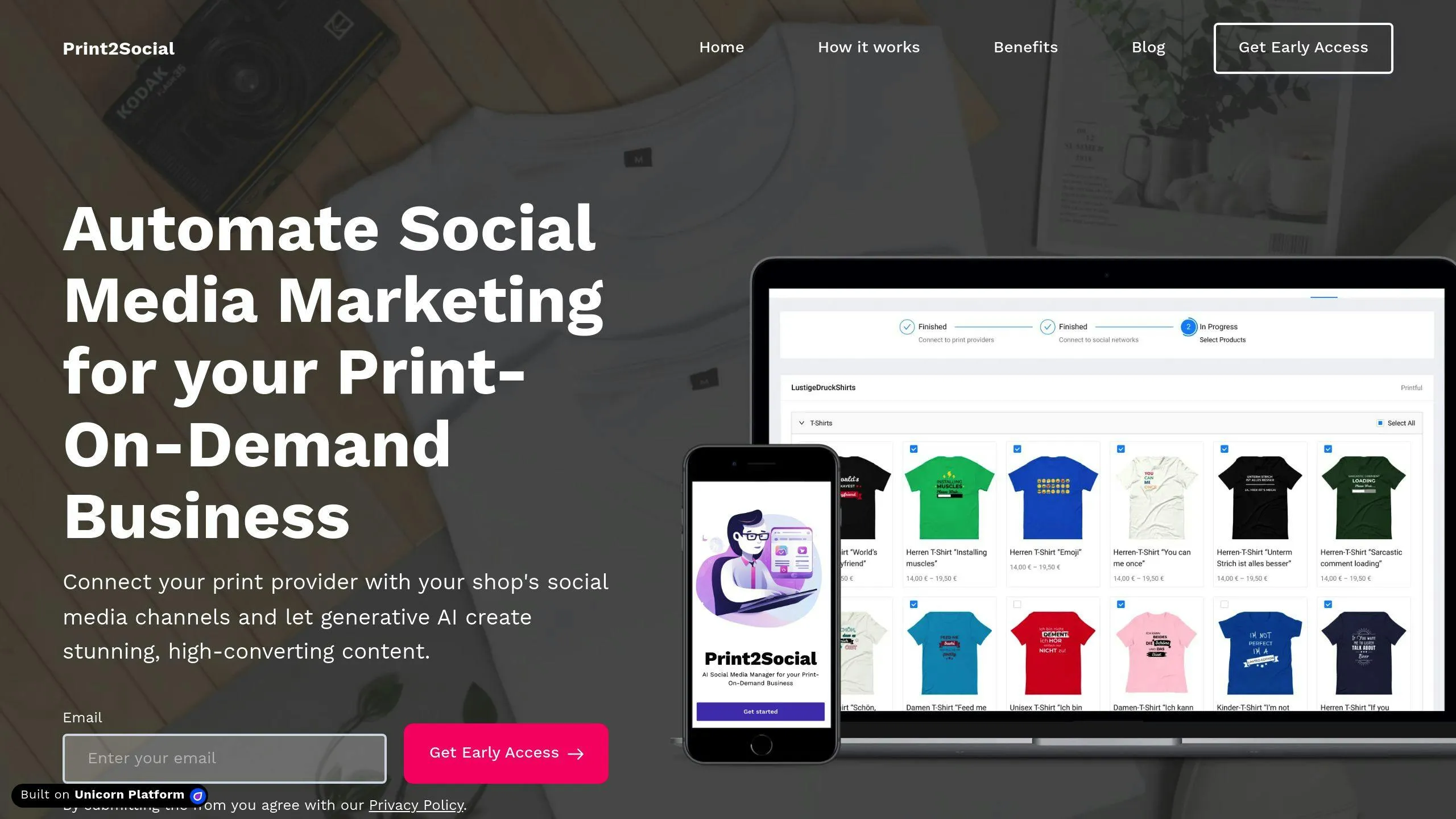
Print2Social is a game-changer for print-on-demand businesses. It lets you:
- Schedule posts across platforms
- Create content using AI
- Track how well your posts are doing
Product research tools
Section titled “Product research tools”These tools help you find products that’ll sell:
Tool
What it does
Oberlo
Works with AliExpress, import products easily
US/EU suppliers, faster shipping
DSers
Handle lots of orders at once, watch prices
Inventory management systems
Section titled “Inventory management systems”Keeping track of what you have is key. Try these:
- Inventory Source: Real-time updates from different suppliers
- Ecomdash: Sell on multiple channels, route orders smartly
These help you avoid selling stuff you don’t have.
Order processing software
Section titled “Order processing software”Handle orders faster and with fewer mistakes:
- Oberlo: Fills orders automatically for Shopify stores
- DSers: Processes lots of AliExpress orders at once
Customer service tools
Section titled “Customer service tools”Keep customers happy with these:
- Chatbots for round-the-clock help
- Automatic email replies
- DIY help centers
For example, Sprout Social has a Smart Inbox to manage customer chats across platforms.
Setting up your automated store
Section titled “Setting up your automated store”Want to save time and streamline your dropshipping business? Here’s how to set up an automated store:
Pick an e-commerce platform
Section titled “Pick an e-commerce platform”Go for a platform with solid automation features. Shopify’s a popular choice - it’s easy to use and has tons of automation apps.
Platform
Key Features
Starting Price
Shopify
Lots of apps, SEO tools
$29/month
Sell everywhere, no extra fees
$39/month
Free WordPress add-on
Free (+ hosting)
Add automation tools
Section titled “Add automation tools”Now, let’s add some automation magic:
- Oberlo: Lists products and handles orders for Shopify
- DSers: Manages AliExpress orders and tracks inventory
- Spocket: Finds US/EU suppliers for faster shipping
To set these up:
- Hit your platform’s app store
- Search for the tool you want
- Click “Install” or “Add to Store”
- Follow the setup steps
Create workflows
Section titled “Create workflows”Build automated processes that work for you:
1. Order processing:
- Auto-send orders to your supplier
- Update inventory in real-time
- Send tracking info to customers
2. Product management:
- Sync products daily for prices and stock
- Hide out-of-stock items automatically
- Add new supplier products on a schedule
3. Customer service:
- Set up auto-replies for common questions
- Use a ticket system for tricky issues
- Add chatbots for round-the-clock support
With these automation tricks, you’ll run a smoother, more efficient dropshipping business. Less manual work, more time to grow!
Automating product management
Section titled “Automating product management”Dropshipping automation tools can streamline your product management. Here’s how:
Finding and adding products
Section titled “Finding and adding products”Tools like AutoDS and Oberlo make product importing a breeze:
- AutoDS: Import thousands of products at once. Use one-click, single product, or bulk CSV uploads.
- Oberlo: Seamlessly import AliExpress products to Shopify. Handles order fulfillment and real-time inventory updates.
Automatic pricing
Section titled “Automatic pricing”Smart pricing tools keep your profits intact:
- AutoDS monitors supplier prices to maintain your margins.
- Spark Shipping lets you set rules to protect profits as costs change.
Keeping inventory up-to-date
Section titled “Keeping inventory up-to-date”Avoid selling out-of-stock items with inventory syncing:
- DSers syncs up to 20,000 products across 10 stores.
- WooDropship syncs AliExpress inventory for WooCommerce users.
Tool
Key Feature
Pricing
AutoDS
Bulk importing
Varies
Oberlo
AliExpress integration
Free - $79.90/month
DSers
Multi-store sync
Free - $20/month
WooDropship
WooCommerce integration
Free - $14.99/month
These tools handle the grunt work, letting you focus on growing your store.
“AutoDS automation runs all my dropshipping stores. It’s the only platform I trust to save time, monitor products 24/7, and fulfill orders on time.” - Paul Lipsky, Dropshipping Titans Owner
Automating order fulfillment
Section titled “Automating order fulfillment”Let’s talk about making your dropshipping business run smoother. Here’s how automation can help you from order to delivery:
Handling orders faster
Section titled “Handling orders faster”Want to process orders at lightning speed? Check out these tools:
- DSers: This app works with AliExpress and can handle hundreds of orders in seconds. No more manual data entry!
- AutoDS: It’s an all-in-one solution that automates everything from finding products to processing orders.
Tool
Main Feature
Cost
DSers
Bulk ordering
Free - $19.9/month
AutoDS
Full automation
$24/month (Try for $1)
Talking to suppliers
Section titled “Talking to suppliers”Automation can make supplier communication a breeze:
- Ordoro: Suppliers can log in to see active orders, print labels, and track orders in real-time.
- Inventory Source: This tool syncs inventory and routes orders across multiple suppliers automatically.
Updating customers
Section titled “Updating customers”Keeping customers in the loop is crucial. Here’s how automation helps:
- Automatic tracking updates: Tools like AutoDS send tracking info to customers without you doing a thing.
- Chatbots: They can handle basic order status questions, freeing you up for bigger issues.
“Imagine your vendors seeing orders in real-time instead of waiting for your end-of-day email.” - Ordoro
Automation can transform your dropshipping business. It’s not just about saving time - it’s about growing your business without growing your workload.
Marketing automation
Section titled “Marketing automation”Marketing automation can supercharge your dropshipping business. Here’s how:
Email marketing
Section titled “Email marketing”Email is a powerhouse, returning $36 for every $1 spent. Use it wisely:
- Set up automated flows with Mailchimp or Klaviyo:
- Welcome new customers
- Confirm orders
- Update on shipping
- Remind about abandoned carts
Tool
Standout Feature
Starting Price
Mailchimp
Easy to use
Free (up to 2,000 contacts)
Klaviyo
E-commerce friendly
Free (up to 250 contacts)
Multi-channel
Free (up to 250 contacts)
“Email marketing lets you talk one-on-one with customers worldwide.” - HubSpot
Social media posting
Section titled “Social media posting”Stay visible on social media:
1. Pick a scheduler (Buffer, Hootsuite)
2. Plan your content
3. Create posts in batches
4. Schedule for peak times
Pro tip: Use AI for post ideas and captions. It’s a time-saver.
AI content creation
Section titled “AI content creation”Speed up content production with AI:
- ChatGPT can help with:
- Product descriptions
- Blog outlines
- Ad copy
- Microsoft Designer for quick visuals:
- Social media graphics
- Banner ads
- Product mockups
sbb-itb-8547c32
Section titled “sbb-itb-8547c32”Customer service automation
Section titled “Customer service automation”Customer service automation helps dropshipping businesses handle customer questions without human agents 24/7. It’s a win-win: customers get help anytime, and you keep costs down.
Chatbots and AI helpers
Section titled “Chatbots and AI helpers”Chatbots are like digital customer service reps. They use AI to chat with customers and tackle common questions. Here’s what they can do:
- Answer product questions
- Check order status
- Help with returns
Take eBay’s ShopBot. It handles MILLIONS of customer chats each year. That’s a lot of happy customers and a lot fewer headaches for human agents.
Automatic responses
Section titled “Automatic responses”Think of automatic responses as your always-on customer service team. They jump in to answer frequent questions right away. No more waiting around for customers.
How to make it happen:
- Use pre-written emails for common issues
- Set up auto-replies for order confirmations
- Create a knowledge base with answers to FAQs
Self-service options
Section titled “Self-service options”Let customers be their own heroes. Self-service options save time for everyone involved.
Try these:
- Order tracking page
- Return portal
- Product FAQs
Here’s a fun fact: A Harvard Business Review study found 81% of customers try to fix issues themselves before reaching out. That’s a lot of people who’d love some self-service options!
Tool
Starting Price
Key Feature
Free plan available
AI bot for multiple platforms
$39/month/seat
Advanced chatbot options
Free plan available
Easy-to-use interface
Automating analytics and reports
Section titled “Automating analytics and reports”Data drives dropshipping success. But who’s got time for endless number crunching? Enter automation. Let’s see how to make your data work smarter, not harder.
Tracking performance
Section titled “Tracking performance”Your business metrics? They’re gold. Shopify’s built-in analytics make tracking a snap. They play nice with Google Analytics too, giving you the full scoop on your store’s performance.
What can you track? Think:
- Daily sales
- Best-selling products
- Customer acquisition costs
- Conversion rates
Automate these metrics, and you’ll always know your business’s pulse.
Making custom dashboards
Section titled “Making custom dashboards”Custom dashboards are your business’s command center. They put the important stuff front and center.
Here’s your dashboard game plan:
1. Pick your key metrics (revenue, orders, traffic)
2. Choose your tool (Google Data Studio or Tableau work great)
3. Hook up your data sources
4. Design your layout
5. Set it to auto-refresh
Boom. Real-time insights at your fingertips. No more spreadsheet diving.
Generating reports
Section titled “Generating reports”Automated reports? They’re time-savers and accuracy-boosters. They turn data into action, minus the elbow grease.
Check out Data Export Reports, a Shopify app. It’s a powerhouse:
- Whips up over 2,000 report types
- Schedules regular report creation
- Emails reports or saves them to the cloud
Report Type
Use Case
Frequency
Sales by product
Inventory planning
Weekly
Customer acquisition
Marketing strategy
Monthly
Refund details
Quality control
Quarterly
Automate these reports and free up time to grow your business. It’s that simple.
Advanced automation methods
Section titled “Advanced automation methods”Dropshipping automation is getting smarter. Here’s how cutting-edge tech can boost your business:
Predicting demand
Section titled “Predicting demand”AI is changing the inventory game. It crunches data from sales, trends, and social media to forecast demand accurately.
Take Inventory Planner. This tool uses smart algorithms to:
- Update buying recommendations on the fly
- Adapt to new info quickly
- Improve restocking suggestions
The payoff? Businesses using AI forecasting have seen:
- 20-50% fewer forecasting errors
- Up to 65% less lost sales and stock-outs
- 5-10% lower warehousing costs
Personalizing with AI
Section titled “Personalizing with AI”AI isn’t just for behind-the-scenes work. It’s making shopping more personal, too.
Check out how these companies use AI:
Company
AI Use
Result
Bliss
Skin-based product picks
Better product matches
Cutter and Buck
Team-based outfit ideas
Full outfit suggestions
Tommie Copper
Personalized compression gear
Products that fit needs
The impact? One personalized suggestion can boost average order value by 369%.
Smart inventory management
Section titled “Smart inventory management”Predictive analytics is making inventory smarter. By mixing real-time data with AI, businesses make better stock decisions.
IKEA uses a “Min/max” approach. They split high-flow and low-flow stock, automating the first and manually handling the second.
Dell does things differently with Just in Time (JIT):
- Materials arrive only when needed
- Stock stays for 6 days max
- Result: Lower storage costs, less waste
For dropshippers, tools like EPROLO offer:
- Easy e-commerce platform integration
- Automated order handling
- Real-time stock updates
Challenges and things to consider
Section titled “Challenges and things to consider”Risks of too much automation
Section titled “Risks of too much automation”Automation in dropshipping can backfire. Here’s how:
- It can make your brand feel cold and impersonal
- It might not handle unique situations well
- Tech problems can bring your whole business to a halt
To stay safe:
- Check your automated processes often
- Keep humans in charge of important stuff like customer service
- Have a Plan B for when tech fails
Balancing automation and personal touch
Section titled “Balancing automation and personal touch”You need both robots and humans. Here’s a quick breakdown:
Task
Let the bots handle
Keep it human
Day-to-day stuff
Processing orders, updating stock
Tricky customer questions
Marketing
Sending emails, posting on social media
Personal follow-ups, creating content
Customer service
Simple FAQs
Dealing with complaints, building relationships
Here’s a real-world example: A French e-commerce company went all-in on a fancy chatbot. Sure, they answered questions faster and saved money. But customers hated it. The bot couldn’t show empathy. They had to backtrack and use both AI and human agents.
Legal and ethical issues
Section titled “Legal and ethical issues”Watch out for these legal and ethical landmines:
- Data privacy: Follow laws like GDPR
- Consumer protection: Be honest about shipping times and product quality
- Intellectual property: Don’t sell fake stuff or use copyrighted material without permission
Heads up: Since May 2024, businesses in Europe have to tell customers when they’re talking to an AI. It’s all about being upfront with automated customer service.
To stay out of trouble:
- Know the trade laws in your target markets
- Double-check that your suppliers are legit
- Have clear return policies and realistic delivery times
Future of dropshipping automation
Section titled “Future of dropshipping automation”New automation technologies
Section titled “New automation technologies”Dropshipping is changing fast. Here’s what’s coming:
- AI product selection
AI now picks winning products by analyzing trends and customer data. Shopify’s algorithms even predict future demand.
- Smart inventory management
Companies like ShipBob use AI to forecast stock needs and optimize warehouses. This means faster, cheaper shipping for dropshippers.
- Advanced chatbots
AI chatbots are getting smarter. They can now handle complex questions, recommend products, and process orders.
- AR for “try before you buy”
Augmented Reality lets customers visualize products. It’s great for furniture and fashion dropshippers.
AR Benefits
Impact
Fewer returns
Higher profits
More sales
Better conversion
Happier customers
Repeat business
What’s next?
Section titled “What’s next?”The future looks bright:
- Lightning-fast shipping
Customers will expect same-day or next-day delivery. Dropshippers who can deliver will win big.
- Hyper-personalization
Imagine a store that changes its products based on who’s visiting. AI will make this possible.
- Voice shopping boom
As smart speakers take over, dropshippers will need to optimize for voice search.
- Blockchain for trust
Blockchain will make supply chains transparent, helping dropshippers prove product authenticity.
- Local suppliers on the rise
To ship faster, more dropshippers will partner with nearby suppliers. This could reshape global trade.
The dropshipping market is set to explode. Experts say it’ll hit $500 billion by 2027, growing 27.1% yearly from 2022 to 2031. To keep up, dropshippers must embrace these new tech trends.
Success stories
Section titled “Success stories”Let’s look at some real dropshipping wins:
Irwin Dominguez: $0 to $1M in 8 months
Section titled “Irwin Dominguez: $0 to $1M in 8 months”Irwin’s story is wild:
- First sale? 3 days after launch
- Best day? $30,000 in sales
- Now? About $10,000 daily
Irwin says: “Try e-commerce. It costs nothing to start.”
Andreas and Alexander: Pet product pros
Section titled “Andreas and Alexander: Pet product pros”These guys nailed it by focusing:
- Switched to just pet stuff
- Daily sales jumped from $30 to $350-400
- Hit $144,110 in 3.5 months
Their tip? “Focus on customers and suppliers.”
Erin Rafferty: Three stores, big wins
Section titled “Erin Rafferty: Three stores, big wins”Erin’s strategy? Know your market:
- Opened stores for women’s clothes, baby gear, and pets
- Covered rent 4x over in three weeks
- Made $442,991 in six months
Erin’s secret? “Talk to your people on social media.”
What we learned
Section titled “What we learned”- Start small, dream big
- Pick a niche and own it
- Get social
- Use tools to grow faster
- Don’t give up
- Treat customers right
These stories show it’s possible. With the right approach and some grit, you could be next.
Wrap-up
Section titled “Wrap-up”Let’s recap the key points about dropshipping automation:
- It saves time
- It improves accuracy
- It’s cost-effective
- It streamlines operations
Automation frees you up to grow your business. It cuts down on mistakes, keeps startup costs low, and smooths out your workflow.
Looking ahead, here’s what to watch for:
- AI and machine learning will shake things up
- Niche stores will likely outperform general ones
- Customer experience is crucial
- Data will drive decisions
Start small with automation. Remember Irwin Dominguez? He went from $0 to $1M in 8 months. That’s what’s possible.
The dropshipping world is changing fast. Jump on the automation train now, and you’ll be ready for whatever comes next in e-commerce.
Can I automate my dropshipping business?
Section titled “Can I automate my dropshipping business?”Yes, you can. Here’s how:
1. Set up a Shopify store
This is your starting point. Shopify makes it easy to create an online store quickly.
2. Add automation apps
Head to the Shopify App Store. Look for dropshipping automation apps like AutoDS.
3. Configure your setup
Use these apps to handle:
- Finding and listing products
- Managing inventory
- Processing orders
- Dealing with customer service
By automating these tasks, you’ll save time and cut down on mistakes.
“Shopify lets you build and launch an automated dropshipping store. Just set up your store, then add the automation apps that fit your needs.” - Tiny Marketing Lab