Skip to content

Blog

5 AI Content Curation Tools for Social Media

Looking for AI tools to manage your social media content? Here are the top 5 tools and what they do best:

  1. SocialPilot ($35/month) - Best for managing multiple accounts across 20+ platforms
  2. BuzzSumo ($99/month) - Excels at finding trending topics and viral content
  3. Feedly ($8/month) - Smart RSS reader with AI recommendations
  4. UpContent (Contact sales) - Combines manual and automated curation
  5. Print2Social (Contact sales) - Built for print-on-demand businesses

44% of businesses now use AI tools for content creation. These tools help you:

  • Find relevant content faster
  • Schedule posts at optimal times
  • Track performance metrics
  • Generate AI-powered content
  • Save 15-20 hours per week on content management

Quick Comparison:

Tool

Main Strength

Best For

Starting Price

SocialPilot

Multi-platform management

Small businesses

$35/month

BuzzSumo

Trend detection

Content marketers

$99/month

Feedly

Smart content discovery

Individual creators

$8/month

UpContent

Hybrid curation approach

Social media teams

Contact sales

Print2Social

POD-specific features

POD businesses

Contact sales

Want to know which tool fits your needs? Let’s break down each option in detail.

AI has reshaped the way businesses manage their social media content, offering noticeable boosts in both efficiency and performance. In fact, 44% of businesses already leveraging AI for content creation report clear improvements in their digital marketing efforts.

One standout benefit? AI-powered content curation saves you a ton of time. Instead of manually hunting for content across various platforms, these tools can quickly scan and sort through massive amounts of data, delivering high-quality, relevant material tailored to your audience’s interests. Social media managers can save as many as 15–20 hours each week simply by automating content discovery and curation.

“AI-based content curation tools automate the process of finding and sharing relevant content, saving you time and effort. They help ensure that the content you share is high-quality and resonates with your audience, enhancing engagement and establishing your brand as a thought leader.” - Influencer Marketing Hub

Another game-changer is AI’s data-driven insights. These tools go beyond curation - they analyze engagement trends, identify the best times to post, and track content performance metrics. For example, platforms like BuzzSumo and Feedly use advanced algorithms to uncover trending topics and even forecast how specific content might perform.

For print-on-demand businesses, AI is especially handy. Many platforms can now generate product images, write catchy captions, and schedule posts to hit at peak engagement times - all without lifting a finger. This smooth process guarantees consistent branding and helps amplify your reach and interaction rates.

Here’s a breakdown of how AI enhances different aspects of content management:

Aspect

AI-Driven Benefits

Impact

Content Discovery

Automatically identifies trending and relevant topics

Cuts research time by 70%

Scheduling

Smart timing based on audience activity patterns

Boosts engagement rates by 35%

Analytics

Tracks performance and provides predictive insights

Refines content strategies using data

Engagement

Automates replies and evaluates audience sentiment

Strengthens audience relationships
SocialPilot

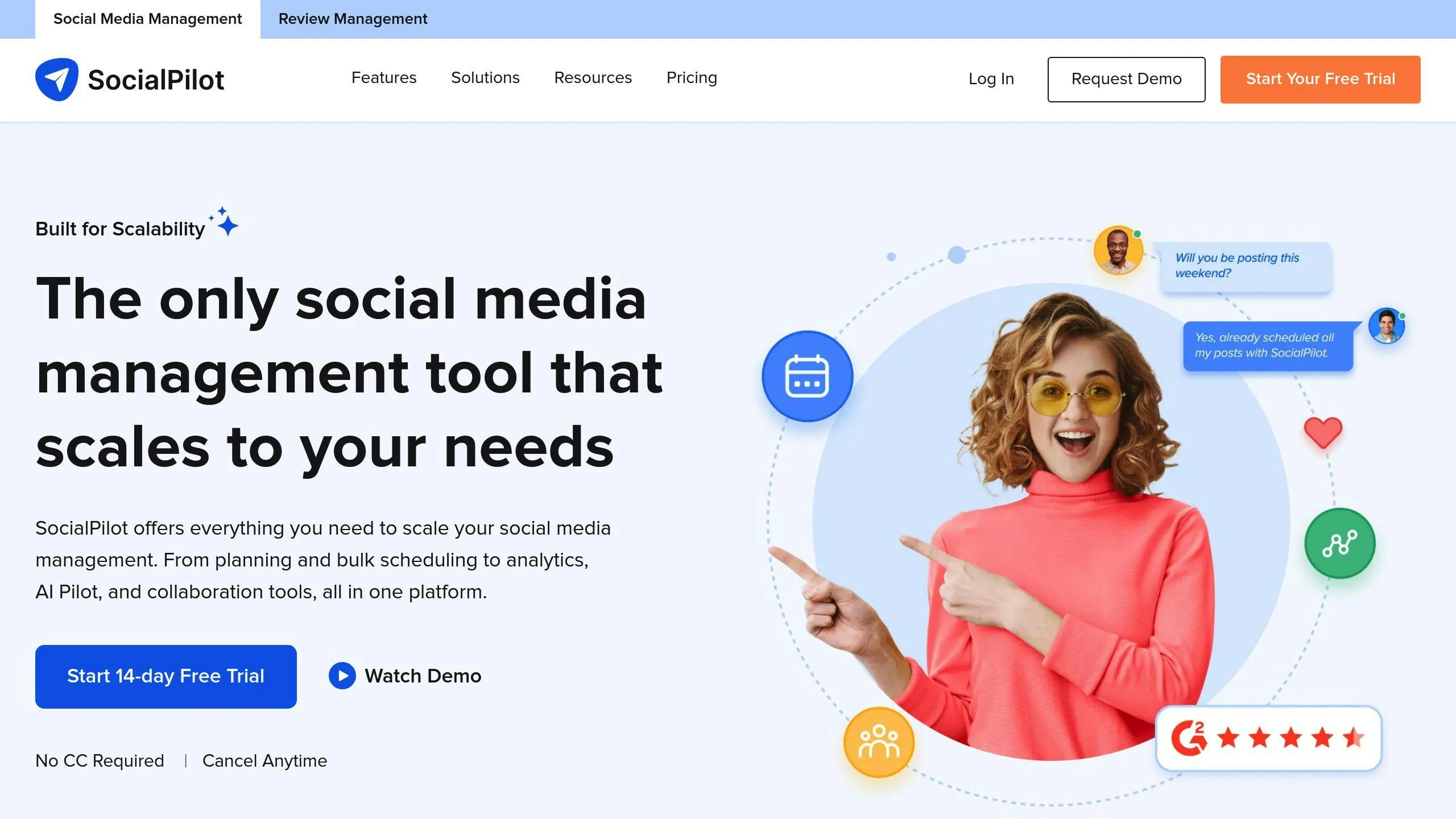
SocialPilot makes managing social media easier, especially for businesses juggling multiple accounts and heavy posting schedules. Supporting over 20 social platforms, it’s designed to simplify your social media strategy and save you time.

One of its standout features is the AI-powered content discovery engine, which finds relevant industry content, trending topics, and viral posts that your audience will love. This tool can save social media managers as much as 12 hours a week on content research and curation.

Another highlight is its smart scheduling system. By analyzing past engagement data, the platform identifies the best times to post for maximum visibility and interaction. Businesses using this feature have reported engagement rates increasing by up to 35%.

“SocialPilot’s AI-powered scheduling has transformed how we manage our clients’ social media presence. We’ve seen engagement rates increase by nearly 40% since implementing their smart posting times feature”, says the product team behind SocialPilot.

For teams managing multiple accounts, SocialPilot offers strong collaboration tools, including built-in approval workflows. Its analytics dashboard provides real-time insights into content performance, enabling teams to make smart, data-informed decisions about their strategies.

Here’s a quick look at how its plans cater to different types of businesses:

Plan Type

Best For

Key Features

Monthly Posts

Professional

Small Businesses

50 accounts, Basic Analytics

200/day

Business

Growing Teams

100 accounts, Advanced Analytics

500/day

Agency

Large Organizations

500 accounts, Custom Workflows

2,000/day

SocialPilot also integrates easily with other tools, making it a smooth addition to your existing workflow. Plus, their around-the-clock customer support ensures help is always available. If you’re curious, the 14-day free trial is a great way to explore everything SocialPilot has to offer before making a commitment.
BuzzSumo

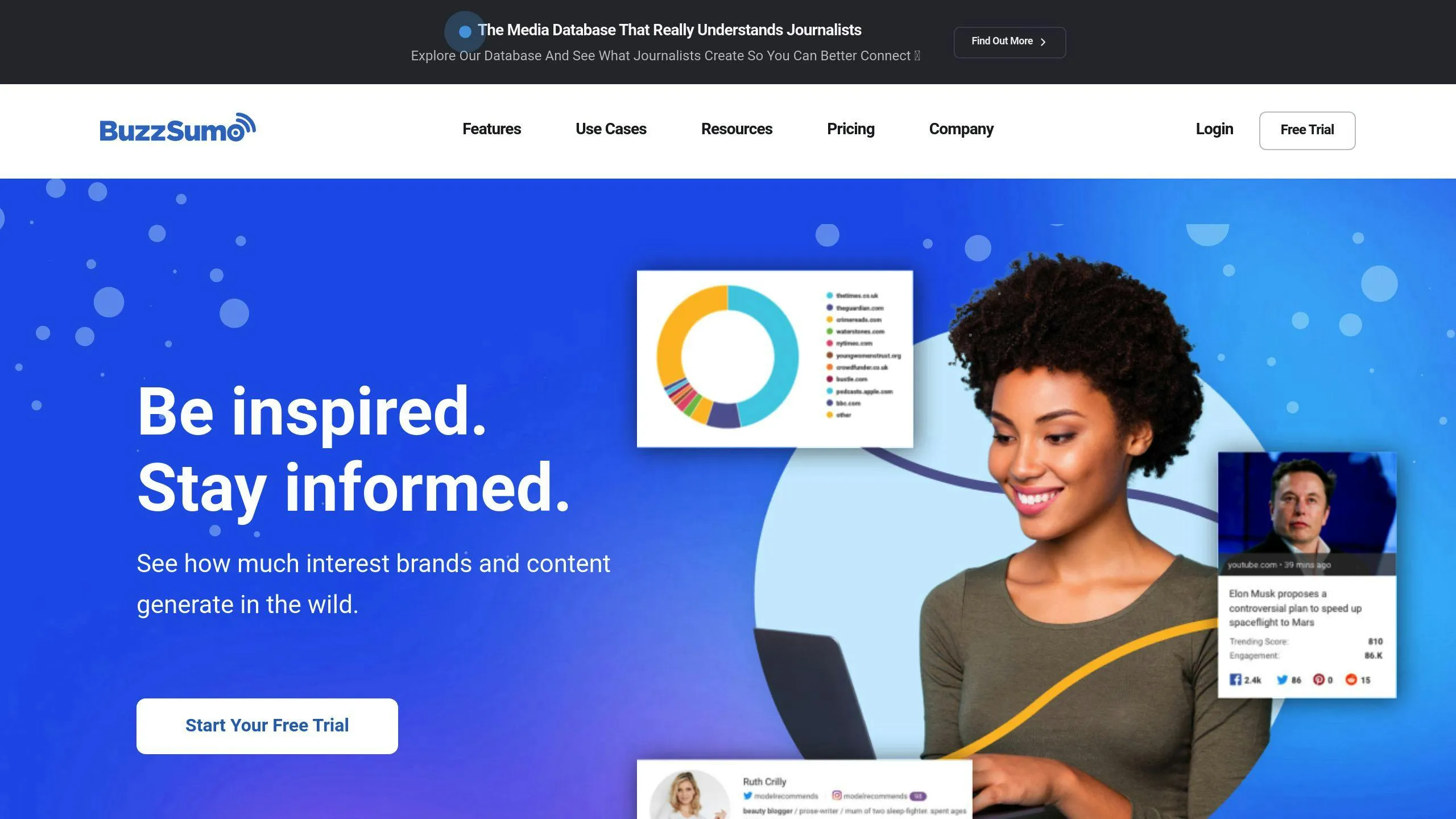
BuzzSumo is a go-to platform for finding and sharing attention-grabbing social media content. With its AI-driven technology, it scans millions of articles and social media posts every day, pinpointing trending topics and high-engagement material tailored to your target audience.

The platform’s content discovery tool does more than typical keyword searches. It leverages AI to spot patterns and engagement trends across different social networks. This lets businesses see which content types resonate most in their industry and with their audience.

“BuzzSumo’s AI-powered content discovery has revolutionized how we approach content curation. We’re now able to identify trending topics hours before they peak, giving us a significant advantage in our social media strategy”, shares the BuzzSumo product team.

One of the most useful tools in BuzzSumo is its performance analytics dashboard. This feature breaks down key performance metrics, such as:

Metric Type

What It Measures

Why It Matters

Engagement Rate

Likes, shares, comments

Shows how well your content connects

Content Format

Videos, articles, images

Tells you which formats your audience prefers

Peak Times

Posting time performance

Helps you post at the right times

Topic Trends

Rising and falling topics

Guides what topics to focus on

BuzzSumo also integrates with popular social media management tools, so adding curated content into your workflow is a breeze. Plans start at $99 per month, providing businesses with a consistent way to stay active and relevant on social media.

What sets BuzzSumo apart? Its AI not only finds content but keeps refining its recommendations based on what your audience likes. This automatic adjustment helps ensure your strategy stays aligned with your audience’s evolving interests.
Feedly

Feedly offers a standout approach to AI-driven content curation with its intelligent assistant, Leo. This tool completely rethinks how businesses discover and organize social media content, going well beyond standard RSS feed management. Leo learns from your interactions, making content recommendations increasingly relevant over time.

With Feedly’s customized organization tools, you can build feeds tailored to specific topics, industries, or sources. For example, if you’re monitoring industry updates, Leo will sort related articles into specific boards while weeding out unnecessary duplicates or irrelevant content.

Feature

Function

Benefit

Leo AI

Smart content recommendation

Suggests articles based on your habits

Custom Feeds

Organizes content by topic

Simplifies finding what you need

Cross-Platform Access

Works on web and mobile

Curate content anywhere

Content Filtering

Screens articles for relevance

Saves time by reducing clutter

“Leo, our AI assistant, processes millions of articles daily to surface the most relevant content for each user’s specific interests and industry focus”, shares the Feedly development team.

Feedly also integrates with popular sharing tools, making it simpler to manage and schedule social media updates. This connection streamlines the flow from discovering content to sharing it, saving time and effort. Their professional plan starts at $8/month, though a free version is available for basic content gathering.

What sets Feedly apart is Leo’s ability to learn as you use it. The more you interact with content, the better it gets at picking out articles and sources that matter most to you. This doesn’t just save time - it boosts efficiency, letting you spend more energy engaging with your audience.

UpContent

UpContent strikes a middle ground between fully manual and completely automated content curation, offering a more flexible way to discover and share engaging content. Its discovery system uses AI to sift through multiple sources, picking articles that match your social media goals.

One standout feature is its filtering system, which goes beyond basic keyword matching. The AI examines the context and relevance of content. For example, if you’re focused on digital marketing, it knows to prioritize articles about digital strategies rather than general marketing topics - saving you from irrelevant results.

Feature

What It Does

Benefit

Smart Discovery

AI-driven content search

Cuts down time spent hunting for articles

Contextual Analysis

Focuses on relevance over keywords

Delivers higher-quality content

Platform Integration

Works with leading social tools

Simplifies your workflow

Custom Filters

Fine-tunes content selection

Keeps everything aligned with your brand voice

One of UpContent’s strengths lies in its ability to integrate with popular tools like Buffer and Hootsuite. This supports a smooth workflow, letting you directly schedule and share curated posts without leaving your existing social media management platform.

“UpContent serves as a bridge between manual and automated curation, offering businesses the flexibility to maintain their unique voice while leveraging AI to streamline the discovery process”, says the UpContent development team.

Its filter customization is another key feature. You can set specific parameters like content type, trusted publishers, and relevance to your niche. This means the content showing up in your social feeds is always on point and maintains a level of professionalism across the board.

UpContent’s hybrid approach is especially useful. It automates the tedious parts of content discovery but still gives you control to ensure content feels genuine and fits your brand. This balance helps businesses stay authentic while cutting down the time it takes to find the right articles.
Print2Social

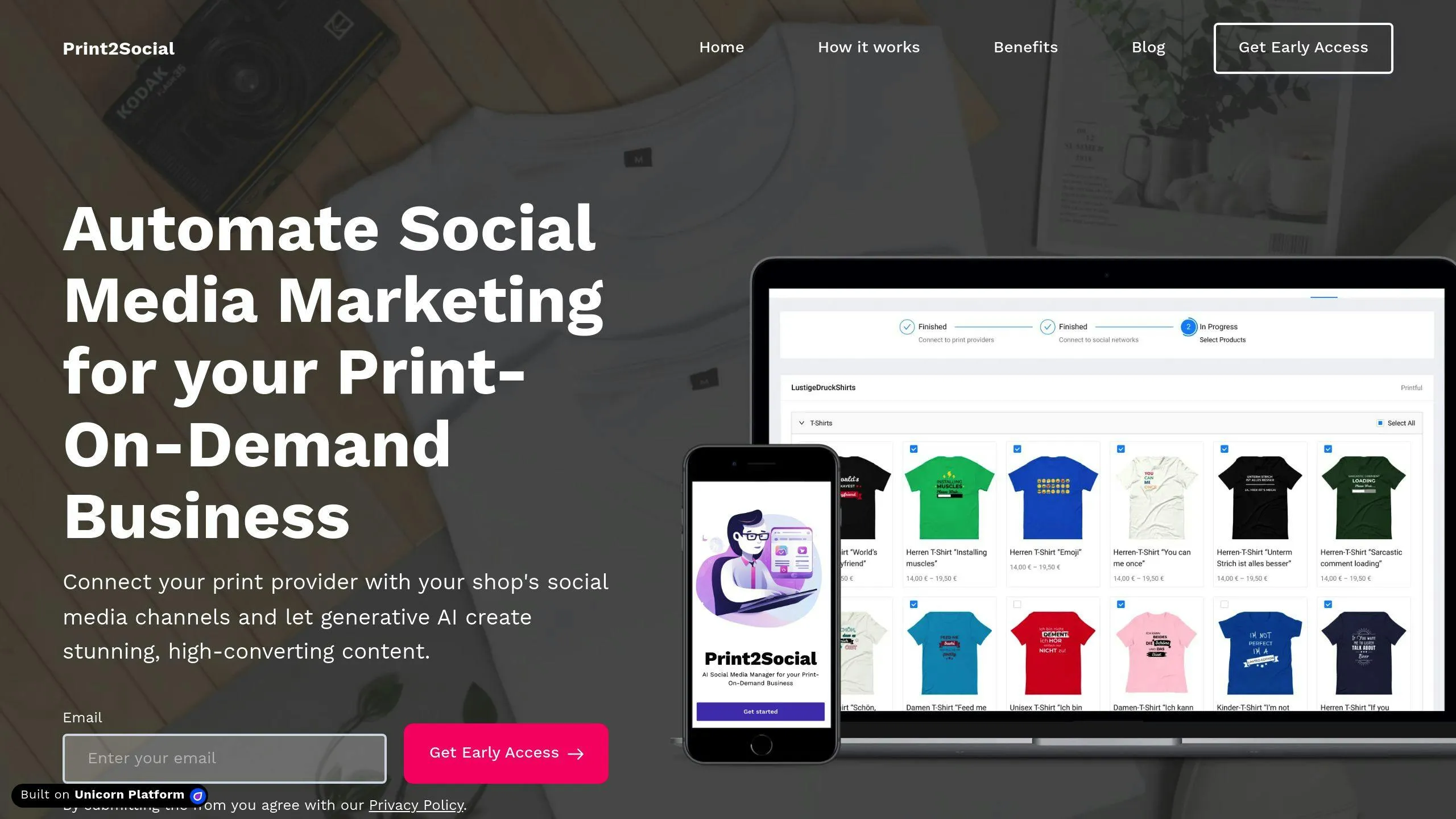
Print2Social is an AI-powered content tool designed specifically for print-on-demand businesses. Its goal? To take the hassle out of creating and scheduling promotional content for social media.

This tool shines because of its direct integration with print-on-demand suppliers. It connects to fulfillment providers, pulls in product catalogs, and automatically generates social media-ready promotional content. No more manual imports or time-consuming content creation.

Feature

Purpose

Benefit to Business

Store Integration

Syncs with POD providers

Makes product selection easier

AI Content Generation

Produces images and videos

Saves time on creative tasks

Automated Scheduling

Manages post calendars

Keeps social media consistent

Custom Content

Aligns with brand guidelines

Protects brand identity

Powered by generative AI, Print2Social does more than schedule posts. It rolls out fully packaged social media content, pairing eye-catching images and videos with effective product highlights. This allows businesses to stay active on social platforms without devoting endless hours to the process.

“Print2Social serves as a bridge between print-on-demand operations and social media marketing, automating the content creation process while maintaining brand authenticity”, says Dipl.-Ing. Samir Alibabic, founder of Print2Social.

What really sets Print2Social apart is its ability to match your brand’s unique voice. The AI isn’t confined to cookie-cutter templates - it adjusts to your specific branding needs and marketing strategies. That way, the posts not only save time but also feel perfectly in sync with your business.

For print-on-demand brands, this platform takes the guesswork out of showcasing new products. It simplifies both the creative and logistical parts of social media marketing, giving entrepreneurs more bandwidth to focus on designing and selling their products.

Let’s break down what these AI content curation tools bring to the table in terms of features and costs. Each option caters to different needs, making it easier to find the right match for your business goals and budget.

Tool

Core Features

Best For

Monthly Price

Scoop.it

Content discovery engine, Topic pages, CRM integration

Content marketers, Small teams

$15 (Pro), $79 (Business)

ContentStudio

Social media management, Content curation, Analytics

Marketing agencies, Large teams

$49

Feedly

Smart RSS reader, AI recommendations

Individual creators, Content researchers

$8

UpContent

Smart Sort, Social media integration

Social media managers

Contact sales

Print2Social

POD integration, AI content generation

Print-on-demand businesses

Contact sales

Feedly stands out as the most affordable option at $8 per month. This makes it perfect for solo creators or small businesses diving into content curation. Its AI recommendation system learns your preferences over time, making discovery quick and efficient.

Meanwhile, ContentStudio goes beyond curation with tools for managing social media, offering analytics and collaboration capabilities. Priced at $49 a month, it’s an excellent fit for growing teams or agencies looking for an all-in-one solution.

“The integration of AI in content curation tools has transformed how businesses approach social media management, making it possible to maintain an active presence across multiple platforms without sacrificing quality or authenticity,” shares a Scoop.it product specialist.

Scoop.it provides flexibility through its tiered pricing. At $15/month, the Pro tier covers basic curation, while the $79/month Business plan unlocks features like CRM integrations and customizable topic pages - ideal for content marketers juggling multiple streams.

UpContent places a heavy emphasis on audience engagement with its Smart Sort technology, which ranks curated content based on how likely it is to resonate with your audience. Pricing details aren’t public, but its focus on engagement makes it appealing for social media teams.

Finally, Print2Social is tailored specifically for print-on-demand businesses. Its combination of AI-generated content and e-commerce integration can make it a game-changer for that niche, though you’ll need to contact sales for pricing details.

When selecting a tool, think about what matters most to your workflow:

  • How much content you need to manage
  • Team size and collaboration features
  • Integration with tools you already use
  • Budget constraints
  • Industry-specific functionality (e.g., Print2Social’s focus on print-on-demand)

The goal is to choose a solution that balances automation, supports your brand voice, and enhances your content strategy - all without exceeding your budget.

When choosing an AI content curation tool for your social media strategy, it’s crucial to focus on features that fit your business needs. Recent data from Semrush shows that 44% of businesses use AI for content creation, emphasizing how essential these tools have become in today’s marketing landscape.

The right tool can make or break your content curation efforts. Here are a few key factors to consider as you evaluate your options:

1. Content Discovery Options
Different tools approach content discovery in unique ways. For example, BuzzSumo specializes in finding trending topics and offering performance analytics, while Feedly uses an AI-driven system to tailor content feeds to your industry. Decide which approach aligns best with your goals.

2. Time-Saving Automation
Tools like SocialPilot (priced at $35/month) simplify labor-intensive tasks like scheduling and distributing content across platforms. By automating these processes, your team can dedicate more time to strategy development and audience engagement.

“AI tools can analyze vast amounts of data to uncover trends, making it easier for businesses to identify and share content that resonates with their audience”, says an expert from Fastlearner.ai.

3. Industry-Focused Tools
In niche industries, specialized tools can give you an edge. For instance, Print2Social is designed for print-on-demand businesses, featuring automated product promotions and AI-generated visuals. Such targeted tools often outperform one-size-fits-all solutions for specific niches.

4. Budget and ROI
Pricing can range from Feedly’s $8 monthly plan to BuzzSumo’s more feature-rich $99 monthly option. Weigh the tool’s features against your budget, but also consider the potential for saving time and boosting engagement - key aspects of a solid ROI.

5. Integration with Existing Tools
Seamless integration is a must. Look at how well the curation tool works within your current workflow. For example, UpContent offers smart sorting to enhance social media platforms, while Print2Social connects users directly to POD fulfillment services, making content creation practically effortless.


The best tools don’t just automate your workflow - they help keep your brand’s voice consistent and genuine. Prioritize tools with the features you need for your industry and content goals, and don’t lose sight of your budget in the process.

AI content creation tools are advanced software that use machine learning to simplify tasks like managing social media content. These tools are becoming increasingly popular in businesses, offering features such as content discovery, scheduling, and platform integration.

Here’s a breakdown of what they do:

Content Discovery and Analysis
AI tools can sift through endless online content to find material that fits your industry and appeals to your audience. For instance, Feedly’s AI system (priced at $8/month) processes millions of articles to provide tailored content recommendations, making it easier to stay relevant in your niche.

Automated Scheduling and Distribution
These tools take the hassle out of posting by automating the process. A good example is Scoop.it’s Business plan ($79/month), which can determine the best times to post and handle distribution across different platforms for you.

“AI-powered content curation tools reduce manual effort by up to 60% while maintaining consistent engagement rates across social media channels”, according to UpContent’s research team.

Integration Capabilities
Most AI tools connect seamlessly with your existing systems and platforms. For example, Print2Social is designed for businesses using print-on-demand workflows, automating both content creation and promotional activities through its AI functionalities.

These tools not only save time but also keep your content engaging and relevant. From analyzing engagement trends to suggesting posting schedules and trending topics, they’re a game-changer for efficient social media management.
Cost-Based vs Value-Based Pricing Guide 2024

Choosing the right pricing strategy can make or break your print-on-demand (POD) business. Here’s what you need to know about cost-based and value-based pricing:

  • Cost-based pricing: Add up costs + markup
  • Value-based pricing: Set price based on perceived customer value

Key differences:

  1. Calculation: Cost-based is simple math, value-based is more complex
  2. Profit potential: Value-based can lead to higher profits
  3. Market position: Value-based helps you stand out
  4. Customer focus: Value-based prioritizes customer perception

Which to choose? It depends on your:

  • Product uniqueness
  • Market willingness to pay
  • Brand strength
  • Long-term goals

Many businesses use both. Start with cost-based to ensure profitability, then incorporate value-based elements as you grow.

Remember: Review and adjust your pricing regularly to stay competitive and maximize profits.

Quick Comparison:

Factor

Cost-Based

Value-Based

Calculation

Simple

Complex

Profit Potential

Predictable

Potentially Higher

Market Position

Vulnerable

Can Be Unique

Best For

High-Volume Markets

High-Value Products

Pricing methods are how businesses figure out what to charge for their stuff. For print-on-demand (POD) businesses, picking the right method can make a huge difference.

Let’s break it down:

Cost-Oriented Pricing: This is all about your production costs. It’s simple, but it might not match what people are willing to pay.

Market-Oriented Pricing: This looks at things like what customers think, how much they want your product, and what your competitors are doing. It’s more flexible but needs more research.

For POD businesses, knowing these is key. If you’re selling custom t-shirts, cost-oriented pricing might just look at material and printing costs. But market-oriented pricing might think about how cool your design is or if it’s beach season.

Your pricing can really shake things up for your POD business:

1. Profitability

It’s all about making sure you’re not losing money. Let’s say your custom mug costs $9.7 to make. If you price it at $11.64 (that’s a 20% profit margin), you’re covering costs. But if people think your mug is super awesome, you might be leaving money on the table.

2. Customer Perception

How you price stuff changes how people see it. Think about Walmart versus Starbucks. Walmart’s low prices attract bargain hunters, while Starbucks’ higher prices make people think “fancy coffee.”

3. Competitive Edge

Your prices can make you stand out. Check this out: In March 2023, a POD company launched eco-friendly t-shirts. They used value-based pricing, charging 30% more than others. But they made a big deal about the sustainable materials. Result? Sales jumped 45% in just one month.

4. Market Position

Pricing helps show where you fit in the market. Are you going for the luxury crowd or trying to be the budget-friendly option?

“The right pricing strategy - cost-based or value-based - depends on your industry, market and customer perception.” - Flintfox

Here’s a real-world example:

In 2022, a POD business selling custom phone cases switched up their pricing. They went from cost-based to value-based pricing. They bumped up prices by 25% but really played up their unique designs and how tough their cases were. The outcome? Profit margins shot up 40% and they kept 15% more customers.

Cost-based pricing is a simple way for print-on-demand businesses to set prices. It’s all about covering costs and making a profit. Here’s how it works:

  1. Add up all your costs
  2. Decide on your markup
  3. Do some simple math

Let’s break it down:

1. Calculate your costs

For a POD t-shirt, this might include:

  • Base cost of the shirt
  • Printing fees
  • Shipping
  • Platform fees
  • Design costs

2. Choose your markup

In fashion, markups usually range from 30% to 60%.

3. Do the math

Use this formula:

Total Costs + (Total Costs × Markup Percentage) = Selling Price

Here’s a real-world example:

In 2023, NovaTomato, a POD hoodie seller, had a total cost of $49.90 per hoodie. With a 40% markup, they priced their hoodie at $69.86.

Cost-based pricing fits POD like a glove. Here’s why:

Know your numbers

Be thorough. Don’t forget about taxes. Shopify reminds us:

“Taxes may need to be charged based on customer location, including sales tax, VAT, and GST.”

Keep an eye on competitors

Your costs matter, but so do market prices. If you’re way off, you might need to adjust.

Quick decisions

Need to price a new product fast? Cost-based pricing has your back.

Stay flexible

The POD world moves fast. Keep checking your numbers and be ready to change.

Tell your story

Some businesses use pricing to build trust. Take Everlane:

They show the cost to make each item and their markup, which is 2-3x compared to the industry average of 5-6x.

While not strictly POD, it shows how pricing can be part of your brand.

Cost-based pricing gives you a solid start. It covers your costs and ensures profit. But it’s just one tool. As you grow, explore other methods to stay competitive in the POD market.

Value-based pricing isn’t about production costs. It’s about what customers think your product is worth. For print-on-demand businesses, it’s a way to boost profits and stand out.

The key? Understanding what makes your product special to customers. Here’s the process:

1. Find out what customers value

Talk to your target audience. What do they love about your products? The design? The quality? Something else?

2. Look at the competition

Check out similar products. How much do they cost? How is yours different or better?

3. Set a price that reflects value

Use what you’ve learned to pick a price that shows off your product’s worth.

4. Test and adjust

Try different prices. See what works best.

Here’s a real-world example:

Luxe Prints, a POD company selling custom wall art, switched to value-based pricing in 2022. They hiked prices by 35% on their most unique designs, focusing on artistry and exclusivity. The result? Sales stayed steady, but profits jumped 40% in just three months.

Value-based pricing fits print-on-demand like a glove. Here’s why:

Unique designs are key: One-of-a-kind artwork can command higher prices. People pay more for something they can’t get elsewhere.

Quality matters: Better-looking, longer-lasting prints? That’s added value.

Tell your story: Your brand’s story can boost perceived value. Maybe your shirts are eco-friendly or support a cause.

Here’s how some POD businesses are making it work:

1. Customization premium

Offer personalization at a higher price. People will pay more for something made just for them.

2. Limited editions

Create scarcity with limited runs. This can justify higher prices.

3. Bundle deals

Package related items together at a slight discount, but still at a value-based price.

Check out this success story:

In 2023, ThreadTales, a POD t-shirt company, launched a line of shirts with AI-generated art based on customers’ personal stories. They priced these at $49.99, nearly double their standard designs. Despite the higher price, sales beat expectations by 75% in the first month. Proof that customers valued the unique, personal touch.

Let’s dive into how cost-based and value-based pricing stack up for print-on-demand businesses:

Cost-based pricing? It’s simple math. Add up your costs, slap on a markup, and boom - you’ve got your price. Value-based pricing? It’s trickier. You’re trying to figure out what customers think your product is worth.

Cost-based pricing guarantees you cover your costs and make a steady profit. But value-based pricing? It can be a game-changer.

Take Luxe Prints. They switched to value-based pricing in 2022, bumping up prices by 35% on their unique designs. The result? Profits shot up 40% in just three months. And they didn’t lose customers.

Cost-based pricing can leave you vulnerable if competitors can produce cheaper. But value-based pricing? It can help you stand out.

Look at ThreadTales. They priced their AI-generated art shirts at $49.99 - double their standard designs. It positioned them as a premium brand. Sales beat expectations by 75% in the first month.

Cost-based pricing ignores how customers see your product. Value-based pricing is ALL about customer perception.

Apple’s a pro at this. They use cost-plus pricing as a starting point, but their strategy leans heavily on value-based principles. They charge premium prices, reflecting the unique value they offer. It’s why they’re seen as a luxury tech brand.

Cost-based pricing can make you complacent. Set your markup and you’re done. Value-based pricing pushes you to keep improving to justify higher prices.

Different industries favor different methods. Supermarkets often use cost-based pricing for everyday items. Specialist medical services? They often go for value-based pricing, focusing on patient outcomes rather than just costs.

Here’s a quick comparison:

Factor

Cost-Based Pricing

Value-Based Pricing

Calculation

Simple

Complex

Profit Potential

Predictable

Potentially Higher

Market Position

Vulnerable

Can Be Unique

Customer Focus

Low

High

Innovation Driver

Low

High

Best For

High-Volume Markets

High-Value Products

Michael Stanisz from Revenue Management Labs says: “Value is subjective, and companies are often estimating the hypothetical value customers will benefit from.”

For print-on-demand businesses? Start with cost-based pricing to ensure profitability. Then, as you get to know your market, mix in value-based elements. Stay flexible and keep an eye on both your costs and what your customers think.

Choosing between cost-based and value-based pricing for your print-on-demand business isn’t simple. It depends on your products, market, and goals. Let’s break it down:

Cost-based pricing works when:

  • You’re new and need to ensure profits
  • Your products are similar to competitors’
  • You’re selling basic items
  • You want to compete on price

Value-based pricing fits if:

  • You offer unique products
  • Your market values quality over price
  • You have a strong brand
  • You want to maximize profits on premium items

Here’s a real example:

CustomTees, a print-on-demand t-shirt company, switched to value-based pricing for their limited edition designs in 2022. They hiked prices by 40%, focusing on exclusivity and artistry. The result? 25% more profits in 6 months, without losing sales.

To decide, ask yourself:

  1. How unique are my products?
  2. What will my market pay?
  3. How strong is my brand?
  4. What are my long-term goals?

You’re not stuck with one method. Many businesses use both. You might price standard products based on cost and premium items based on value.

Darshit Singh from ClippedCode says: “Cost-based pricing generally results in competitive prices.” True, but don’t ignore the power of perceived value in print-on-demand.

After choosing your pricing strategy, you need to promote effectively. That’s where tools like Print2Social come in handy.

Print2Social is an AI tool for social media management, made for print-on-demand businesses. It can showcase your products across platforms. Here’s how it helps:

1. AI-powered content

It creates product images and videos automatically.

2. Targeted promotion

You can highlight specific products, whether they’re priced based on cost or value.

3. Consistent branding

It keeps your brand image consistent, which is key for value-based pricing.

4. Smart scheduling

Automated posting keeps your products visible, supporting your pricing strategy.

Tools like Print2Social help you show your products’ value to your audience, no matter how you price them. This can justify higher prices for premium items or show off competitive pricing for standard ones.

Want to shake up your print-on-demand business? Changing your pricing strategy might do the trick. Here’s how to do it:

1. Analyze Your Market

Dig into your competitors and industry trends. CustomTees, a print-on-demand t-shirt company, spent two months doing this in 2023. They found customers would pay up to 40% more for limited edition designs. That’s huge!

2. Define Your Value Proposition

What makes your products special? CustomTees nailed it with exclusive artwork and top-notch printing. They even backed it up with data: 78% of their customers said their designs were way better than the competition.

3. Set Strategic Goals

Know what you want. CustomTees aimed for a 25% profit boost without losing sales. Having a clear target helps you measure success.

4. Calculate New Rates

Play with the numbers. CustomTees used a pricing tool to test different scenarios. They ended up bumping their premium line by 35%.

5. Communicate Changes Effectively

Don’t blindside your customers. CustomTees gave a two-month heads up about their price increase. They made sure to highlight why their products were worth it.

6. Test and Refine

Start small. CustomTees tried their new prices with 10% of their customers for a month. This let them see how people reacted and make tweaks.

7. Monitor and Adjust

Keep a close eye on things after you change prices. CustomTees checked sales, feedback, and profits weekly. They saw a 5% dip in sales at first, but profits jumped 30% in the first quarter.

Don’t set it and forget it. Top companies look at their prices every three months and adjust twice a year. As Cody Arsenault, Founder of CodyArsenault.com, puts it:

“Whatever pricing strategy you choose, it’s important to have a clear plan backed by market research.”

Changing your prices isn’t easy, but it can pay off big time if you do it right.

Picking the right pricing strategy for your print-on-demand business is crucial. Here’s what you need to know:

Cost-based pricing is simple but might not maximize profits. It’s good for:

  • New businesses
  • Products similar to competitors
  • Basic items with clear costs

Value-based pricing focuses on what customers think your product is worth. It’s great for:

  • Unique or premium products
  • Strong brands with loyal fans
  • Businesses looking to boost profits

You don’t have to stick to just one method. Many successful businesses mix it up.

Take CustomTees, for example. They switched to value-based pricing for their limited edition designs in 2022. The result? They made 25% more profit in just 6 months, without losing any sales.

Here’s what to do:

  1. Check out your market and competitors
  2. Figure out what makes your product special
  3. Set clear goals
  4. Try different pricing strategies
  5. Tell your customers about any changes
  6. Keep an eye on how it’s going and make changes if needed

Don’t set your prices and forget about them. Top companies look at their prices every three months and make changes twice a year.

As you work on your pricing, think about using tools like Print2Social to show off your products on social media. This AI tool can help you highlight what’s special about your products and back up your pricing decisions with targeted content.

“No matter what pricing strategy you pick, make sure you have a solid plan based on market research.” - Cody Arsenault, Founder of CodyArsenault.com

Dropshipping Automation

: Streamline Your E-commerce Business

Dropshipping automation uses software to handle key tasks like:

  • Finding products
  • Updating inventory
  • Processing orders
  • Communicating with suppliers
  • Notifying customers

Benefits:

  • Saves time
  • Reduces errors
  • Enables scaling
  • Cuts costs

Here’s a quick comparison of traditional vs. automated dropshipping:

Aspect

Traditional

Automated

Order Processing

Manual

Automatic

Inventory Updates

Slow, manual

Real-time, automatic

Supplier Communication

Frequent, time-consuming

Minimal, automated

Scalability

Limited

Highly scalable

Error Rate

Higher

Lower

Key automation tools include:

  • Print2Social for social media
  • Oberlo for product importing
  • Inventory Source for stock management
  • DSers for order processing
  • Chatbots for customer service

To set up an automated store:

  1. Choose an e-commerce platform (e.g. Shopify)
  2. Add automation tools
  3. Create workflows for orders, products, and customer service

Automation can transform your dropshipping business, letting you focus on growth instead of repetitive tasks.

Dropshipping has evolved. Here’s how:

Old way:

  • Manual orders
  • Slow inventory updates
  • Constant supplier contact
  • More errors

New way:

  • Automatic orders
  • Real-time stock updates
  • Less supplier interaction
  • Fewer mistakes

Automation has supercharged dropshipping. Take SaleHoo’s Dropship Automation tool. It can add AliExpress products to a Shopify store in minutes, complete with shipping info, images, and descriptions.

An automated dropshipping setup includes:

1. Product research and import tools

Find hot items and add them to your store fast.

2. Inventory management

Keep tabs on stock across suppliers.

3. Order processing software

Customer buys, software tells supplier. No manual work needed.

4. Customer service tools

Handle FAQs and order updates.

5. Pricing automation

Tools like SaleHoo’s ‘Pricing Controls’ maintain consistent markups.

These pieces work together to reduce hands-on tasks. Gerard Ecker, Founder & CEO of Ocean & Co., shares:

“We started with dropshipping. No inventory costs was nice, but we had zero quality control. Poor shipping times and customer experience made us realize dropshipping wasn’t sustainable long-term.”

This highlights why automation matters. It tackles traditional dropshipping’s big issues: slow shipping and poor customer experience.

Aspect

Traditional Dropshipping

Automated Dropshipping

Order Processing

Manual

Automatic

Inventory Updates

Slow, manual

Real-time, automatic

Supplier Communication

Frequent, time-consuming

Minimal, automated

Scalability

Limited

Highly scalable

Error Rate

Higher

Lower

Automated dropshipping isn’t just trendy—it’s becoming essential for growth-focused businesses.

Dropshipping automation can supercharge your e-commerce business. Here’s how:

Automation zaps away hours spent on boring tasks:

  • Orders process instantly
  • Inventory updates in real-time
  • Customer notifications fly out automatically

This frees you up to focus on growing your business. As Ordoro puts it:

“Your time is better spent on things that only you can do, like marketing, public relations, and connecting with your customers.”

Humans make mistakes. Machines? Not so much. Automation:

  • Keeps product info consistent across platforms
  • Maintains spot-on inventory levels
  • Processes orders without typos

With automation, you can scale up FAST without drowning in work or errors. You’ll be:

  • Handling more orders without hiring an army
  • Expanding to new markets like it’s nothing
  • Adding products in a snap

Automation slashes expenses by reducing manual work and mistakes:

Area

How It Saves You Money

Labor

Fewer people needed for day-to-day tasks

Errors

Less money lost on order mix-ups

Inventory

Smarter stock management = less overstock

Customer Service

Fewer issues = happier customers

McKinsey & Company found that about 70% of businesses are looking into automation. It’s becoming a must-have to stay in the game.

Dropshipping automation software links your store to suppliers, syncing product data and managing stock across sales channels. It’s like having a digital assistant that never sleeps.

Take AutoDS, for example. It handles order fulfillment and tracking updates automatically. Your customers get a smooth experience, and you get to kick back (or work on growing your empire).

Dropshipping automation tools can make your business run smoother. Let’s look at some top picks:

Print2Social

Print2Social is a game-changer for print-on-demand businesses. It lets you:

  • Schedule posts across platforms
  • Create content using AI
  • Track how well your posts are doing

These tools help you find products that’ll sell:

Tool

What it does

Oberlo

Works with AliExpress, import products easily

Spocket

US/EU suppliers, faster shipping

DSers

Handle lots of orders at once, watch prices

Keeping track of what you have is key. Try these:

  • Inventory Source: Real-time updates from different suppliers
  • Ecomdash: Sell on multiple channels, route orders smartly

These help you avoid selling stuff you don’t have.

Handle orders faster and with fewer mistakes:

  • Oberlo: Fills orders automatically for Shopify stores
  • DSers: Processes lots of AliExpress orders at once

Keep customers happy with these:

  • Chatbots for round-the-clock help
  • Automatic email replies
  • DIY help centers

For example, Sprout Social has a Smart Inbox to manage customer chats across platforms.

Want to save time and streamline your dropshipping business? Here’s how to set up an automated store:

Go for a platform with solid automation features. Shopify’s a popular choice - it’s easy to use and has tons of automation apps.

Platform

Key Features

Starting Price

Shopify

Lots of apps, SEO tools

$29/month

BigCommerce

Sell everywhere, no extra fees

$39/month

WooCommerce

Free WordPress add-on

Free (+ hosting)

Now, let’s add some automation magic:

  • Oberlo: Lists products and handles orders for Shopify
  • DSers: Manages AliExpress orders and tracks inventory
  • Spocket: Finds US/EU suppliers for faster shipping

To set these up:

  1. Hit your platform’s app store
  2. Search for the tool you want
  3. Click “Install” or “Add to Store”
  4. Follow the setup steps

Build automated processes that work for you:

1. Order processing:

  • Auto-send orders to your supplier
  • Update inventory in real-time
  • Send tracking info to customers

2. Product management:

  • Sync products daily for prices and stock
  • Hide out-of-stock items automatically
  • Add new supplier products on a schedule

3. Customer service:

  • Set up auto-replies for common questions
  • Use a ticket system for tricky issues
  • Add chatbots for round-the-clock support

With these automation tricks, you’ll run a smoother, more efficient dropshipping business. Less manual work, more time to grow!

Dropshipping automation tools can streamline your product management. Here’s how:

Tools like AutoDS and Oberlo make product importing a breeze:

  • AutoDS: Import thousands of products at once. Use one-click, single product, or bulk CSV uploads.
  • Oberlo: Seamlessly import AliExpress products to Shopify. Handles order fulfillment and real-time inventory updates.

Smart pricing tools keep your profits intact:

  • AutoDS monitors supplier prices to maintain your margins.
  • Spark Shipping lets you set rules to protect profits as costs change.

Avoid selling out-of-stock items with inventory syncing:

  • DSers syncs up to 20,000 products across 10 stores.
  • WooDropship syncs AliExpress inventory for WooCommerce users.

Tool

Key Feature

Pricing

AutoDS

Bulk importing

Varies

Oberlo

AliExpress integration

Free - $79.90/month

DSers

Multi-store sync

Free - $20/month

WooDropship

WooCommerce integration

Free - $14.99/month

These tools handle the grunt work, letting you focus on growing your store.

“AutoDS automation runs all my dropshipping stores. It’s the only platform I trust to save time, monitor products 24/7, and fulfill orders on time.” - Paul Lipsky, Dropshipping Titans Owner

Let’s talk about making your dropshipping business run smoother. Here’s how automation can help you from order to delivery:

Want to process orders at lightning speed? Check out these tools:

  • DSers: This app works with AliExpress and can handle hundreds of orders in seconds. No more manual data entry!
  • AutoDS: It’s an all-in-one solution that automates everything from finding products to processing orders.

Tool

Main Feature

Cost

DSers

Bulk ordering

Free - $19.9/month

AutoDS

Full automation

$24/month (Try for $1)

Automation can make supplier communication a breeze:

  • Ordoro: Suppliers can log in to see active orders, print labels, and track orders in real-time.
  • Inventory Source: This tool syncs inventory and routes orders across multiple suppliers automatically.

Keeping customers in the loop is crucial. Here’s how automation helps:

  • Automatic tracking updates: Tools like AutoDS send tracking info to customers without you doing a thing.
  • Chatbots: They can handle basic order status questions, freeing you up for bigger issues.

“Imagine your vendors seeing orders in real-time instead of waiting for your end-of-day email.” - Ordoro

Automation can transform your dropshipping business. It’s not just about saving time - it’s about growing your business without growing your workload.

Marketing automation can supercharge your dropshipping business. Here’s how:

Email is a powerhouse, returning $36 for every $1 spent. Use it wisely:

  • Set up automated flows with Mailchimp or Klaviyo:
    • Welcome new customers
    • Confirm orders
    • Update on shipping
    • Remind about abandoned carts

Tool

Standout Feature

Starting Price

Mailchimp

Easy to use

Free (up to 2,000 contacts)

Klaviyo

E-commerce friendly

Free (up to 250 contacts)

Omnisend

Multi-channel

Free (up to 250 contacts)

“Email marketing lets you talk one-on-one with customers worldwide.” - HubSpot

Stay visible on social media:

1. Pick a scheduler (Buffer, Hootsuite)

2. Plan your content

3. Create posts in batches

4. Schedule for peak times

Pro tip: Use AI for post ideas and captions. It’s a time-saver.

Speed up content production with AI:

  • ChatGPT can help with:
    • Product descriptions
    • Blog outlines
    • Ad copy
  • Microsoft Designer for quick visuals:
    • Social media graphics
    • Banner ads
    • Product mockups

Customer service automation helps dropshipping businesses handle customer questions without human agents 24/7. It’s a win-win: customers get help anytime, and you keep costs down.

Chatbots are like digital customer service reps. They use AI to chat with customers and tackle common questions. Here’s what they can do:

  • Answer product questions
  • Check order status
  • Help with returns

Take eBay’s ShopBot. It handles MILLIONS of customer chats each year. That’s a lot of happy customers and a lot fewer headaches for human agents.

Think of automatic responses as your always-on customer service team. They jump in to answer frequent questions right away. No more waiting around for customers.

How to make it happen:

  • Use pre-written emails for common issues
  • Set up auto-replies for order confirmations
  • Create a knowledge base with answers to FAQs

Let customers be their own heroes. Self-service options save time for everyone involved.

Try these:

  • Order tracking page
  • Return portal
  • Product FAQs

Here’s a fun fact: A Harvard Business Review study found 81% of customers try to fix issues themselves before reaching out. That’s a lot of people who’d love some self-service options!

Tool

Starting Price

Key Feature

Freshdesk

Free plan available

AI bot for multiple platforms

Intercom

$39/month/seat

Advanced chatbot options

Tidio

Free plan available

Easy-to-use interface

Data drives dropshipping success. But who’s got time for endless number crunching? Enter automation. Let’s see how to make your data work smarter, not harder.

Your business metrics? They’re gold. Shopify’s built-in analytics make tracking a snap. They play nice with Google Analytics too, giving you the full scoop on your store’s performance.

What can you track? Think:

  • Daily sales
  • Best-selling products
  • Customer acquisition costs
  • Conversion rates

Automate these metrics, and you’ll always know your business’s pulse.

Custom dashboards are your business’s command center. They put the important stuff front and center.

Here’s your dashboard game plan:

1. Pick your key metrics (revenue, orders, traffic)

2. Choose your tool (Google Data Studio or Tableau work great)

3. Hook up your data sources

4. Design your layout

5. Set it to auto-refresh

Boom. Real-time insights at your fingertips. No more spreadsheet diving.

Automated reports? They’re time-savers and accuracy-boosters. They turn data into action, minus the elbow grease.

Check out Data Export Reports, a Shopify app. It’s a powerhouse:

  • Whips up over 2,000 report types
  • Schedules regular report creation
  • Emails reports or saves them to the cloud

Report Type

Use Case

Frequency

Sales by product

Inventory planning

Weekly

Customer acquisition

Marketing strategy

Monthly

Refund details

Quality control

Quarterly

Automate these reports and free up time to grow your business. It’s that simple.

Dropshipping automation is getting smarter. Here’s how cutting-edge tech can boost your business:

AI is changing the inventory game. It crunches data from sales, trends, and social media to forecast demand accurately.

Take Inventory Planner. This tool uses smart algorithms to:

  • Update buying recommendations on the fly
  • Adapt to new info quickly
  • Improve restocking suggestions

The payoff? Businesses using AI forecasting have seen:

  • 20-50% fewer forecasting errors
  • Up to 65% less lost sales and stock-outs
  • 5-10% lower warehousing costs

AI isn’t just for behind-the-scenes work. It’s making shopping more personal, too.

Check out how these companies use AI:

Company

AI Use

Result

Bliss

Skin-based product picks

Better product matches

Cutter and Buck

Team-based outfit ideas

Full outfit suggestions

Tommie Copper

Personalized compression gear

Products that fit needs

The impact? One personalized suggestion can boost average order value by 369%.

Predictive analytics is making inventory smarter. By mixing real-time data with AI, businesses make better stock decisions.

IKEA uses a “Min/max” approach. They split high-flow and low-flow stock, automating the first and manually handling the second.

Dell does things differently with Just in Time (JIT):

  • Materials arrive only when needed
  • Stock stays for 6 days max
  • Result: Lower storage costs, less waste

For dropshippers, tools like EPROLO offer:

  • Easy e-commerce platform integration
  • Automated order handling
  • Real-time stock updates

Automation in dropshipping can backfire. Here’s how:

  • It can make your brand feel cold and impersonal
  • It might not handle unique situations well
  • Tech problems can bring your whole business to a halt

To stay safe:

  • Check your automated processes often
  • Keep humans in charge of important stuff like customer service
  • Have a Plan B for when tech fails

You need both robots and humans. Here’s a quick breakdown:

Task

Let the bots handle

Keep it human

Day-to-day stuff

Processing orders, updating stock

Tricky customer questions

Marketing

Sending emails, posting on social media

Personal follow-ups, creating content

Customer service

Simple FAQs

Dealing with complaints, building relationships

Here’s a real-world example: A French e-commerce company went all-in on a fancy chatbot. Sure, they answered questions faster and saved money. But customers hated it. The bot couldn’t show empathy. They had to backtrack and use both AI and human agents.

Watch out for these legal and ethical landmines:

  • Data privacy: Follow laws like GDPR
  • Consumer protection: Be honest about shipping times and product quality
  • Intellectual property: Don’t sell fake stuff or use copyrighted material without permission

Heads up: Since May 2024, businesses in Europe have to tell customers when they’re talking to an AI. It’s all about being upfront with automated customer service.

To stay out of trouble:

  • Know the trade laws in your target markets
  • Double-check that your suppliers are legit
  • Have clear return policies and realistic delivery times

Dropshipping is changing fast. Here’s what’s coming:

  1. AI product selection

AI now picks winning products by analyzing trends and customer data. Shopify’s algorithms even predict future demand.

  1. Smart inventory management

Companies like ShipBob use AI to forecast stock needs and optimize warehouses. This means faster, cheaper shipping for dropshippers.

  1. Advanced chatbots

AI chatbots are getting smarter. They can now handle complex questions, recommend products, and process orders.

  1. AR for “try before you buy”

Augmented Reality lets customers visualize products. It’s great for furniture and fashion dropshippers.

AR Benefits

Impact

Fewer returns

Higher profits

More sales

Better conversion

Happier customers

Repeat business

The future looks bright:

  1. Lightning-fast shipping

Customers will expect same-day or next-day delivery. Dropshippers who can deliver will win big.

  1. Hyper-personalization

Imagine a store that changes its products based on who’s visiting. AI will make this possible.

  1. Voice shopping boom

As smart speakers take over, dropshippers will need to optimize for voice search.

  1. Blockchain for trust

Blockchain will make supply chains transparent, helping dropshippers prove product authenticity.

  1. Local suppliers on the rise

To ship faster, more dropshippers will partner with nearby suppliers. This could reshape global trade.

The dropshipping market is set to explode. Experts say it’ll hit $500 billion by 2027, growing 27.1% yearly from 2022 to 2031. To keep up, dropshippers must embrace these new tech trends.

Let’s look at some real dropshipping wins:

Irwin’s story is wild:

  • First sale? 3 days after launch
  • Best day? $30,000 in sales
  • Now? About $10,000 daily

Irwin says: “Try e-commerce. It costs nothing to start.”

These guys nailed it by focusing:

  • Switched to just pet stuff
  • Daily sales jumped from $30 to $350-400
  • Hit $144,110 in 3.5 months

Their tip? “Focus on customers and suppliers.”

Erin’s strategy? Know your market:

  • Opened stores for women’s clothes, baby gear, and pets
  • Covered rent 4x over in three weeks
  • Made $442,991 in six months

Erin’s secret? “Talk to your people on social media.”

  1. Start small, dream big
  2. Pick a niche and own it
  3. Get social
  4. Use tools to grow faster
  5. Don’t give up
  6. Treat customers right

These stories show it’s possible. With the right approach and some grit, you could be next.

Let’s recap the key points about dropshipping automation:

  • It saves time
  • It improves accuracy
  • It’s cost-effective
  • It streamlines operations

Automation frees you up to grow your business. It cuts down on mistakes, keeps startup costs low, and smooths out your workflow.

Looking ahead, here’s what to watch for:

  • AI and machine learning will shake things up
  • Niche stores will likely outperform general ones
  • Customer experience is crucial
  • Data will drive decisions

Start small with automation. Remember Irwin Dominguez? He went from $0 to $1M in 8 months. That’s what’s possible.

The dropshipping world is changing fast. Jump on the automation train now, and you’ll be ready for whatever comes next in e-commerce.

Yes, you can. Here’s how:

1. Set up a Shopify store

This is your starting point. Shopify makes it easy to create an online store quickly.

2. Add automation apps

Head to the Shopify App Store. Look for dropshipping automation apps like AutoDS.

3. Configure your setup

Use these apps to handle:

  • Finding and listing products
  • Managing inventory
  • Processing orders
  • Dealing with customer service

By automating these tasks, you’ll save time and cut down on mistakes.

“Shopify lets you build and launch an automated dropshipping store. Just set up your store, then add the automation apps that fit your needs.” - Tiny Marketing Lab

Merch by Amazon Automation

: Boost Your POD Business

Want to supercharge your Merch by Amazon business? Automation is the key. Here’s what you need to know:

  • What it is: Use tools to handle uploads, pricing, and marketing automatically
  • Why it matters: Save time, reduce errors, and scale your business effortlessly
  • Main areas to automate:
    1. Design creation
    2. Product listings
    3. Pricing adjustments
    4. Marketing
    5. Inventory management
    6. Performance analysis

Quick comparison of automation tools:

Tool

Function

Key Benefit

Merch Titans

Design upload

Multi-platform support

Merch Lister Pro

Product listings

2-click listing creation

Amazon Automate Pricing

Pricing

24/7 price updates

Print2Social

Marketing

Automated social media posts

Orderhive

Inventory

Real-time stock updates

Merch Analytics

Performance tracking

AI-powered insights

Automation can transform your Merch by Amazon business, but remember to keep your brand consistent and mix in human checks for quality control. Stay ahead by embracing AI tools, focusing on eco-friendly products, and personalizing your offerings.

Merch by Amazon

Automating Merch by Amazon can boost your efficiency and profits. Here are the key areas to focus on:

AI tools can create designs in bulk, saving you time. Merch Titans Automation lets you upload designs to multiple POD marketplaces at once, working on both Windows and Mac.

“It gave me all my time back. Uploading and writing went from hours per day to minutes… It’s made my life so much easier.” - Matt Carlett, MerchDesignFactory.com

Tools like Merch Lister Pro streamline the listing process. Create profiles to save Brand Name, Title, Price, Bullet Points, Description, and Color Selections. Fill in all info with just 2 clicks or a keyboard shortcut.

“HUGE TIMESAVER. I’m blown away by how much easier it makes uploading. It pays for itself every day.” - RJ Martinez, Merch by Amazon Mastermind

Use tools that change prices based on market conditions. Amazon’s Automate Pricing feature lets you set pricing rules that update 24/7.

Feature

Amazon Repricing Tool

Third-Party Pricing Tool

Cost

Free with pro selling plan

Often has extra fees

Features

Basic repricing

More advanced options

Reporting

Basic analytics

Usually more robust

Want to boost your Merch by Amazon sales without breaking a sweat? Let’s dive into marketing automation.

Print2Social

Print2Social is like having a personal assistant for your Merch by Amazon social media. It helps you:

  • Post across platforms on autopilot
  • Manage everything in one spot
  • Keep your brand message consistent

Set it up once, and watch your social presence thrive while you focus on designing.

Email marketing isn’t just powerful - it’s a money-making machine for Merch sellers. Here’s the scoop:

  • For every $1 you spend, you could make $36 back
  • It’s cheaper than most other marketing tactics
  • It builds lasting customer relationships

Ready to crush it with email? Here’s how:

  1. Add sign-up forms to your website
  2. Use customer data to make emails personal
  3. Always include a clear next step (CTA) in your emails

Check out this simple email game plan:

Email Type

What to Say

When to Send

Why It Works

Welcome

“Thanks for joining! Here’s 10% off”

Right after sign-up

Gets that first sale

New Stuff

“Fresh designs just dropped!”

Weekly

Shows off new merch

Cart Reminder

“Hey, you forgot something!”

1 hour after cart abandon

Saves lost sales

Set these up once, and you’ll keep customers coming back - no daily grind required.

Managing inventory for your Merch by Amazon business can be tricky. But with the right tools, you can keep your stock levels perfect without breaking a sweat.

Forget manually checking your inventory. Smart tools can do the work for you:

  • Orderhive: Real-time inventory updates across platforms. It’s like having a stock assistant.
  • Zoho Inventory: Works with major e-commerce sites. Great for managing Merch by Amazon stock alongside other platforms.

Pro Tip: Set up reorder points in your software. When stock hits that level, it’ll trigger a reorder. No more “out of stock” surprises!

Selling on multiple platforms? Keeping your inventory in sync is key. Here’s how:

Tool

Function

Key Benefit

Mintsoft

Manages stock, orders, shipping

Interactive warehouse map, automated label printing

TradeGecko (Quickbooks Commerce)

Real-time inventory updates

Prevents overselling, keeps stock accurate

These tools help you:

  • Avoid overselling
  • Keep stock levels accurate everywhere
  • Save time on updates

Tracking your Merch by Amazon business can be overwhelming. But automated performance analysis makes it a breeze.

Performance dashboards give you a quick overview of your business. Here’s how to set one up:

  1. Pick your metrics: Focus on sales, royalties, and product performance.
  2. Choose a tool: Many sellers use Merch Analytics.
  3. Connect your data: Link your Amazon account to your tool.
  4. Customize your view: Highlight what’s important to you.

“Check your dashboard weekly to spot trends and make quick adjustments.”

AI isn’t just futuristic tech. It’s your growth secret weapon. Here’s how:

AI Feature

What It Does

Pattern recognition

Finds sales trends

Predictive analysis

Suggests potential bestsellers

Pricing optimization

Finds the profit sweet spot

Here’s a real example:

A seller uploaded their CSV reports to Merch Analytics. The tool showed that 86% of their sales were t-shirts, with 65% being men’s items. This led them to focus on men’s t-shirt designs, boosting their sales.

Remember: AI is a tool, not a decision-maker. Use its insights to guide you, not rule you.

Automation can supercharge your Merch by Amazon business. Let’s look at how to use it for adding products and improving customer service.

Want to boost your catalog size and sales? Here’s how to automate product creation:

1. Use AI for design generation

AI tools can crank out unique designs fast:

These tools help you hit that sweet spot of 20-40 shirts per niche that top sellers swear by.

2. Automate product uploads

Tools like PrintJourney can make listing products a breeze:

  • Upload designs to multiple sales channels automatically
  • Keep product info synced across platforms

This saves you time and keeps things consistent as you grow.

3. Plan ahead with a content calendar

Map out key events and holidays for the year. Start designing and uploading shirts 3 months before each event. This way, you’ll:

  • Catch early sales
  • Get more eyeballs on your stuff with timely launches

Great customer service is a must for growth. Here’s how to automate it:

1. Use AI-powered chatbots

ChatGPT can handle common customer questions. This:

  • Cuts down response times
  • Frees you up for trickier issues

2. Set up automated email responses

Create templates for FAQs. This ensures:

  • Your messaging stays consistent
  • Customers get quick answers

3. Use tools for review management

Automate collecting and responding to customer reviews. This helps you:

  • Keep your brand image shiny
  • Spot areas where you can do better

Solving Problems in Merch by Amazon Automation

Section titled “Solving Problems in Merch by Amazon Automation”

Automating your Merch by Amazon business can be great, but it’s not all smooth sailing. Let’s tackle two big issues head-on.

Automation can make your brand look messy. Here’s how to fix that:

  1. Set up brand guidelines Write down your brand’s style rules. Think colors, fonts, and design must-haves.
  2. Use templates Create go-to designs and listing formats. It’ll keep everything looking the same.
  3. Regular audits Look over your stuff weekly. Catch any weird-looking items fast.

Automation saves time, but you can’t ditch the human touch. Here’s why:

In 2013, Solid Gold Bomb’s automated system created shirt slogans like “Keep Calm and Rape On”. Yikes. That’s what happens when no one’s watching the robots.

  1. Avoid policy violations Amazon’s rules are tough. Human eyes catch things machines miss.
  2. Two-step review process
    • Let computers catch basic stuff
    • Have humans look for tricky issues
  3. Use tools smartly The Merch Security Chrome extension flags iffy words. But don’t trust it 100% - always do a final human check.
  4. Watch out with AI designs AI tools like MidJourney are fast, but they might accidentally copy stuff. Always double-check what they make.
  5. Handle customer service right Auto-replies are handy, but get a real person on complex problems.

What’s Next for Merch by Amazon Automation

Section titled “What’s Next for Merch by Amazon Automation”

The print-on-demand world is changing fast. Here’s what’s coming to Merch by Amazon:

  1. AI-powered design tools

AI is shaking up design creation. Tools like MidJourney and DALL-E can whip up unique designs from text prompts. This means you can create more designs, faster.

  1. Smart inventory management

Amazon Business is rolling out new inventory control features. These tools track stock levels and reorder automatically. While it’s for Amazon Business now, similar tech could hit Merch by Amazon soon.

  1. Advanced marketing automation

AI is making marketing a breeze. ChatGPT and its cousins can help with product descriptions, ad copy, and marketing emails. Less time on marketing, more time on creating.

Want to stay ahead in Merch by Amazon? Try these:

  1. Jump into AI tools

Start playing with AI design tools now. They’re your ticket to cranking out more designs.

Tool

Monthly Cost

What It Does

MidJourney

$10 - $120

Makes AI images

DALL-E 3

$20 (with ChatGPT Plus)

Turns text into images

ChatGPT

Free - $20

Generates text, helps with marketing

  1. Go green

Customers love eco-friendly stuff. Think about using green materials and shouting about ethical production.

  1. Get personal

People dig unique items. Look into custom designs or limited editions.

  1. Streamline your work

Use tools like PODtomatic to automate uploads. It can post up to 200 products a day. Time is money, right?

  1. Keep your ear to the ground

Watch what Amazon Business is up to. Their new features might be a sneak peek at what’s coming for Merch by Amazon.

Merch by Amazon automation is a game-changer. It lets you focus on what really matters: great designs and business growth.

Here’s why it’s so important:

  • It saves time. You can automate uploads, listings, and pricing.
  • It boosts efficiency. Tools like PODtomatic can post up to 200 products a day.
  • It improves marketing. Print2Social automates social media and email campaigns.
  • It manages inventory better. Auto-monitoring prevents stockouts and overstocking.
  • It provides data insights. Automated dashboards help refine your strategy.

Amazon handles production, shipping, and customer service. You earn royalties (12% to 37%) without upfront costs.

To make the most of automation:

1. Use free tools like Merch Dominator for trend research.

2. Try AI-powered design tools to create more designs faster.

3. Use PPC automation tools like AiHello AutoPilot for 24/7 ad management.

4. Keep an eye on Amazon’s Best Sellers list for trends.

5. Sync Amazon sales with QuickBooks using PayTraQer for easier accounting.

AI Social Media Marketing for Print-on-Demand 2025

AI is revolutionizing print-on-demand (POD) social media marketing in 2025. Here’s what you need to know:

  • AI tools create designs and content faster
  • Smart targeting groups customers more effectively
  • AI chatbots handle most customer questions
  • AI manages social posts and tracks sentiment
  • AR/VR offer virtual try-ons and 3D product views

The POD market is booming, set to hit $9.9 billion by 2027. Businesses using AI see 20-30% more revenue on average.

Quick Comparison:

Feature

Without AI

With AI

Design Creation

Manual, time-consuming

Fast, automated

Customer Targeting

Broad, less effective

Precise, personalized

Customer Service

Human-dependent

24/7 AI support

Social Media Management

Time-intensive

Automated, consistent

Product Visualization

Static images

Interactive AR/VR

To succeed in 2025, POD businesses must embrace AI while keeping ethics in mind. The future of POD marketing is smart, interactive, and data-driven.

AI in social media marketing is your digital sidekick. It’s not just fancy tech - it’s a game-changer for print-on-demand businesses aiming to crush it in 2025.

Here’s the scoop: AI tools do the heavy lifting. They write posts, create images, and even pick the best times to share your content. But that’s just the start.

Let’s dive in:

1. Content Creation

AI doesn’t just throw random posts at the wall. It learns what clicks with your audience and crafts content that hits home. For example:

  • FeedHive’s AI Writing Assistant churns out posts from simple prompts. It’s your 24/7 content machine.
  • Jasper.ai keeps your brand voice consistent across platforms. No more Jekyll and Hyde vibes between networks.

2. Audience Targeting

AI is a pro at spotting your ideal customers. It sifts through data to find patterns humans might miss. Check this out:

  • AdCreative.ai helps businesses boost conversion rates by up to 14 times. How? By creating ads that speak directly to the right people.

3. Performance Prediction

Want to know how a post will perform before you hit publish? AI’s got you covered:

  • FeedHive’s AI predicts post performance. It’s like having a crystal ball for your social strategy.

4. Automation

AI handles the tedious tasks, freeing you up for big-picture thinking:

  • Buffer uses AI to auto-tailor your posts for each platform. No more manual tweaking for every network.

Here are the key players in the AI social media game:

Tool

Function

Why It Rocks

Natural Language Processing (NLP)

Decodes and analyzes text

Gauges brand sentiment

Predictive Analytics

Forecasts trends

Keeps you ahead of the curve

Computer Vision

Analyzes visuals

Creates more engaging content

These tools team up to make your social media marketing smarter, faster, and more effective.

Print-on-demand (POD) is set to explode by 2025. The numbers are impressive:

  • Global POD market: $9.9 billion by 2027
  • CAGR: 25.8% from 2023 to 2030
  • Projected market size: $59.3 billion by 2032

But it’s not just about growth. POD is changing the game for entrepreneurs and businesses.

Here’s what’s happening:

AI-Powered Personalization

AI is making custom product creation a breeze. Tools like MidJourney let you create unique designs in minutes. Then, you can fine-tune them in Canva or Photoshop.

The result? Products that customers can’t resist.

Sustainability Matters

By 2025, eco-friendly practices will be a must. POD businesses using renewable resources and ethical manufacturing will stand out.

Niche Markets Thrive

POD isn’t just t-shirts anymore. Niche markets are taking off:

  • Custom leggings (GearBunch)
  • Personalized maps (iLikeMaps)
  • Quirky wallpapers (Sharp Shirter)

The key? Find your unique angle.

Global Reach, Local Touch

E-commerce is going global. But success means thinking local. POD businesses need to tailor their designs and marketing for different cultures.

AI Streamlines Operations

AI isn’t just for design. It’s transforming the entire POD process:

AI Application

Benefit

Demand Forecasting

Cuts waste, saves money

Inventory Management

Automates restocking

Order Processing

Speeds up fulfillment

Customer Service

24/7 support with chatbots

The Challenges

It’s not all smooth sailing. POD in 2025 faces some hurdles:

  • Fierce competition (only 24% of POD merchants last 3+ years)
  • Need for constant innovation
  • Balancing automation with human touch

The Bottom Line

POD in 2025 is about using AI while staying human. It’s about creating products people love, not just churning out more stuff.

As Travis Ross says:

“The opportunities for using AI in print-on-demand are only limited by your own imagination.”

The future of POD is bright. But only for those who can keep up.

AI is shaking up print-on-demand (POD) businesses in 2025. Here’s how it’s speeding up design and content creation:

No design skills? No problem. AI tools are making it easy:

  • MidJourney: Create realistic images via Discord. Fast and unique.
  • DALL-E: Turn text into images. Bring your ideas to life.
  • Visme: Make pro designs quickly. Popular with POD sellers.

Quick comparison:

Tool

Best For

Starting Price

MidJourney

Realistic images

$10/month

DALL-E

Text-to-image

$20/month

Visme

Professional designs

Free plan available

Start with templates to save time and spark ideas.

Video is king in social media marketing. AI makes it simple:

  • Synthesia: Text to video with AI avatars. Used by Reuters and Amazon.
  • CapCut: Auto-captions and script generation. Great for short promos.
  • Descript: Edit videos using transcripts. Quick content cleanup.

Cost breakdown:

Tool

Features

Price

Synthesia

60+ video templates, 160+ AI avatars

From $22/month

CapCut

Auto-captions, script generation

Free, Pro at $9.99/month

Descript

Transcript-based editing

Free plan, paid from $12/month

“Synthesia let me create channels in English, Spanish and Portuguese. I never thought I’d have this before.” - Arturo V.

AI tools can help you create videos in multiple languages, expanding your global reach.

AI is shaking up how print-on-demand businesses find and connect with customers. Let’s dive into AI’s role in customer targeting for 2025.

AI now sorts customers into groups based on what they like, do, and buy. This helps businesses send the right messages to the right people.

Here’s the scoop on AI grouping:

  • It digs into past purchases, website visits, and social media activity
  • It spots patterns to group similar customers
  • These groups help businesses craft better marketing plans

Take Teikametrics. It uses AI to crunch sales data, showing which products are hot and helping businesses nail their pricing and marketing.

AI Tool

What It Does

How It Helps

Teikametrics

Crunches sales data

Spots top products, guides pricing

Printful AI

Forecasts demand

Keeps stock levels on point

ActiveCampaign AI

Groups customers

Personalizes marketing

These AI tools don’t just group customers. They also:

1. Predict Customer Wants

AI looks at past purchases to guess what customers might want next. This helps businesses suggest the right products at the right time.

2. Supercharge Ads

By knowing customer groups better, businesses can create ads that speak directly to what each group cares about. Result? More clicks and sales.

3. Uncover New Customers

AI can spot patterns that reveal who else might love a product, even if they’re new to the business.

“When customers feel a company gets them and knows what they need, they stick around and buy more.” - Senior Executive and Consultant

AI Features on Social Media for Print-on-Demand

Section titled “AI Features on Social Media for Print-on-Demand”

Social media platforms are upping their game for print-on-demand businesses in 2025. Facebook and Instagram are rolling out AI tools that make selling and customer service easier than ever.

AI is making it a breeze for customers to buy directly on social media. Here’s what’s new:

  • AI recommends products based on user preferences
  • Visual search finds similar items from a photo
  • AI chatbots help customers find and buy products

Real-world wins:

Brand

AI Tool

Result

H&M

Heyday Chatbot

Faster service, more online sales

Fresh (Beauty)

Meta’s Advantage+

5x return on ad spend, 42% more conversions

Meta is going all-in on AI for advertisers. They’re launching tools that can create entire ads—images, text, and all. This is huge for print-on-demand sellers without big design teams.

“The updated generative AI features will be available in Ads Manager through Advantage+ creative, optimizing ad campaign creation.” - Meta announcement

AI is making the whole social media experience smoother:

1. Customer Service: AI chatbots handle up to 75% of customer questions, working 24/7.

2. Content Creation: AI tools help draft captions, pick hashtags, and create images.

3. Smart Scheduling: Tools like Hootsuite use AI to optimize post timing.

The best part? This tech isn’t just for big players. Small print-on-demand shops can use these AI tools to compete with the giants.

As we look to 2025, these AI features are becoming must-haves for print-on-demand success on social media.

AI is shaking up social media for print-on-demand businesses in 2025. It’s not just about posting anymore - AI’s got its fingers in every pie, from timing to customer insights.

AI tools are making social media posting a snap:

  • SocialBee’s AI Copilot whips up entire campaigns in 5 minutes flat.
  • FeedHive automatically recycles your top posts, saving you time and boosting engagement.
  • Vista Social lets you juggle multiple social accounts from one spot.

Check out what these AI tools can do:

Tool

Cool Feature

Why It’s Awesome

SocialBee

AI Copilot

Builds campaigns in minutes

Pallyy

Visual calendar

Makes scheduling a breeze

FeedHive

Auto-reposting

More reach, less work

Vista Social

Multi-channel dashboard

One-stop-shop for all accounts

AI isn’t just a posting pro - it’s got ears too:

  • It tracks brand mentions across social media in real-time.
  • It can tell if people are singing your praises or throwing shade.
  • It sniffs out new trends in your industry.

Brand24 is a standout here. It not only tracks mentions but also does automatic sentiment analysis. You can quickly gauge the vibe around your print-on-demand products without drowning in comments.

“AI sentiment analysis is like having a finger on the pulse of your brand’s reputation.” - AI industry insight

For print-on-demand businesses, this is gold. You can:

  1. Spot product issues fast
  2. See which styles are hot
  3. Catch and fix customer service snags quickly

AI’s not just changing the game - it’s rewriting the rulebook for social media management in print-on-demand.

AI is shaking up print-on-demand businesses in 2025. But it’s not all fun and games. Here’s how to use AI responsibly in your social media marketing:

Data protection isn’t just nice to have - it’s a must. Here’s the deal:

  • Tell customers what data you’re collecting and why
  • Use top-notch security to keep hackers out
  • Don’t hoard data - delete it when you’re done

“Our digital economy has a big privacy problem.” - Marco Iansiti, Harvard Business School

To stay legal and keep customers happy:

1. Be open

Explain how AI helps you serve customers better. Put it in plain English on your website and social media.

2. Mix it up

Use diverse teams when building AI systems. It helps catch bias early.

3. Keep an eye on things

Test your AI regularly. Make sure it’s not making unfair choices.

4. Humans in the loop

Don’t let AI run wild. Have real people oversee important decisions.

“AI isn’t ready to fly solo yet.” - Arjun Narayan, SmartNews

5. Stay sharp

AI and privacy laws are changing fast. Keep learning and adapting.

By 2025, AI won’t just be creating content for print-on-demand businesses - it’ll be crucial for measuring success too. Here’s how AI helps track marketing results:

AI crunches data faster than humans ever could. It spots trends and gives insights to help businesses make smart choices.

Here’s what AI can do for your marketing metrics:

  1. Track engagement like a pro

AI goes beyond likes and shares:

  • Analyzes comment sentiment
  • Spots trending hashtags
  • Predicts top-performing posts

Hootsuite’s AI can predict post performance before you publish. This helps businesses fine-tune content for maximum impact.

  1. Link social media to sales

AI connects social media activity to actual sales, showing which campaigns really work.

Metric

Meaning

Importance

Conversion Rate

% of viewers who buy

Shows if posts lead to sales

Cost Per Lead

Money spent per potential customer

Helps budget marketing

Customer Lifetime Value

Total value a customer brings

Shows if you’re attracting the right buyers

  1. Spot trends early

AI scans millions of posts to find what’s hot. This helps businesses jump on trends before competitors.

“AI isn’t just about automation. It’s about prediction. By 2025, we expect AI to predict campaign ROI with 95% accuracy.” - CEO of INM Digital

  1. Personalize at scale

AI tailors content to individual users, boosting engagement and sales. By 2025, 80% of customer interactions will likely be AI-personalized. For print-on-demand, this could mean showing designs based on past likes and purchases.

  1. Automate reporting

AI tools create clear, visual reports in minutes. This frees up time to act on insights instead of just gathering data.

Remember: AI is a tool, not a replacement for human creativity. Use these insights to guide your strategy, but don’t let numbers control every decision. The best marketing still needs a human touch.

What’s Next for AI in Print-on-Demand Marketing

Section titled “What’s Next for AI in Print-on-Demand Marketing”

AI is set to shake up print-on-demand marketing by 2025. But the real kicker? AR and VR.

Here’s how AR and VR will flip the script on social media for print-on-demand:

1. Virtual Fitting Rooms

AR lets customers “try on” products before buying. Think:

  • T-shirts you can “wear” through your phone
  • Wall art that pops up on your actual walls
  • Custom mugs chilling on your kitchen counter

Result? Fewer returns, happier customers.

2. VR Shopping Experiences

VR will create immersive shopping worlds. Picture this:

  • 3D product galleries you can walk through
  • Real-time design customization
  • Chatting with other shoppers in virtual space

It’s like a product launch party, but in VR.

3. AR Social Filters

Remember Snapchat’s face filters? Now imagine:

  • “Wearing” your latest designs in posts
  • Custom artwork that comes to life
  • Shareable AR experiences tied to new products

It’s free marketing, courtesy of your customers.

4. Smart Personalization

AR and VR interactions = tons of data. This means:

  • Products tailored to individual tastes
  • Ads that hit the mark every time

5. Bridging Online and Offline

QR codes on products could unlock AR experiences:

  • T-shirt designs that animate when scanned
  • Business cards showcasing 3D portfolios
  • Posters that launch AR games

It’s like hiding Easter eggs in your products.

AR/VR Feature

POD Benefit

Virtual Try-On

Fewer returns, more confident buyers

VR Galleries

Next-level online shopping

AR Filters

Free social media buzz

Data Insights

Spot-on personalization

QR-AR Combo

Products that do tricks

The future of print-on-demand? It’s immersive, interactive, and AI-powered. Brands that jump on this tech train will leave the competition in the dust.

AI is changing the game for POD businesses on social media in 2025. Here’s what you need to know:

AI tools now help POD sellers create designs and content faster. This frees up time for strategy instead of getting bogged down in repetitive tasks.

Smart AI systems group customers more effectively, leading to targeted marketing and better sales.

AI chatbots handle most customer questions without human help. For example, Photobucket saw faster response times and happier customers after implementing AI.

AI also manages social media posts and tracks online customer sentiment, keeping your profiles active without constant babysitting.

But it’s not all roses. As AI grows, so does the need to use it responsibly. More countries are passing AI laws to keep things in check.

AR and VR are also shaking things up, offering virtual try-ons and 3D product views.

The POD market is booming, set to more than double by 2025. Businesses using AI are seeing 20-30% more revenue on average.

AI Feature

POD Benefit

Content Creation

Faster production

Customer Targeting

Focused marketing

Chatbots

Better service

Social Media Tools

Consistent presence

AR/VR

Interactive experiences

To win in 2025, POD businesses need to jump on the AI train while keeping ethics in mind. The future of POD marketing is smart, interactive, and data-driven. Adapt or get left behind.

It depends on what you need. Here are some solid options:

AI Tool

Good For

Cost

MidJourney

Lifelike images

$10-$120/month

DALL-E

Words to pictures

$20/month (unlimited)

Remove.bg

Zapping backgrounds

From $1.99/image

MidJourney? Clean interface, crazy-real images. DALL-E? Even newbies can turn text into pics. Remove.bg? Quick and easy background removal.

By 2025, AI in marketing will be all about:

1. Mapping customer journeys in real-time

2. Instant multi-channel insights

3. Beefed-up data privacy

AI will help marketers get the big picture on customer behavior, FAST. Result? Campaigns that hit the mark.

For POD businesses, this means:

  • Pinpointing the right customers
  • Product suggestions that feel tailor-made
  • Ads that actually work

Take Amazon. They’re already using AI to show you stuff based on what you’ve been eyeing. By 2025, this could be the norm for POD marketing.